

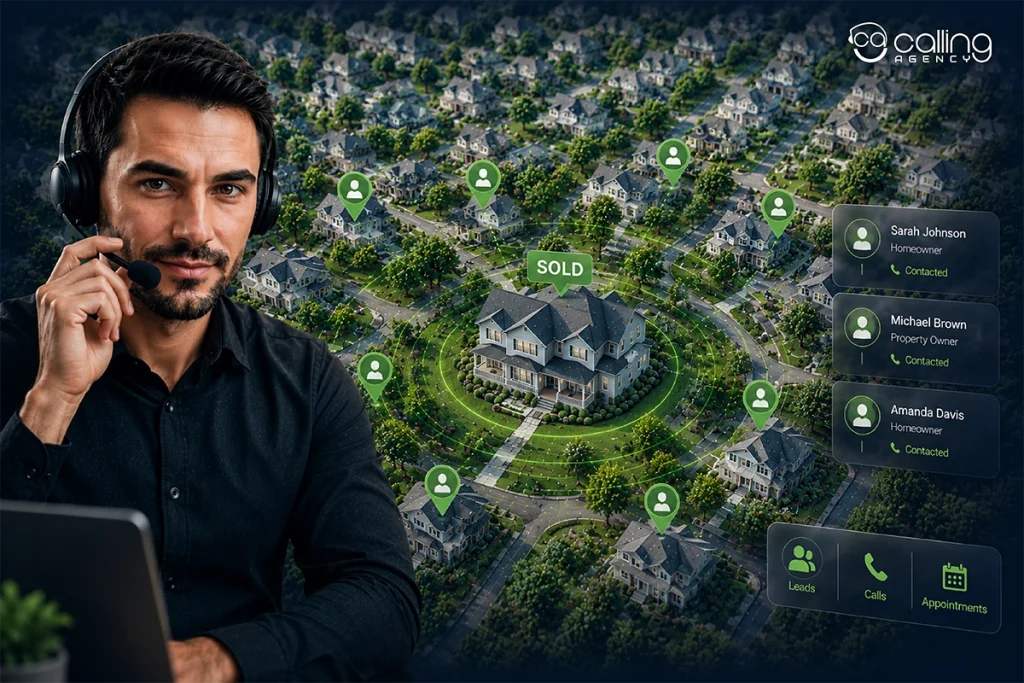
Circle prospecting in real estate is a proven lead-generation strategy and one tactic within broader real estate cold calling. Real estate agents reach out to every household near a particular listing. Circle prospecting aims to produce leads by displaying social proof with the listing.
This method can also take advantage of completed transactions to show your proficiency. If done consistently, it creates brand awareness: your name becomes synonymous in the minds of neighbors with activity on their street.
Circle prospecting is also cheap to run. Time, data tool & dialer are your largest expenses, so it is one of the lowest-cost listing methods for an agent to use.
At a Glance: How Circle Prospecting Works
| Element | What it means |
| Anchor property | The recent sale or new listing that gives you a reason to call |
| Target radius | 20 to 100 homes around the anchor |
| Timing window | The 2 to 3 weeks right after the sale or listing |
| Core message | Local market news delivered as a neighborhood update |
| Goal | Find homeowners thinking about selling before a competitor does |
Key Takeaways
- Circle Prospecting: Calling homeowners surrounding a recent listing or sale via phone or mail. To know if they want to buy/sell and whether they know anyone who would like to do the same.
- Keep the circle small: 20–50 nearby homes you can actually follow up with. A dialer and data tool can widen that to a few hundred of the closest properties, but only as far as your follow-up capacity allows.
- Use a trigger-based script: New listing, sale completion, or market milestone with a specific reference to something local (not the cliché “a house recently sold near you”).
- It builds long-term business: 66% of sellers go with an agent they were referred to or had an agent they worked with before. Circle prospecting gives you that name you keep hearing.
- It’s regulated: Scrub your list against the National DNC Registry, and only call between 8 a.m. and 9 p.m. in the prospect’s local time zone. A good data tool flags do-not-call numbers automatically.
What is Circle Prospecting?
Circle prospecting is a geographic lead-generation strategy where an agent contacts homeowners within a targeted radius, usually a home that has just sold or just been listed. It is also called neighborhood farming’s starting engine, and it is one of the most direct forms of proactive outreach available to agents.
The strategy works on a simple idea: A sale on a street creates curiosity on that whole street. You call with the information that curiosity is asking for.
How It Differs From Regular Cold Calling
Traditional cold calling targets people who have shown no signal at all. Circle prospecting starts with a real, local event, which gives you a credible reason to call and shifts the conversation from “why are you calling me” to “what did it sell for.” For the general technique, see our how-to guide linked at the top of this article.
How It Differs From Geographic Farming
Circle prospecting is short-term and event-driven, triggered by a specific sale or listing. Geographic farming is the long-term strategy of owning a neighborhood through repeated contact over months and years. Circle prospecting is the engine that builds a farm over time.
How Many Homes Should You Circle Prospect?
Start small and local. Most coaches suggest focusing on 20 to 50 homes in your hyperlocal area of recently listed or sold homes. It is good practice to select listings in proximity where home types are similar (For example, similar floor plans) and genuine interest in nearby sales activity can be readily supported with filtered comparable metrics.
| Area type | Radius | Homes to call |
| Dense urban | Quarter-mile or same block | 20 to 50 |
| Suburban | Half-mile or by subdivision | 50 to 200 |
| Rural | Up to a full mile | 50 to 100+ |
Get a dialer and a data tool to widen the radius, and you can pull contact info for anywhere from 50 up to a few hundred of the closest properties. The point is a reach you can actually follow up on, not the biggest possible circle.
Circle Prospecting Scripts (Just Listed, Just Sold, Market Milestone)
The best circle prospecting calls are based on a local “trigger,” and there are three that work wonders: just listed, just sold, or any local market milestone with a price hook (e.g., neighborhood median crossing a price barrier). The opener, bridge question, and close differ for each, so treat them as three separate calls and always lead with a specific detail, never a vague “a home sold near you.”
| Trigger | Opener | Bridge question | Close |
| Just listed | “I just listed the home at {{Address}}, a few doors down from you.” | “Have you seen how hot the street is?” | “Would you like me to let you know what it sells for once it closes?” |
| Just sold | “I just sold the home at {{Address}}, around the corner from you. You may have seen the activity. “ | “Would you like to know how much it went for?” | “Is it OK if I send you a quick summary of what homes nearby are selling for?” |
| Market milestone | “{{Neighborhood}} home values just reached {{Price}}.” | “Do you know what that means for your home’s value?” | “Want a current estimate for your address? It takes me two minutes.” |
A common disarming opener takes the pressure off the homeowner:
“Hi, this is {{YourName}} with {{Brokerage}}. I don’t expect you’re planning to sell — I just wanted to let the neighbors know about a recent {{listing/sale}} on {{Street}}, just up the road. Would you like to know what it went for?”
From there, the goal is not to sell on the call. It’s to have a useful conversation, confirm contact details, and earn a face-to-face appointment or a spot in your follow-up database.
How Do You Run a Circle Prospecting Session?
Circle prospecting rewards a tight, repeatable routine. A focused power hour, run the same way every time, produces more than scattered calling across the week.
- Pull your list (10 minutes): Use a dialer, CRM, or public records to pull 50 to 75 homeowner numbers within your radius of the anchor property. Cross-check ownership and rental status.
- Scrub against the Do Not Call Registry: Remove every registered number before you dial. Most real estate dialers include built-in DNC tools.
- Run your power hour (45 minutes): Dial the list using your scripts. Aim for 40 to 60 dials per session and expect to reach 15 to 20 live conversations. Track every outcome: reached, voicemail, no answer, callback, appointment.
- Send follow-up materials (5 minutes): For anyone who showed interest, send a personalized market snapshot or comparative market analysis within a couple of hours. Speed matters, since the lead cools fast.
- Log and schedule the next touch: Most owners are not ready yet, so set the next contact and keep them in your sequence.
What Are the Best Circle Prospecting Strategies?
Below, we are discussing the six most effective strategies of circle prospecting. These strategies can be useful for you as a real estate agent to grow your network and acquire potential prospects. The six strategies are:
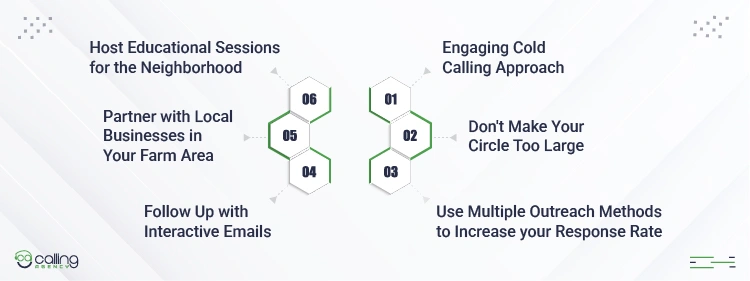
1. Engaging Cold Calling Approach
Cold calling works when it’s a conversation and not a script that’s read. You’re not dialing to pitch; instead, you’re dialing to be curious, add value, and earn a follow-up.
Buyers are more open to a call than most agents assume. RAIN Group’s Top Performance in Sales Prospecting study found that 82% of buyers accept meetings with sellers who proactively reach out. That research covers B2B buyers rather than homeowners, so treat the number as directional, but the takeaway holds: the problem is rarely the call itself; it’s how prepared and specific you are.
Here, preparation matters most. Understand your marketplace, predict questions, and come prepared with answers. This makes prospects far more receptive.
One of the great ways you could improve your real estate cold calling approach is by personalizing it. Say their name, mention their street or a street nearby that recently sold, and speak as though you truly know their neighborhood.
Listening matters just as much. Gather insights about the client to respond effectively, provide market information, and position yourself as an authority.
Remember to follow up, as persistence matters most. Most homeowners might not pick even on the first try, so plan on two to three attempts per household before moving them to email or mail. By doing this, your cold-calling approach will effectively achieve the target.
2. Don’t Make Your Circle Too Large
You might think of drawing a large circle on the map and extracting thousands of contacts. Moreover, each call takes time, every lead needs to be followed up with, and every street acts slightly differently; therefore, a huge arc gets out of hand very quickly. Before scaling up, master how to do cold calling and follow-up in a small area first.
Choose an area you know well. Your phone calls are more personal and educated; your follow-ups are on point, and you can provide value because you know local prices and trends. Having a smaller circle also allows you to better manage your time and create deeper connections with the same prospects for months.
3. Use Multiple Outreach Methods to Increase Your Response Rate
No single channel reaches everyone. Some homeowners screen unknown numbers, some only read email, and some won’t notice you until a mailer lands. Pairing calls with email, direct mail, and the occasional in-person touch simply gives the same homeowner more chances to engage you on a channel they actually use.
Start with cold calling, since they tend to drive the strongest response. But it might still be lower than you expected. Some might not answer any unknown number, and others could be busy. In these situations, you should improve your cold-calling skills or diversify your outreach methods.
Then layer in a personalized email: a short intro followed by a monthly market update for their street. The goal isn’t to use every channel at once. It’s to give your targeted circle repeated, low-pressure touches, then double down on whatever performs best in your specific area.
4. Follow Up with Interactive Emails
Email supports and reinforces your calling and door-knocking efforts. Identify those homeowners within your sphere, send a quick and friendly introduction, then follow up with updates that give them a monthly market update for that street. Add interactive touches like a “What is your home worth now?” link or a one-question reply poll. The responses tell you who’s warming up. If done consistently, email keeps you top of mind between calls.
5. Partner with Local Businesses in Your Farm Area
Partner with local businesses that already serve your clients. You can host a small workshop with a home improvement store, co-run an event with a landscaping company, or meet up with an interior designer. These collaborations help to build trust before prospects ever call you and also create organic connections with homeowners.
6. Host Educational Sessions for the Neighborhood
Teaching establishes credibility faster than pitching. Hold a quick online or physical session about something that interests your homeowners, how local valuations work, and price movements on their streets. It demonstrates your selling and listing expertise. This approach allows you to develop strong reasons for inviting people to your circle-prospecting calls. It also ensures everyone in the neighborhood is aware of the property listed below.
Why Is Circle Prospecting Effective?
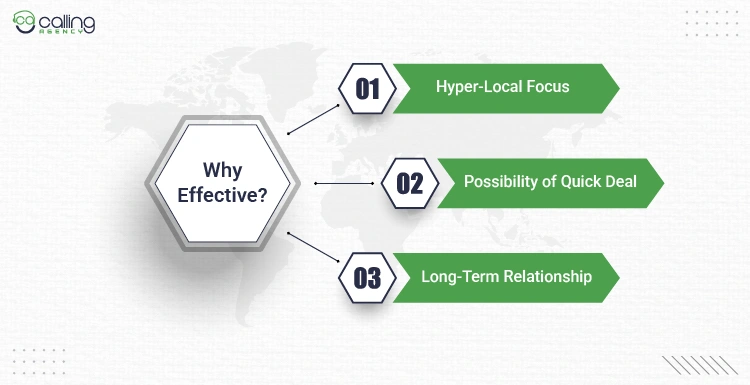
There are several reasons why circle prospecting in real estate is effective. Here, we discuss the three main reasons.
1. Hyper-Local Focus
Circle prospecting allows real estate agents to concentrate on a specific area. And this allows one to specialize in that neighbourhood and become an expert. You will be aware of the trends in your local market, property values, and community dynamics with ease. Buyers care about the local edge, and neighborhood quality was the top factor in choosing where to buy for 59% of buyers.
That lets you match your service to what local clients actually expect. Local networks or the use of prior relationships can also help funnel people as prospects. So, it’s an important reason for success in real estate.
2. Possibility of Quick Deal
Because circle prospecting is focused on a geographic area, it is more likely that you’ll find someone ready to sell their home. Which means you can potentially close deals faster than other prospecting channels. In such cases, if you already have a buyer for the area, you can match them with a motivated seller and shorten the path to a deal.
3. Long-Term Relationship
Circle Prospecting is more than just immediate sales. It is also about sustainable relationships in the community. Through regular communication with homeowners in the region, you can build recognition as a trusted advisor.
It is very helpful to build a good image, and when the time comes for homeowners to sell, they know you and are more likely to approach you. The payoff is tangible as 66% of sellers hire an agent who was referred to them or whom they’ve worked with before. Consistent circle prospecting is how you become that trusted name before the listing appointment even happens.
What Should You Consider Before Circle Prospecting?
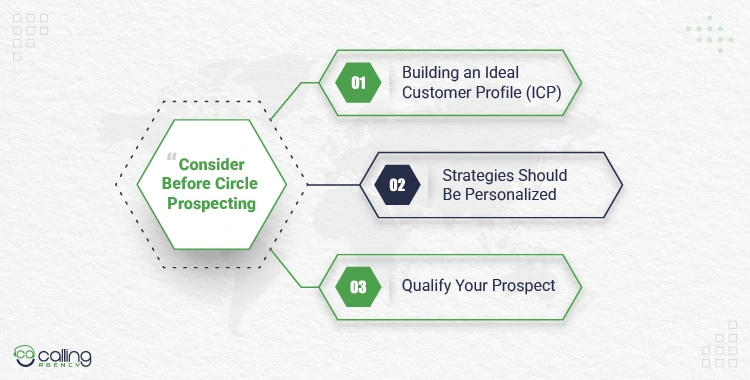
For effective circle prospecting in real estate, you should consider three key factors. So let us examine the three important factors:
1. Building an Ideal Customer Profile (ICP)
Now, you may be wondering who circle prospecting actually works for. This means getting insight into the demographics, psychographics, and property preferences of your target audience. Doing this will help you focus on your hottest leads and create messaging that speaks with them.
2. Strategies Should Be Personalized
Circle Prospecting works best with a targeted approach. This means knowing the unique needs of each client, as well as the situation within the area you want to target.
Offering things like personalized mailers, community events, and home improvement advice falls under the category of personalized strategies. To do this, aim to establish trust and a relationship with homeowners.
3. Qualify Your Prospect
Not all homeowners in your area will be suitable targets. You should be qualifying your leads with variables such as their readiness to sell, house condition, and asking price. You get this from sites similar to Zillow or their lead generation services. This will allow you to concentrate your time and efforts on those prospects with the highest chance of closing.
What Tools Do You Need for Circle Prospecting?
A data tool plus a dialer makes circle prospecting far faster. The platforms most agents use:
- Lead data/radius search: REDX GeoLeads lets you draw a circle on a map and pull contacts for nearby homes; Vulcan7 and Cole offer similar neighborhood data.
- Dialers: a multi-line power dialer raises your call volume and keeps sessions focused. See dialers for real estate cold calling.
- CRM: to log every conversation and schedule the follow-ups where most deals actually close.
A practical bonus: reputable data tools cross-check every number against the National DNC list and flag the ones you can’t call, which makes compliance much easier.
Is Circle Prospecting Legal? DNC & TCPA Rules
Circle prospecting is cold calling, so the same federal telemarketing rules apply. You can’t call numbers on the National Do Not Call (DNC) Registry to solicit business. Solicitation calls are only permitted between 8 a.m. and 9 p.m. in the local timezone of the prospect (FTC; REDX, 2025). If your callers are going to be working from a list, scrub it against the DNC before calling; most data tools (REDX, Vulcan7) will do this automatically and flag DNC entries.
Under the TCPA, autodialed or prerecorded calls and texts to cell phones require prior consent, so manual or compliant dialing modes matter when your list includes mobile numbers.
A few practical notes:
- Past-client exception: you may call a past client on the DNC list for up to 18 months after their last transaction.
- Door knocking is generally fine unless there’s a “no soliciting” sign (a local solicitor’s permit adds protection), and direct mail is fair game unless someone asks you to stop.
Frequently Asked Questions
What is Circle Prospecting in Real Estate?
Circle prospecting is when you contact homeowners surrounding one of your listings or recent sales, asking if they want to buy or sell or know anyone else who does. It focuses on local events as the default excuse to start a conversation.
Does Circle Prospecting Still Work?
Yes. Because nearby sales create genuine curiosity. It is still one of the cheapest ways to get leads out there. You get results from consistency, a remembered stimulus, and regular following up (not one-off calls)
How Many Homes Should You Circle Prospect?
Most coaches suggest 20 to 50 homes in the immediate area of your listing or sale. You can expand that to a few hundred nearest properties with a dialer and a data tool, but only if you can follow up on them.
What Do You Say When Circle Prospecting?
Start with a specific trigger and a soft, no-pressure line: ‘You may not be thinking of selling, but I just sold a home on your street. Would you like to know what it went for?’ The goal isn’t a pitch; it’s a conversation that works toward an appointment.
Is Circle Prospecting Legal?
Yes, but circle prospecting is cold calling, so the federal rules for telemarketing apply. You cannot call numbers on the National Do Not Call (DNC) Registry to solicit business, and solicitation calls are only permitted between 8 a.m. and 9 p.m. in the prospect’s local time zone (FTC Telemarketing Sales Rule). Scrub your list against the DNC before calling; most data tools (REDX, Vulcan7) do this automatically and flag DNC entries.
Is Circle Prospecting Worth It for New Agents?
Yes. Circle prospecting rewards time and consistency over budget, which makes it a strong fit for newer agents who can’t yet afford paid leads and are still building a database and local reputation.
What is the Difference Between Circle Prospecting and Farming?
Farming is focused on an entire neighborhood over the long haul to build brand dominance; circle prospecting is more event-driven, concerned with the homes surrounding a specific recent listing or sale. Many agents use both together.
Conclusion
Circle prospecting is a highly effective and efficient strategy in real estate. It emphasizes building deeper and long-term relationships as well. Cold calling, interactive emails, and educational webinars are just some of the strategies that realtors can use to reach out to prospects.
This is where the circle needs to be kept under control so that you use more than one outreach channel, and local partnerships build more interest in your name. Success, ultimately, depends on personalized strategies and a defined Ideal Customer Profile (ICP) to qualify your prospects.
Most importantly, establish trust that permeates every successful real estate transaction.