



A refined and quality lead list is the first requirement to make a cold call in the real estate industry. You should not start dialing immediately after getting a list because that list may contain some numbers from the Do Not Call Registry or unfit contacts that will waste the caller’s time. After running a lead scoring or qualification, make a call and ask qualification questions during the conversation. Then the most important part of cold calling comes, which is an on-time follow-up.
Lets breakdown the 6 steps of cold calling in real estate, including script writing, approach, and objection handling tips to keep your sales pipeline healthy.
Key Takeaways
- Real estate cold calling runs as a 6-stage loop. Build the list, scrub for compliance, prep the script, make the calls, follow up and track the funnel.
- List type sets your starting conversion rate. Expired listings carry the highest seller intent. FSBOs, absentee owners and probate each need a different angle and opener.
- Scrub every list against the National DNC Registry every 31 days. Calling a registered number exposes you to penalties starting at $500 per violation.
- A real estate cold calling script has four fixed parts. These are the opener, reason for the call, one or two qualifying questions and a clear next step.
- The first three to five seconds decide the call. Lead with the prospect’s property or street. Never open with your title or brokerage name.
- Most listings come from follow-up, not the first call. Build a multi-touch cadence across calls, texts and mailers spaced from day 1 through day 14 and beyond.
- Track four numbers across every session: dials, contacts, appointments and listings. Each ratio between them shows you exactly where your process breaks.
The Real Estate Cold Calling Process at a Glance
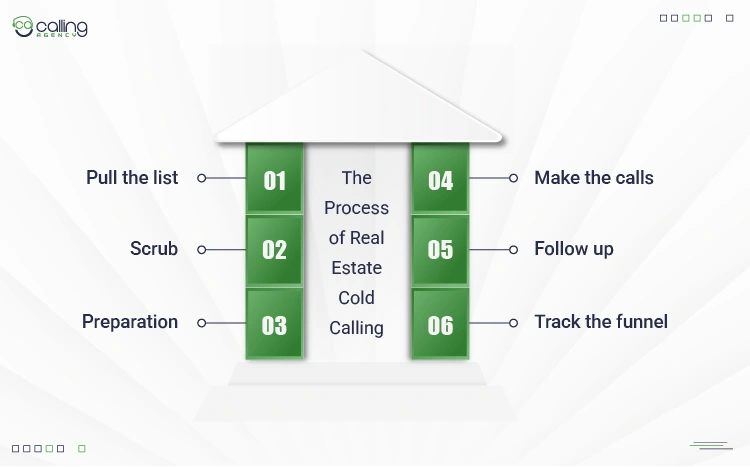
| Step | What you do | Goal |
| 1. Pull the list | Choose a list type (expired, FSBO, farm) and source the contacts | A targeted call list |
| 2. Scrub | Remove every DNC number, re-scrub every 31 days | A compliant list |
| 3. Prep | Write your opener per list type and choose your dialer | A ready script and dialer |
| 4. Make the calls | Open on their situation, qualify, log the result and set the next step | A booked appointment |
| 5. Follow up | Run a call, text and mailer sequence from day 1 through day 14 | A warm pipeline ready to list |
| 6. Track the funnel | Measure dials, contacts, appointments and listings per session | A clear view of where the process breaks |
The Process of Real Estate Cold Calling
The process of real estate cold calling in lead generation does not stop after disposing of the call. From pulling a contact list, it goes to follow up. And all of them make it a process of cold calling in real estate.
Anyway, the process of real estate cold calling runs in six stages.
- Pull a targeted seller contact list
- Remove every DNC number before you dial
- Prepare your script and set up your dialer
- Dial in blocks, qualify fast, and book the appointment
- Run a multi-touch sequence until they are ready to list
- Measure your 4 ratios and fix the weakest one
Now, let’s get to know them in depth.
Stage 1: Pull a Targeted Seller Contact List
A quality list impacts you calls outcome, so a random list with unfit contacts consumes too much time and wastes your effort. A warm lead helps you make a conversation with prospects who are ready to sell their property. As a real estate agent, you will face different types of contact lists before calling. Let’s take a look at what they are:
- Expired listings: Expired listings mean the listing is list is not expired for you as a cold caller. The property was listed for sale, but it was not sold. So it’s an expired listing from the prospect’s point of view. But those prospects are high intent for you. A lot of agents will try to call them; whoever reaches them first will have the most possibilities to close the deal.
- FSBOs: This is the acronym for For Sale By Owner. This type of contact list holds the phone numbers of prospects who put a sign in their yard by saying, “This property is for sale” or something like this. You can call them and say you have a buyer who might buy your property.
- Pre-foreclosures: The prospect of this type of list borrowed money to buy a house. Now they cannot pay it back. The borrower or bank is about to take the house away. They need to sell fast before the bank steps in. You are calling to help them get out of a bad situation. Remember to be gentle because this is a hard time for them.
- Absentee owners: This type of prospect owns a property or house, but they do not live there. Basically, they are not in a rush to sell, and they are also not emotional about making a decision. The competition is lower here, but you need patient outreach and continuous follow-up.
- Probate leads: Probate leads are when someone has passed away and left behind a house for them. Now the family or your lead needs to sell. They did not plan to sell the property; it just happened. They want the process to be easy and respectful. Speak slowly and kindly here.
- Circle prospecting. This list can have less potential than others because you are telling them that a house was sold for a tempting amount right beside yours. Do you want to know what your worth is? Informing like that. So when they plan to sell, they will call you.
Those are types of lists you can target to make a call for lead generation. Every type of list has its own tonality. Don’t use the same script for all of them; personalize each prospect according to their type and situation for the best possible outcome.
Stage 2: Remove Every DNC Number Before You Dial
Before dialing any number, you check some facts or filter those contacts. If their number is listed on the DNC list, it will be a serious issue for your company, and violating these rules can cost you money through legal issues.
- Filter 1 ( National DNC Registry): Go to gov and clean or update your list according to their instructions every 31 days. Calling any number from that list is illegal in the USA.
- Filter 2 (Your internal DNC list): For every prospect who told you not to call, create a list for them, and before making every call, check that list as well.
- Filter 3 (State DNC lists): Some states, like Florida, Indiana, Texas, etc., have their own list aside from the central list. So check that list also if you are operating in those states.
- Filter 4 (Reassigned Numbers Database): If you are calling someone who does not hold the place, number, or role is also illegal.
- Filter 5 (Litigator scrub): There are some people in the USA who receive cold calls intentionally and then sue you and earn $500. They take this as a full-time profession and earn money. So avoid them by carefully checking the list.
In addition to these 5 filters, you also need to maintain timing for calling. Check who you are calling and the time it is in your prospect’s area. If you are calling someone at midnight, it will also be a violation of the rules.
Stage 3: Prepare Your Script and Set Up Your Dialer
A personalized cold calling script and a dialer for real estate are significant materials for a cold caller. A cold calling script can be divided into 4 parts,
Which are:
- The Opening Hook: The first 10 seconds of your call are important. This is where you explain the reason for the call and attract the prospect to continue.
- The Context / Problem: After opening, you should find and highlight the pain point and the relevant solution that can help your prospect.
- The Qualification / Objection Handling: This part is dedicated to lead qualification and handling objections, such as:
- The Close (CTA): Closing line or CTA should be asking the prospect for a quick meeting at their preferred time and channel.
Before you start dialing, you need to understand the interface of the dialer and set your CRM system up if you are new to cold calling. There are 4 different types of dialers for cold calling.
- Preview Dialers (The Strategic Option)
- Power Dialers / Progressive Dialers (The Standard)
- Predictive Dialers (The High-Volume Beast)
- Ringless Voicemail Dialers (The Passive Approach)
You can use any of those according to your business type, goal, and headcount.
Stage 4: Dial in Blocks, Qualify Fast, and Book the Appointment
Your main target should be ending as soon as possible with a natural pace. The longer you hold the conversation, the lower your chances become. So divide your time into small blocks. Let’s see which those blocks are.
- The first 3 to 5 seconds: This decides whether the call will continue or not. That depends on your tone, energy, and pace. So, stand up, smile, and control your pace.
- Discovery is questions, not pitching: Always keep your listening ratio high. It motivates owners to reveal themselves.
- Objection handling: Here, you have to follow a loop. Acknowledge, isolate, respond, re-ask, and never argue.
- The top objections repeat: You may often hear “I am not selling/I already have an agent/Just send me info/how did you get my number?” Answer that last one straight, and it will get into public records.
- Disqualify fast: This will protect your dial time.
- The micro-goal: This is small. Just book the appointment or get clear permission for the next touch.
Remember, voicemail rarely earns a callback. But it can make you earn name familiarity for the next live attempt. Also, a ringless voicemail works like a TCPA gray area.
Stage 5: Run a Multi-touch Sequence Until They Are Ready to List
Most of the real estate sales reps stop following up too soon. And this is the right time when a prospect says yes to you. But most of them lose here. You should reach out to targeted prospects in many ways, through social media and other professional platforms, as much as possible.
Space out your touches like this. Don’t call every single day. Give them a little room. A good plan looks like this:
- Day 1: Call
- Day 2: Text or voicemail
- Day 4: Email
- Day 7: Call again
- Day 14: Another touch
- Keep going from there
Texting has rules, like cold calling. A text counts as a call under the TCPA. So DNC, consent, and the opt-out keywords all apply to your messages. Leads that are ready for appointments get tight callbacks. This is a part of your cold calling process. If you think that only making calls brings you deals, you are wrong.
Stage 6: Measure Your Four Ratios and Fix the Weakest One
If you do not measure or keep a regular track of what you call and their outcomes, you can not see revenue. Tracking KPI is as important as making a call. Let’s see which are the key areas that you should keep track of.
- Low connection rates
- Good connections but few conversations
- Conversations, but few leads
- Leads, but few appointments
- Appointments set but not held
- Appointments held, but no listings
And to handle your sales funnel, you can measure the following 4 ratios:
- Treat benchmarks as your own: Numbers float across sources. So track your own ratios over time. Then attack the weakest link.
- Small lifts at the top compound: You have to connect the rate at the funnel’s mouth. So test openers, call times, and list sources. Then review your call recordings like game film.
- Run the unit economics: Cost per lead equals data plus dialer plus skip trace plus labor, divided by leads. Then the cost per listing. Thus, you can know exactly where the channel is going.
- Manage the leading number: Dials are the leading indicator you control daily. Listings are the lagging result. So, manage both of them.
What Matters Most
The agents who make this work share two habits. They bake compliance into stage two as a design rule, not an afterthought. And they obsess over connection rate and cadence, not the calls themselves. It means the dialing is the commodity here. The list, the scrub, and the follow-up are just the edges.
How Do You Write a Real Estate Cold Calling Script?
Cold call scripts are not a cage. It is a track to stay on when nerves hit. Generally, a commercial real estate script has four parts. A fast introduction, a reason tied to the prospect’s situation, one or two qualifying questions, and a clear next step. The opener is the part that changes most, because it has to match the list type. Here are three openers you can try.
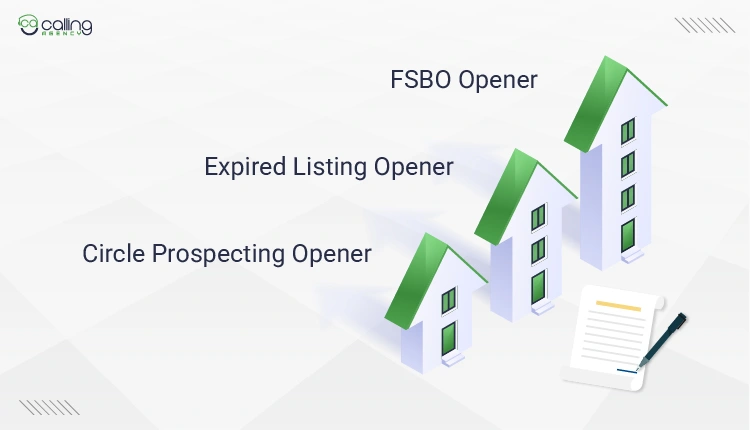
FSBO Opener
Hi {{name}}, this is {{you}} with {{brokerage}}. I saw you are selling your place on {{street}} yourself. I am not calling to list it. I work with buyers in the area, and I wanted to ask. Would you be open to a qualified buyer if I had one?”
Expired Listing Opener
Hi {{name}}, this is {{you}} with {{brokerage}}. I saw your home on {{street}} came off the market without selling. That is usually more about timing or price than the house itself. Are you planning to try again, or holding off for now?
Circle Prospecting Opener
Hi {{name}}, this is {{you}} with {{brokerage}}. A home two doors down just sold for {{price}}. A lot of owners on your street are asking what that means for their own value. Would you like me to run your number?”
Notice what each opener has in common. Then you can know the reason behind the prospect’s specific situation. For more openers, you can adapt across list types. Or you can just go through our guide, best cold call opening lines.
How Should You Open a Real Estate Cold Call?
The first ten seconds of the call decide whether you get a conversation or not. Sellers screen agent calls, especially FSBOs and expired-listing owners. They get called daily. To grab their attention, you can try these three moves.
- Lead with their property, not your title: Don’t say “I am a realtor” and open on their street, or their listing. Talk about the prospect first, then about you.
- Reference a real number: Give a comparable sale nearby. This will bring attention faster than a pitch. For example, you can say, “A home on your street just sold for [price].” Trust me, this works.
- State your name, pause, then ask about them: The pause works. It shows that you are confident. Also, the prospect feels like a real person is on the line. Then ask about their situation, not your services. If you are still confused, just check out how to build rapport on a real estate cold call.
How Do You Handle Objections on a Real Estate Cold Call?
Most calls open with resistance. That is normal. Don’t take it as a rejection. If you can handle the resistance, you have done half the job. In this case, you can keep your replies short and calm, and not jump into a pitch.
For example,
- When they say they are busy, say “I hear you. I will be quick. One question, then I will let you go.”
- When they say they are not selling, say “Fair enough. When you eventually do, who is first on your list to call?”
- When they ask how you got their number, say “It is public record. I only called to ask one quick thing.”
- When they say they already have an agent, say “That makes sense. If anything changes, would it be alright if I stayed in touch with the occasional market update for your street?”
The pattern is the same every time. You just need to acknowledge the objection and stay calm. If you can pivot to one small question or a low-commitment one that can bring you to the next step. You can also take a look at handling cold call objections.
How Do You Follow Up and Book the Appointment?
Most owners you reach are not listing this week, but many will within months. This is also how you can do the follow-up in real estate. Let’s say you got a “not now” in spring. But that can become your listing by summer if you stay in the picture.
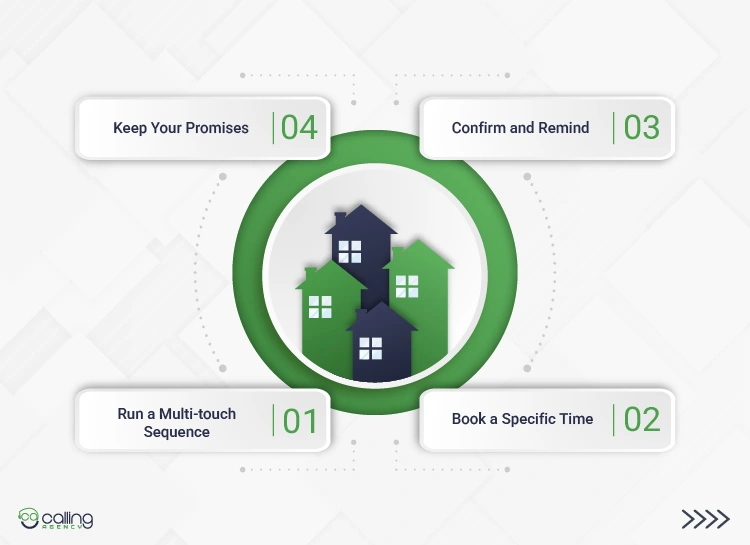
Here are some ways to do an effective follow-up:
Run a Multi-touch Sequence
Loop a call, a text, and the occasional mailer. Hopefully, this will make the prospect ready. Pair each call with a text follow-up. People now reply to texts far more than to an unknown number.
Book a Specific Time, Not a Vague One
Don’t say “Can we schedule a follow-up?” Instead, propose an exact slot, like “Would Tuesday at 3 PM work for you?” Hearing a specific time will compel them to say yes.
Confirm and Remind
Send a calendar invite once the appointment setting is done. Then send a short reminder for a better approach, as the prospect may forget the set time.
Keep Your Promises
If you said you would call back Thursday, call back Thursday. Being reliable on the small things. This will help you earn the listing conversation later.
How Do You Track and Improve Your Cold Calling?
You cannot improve what you do not measure. Just track four numbers and the ratios between them. This will show you exactly how you are doing.
| Metric | What does it tell you |
| Dials | Your activity volume per session |
| Contacts | How many dials turn into live conversations |
| Appointments | How many conversations turn into booked meetings |
| Listings taken | How many appointments turn into signed listings |
Maybe you have plenty of contacts but few appointments. Here, the problem is your list or your opener. On the other hand, if you have appointments but few listings, the problem is your listing presentation, not your calling. By seeing the ratios, you can know where to fix them.
A platform built for real estate helps here. It bundles your call list, the dialer, and DNC scrubbing in one place. It even logs your numbers automatically.
Just read out the best dialer for cold calling. You can relate more. And to run your call blocks, see the best time to cold call in real estate.
What Mistakes Should You Avoid in Cold Calling?
Some agents fail at cold calling but are good on the phone. It’s because they make some silly mistakes that are totally fixable. These can be:
- Sounding like every other agent. Here, you have to lead the call with the prospect’s street, not your brokerage.
- Pitching before you know why the home did not sell. Whereas you should ask first, pitch later.
- Calling expired listings with no comparable sales ready. So, better pull your comps before you dial.
- Dropping the seller who says “not yet.” But you can keep them in touch by giving follow-up sequences.
- Skipping the DNC scrub on a pulled list. Instead, scrub every list, every time, but don’t keep exceptions.
Should You Do It Yourself or Outsource It?
It depends on what your time is worth. If you are newer and on a budget, do some calls yourself. As a result, you can build objection-handling skills and market knowledge. But if your hour is worth more than a caller’s rate, outsource it.
A cold calling service dials your lists, qualifies prospects, and sets appointments. But remember, if you hire a service, their compliance becomes your liability. So confirm how they scrub for the DNC and follow TCPA rules before calling.
If you are thinking of handing off the dialing to a trained team, you may look at our real estate cold calling service.
Frequently Asked Questions
How do you start a cold call in real estate?
First, open with your name and brokerage. Then immediately give a reason tied to the prospect’s situation. It can be about their expired listing or a recent sale on their street. Try to lead the call with their property, not your title. Lastly, end your opening with a single question about them.
What should a real estate cold calling script include?
A real estate cold calling script includes four parts. A fast introduction, a reason for the call tied to the prospect’s situation, one or two qualifying questions, and a clear next step. Always keep the opener specific to the list type you are calling. This can be FSBO, expired, or circle prospecting.
What is the best list to cold call in real estate?
Expired listings and FSBOs are the best lists to call in real estate. Those owners are already motivated to sell. Circle prospecting is also good if they are around a recent sale and geographic farming.
Is cold calling in real estate worth it?
Yes, cold calling in real estate is worth it if you can stay consistent and follow up. It puts you in front of off-market sellers. So, the competition is also less.
The Bottom Line
Cold calling in real estate is a process, not a personality trait. Here, you have to pull a targeted list, scrub it, and open on the prospect’s situation. Also, you must handle the brush-off calmly and follow up until they are ready. For best results, track your four numbers. Thus, you can know where to improve.
Don’t think only the smoothest talkers win. The agents who win are the ones who run the process consistently. They also ensure follow-up without fail, and stay compliant on every call.
Well, you can start with one list type. Then master the opener, and build from there.