

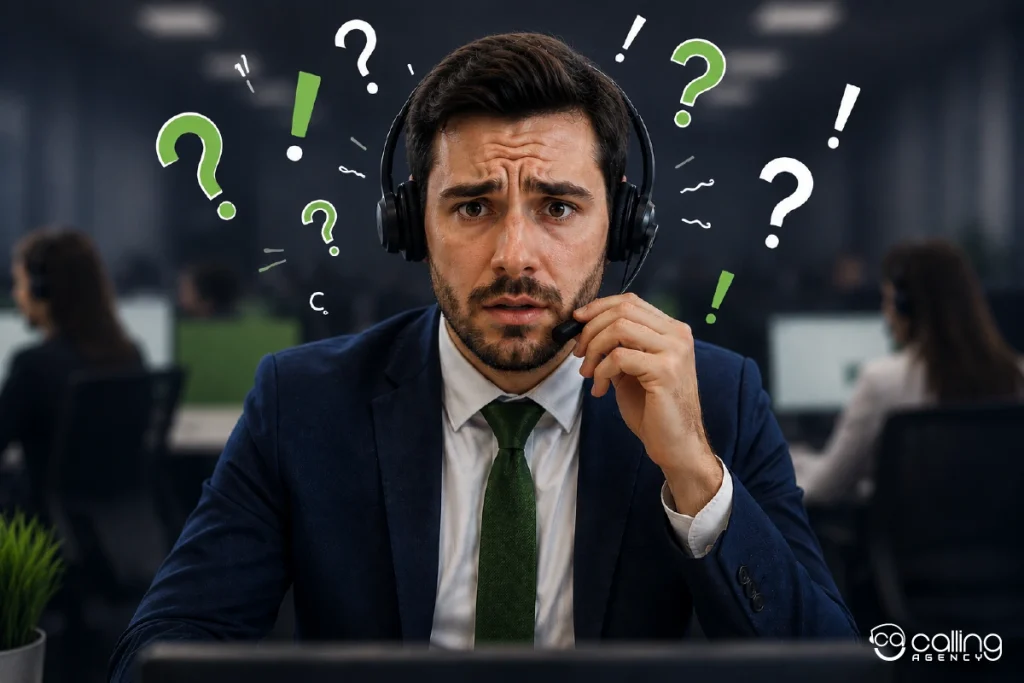
Cold calling anxiety is what happens in your body the moment before you dial: the racing heart, the dry mouth, the urge to find one more thing to prepare. This guide covers what to do with that anxiety in real time: in the five minutes before your call block, during a live call when anxiety spikes, and immediately after a difficult conversation. For the science of why cold calling triggers anxiety and how to overcome it over time, see our guide to overcoming the fear of cold calling.
Key Takeaways
- Cold calling anxiety is a physical response, not a mindset problem. Your nervous system activates before you dial. The fastest fix is a physical one: a specific breathing technique that works in under two minutes.
- Cyclic sighing (Stanford, 2023) outperforms mindfulness for real-time anxiety reduction. Daily 5-minute sessions of double-inhale, long-exhale breathing reduced anxiety and improved mood more than meditation in a randomized controlled trial (Balban et al., Cell Reports Medicine, 2023).
- The words “I’m excited” work better than “I’m calm.” Research by Alison Wood Brooks (Harvard/APA) found that reappraising anxiety as excitement improves performance because both states are high-arousal: you work with the energy rather than against it.
- Voice betrays anxiety before your words do. Slowing your speech rate by 10-15% and lowering your pitch deliberately are the two fastest mid-call adjustments that signal calm to the prospect and to yourself.
- The post-call window matters as much as the pre-call window. Moving to the next dial within two minutes of a difficult call is clinically better for anxiety than reviewing what went wrong.
Cold Calling Anxiety: At a Glance
Use this as a quick reference during your call block.
| When | Technique | Why it works |
| 5 min before dialing | Cyclic sighing: double inhale, long exhale, 10 to 15 reps | Activates the parasympathetic nervous system; calms faster than meditation (Stanford, 2023) |
| Just before the first dial | Say “I’m excited” out loud | Reappraisal outperforms suppression; both states are high-arousal (Brooks, APA) |
| Voice starts shaking | Diaphragmatic breath + drop chin slightly | Releases laryngeal tension; shifts breath from chest to abdomen |
| Mind goes blank mid-call | Pivot line + slow speech by 10–15% | Breaks panic loop; buys time without losing the call |
| After a difficult call | Move to the next dial within 2 minutes | Interrupts rumination window before negative emotion compounds |
Cold calling anxiety is the acute stress response triggered by the anticipation of making or receiving an unsolicited call. It overlaps with performance anxiety and phone anxiety (telephobia), and it manifests physically: elevated heart rate, muscle tension, shallow breathing, and a shaky voice. For the full psychology and long-term treatment, see our cold calling fear guide (linked above).
What this guide addresses is the immediate experience: what to do right now, with the phone in your hand and your heart already racing.
What Should You Do in the 5 Minutes Before Your Call Block?
The five minutes before a call block is where anxiety builds fastest. Most reps spend that time re-reading notes, adjusting their script, or checking the time. Here is a more effective sequence.
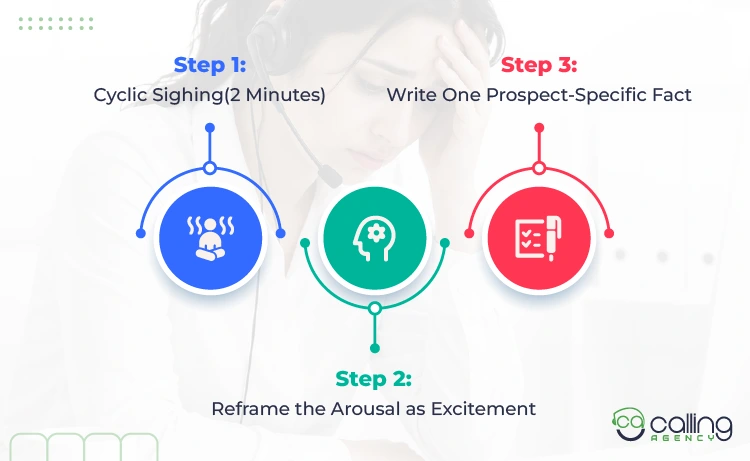
Step 1: Cyclic Sighing (2 Minutes)
A randomized controlled trial at Stanford University found that daily 5-minute cyclic sighing sessions reduced anxiety and improved mood significantly more than mindfulness meditation (Balban, Huberman, Spiegel et al., Cell Reports Medicine, 2023). Cyclic sighing can be used for two minutes before a call block and produces calm “without having to disengage from the stress-inducing activity,” as Huberman notes.
How to do it:
- Inhale deeply through your nose until your lungs are full.
- Without exhaling, take a second, shorter inhale through your nose to fully expand the lungs.
- Exhale slowly and fully through your mouth.
- Repeat for 10 to 15 cycles.
The extended exhale activates the parasympathetic nervous system, slowing heart rate and reducing the physical arousal that makes your voice shake. It takes under two minutes and can be done at your desk before anyone else notices.
Step 2: Reframe the Arousal as Excitement
Telling yourself to calm down rarely works, because anxiety and excitement are both high-arousal states. Research by Alison Wood Brooks (Harvard, published by the American Psychological Association) found that saying “I’m excited” out loud before a performance task produced better outcomes than trying to force calm. The reframe redirects the same physical energy toward a positive interpretation rather than fighting the body’s response.
Before your first dial, say it silently or aloud: “I’m excited.” The goal is not to trick yourself: it is to point the arousal in a useful direction.
Step 3: Write One Prospect-Specific Fact
Research before the call reduces the biggest source of anxiety: the fear of not knowing what to say. Before each call, write down one specific, relevant fact about the prospect: a recent job change, a company news item, an industry trend affecting their sector. Knowing you have one concrete, relevant thing to say removes the uncertainty that feeds the anxiety spiral. For a structured approach to pre-call research, see our cold call script guide.
What Should You Do When Anxiety Spikes During a Call?
Anxiety does not always arrive before you dial. Sometimes it hits mid-call: when the prospect pushes back, when you lose your train of thought, or when you realize the conversation is going sideways. Here is how to manage it in real time.
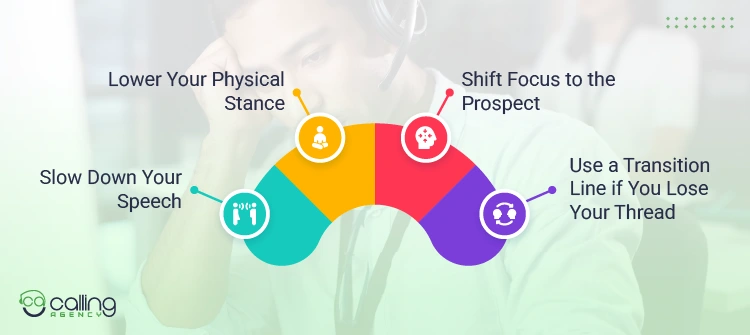
Slow Down Your Speech
Anxiety causes people to talk faster. Faster speech signals nervousness to the prospect and amplifies your own sense of rushing. Deliberately slowing your speech rate by 10 to 15% does two things: it makes you sound more authoritative, and it gives your nervous system a signal that the situation is under control. Slower speech also buys you time to think.
Lower Your Physical Stance
If you are standing, sit. If you are sitting, uncross your arms and place both feet on the floor. Body position affects voice quality and anxiety level. A more grounded physical position reduces the tension that tightens your voice and makes it harder to project authority.
Shift Focus to the Prospect
Anxiety is self-focused: you are listening to your own voice, monitoring your own delivery, and evaluating your own performance in real time. The fastest way to interrupt this loop is to shift your attention entirely to the prospect. What are they actually saying? What is their tone? What word did they emphasize? Genuine curiosity about the other person is incompatible with performance anxiety, because your attention cannot be fully in both places at once.
Use a Transition Line if You Lose Your Thread
If anxiety causes you to blank mid-call, a prepared recovery line prevents a silence from turning into panic:
- “Let me ask you a quick question about that.”
- “That’s actually exactly the kind of situation we work with: tell me more.”
- “Before I go further, I want to make sure I understand your situation correctly.”
Any of these pivots the conversation while you find your footing. For a full set of objection-handling responses, see our guide to handling cold call objections.
How Should You Control Your Voice When You Are Nervous?
The voice is the first place anxiety shows up on a cold call. Shallow breathing causes a tighter, higher, thinner voice. Here are the three adjustments that work immediately.
Breathe from the diaphragm, not the chest. Chest breathing, which anxiety triggers automatically, produces a tighter voice. Placing a hand on your abdomen and breathing so that your hand moves, not your chest, shifts the breath source and immediately loosens vocal tension.
Drop your chin slightly. Tilting the chin down rather than forward relaxes the laryngeal muscles and lowers perceived pitch. This works in combination with the diaphragmatic breath.
Start with a slower word. The opening word of a call sets the pace. “Hi,” spoken quickly, signals urgency or nervousness. “Hi,” spoken with a brief pause before the next word signals confidence. Practice your opener until the first word is consistently unhurried.
CBT-based communication coaching, which is increasingly used in sales training, targets exactly these physiological symptoms: muscle tension, rapid heartbeat, and shallow breathing can all be modulated in the moment with targeted physical techniques (Open Access Journals of Pharmacy, 2024). For structured coaching on call delivery, see our cold calling training guide.
What Should You Do Immediately After a Difficult Call?
The minutes after a bad call are where anxiety compounds or disperses, depending on what you do next.
Move to the next dial within two minutes. Research on rumination consistently shows that the longer you sit with a negative event without acting, the more the negative emotion intensifies. Dialing again before the negative loop closes is the most effective interrupt.
Brief review, not extended debrief. Ask one question: what one thing would I do differently? Write it down in a word or two. That is the entire post-call review. Anything more shifts from learning to rumination.
Do not revisit the call out loud during the call block. Talking about a bad call with a colleague, however sympathetically, extends the emotional processing during a time when your nervous system needs to return to neutral.
How Can Sales Managers Reduce Team Cold Calling Anxiety?
Anxiety is contagious in call environments. The team’s emotional baseline rises and falls with the manager’s energy, the call floor’s noise level, and how failure is discussed.
- Start the day with a 2-minute breathing exercise as a team. This is not a wellness gesture: it is a performance tool backed by the Stanford cyclic sighing trial.
- Measure activity, not just outcomes. Reps whose only tracked metric is booked meetings experience higher anxiety than those whose call volume and conversation quality are also recognized. Remove the all-or-nothing evaluation.
- Model neutral responses to rejection. If a manager reacts to a lost call with visible disappointment, the floor’s anxiety level rises. A neutral, process-focused response (“What did we learn from that one? “) lowers it.
Frequently Asked Questions
What is the fastest way to reduce cold calling anxiety right before a call?
Cyclic sighing: a double inhale through the nose followed by a long exhale through the mouth, repeated 10 to 15 times: reduces anxiety faster than mindfulness meditation in a Stanford randomized controlled trial (Balban et al., 2023). It takes under two minutes and can be done at your desk.
What should I do if I freeze or go blank mid-call?
Use a pivot line: “Let me ask you a quick question about that,” or “Before I continue, I want to make sure I have your situation right.” These give you 5 to 10 seconds to recover while keeping the conversation moving. Having two or three of these prepared removes the fear of blanking, which reduces the likelihood of blanking.
Why does my voice shake when I make cold calls?
A shaky voice is caused by shallow chest breathing and laryngeal muscle tension, both triggered by the anxiety response. Shifting to diaphragmatic breathing (where your abdomen, not your chest, expands) and slightly dropping your chin both reduce the tension immediately.
Does reframing anxiety as excitement actually work?
Yes, according to research by Alison Wood Brooks published by the APA. The study found that telling yourself “I’m excited” before a performance task produced better results than trying to calm down, because anxiety and excitement are both high-arousal states. Working with the arousal rather than suppressing it is more effective.
How is cold calling anxiety different from the fear of cold calling?
Cold calling anxiety is the acute, in-the-moment physical response: the racing heart, shallow breathing, and shaky voice that occur immediately before or during a call. Fear of cold calling is the broader psychological pattern, often including long-term avoidance and anticipatory dread. For the psychology and long-term solutions, see our cold calling fear guide (linked in the introduction above). For persistent avoidance patterns, see our call reluctance guide.
Should I try to calm down before a cold call or use the anxiety?
Use the anxiety. Research by Alison Wood Brooks (APA) found that suppressing or fighting the arousal is less effective than reframing it. Telling yourself “I’m excited” rather than “I need to calm down” channels the same physical energy toward a positive state and produces better performance outcomes.
The Bottom Line
Cold calling anxiety is a physical response that can be managed in real time with specific, evidence-backed techniques. Cyclic sighing before a call block reduces anxiety faster than meditation. Reappraising the arousal as excitement outperforms forced calm. Voice control comes from breath source and physical stance, not from thinking yourself into confidence. And moving to the next dial within two minutes of a difficult call is the most effective interrupt for the negative loop that compounds anxiety over a session.
If your team’s anxiety is a consistent productivity problem and managing it internally is not workable, CallingAgency’s cold calling services put experienced, trained callers on your campaign.