



Cold calling in real estate is a prospecting method where agents call homeowners, landlords, expired listings, FSBO sellers, or property investors with no prior contact. The goal of these calls is to start a meaningful conversation rather than sell immediately.
These conversations help agents to find selling interest and book qualified appointments. This guide covers what cold calling actually is, who agents call, common objections, scripts, and legality.
Key Takeaways
- Cold calling in real estate means calling homeowners, landlords, FSBO sellers, expired listings, or investors with no prior contact.
- The goal is not to sell immediately. It is to start a conversation, qualify interest, and book the next step.
- Different lead types need different call angles, scripts, and follow-up plans.
- Real estate cold calling is legal in the US, but agents must follow DNC, TCPA, calling-hour, and consent rules.
What Cold Calling in Real Estate Actually Is
Cold calling in real estate is a prospecting method where agents call homeowners, property owners, or potential buyers with no prior contact. Agents use it to start a conversation, check selling or buying interest, and book a listing or buyer appointment.
The main goal of a real estate cold call is to generate leads or hunt for new clients rather than sell the property immediately.
A real estate cold call usually does not close the deal on the phone. It helps the agent understand interest, timing, and motivation, then move the right prospect toward a listing appointment, buyer consultation, or follow-up. This is also where structured real estate appointment setting services can help turn raw conversations into qualified meetings.
A real estate cold call normally has:
- An opener where the agent introduces themselves and asks permission to continue the call
- Provides a value statement that gets the agent more time to talk
- Qualifies buying or selling interest by asking qualifying questions
- Objection handling
- Closes with a CTA to set a next step
Cold calling is effective in real estate because some lists already show potential selling intent. For example,
- FSBO sellers are already trying to sell without an agent.
- Expired listing owners already listed their home, but did not sell.
- Circle prospecting by contacting homeowners in a specific area where someone has recently bought or sold any property.
- For Rent By Owner (FRBO), landlords struggle to manage their property.
Real estate cold calling agencies usually target private property owners, like homeowners. These are people who are thinking about their property, timing, price, and personal situation. So the call has to feel more respectful, personalized, and specific.
Cold Calling vs Other Real Estate Outreach Methods
Cold calling gives agents the fastest way to communicate with property owners at the right moment. Other channels like cold email, texting usually move more slowly and are easier to ignore.
Most successful realtors use a multichannel approach. They combine cold calls with email, texting, and in-person outreach to stay in touch with a prospect.
| Channel | Best for | Response speed | Cost | Personalization | Main challenge |
| Cold calling | Direct conversations and booking appointments | Immediate | Moderate | High (with prior research) | Rejection, DNC/TCPA rules |
| Cold email | Warm leads before the call and follow-up | Delayed | Low | Medium (with template customization) | Low open rates, inbox competition |
| SMS/text | Quick follow-ups and reminders | Fast | Low | Medium | Feels spammy, needs consent |
| Door knocking | Building trust with homeowners in a specific area | Immediate (face-to-face) | High | Very high | Time-intensive, expensive, and low volume |
Cold calling gets you the best outcome when it is part of a full real estate lead generation system. A strong real estate lead generation service can combine calls, follow-up, and appointment setting so agents spend more time with qualified prospects.
Purpose of Cold Calling in Real Estate
The purpose of cold calling in real estate is to find property owners, sellers, buyers, and investors before they contact another agent. Cold calling helps real estate agents to start a conversation. This conversation then moves to qualify their interest and book listing or buyer appointments.
Instead of waiting for referrals, inbound calls through marketing efforts, or cold calling, helps a realtor directly engage with property owners and create a steady pipeline.
Owners may not want to sell the properties immediately, but it helps to create conversation, which helps with future deals.
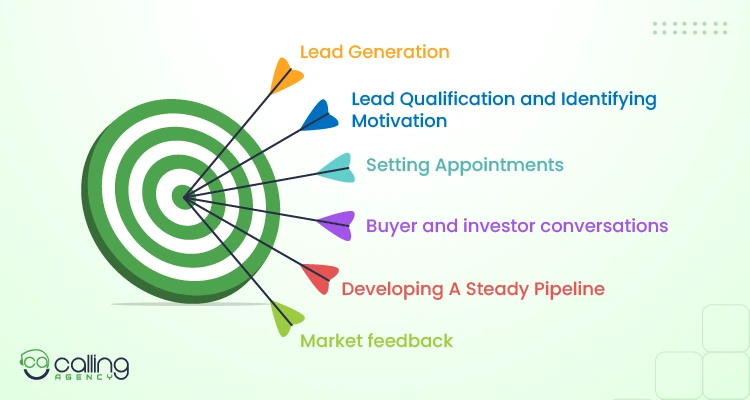
The main purposes of real estate cold calling include:
- Lead Generation: Cold Calling helps to find property owners, sellers, buyers, and investors who may be open to a conversation.
- Qualification and Identifying Motivation: Helps to check if a homeowner has the right motivation, timing, and reason for selling.
- Setting Appointments: Books meetings with interested sellers before they list their property publicly.
- Buyer and investor conversations: Find people looking for homes, rentals, flips, or long-term property deals.
- Developing A Steady Pipeline: Helps an agent to build relationships with potential buyers or sellers and get familiar with a neighborhood.
- Market feedback: Learn what owners think about price, demand, timing, and local property trends.
To turn those conversations into real appointments, agents need to use the right scripts based on the market. These specific scripts help to qualify leads.
Types of Real Estate Cold Calling
Expired listing, FSBO, pre-foreclosure, landlord or FRBO, investor calls, and circle prospecting are the main types of real estate cold calls.
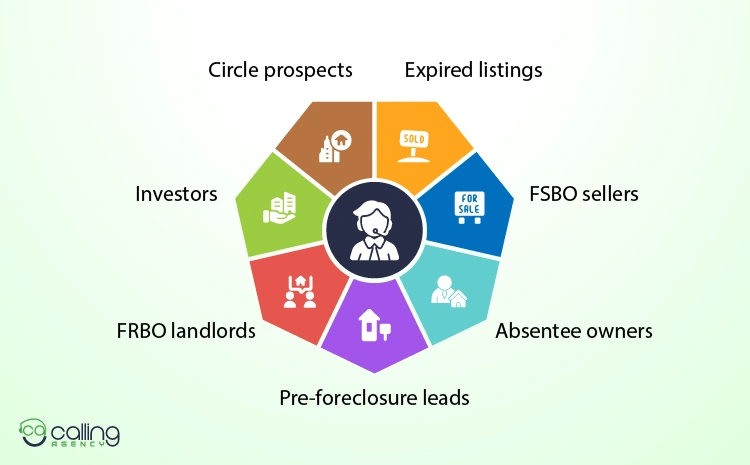
Each type is in a different situation. An expired listing owner may still want to sell, whereas an FSBO is trying to sell without an agent. This is why agents use different openers based on the list and the prospect’s situation.
| List Type | Who agents call | Main call angle |
| Expired listings | Sellers whose listing was ended without a sale | Find out what went wrong and offer a better selling plan |
| FSBO sellers | Owners selling without an agent | Offer buyer access, pricing help, or a smoother sale |
| Absentee owners | Owners who do not live in the property | Discuss property burden, rental issues, or selling interest |
| Pre-foreclosure leads | Homeowners behind on mortgage payments | Start a careful conversation around options and timing |
| FRBO landlords | Owners renting property without a manager | Discuss tenant issues, vacancies, or long-term plans |
| Investors | Buyers, landlords, or property investors | Find buying, selling, or portfolio growth opportunities |
| Circle prospects | Homeowners near a recent sale or listing | Use local market activity to start a neighborhood conversation |
Expired Listings
Expired listing cold calling targets those properties whose MLS listing ended without a sale. As these properties were listed but didn’t get sold, they often still want to sell, but without a listing. These calls focus on what went wrong and what strategy will help sell the property.
FSBO Sellers
FSBO cold calling targets property owners who are trying to sell without an agent. These sellers already have clear selling intent, but they may need help with pricing, buyer screening, paperwork, or negotiation.
In most cases, FSBO sellers want to sell their property without an agent because they don’t want to give a commission to the agent. The call should respect the choice and show how an agent can make the sale easier and can get them an even better price.
Pre-Foreclosure
Pre-foreclosure cold calling targets homeowners who may be struggling and are behind on their mortgage payments. These calls need extra care because the situation can be stressful, private, and time-sensitive.
The agent should avoid pressure, ask about timing, and explain possible options, such as selling before foreclosure or speaking with a qualified advisor. A clear pre-foreclosure cold call script can help agents stay respectful, compliant, and focused during these sensitive conversations.
Circle Prospecting
Circle prospecting means calling homeowners in a neighborhood where properties have recently been listed. These calls are mainly focused on describing the local news and staying in touch for future sales opportunities.
Absentee Owners
Absentee owner cold calling targets homeowners who own the property but do not live there. The call often focuses on rental-related stress, maintenance issues, and vacancies or selling interest. These owners may not be ready to sell, but the right conversation can discover future plans.
How Cold Calling Works in Real Estate
Real estate cold calling works by building a targeted list, researching each prospect, making a short phone call, qualifying selling interest, and setting a clear next step. The goal is to find the right person and move the conversation to set an appointment. For the complete tactical playbook, see how to do cold calling in real estate.
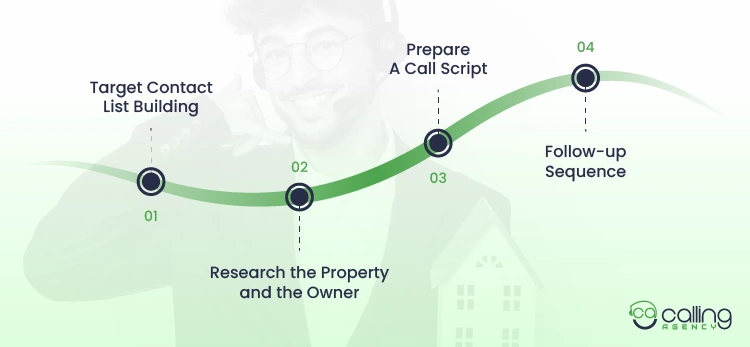
A good cold calling process usually follows these 4 steps:
1. Target Contact List Building
Agents first build a targeted prospect list. The list should contain accurate contact details of expired listings, FSBO sellers, absentee owners, landlords, or investors.
2. Research the Property and the Owner
Realtors do basic research for details on property type, location, listing history, ownership status, and recent market activity. This helps the caller to sound specific and like someone who deeply knows about it.
3. Prepare A Call Script
From the findings of target list building and prospect research, agents develop a call script. Top real estate cold calling companies use these scripts to guide the call to have a successful outcome.
A real estate cold call has these parts:
An Opener
In an opener, an agent introduces him or herself, addresses the interruption, provides a clear reason for the call, and asks permission to continue the call. A good opener often decides whether the prospect will continue the call and hear out the rep.
A strong opener also helps agents build early trust, especially when they mention the property, neighborhood, or reason for calling. For more on this, see how to build rapport in real estate cold calling.
Value Creation With Relevant Statements
After the opener, agents give a value statement to show relevance and keep the prospect engaged. This helps to build trust in the conversation.
Qualification Questions
Agents ask qualifying questions to see if the prospect is a perfect fit and has motivation for buying or selling. Qualifying questions decide the CTA and closing style.
Objection Handling
Prospects often have different objections about the calls. Most common objection handling topics include not now, not interested, we already have someone, just send me an email, etc.
Closing the Call With a CTA
Agents end the cold call with a soft CTA, asking for a follow-up appointment in most cases.
4. Follow-up Sequence
A follow-up sequence in real estate cold calling is the planned set of calls, texts, emails, or voicemails an agent sends after the first cold call. The goal is to stay in touch with the prospect until they either book an appointment or clearly say no.
A prospect needs multiple touches before they finally agree to sit. RAIN Group claims that on average, it takes 8 touches to get an initial meeting.
Here is what a follow-up sequence looks like in real estate outreach:
| Step | Action | Purpose |
| Day 1 | First cold call | Start the conversation |
| Day 1 | Short text or email after the call | Remind them who called |
| Day 3 | Second call | Try to reconnect |
| Day 7 | Follow-up call with a reason | Share market update or ask timing |
| Day 14 | Email or text | Stay visible |
| Day 30 | Check-in call | See if their plans have changed |
Real Estate Cold Calling Script Examples
A real estate cold calling script is a prepared cold calling framework that helps an agent to speak with homeowners, property sellers, buyers, or investors during a call. Different types of real estate cold calling have different scripts. Here are some common scripts for different types of real estate cold calls
FSBO Script
Rep: Hi, this is {{Your Name}} calling from {{Company Name}}. I help homeowners in your area sell their properties by offering tips and guidance. How are you today?
Seller: I’m doing well.
Rep: Great! I noticed this property at {{Property Address or Area}} listed for sale by the owner. Are you the owner of the property?
Seller: Yes.
Rep: Perfect. I’m calling because I work with buyers who are actively looking for homes in this area, and I was curious how the selling process has been going for you so far.
Seller: It is going very well.
Rep: That makes sense. Many FSBO sellers I speak with start that way to see if they can find a buyer on their own.
Just out of curiosity, have you received many inquiries or showings yet?
Seller: Yes.
Rep: Got it. One thing we often help FSBO sellers with is expanding the marketing exposure so more qualified buyers see the property.
Even if you continue selling on your own, we sometimes share insights on pricing, buyer demand, and marketing strategies.
Pre-Foreclosure Cold Call Scripts
Pre-foreclosure cold call scripts are structured conversations designed to help real estate agents, realtors, and brokerages connect with homeowners whose property is at the pre-foreclosure stage.
“Hi {{Homeowner’s Name}}, this is {{Agent’s Name}} from {{Brokerage Name}}. How are you doing today, sir?
I know it’s out of the blue. Can I have 5 minutes of your time?
Just to make sure I don’t waste your time, are you the owner of {{Property Address}}?
I reached out to see if you are considering exploring any option for the property.
We help property owners sell their properties before it gets foreclosure.
We can arrange a quick meeting at your convenience.”
Expired listing script
“Hi {{Homeowner’s Name}}, this is {{Agent’s Name}} from {{Brokerage Name}}. How are you doing today, sir?
I know it’s out of the blue. Can I have 5 minutes of your time?
I saw your home on {{Street}} come off the market recently.
I work in this neighborhood and have a few buyers actively looking here.
Would you be open to a quick chat about what it would take to get it sold this time?”
Common Objections in Real Estate Cold Calling
Common objections in real estate cold calling include not interested, already have an agent, how do you get my number, call me later.
Here are some common objections that agents face in a real estate cold call.
| Objection | What it means | Response angle |
| I’m not interested | No clear value yet | Ask a soft question about future plan |
| I already have an agent | Existing agent relationship | Do not ask anything about the current agent, but leave the door open for future market updates |
| Call me later | Timing is wrong | Confirm a specific date and time to call back |
| How did you get my number | Trust or privacy concern | Be honest, describe where you get the number from |
| I’m not ready to sell | Possible future intent | Ask if you can help you with something else, and ask to contact you in any future need |
| I don’t want to pay commission | Cost concern | Show how professional listing, paperwork, negotiation, and buyer access can help them get a better net result after commission |
Is Real Estate Cold Calling Legal?
Yes, cold calling in real estate is totally legal in the United States, but the agents have to follow federal TCPA rules, the National DNC Registry, and any state calling laws.
You need to conduct the calls during business hours, scrub your lists regularly, and avoid automated or AI voice tools without written consent.
| Rule | What agents need to do or avoid | Where it is described |
| Calling hours | 8 AM and 9 PM in the prospect’s local time | 47 C.F.R. § 64.1200(c)(1) |
| National DNC Registry | Scrub calling lists at least every 31 days | FTC Telemarketing Sales Rule DNC guidance |
| Internal DNC list | Keep a record of people who ask not to be called again | 47 C.F.R. § 64.1200(d) |
| Auto-dialers and prerecorded voices | Do not use them for cold outreach without prior express written consent | 47 C.F.R. § 64.1200(a) |
| Caller identification | State the caller’s name, brokerage or company, and call purpose clearly | 47 C.F.R. § 64.1200(d)(4) |
| Existing business relationship | Manual follow-up may apply for past clients within the allowed limits | 47 C.F.R. § 64.1200(f)(5) |
| FSBO calls | Call only about a specific buyer’s interest | NAR DNC guidance, verify before publishing |
| State Mini-TCPA rules | Check strict state rules before calling, in states like Florida and Georgia, cold calling needs to follow their state rules too | State telemarketing and Mini-TCPA laws |
| TCPA penalties | Avoid violations that can trigger a $500 to $1,500 fine per call | 47 U.S.C. § 227(b)(3) |
Frequently Asked Questions
How many cold calls should a real estate agent make daily?
Real estate agents normally aim for 50-100 calls, while prospecting is the main focus. In a discussion on Quora, several realtors agreed with this. But new agents can start with a lower number at the beginning and track conversations, callbacks, and appointments.
Is cold calling better for new agents?
Yes. With a strong script, regular practice, and a strong hunger to improve, new agents can master real estate cold calling. Cold calling will help to build confidence in new agents as it does not require face-to-face communication. It will also help them to understand the market, trends, customers’ queries, and common objections.
How long does it take to see results?
Typically, with a well-planned approach, you can get noticeable results in 2-4 weeks. But this result deeply depends on list quality, timing, and value creation. With a solid strategy, you can build a strong pipeline within a 1-3 month period.
Is Cold Calling Legal in Real Estate?
Yes, real estate cold calling is legal in the United States, but agents have to follow the rules before they dial. Agents should scrub numbers against the National DNC Registry, call only between 8 AM and 9 PM in the prospect’s local time, and avoid auto-dialed, prerecorded, or AI voice calls without proper written consent. The DNC and TCPA rules section above explains the main exceptions, risks, and penalties.
Final Thoughts
Cold calling in real estate still works when agents call the right list, use a clear script, and follow up on a regular basis. It is not about pushing someone to sell on the first call. The real goal is to start a conversation, qualify interest, and move the right prospect toward an appointment.
Agents who stay compliant, track every call, and use different scripts for each lead type can build a steady pipeline from cold outreach. Whether you call in-house or work with a real estate cold calling team, the process works best when every call has a clear purpose and next step.