


You build rapport in real estate cold calling by gaining a homeowner’s trust from the beginning of the conversation. Start with information relevant to their property, show that you understand the local real estate market, acknowledge their situation with empathy and let them do most of the talking. The goal is to create enough trust that homeowners comfortably share their selling plans, concerns and goals.
Key takeaways
- Rapport in real estate is trust with a homeowner about their home. Skip the small talk and the forced friendship.
- Lead as a local market advisor. Knowing recent sales on their street signals you are worth a few minutes.
- Listen more than you talk. Top performers speak roughly 45% of a call and let the prospect fill the other 55% (Peak Sales Recruiting, 2026).
- Research pays. Top performers are far more likely to always research a prospect before reaching out, 76% versus much lower rates for average sellers (LinkedIn State of Sales, 2022).
- You cannot fake local knowledge or genuine concern. Sellers hear a script the moment you read one.
What Does Building Rapport With Home Sellers Mean?
Building rapport with home sellers is creating enough trust, credibility and comfort that a homeowner feels safe sharing information about their property, selling plans and concerns with you. Rapport in real estate cold calling is the avoidance of small talk or attempting to have a friend-like dialogue.
This is about starting a relevant, low-pressure conversation that leaves the homeowner feeling heard, respected and listened to. That trust leads to homeowners being more transparent with their motivation, timeline and property goals.
Unlike most sales conversations, real estate cold calling has one big difference. You are talking about a person’s home and touching upon a stressful life event. Perhaps sellers are in foreclosure, going through probate, divorcing, relocating or stuck with an inherited property.
These conversations are emotionally and financially loaded and trust is at the core of a productive one. Homeowners are also much more likely to stop communicating if you go into a sales pitch or request an appointment too quickly.
Most agents have less than 30 seconds to give a homeowner a reason to keep listening. That window closes the moment you sound like every other agent who has called that week. We cover that stretch in depth in our guide to building rapport in the first 30 seconds of a cold call.
How Do You Build Rapport With Real Estate Sellers?
Building a relationship with real estate sellers takes five habits: local market knowledge, empathy, listening more than you speak, matching the homeowner’s tone and adjusting to each individual.
Calls that hold local knowledge, connect with the homeowner personally and ask legitimate questions as opposed to reciting pitches translate into more credibility.
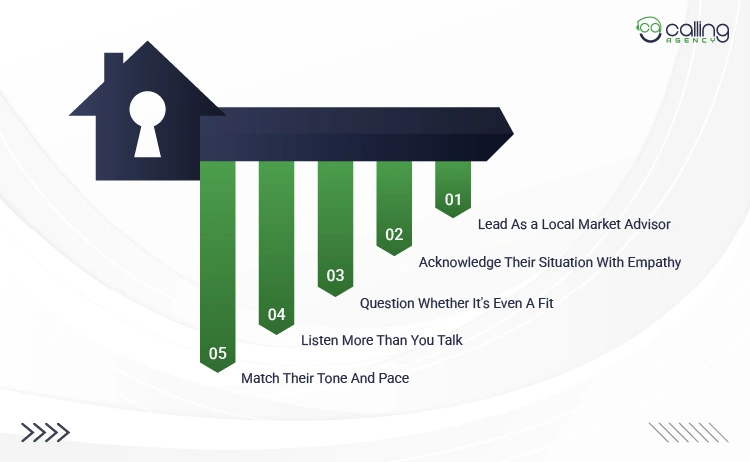
These five habits consistently separate productive real estate conversations from calls that end within seconds of pickup.
| Habit | What it sounds like | Why it works |
| Lead as a local advisor | “I just sold a place two streets over on Maple” | Local proof earns attention fast |
| Acknowledge their situation | “Sounds like the timing has been stressful” | Empathy lowers the seller’s guard |
| Listen more than you talk | Ask, then let them run with it | Talking builds trust; pitching kills it |
| Match their tone and pace | Slow down if they’re guarded, stay brisk if they’re rushed | Forced energy against a flat mood reads as a script |
| Personalize to them | Reference their block, their home, and recent sales | Generic lines get tuned out |
Lead As a Local Market Advisor
The most important way to build credibility when calling is tapping into your local market knowledge. Cite a recent similar property sale in the area or neighborhood price trend, or what other similar homes traded for recently.
Instead of having the voice of another salesperson, you allow yourself to become a resource for good market information. Many homeowners disengage for one reason. The caller waits too long to explain why the call matters to them. By the time the reason comes, interest is already gone.
Many real estate agents rely too heavily on a generic cold calling script, but homeowners respond better when the conversation includes real local market insights. Before every call, review recent comparable sales, neighborhood trends, and the property’s history. This preparation helps you personalize your opening, build trust faster, and turn more real estate leads into meaningful conversations.
Local market knowledge should also support your broader sales pipeline, not just a single call. Combine your research with information from your CRM, referrals, and even social media when appropriate to understand the homeowner’s situation better. The more relevant your conversation feels, the easier it becomes to qualify real estate leads and move them toward the next stage without sounding like a scripted salesperson.
Stating a clear reason for the call early works. A classic 1978 study on requests found compliance jumped from 60% to 94% once any reason was given (Langer, Xerox photocopier study). Advisor first, salesperson never.
Acknowledge Their Situation With Empathy
Each individual homeowner in the area has a different reason for thinking about selling. Some may have moved, inherited a property, got under pressure or simply divorced. When someone tells you their story as a seller, recognize that before talking about the property. Simply acknowledging it with, “That sounds like a lot to manage,” without the addition of explanation and assumption, shows empathy.
For the harder pushback that follows, our guide on how to handle cold call objections walks through staying calm and keeping the door open.
Question Whether It’s Even A Fit
Proper trust building means you never sound desperate to book an appointment. Before you push for a meeting, ask yourself if the timing is even right for this homeowner. For instance, you can say something like: “I’m not sure if now is the right time for you, so I’d like to understand your situation first.” This removes pressure and invites an honest conversation. When homeowners do not feel pushed to sell, they are more likely to share their selling plans, timeline and concerns.
Listen More Than You Talk
Rapport shows up when the seller keeps talking, so your job is to stop. The data is blunt: top performers speak only about 45% of the time and listen the other 55% (Peak Sales Recruiting, 2026). Ask open-ended questions, do not interrupt and paraphrase what you hear to show you understood.
For example, reflect on what the seller told you: “So the goal is to be moved out before spring.” That one line proves you were listening instead of waiting for your turn to pitch. Active listening, when supplemented by appropriate tonality, leaves the homeowners feeling valued and acknowledged. How you sound matters as much as the words, which we break down in how to master tonality in sales.
Match Their Tone And Pace
One of the simplest ways to build rapport on a real estate cold call is to match the homeowner’s tone and pace. You naturally feel more at ease when the dialogue reflects how you, yourself, communicate. If the homeowner speaks in a calm, weary or cautious manner, you should speak more slowly and keep a relaxed voice.
If they expect straight and fast responses, match that rhythm and keep the chit-chat to a minimum. You do not need to copy their exact words, just match their energy. This means making the conversation sound natural and warm. A very simple technique makes it easy to establish trust, keep the homeowner engaged and make the call sound less like a pushy sales call.
Matching a homeowner’s communication style works even better when your call script is flexible instead of rigid. Many real estate agents use sales scripts, realtor scripts, or a follow-up script as a guide, but they should never sound rehearsed. Adapt your voice and questions to the homeowner while using details like the property address, expired listings, or local market activity to make the conversation feel more personal instead of relying on personalized sales pitches that sound scripted.
This approach also prepares you for later conversations with home buyers, property owners, and sellers. Whether you are following a negotiation script or qualifying a new lead, matching the homeowner’s pace keeps the discussion natural and builds trust. A flexible call script allows you to listen carefully, adjust your responses, and continue the conversation instead of forcing every call to follow the same structure.
Personalize To Their Property And Market
Generic openings always failed to grab the attention. Anything introductory, like “I help homeowners in your area,” seems interchangeable and is easily dismissed. Refer to a recent sale in the area, the community or neighborhood of the home, property type or a variable unique to that particular homeowner.
Personalized outreach consistently outperforms generic scripts, and in real estate, the easiest way to personalize is local detail.
Lastly, more important than any script, homeowners can spot fake empathy or inflated market knowledge from a mile away. Genuine rapport cannot be manufactured. Do your homework on the property before you call, be up front regarding what you actually know, empathize with the seller’s situation and use your script as a guideline rather than something to read verbatim.
After a good call, the relationship is kept alive by what comes next. Our cold calling follow-up strategy covers the cadence, and getting the call timing right in the first place helps too. See the best time to cold call in real estate.
Research Checklist Before Every Real Estate Cold Call
Build rapport before you pick up the phone. By researching the homeowner, property and local market, you will be able to adapt your opening sentences, ask better questions and ultimately lead a more meaningful conversation.
Just preparing for five or ten minutes in advance allows you to come across as a local advisor that the prospect has absolute trust in, instead of just another cold caller.
Use this checklist before every real estate cold call:
| Research Item | What to look for | How it helps build rapport |
| Property details | Property type, size, bedrooms, bathrooms, lot size and how recently it sold or was listed. | Demonstrates that you have a perception of the home and can ask the right questions. |
| Ownership history | Length of ownership (how long has the homeowner lived there) and sale history. | Insight into potential equity and selling motivation. |
| Recent comparable sales | Recently sold homes in the same neighborhood, with similar features. | Provides you with natural conversational insights from the local marketplace. |
| Estimated home value | Current estimated market value and recent price trends. | This will help you in providing realistic market information rather than just guesswork. |
| Neighborhood market trends | Days on the market, average selling price and buyer demand. | Showcases local know-how and establishes trust fast. |
| Property condition | Recent renovations, visible maintenance issues. | Generates customized messages for prospecting and stronger discovery questions. |
| Possible selling signals | Probate, foreclosure, vacant property, tax delinquency where legally available and absentee ownership. | Assist you with asking compassionate questions without assumptions. |
| Local community highlights | New transport, schools, shops or local area renovations. | It adds context and shows you know the area. |
| Previous contact history | Old conversations, emails or follow-up notes in your CRM. | Avoids repetitive questions and builds a more customized experience. |
| Potential homeowner goals | Indications that they are moving to a smaller house, out of state or upgrading to a new home. | It helps you to ask questions that trigger motivation. |
What Questions Build Rapport With Home Sellers?
The best questions to build rapport with home sellers are open-ended, easy to answer and work on the homeowner’s property, dreams and situation.
You want to get homeowners speaking about their experience and plans, rather than asking them questions that can be answered with a yes or no. The more they talk, the more trust you develop; the better you understand their cause for selling.
- What is the date when you purchased the property?
- What was the initial thing that made you consider selling your property?
- What do you like best about living in the neighborhood?
- If you sell, where are you moving to?
- So what would have to occur for the timing to feel correct?
- Have you checked how much similar houses were sold for recently?
- If you do sell the property, what are your biggest goals?
- Have you set out a time period to work toward?
- Let us talk about what you have done to the home. Any major upgrades or renovations?
- What do you perceive as differentiating factors with your property compared to other properties?
- Have you recently spoken to a real estate agent or thought of selling before?
- What questions do you have about the local market as it stands today?
These questions are conversation starters and not a sales pitch. They allow homeowners to voice their own concerns, while also providing them with insight into the home seller’s motivation, challenges and plan for selling.
Explore each answer, ask natural follow-up questions and do not interrupt at all. Developing rapport is not about asking the right question; it’s just about showing interest in the homeowner’s story.
For a broader framework of icebreakers, discovery and qualifying questions you can adapt to any call, see our guide on how to build rapport with cold calling questions.
Should You Outsource Real Estate Cold Calling?
Rapport takes practice, patience and a lot of dials, and not every agent has the hours. If prospecting is pulling you away from listings and closings, a trained team can carry the phones, build the early rapport and pass you sellers who are ready to talk. What reaches you is a warm conversation, not a cold list.
If that sounds like a better use of your day, here is how our real estate cold calling service works.
Final Words
Building rapport in real estate cold calling is about earning trust quickly. Homeowners are more likely to continue the conversation when you sound like a helpful local professional instead of a pushy salesperson. Start with local market knowledge, show genuine empathy for their situation, ask questions about their home and plans and spend more time listening than talking.
When you do this, the call feels less like a cold sales pitch and more like a real conversation. That is where most real estate opportunities begin. Agents who consistently build trust, personalize each call and listen carefully often turn difficult first conversations into qualified appointments that many other callers miss.
Frequently asked questions
What is rapport in real estate cold calling?
Rapport is the trust and comfort that make a homeowner willing to talk openly about their property. You build it through relevance, empathy and listening, never through small talk or a hard pitch.
How do you build rapport quickly with a seller?
Open with something specific to them, such as a recent sale on their street, acknowledge their situation and ask an easy open-ended question. Sounding like a knowledgeable local, rather than a salesperson, earns trust in the first few seconds.
What is the ideal talk-to-listen ratio on a cold call?
Top performers talk about 45% of the time and listen for the other 55% (Peak Sales Recruiting, 2026). Letting the seller speak more builds trust and surfaces what is actually motivating them.
What should you avoid when building rapport with home sellers?
Skip generic openers, fake friendliness and pitching before you understand their situation. Sellers quickly sense a script, and pushing too early raises their guard instead of lowering it.
Do I have to know the local market to build rapport?
It helps enormously. Referencing recent comparable sales or neighborhood trends signals that you are worth listening to. You cannot convincingly fake it, so research before you dial.