

79% of marketing leads failed to convert because of the wrong ICP. Cause a weak ICP often leads to longer sales cycles, higher customer acquisition costs and lower client retention.
That creates much bigger problems in IT. Cause if you present your pitch with the wrong info, then you don’t just lose the lead but also the trust.
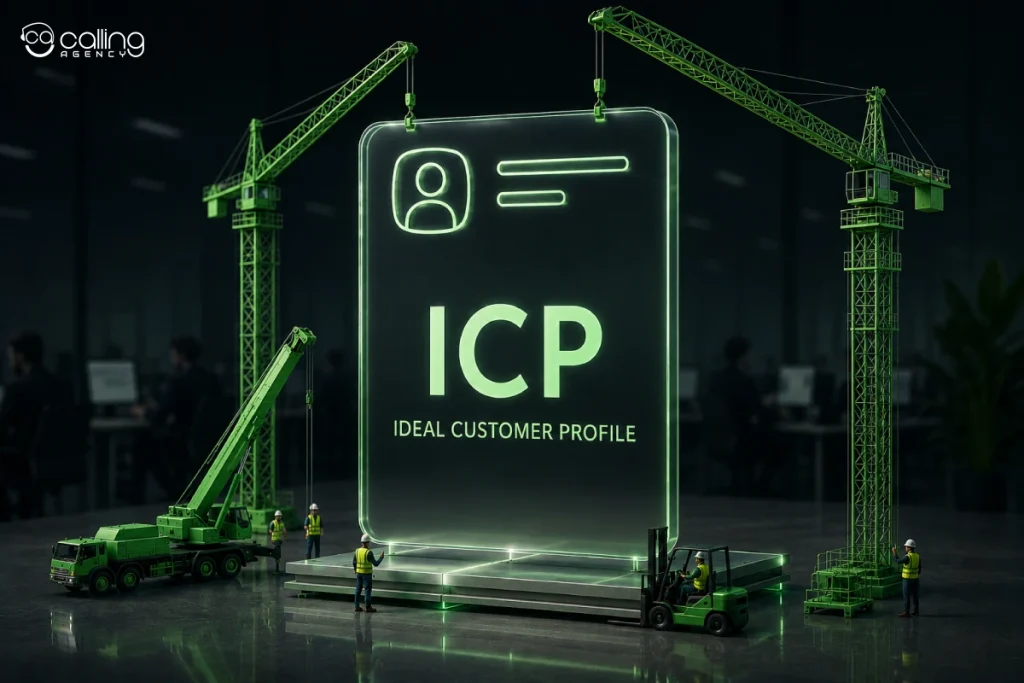
Because an Ideal Customer Profile (ICP) for an IT services company is a clear description of the businesses that are most likely to buy your services, stay with you long-term and grow their accounts.
Ok then, how to build an ICP for IT service companies?
Well, to build an ICP for an IT services company, analyze your best customers and define the common traits. Then see through the challenges, the budget, and the buying behavior data.
It helps you identify the right companies, decision-makers, and buying signals. A clear ICP also makes an IT lead generation service more effective because the outreach team can focus on accounts that match your services, budget, and delivery capacity. Finding more leads is not enough. You also need to filter them for quality and fit.
| TL;DR
An Ideal Customer Profile (ICP) for an IT services company helps you target businesses and find out who is most likely to buy, stay, and grow with you. Focus on your best customers, define your ideal and anti-ICP, and identify buying triggers. |
What Is an ICP for an IT Services Company?
An Ideal Customer Profile (ICP) for an IT services company is to find the businesses most likely to buy its services, stay long-term, and generate the most value. So you focus on the ones that match your expertise, pricing and delivery capacity.
For instance, your ICP might include mid-sized financial services companies in North America with 500–2,500 employees, a hybrid cloud environment and an upcoming compliance audit. You may target the CIO, CISO, CFO, or IT Director with a company like this. If you are not sure how these roles differ in the buying process? Our CTO vs CIO vs IT Director: The IT Sales Buyer Persona Playbook breaks it down for you.
Mainly, ICP clears up who to call and what to say! That’s why the chance of losing leads is so low.
But a new IT company often confuses ICP with buyer persona. Cause it sounds the same, but in reality, it isn’t.
As in,
A CIO at a 50-person startup may fit your buyer persona. Still, that company isn’t the right customer if your services work best for businesses with 200+ employees. The number of employees and company data play such a big role in cold calls.
That’s why you should define your ICP first. Then identify the people who influence the purchasing decisions.
Why Generic ICP Frameworks Fail IT Services Firms?
An Ideal Customer Profile (ICP) for an IT services company should go beyond basic surface-level firmographics (industry, revenue and headcount). Those factors alone don’t tell you anything about a business.
Instead, a strong IT services ICP focuses on technology maturity, current IT challenges, compliance requirements and buying signals. This helps you find the businesses for the services you offer.
That makes it a lot easier to make sales and do projects that turn out well. Relying solely on broad firmographics often results in poor-fit leads, longer sales cycles and lower conversion rates.
Cause IT services aren’t that simple. It needs a much deeper understanding of a company’s challenges, technology and service needs. They rely on projects, managed services, consulting and people.
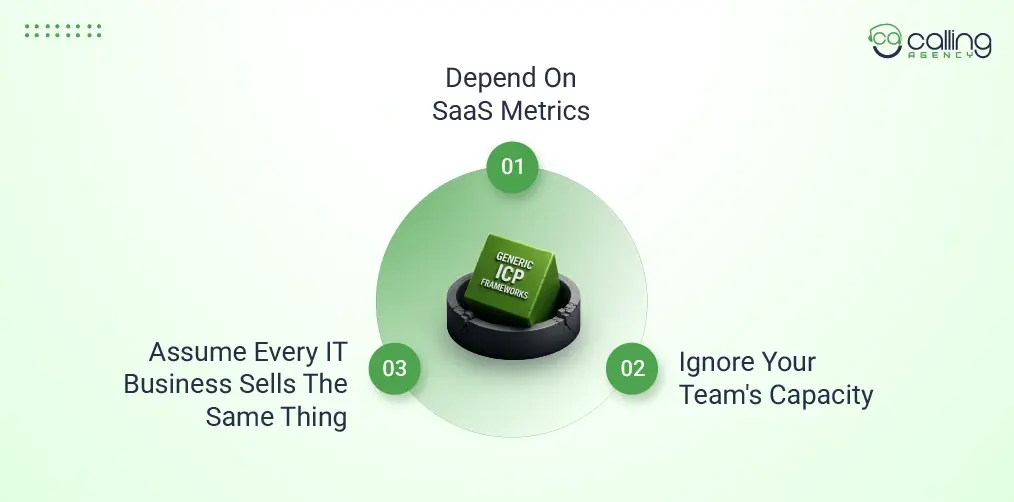
So if you follow a generic ICP framework, there’s a good chance you’ll end up targeting companies that aren’t a good fit because,
They Depend On SaaS Metrics
90% of guides tell you to segment customers using ARR, MRR, or product usage. But IT services companies rarely have that kind of customer data. They usually work with project fees, retainers, or per-user pricing.
They Ignore Your Team’s Capacity
A software company can add hundreds of customers without hiring hundreds of people. An IT services company can’t. Every new client needs engineers, consultants, or support staff. If your team can’t handle the work, signing more deals only creates bigger problems.
They Assume Every IT Business Sells The Same Thing
That’s simply not true. The ideal customer for an MSP won’t be the same as one for a cybersecurity consultant or a systems integrator. Each service has a different buyer, budget, sales cycle and level of technical complexity.
6 IT Services Models and Their ICPs Differ
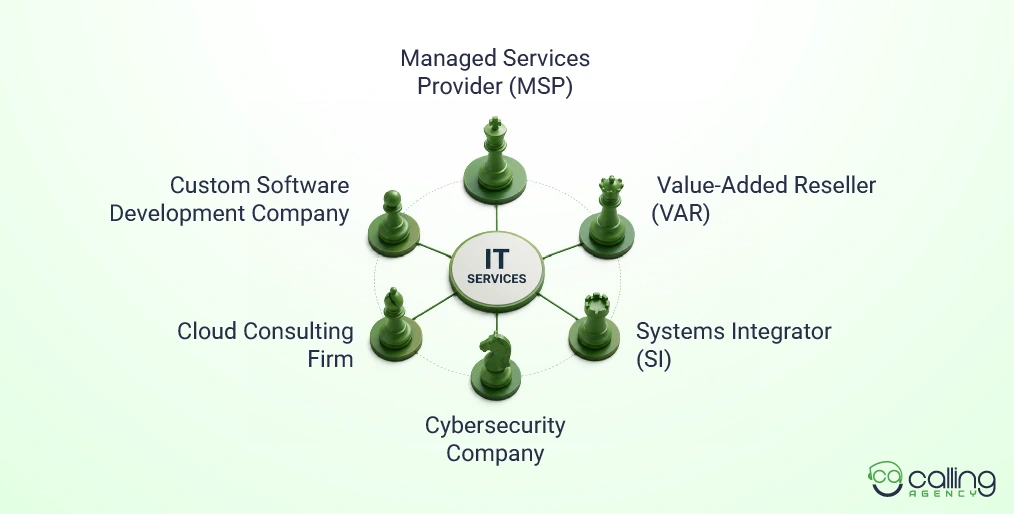
Not every IT services company should target the same type of customer. In fact, your service line has a bigger impact on your ICP than your industry or company size.
For example,
An MSP, a cybersecurity company and a systems integrator could all target the same 1,000-employee healthcare business.
But each of them can have different buying signals, decision-makers, and business needs. That’s because they sell different services, follow different sales cycles and make money in different ways.
That’s why, depending on those factors, IT service has 6 models:
1. Managed Services Provider (MSP)
For MSP lead generation, the ICP usually includes businesses with 25 to 500 employees that need ongoing IT support, monitoring, and maintenance. These companies often need outsourced IT services but do not want to build a large in-house team.
That’s why for them, industries like healthcare, financial services and legal firms are a great fit. That’s because they have ongoing compliance and security requirements.
2. Value-Added Reseller (VAR)
VARs sell hardware and software from vendors. It is often provided along with installation and setup services.
So, for this model, the best fit customers typically have 100 to 2,000 employees and already use technology from vendors you support. In most cases, the buying decision involves the CIO, the IT Director, and the procurement team for this type of company.
3. Systems Integrator (SI)
Systems integrators target large-scale technology projects such as cloud migrations, ERP implementations and digital transformations. So their targeted customers are enterprise organizations with 1,000+ employees.
You need to search for a company that already has a defined project and executive support. Many of these relationships also lead to future implementation or consulting projects.
4. Cybersecurity Company
Cybersecurity firms manage security, threat detection, compliance support and penetration testing.
So, their targeted customers usually work in regulated industries such as healthcare, finance, or government. That’s why compliance requirements and security risks matter much more than company size.
5. Cloud Consulting Firm
Cloud consulting companies help businesses migrate to platforms like AWS, Azure, or Google Cloud. They also design cloud architecture and support modernization projects.
So, they look for customers with growing digital businesses and established companies looking to replace outdated infrastructure. The main decision makers are usually the CTO or VP of Engineering.
6. Custom Software Development Company
Businesses run to custom development companies when they need software built specifically for their goals. These companies commonly work with startups, SaaS businesses and enterprise product teams that need experienced developers to support their projects.
That’s why most buying decisions are made by the CTO or VP of Product. So, you need to call them directly.
The 6 Components of an IT Services ICP
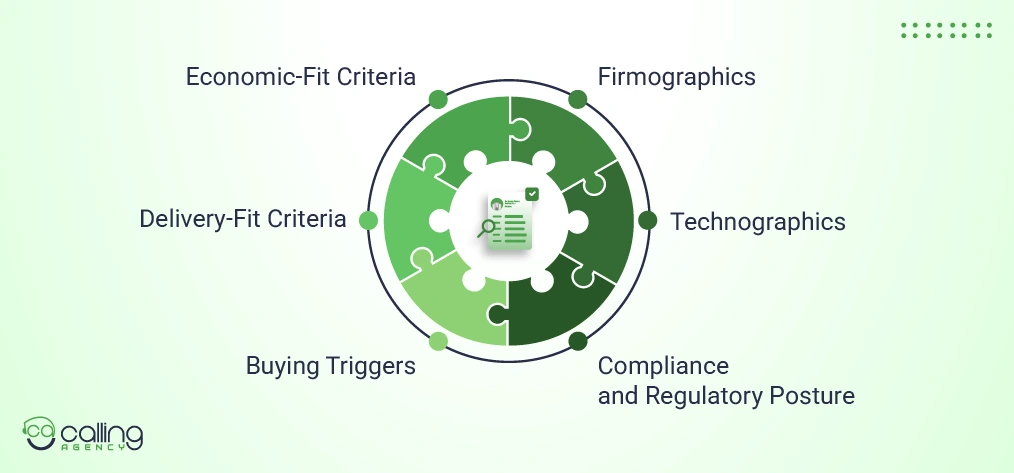
If you are still struggling to build a correct ICP for your service, then just remember your ideal customer profile should have those 6 components as follows:
Firmographics
Firmographics are the basic characteristics of a business. It includes its industry, employee count, annual revenue, location and number of offices. These details help determine whether an account aligns with your service capacity and target market. The industry is especially important because it often determines the customer’s security, compliance and infrastructure requirements.
Technographics
Technographics show the technology a company already uses. This includes its cloud environment, like on-premise, hybrid, single cloud, or multi-cloud. Additionally, software vendors, legacy systems and End of Life (EOL) hardware or software. Tools like BuiltWith, HG Insights and PredictLeads help uncover this data.
Compliance and Regulatory Posture
A company has to follow rules to be safe and comply with laws. There are examples of these plans, such as SOC 2, NIST CSF, HIPAA, PCI DSS, FedRAMP, CMMC, ISO 27001, GDPR, DORA and NIS2. Businesses preparing for an audit or renewing a certification often become active buyers because they need to close security and compliance gaps within a defined timeline.
Buying Triggers
Buying triggers are business events that increase the likelihood of purchasing IT services. These can include cloud migrations, technology contract renewals, failed security audits, cyber incidents, mergers and acquisitions, funding rounds, or new IT leadership. Accounts with a recent buying trigger are typically more likely to engage than companies with no immediate business need.
Delivery-Fit Criteria
Delivery fit measures whether your team can successfully support the account. It considers factors like company size, location, technology stack, required certifications, support hours and your current delivery capacity. Qualifying delivery fit early helps prevent taking on projects that stretch your resources or affect existing service levels.
Economic-Fit Criteria
Economic fit determines whether an account is financially worthwhile. It looks at the expected contract value, profit margin, expansion opportunities, payment history and long-term customer value. The best IT services clients generate profitable revenue while offering opportunities to grow into additional managed services, cybersecurity, cloud, or consulting engagements over time.
If you have all the above, you have a strong you close rate automatically increases by 30%.
6 Components At A Glance
| ICP Component | What to Look For |
| Firmographics | Check the company’s industry, size, locations and any compliance requirements tied to its industry. |
| Technographics | Look at its technology stack, cloud setup, current vendors and any systems nearing End-of-Life (EOL). |
| Compliance | Find out if the company is preparing for or renewing standards like SOC 2, HIPAA, or ISO 27001. |
| Buying Triggers | Watch for events like contract renewals, security incidents, funding rounds, mergers, or new IT leadership that signal a buying opportunity. |
| Delivery Fit | Make sure your team has the skills, capacity and geographic coverage to support the account successfully. |
| Economic Fit | Check if the deal size, Annual Contract Value (ACV) and long-term growth potential make the account profitable. |
How Do You Build an ICP for an IT Services Company? A Six-Step Framework
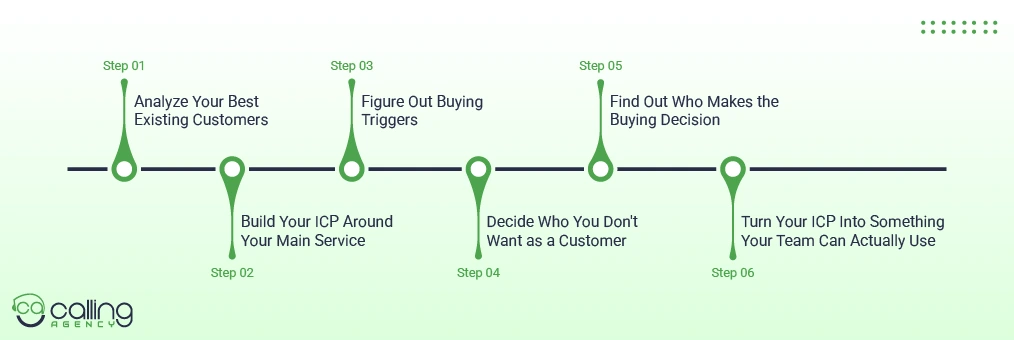
Building an Ideal Customer Profile (ICP) for an IT services company means identifying the businesses that are the best fit for your services based on factors like firmographics, technographics, compliance requirements, buying signals, delivery capacity, and revenue potential.
Here are 6 steps to do that-
Step 1: Analyze Your Best Existing Customers
Before you start looking for new customers, take a close look at the ones you already have. Chances are, your best ICP is sitting right inside your customer list.
One mistake we see a lot is companies ranking customers by revenue alone.
A client paying you $100,000 might sound great. But if they constantly ask for custom work, open support tickets every day, and barely make you a profit, they’re probably not your ideal customer.
So, don’t waste time on them; focus on the clients you actually enjoy working with.
They’re profitable, they don’t create unnecessary problems, and many of them continue buying more services over time. They will naturally provide customer lifetime value (CLV).
As you go through those accounts, look for patterns. Maybe most of them are healthcare companies. Maybe they all have between 100 and 500 employees. Maybe they use Microsoft Azure instead of AWS. Those similarities are what eventually become your ICP.
Take notes on Account-Based Marketing teams and behavioral Insights. Both have a strong influence on an ICP.
Step 2: Build Your ICP Around Your Main Service
Not every IT service attracts the same type of customer.
A business looking for managed IT support has very different needs from one seeking ERP implementation or cloud consulting. Their budgets are different. Their buying process is different. Even the people making the decision are different.
That’s why trying to create one ICP for every service usually doesn’t work.
Start with the service that brings in the most revenue or delivers the highest profit. So, build your ICP around that first. Once it’s complete, you can create separate profiles for your other services.
However, finding info like this is kinda hard for private-company data. Cause they preserve their data pretty well.
Step 3: Figure Out Buying Triggers
Most businesses start looking for an IT partner when something changes. Maybe they’re moving to the cloud. Maybe their software license is about to expire. Maybe they failed a security audit or hired a new CIO who wants to modernize the company’s infrastructure.
These things are called buying triggers. When you understand these triggers, your outreach.
Why?
Well, becomes much more effective because you’re contacting companies when they actually have a reason to make a decision.
As you analyze your existing customers, ask yourself-
- What happened before they contacted you?
- Did they experience rapid growth?
- Were they preparing for a compliance audit?
- Did they recently merge with another company?
The more buying triggers you identify, the easier it becomes to find companies that are actively looking for the services you provide instead of businesses that are simply browsing.
Step 4: Decide Who You Don’t Want as a Customer
This is probably the step most IT companies skip. Everyone spends time defining their ideal customer. But very few define the customers they should avoid.
However, not every company is worth your time.
Some businesses demand heavy customization that falls outside your expertise. Others have unrealistic budgets, take months to pay invoices, or only need a one-time project with no long-term opportunity.
On paper, they may look like great leads. In reality, they often become your least profitable clients.
That’s why it’s helpful to create an “anti-ICP.”
Think about the customers who caused the most frustration in the past. What did they have in common?
Maybe they were too small. Maybe they expected enterprise-level support on a limited budget. Maybe they already had long-term contracts with another provider.
Then write down all their pattern! Writing these patterns down makes qualifying leads much easier. Sometimes the fastest way to grow isn’t by finding more prospects. It’s by saying no to the wrong ones earlier.
Step 5: Find Out Who Makes the Buying Decision
Many people influence the final decision in many companies for intense-
The IT Director may care about technical compatibility, while the CFO wants to understand the return on investment. A CISO may focus on security and compliance and the CEO may only get involved when the project supports a larger business goal.
If you only speak to one stakeholder, you’re only hearing part of the conversation.
That’s why it’s important to understand everyone involved in the buying process. Learn what each person cares about and what problems they’re trying to solve.
Step 6: Turn Your ICP Into Something Your Team Can Actually Use
An ICP shouldn’t live in a document that everyone forgets about after one meeting. It should become part of your daily sales strategy & Sales pipeline.
One of the easiest ways to do that is by creating a simple scoring system. Every time a new lead comes in, compare it against your ICP. Find out if-
- Does the company operate in your target industry?
- Does it fit your preferred size?
- Does it use technology your team supports?
- Is there a clear buying trigger?
The more boxes a company checks, the higher it moves on your priority list.
Your ICP also shouldn’t stay the same forever. Markets change, technology changes and your business changes too. That’s why it’s worth reviewing your best and worst customers every few months.
Over time, you’ll notice new patterns that help you refine your ICP and improve the quality of every lead your team pursues.
What Buying Signals Predict IT Services Deals?
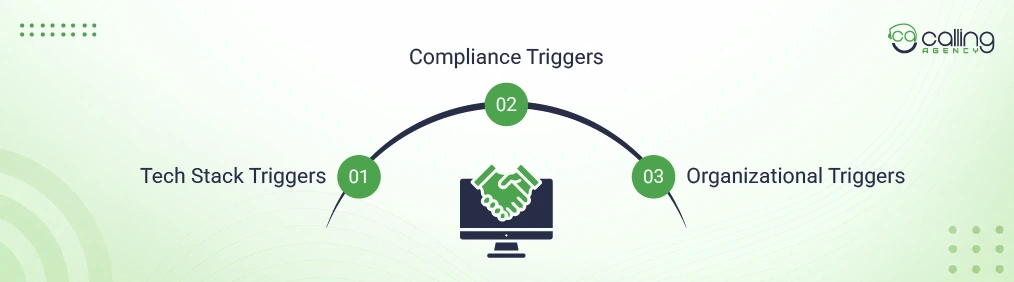
The best time to reach out to a prospect is when they already have a reason to buy. In IT services, the strongest buying signals usually fall into 3 categories:
- Technology Changes
- Compliance Requirements
- Business Events.
So, spotting these early gives your sales team a 30- to 90-day window to start conversations before competitors do. Here are a few tools we usually use:
Tech Stack Triggers
Technology changes often create an immediate need for IT support or consulting.
- Microsoft Enterprise Agreement (EA) or licensing renewals often open the door to discussions about cloud services, licensing costs and vendor consolidation.
- VMware licensing changes under Broadcom have pushed many businesses to explore alternative virtualization platforms.
- Cloud migration projects create opportunities for managed services, cloud consulting and infrastructure modernization.
- End-of-Life (EOL) software and hardware, such as Windows 10, Windows Server, SQL Server, or Exchange Server, force businesses to upgrade their systems and strengthen security.
Compliance Triggers
Compliance deadlines are some of the strongest buying signals because businesses have a fixed timeline to meet.
- Upcoming or renewed audits for SOC 2, ISO 27001, HIPAA, PCI DSS, CMMC, GDPR, DORA, NIS2, or FedRAMP often lead companies to evaluate new IT partners.
- A failed compliance audit or cybersecurity breach also speeds up buying decisions, as organizations need to address security gaps quickly.
Organizational Triggers
Changes inside a business can create new IT spending opportunities like-
- A newly hired CIO, CTO, or CISO often reviews existing vendors and invests in new technology during the first few months.
- Series B or later funding, mergers, acquisitions, or rapid business growth usually increase demand for infrastructure, cybersecurity and managed IT services.
- Companies growing their workforce quickly often need to expand their IT systems to support more employees.
You can track these signals using tools like LinkedIn Sales Navigator, Crunchbase, PredictLeads, ZoomInfo Intent and news alerts. Then adding these events to your CRM helps your sales team prioritize accounts that are actively entering a buying cycle.
But not every trigger performs the same way.
In many IT services campaigns, compliance-related triggers generate faster meetings because businesses are working against fixed deadlines. Tech stack changes can lead to larger projects.
But they often involve longer evaluation periods. Identifying either trigger early gives your team the best chance to start the conversation before competitors.
Who Is on the IT Services Buying Committee?
An IT services deal usually involves several decision-makers, not just one. The buying committee often includes technical decision-makers and budget approvers. Also, security reviewers and internal champions each have a different role in the purchasing process.
To improve your chances of closing the deal, identify and engage each stakeholder individually rather than relying on a single contact.
| Role | What They Decide | What They Care About | Best Way to Reach Them |
| CIO or IT Director | Reviews technical fit and approves IT spending | System reliability, integration and vendor fit | Cold calls and peer referrals |
| CTO or VP of Engineering | Evaluates technical strategy | Scalability, architecture and technology stack | LinkedIn and technical content |
| CFO | Approves the budget | ROI, Total Cost of Ownership (TCO) and contract value | ROI-focused emails |
| CISO or Security Lead | Reviews security and compliance | Cybersecurity, compliance and vendor risk | Security-focused outreach |
| IT Manager or Operations Lead | Influences day-to-day decisions | Supports quality, response times and tools | Cold calls and product demos |
| Procurement | Finalizes contracts | Pricing, payment terms, MSA and SLA | Late-stage discussions |
| CEO | Approves strategic investments | Business growth and competitive advantage | Executive emails and warm introductions |
But remember, the buying committee varies by company size.
Small and mid-sized businesses often involve only the CEO and IT Director, while enterprise organizations. It may also include security teams, procurement, and department leaders.
So, for every opportunity, identify 3 key people:
- The Champion
- The Economic Buyer
- The Veto Authority
The champion supports your solution internally, the economic buyer controls the budget and the veto authority can stop the deal if security, compliance, or technical requirements aren’t met. Mapping these roles early gives your sales team a much better chance of moving the deal forward.
Which Accounts Should You Put on Your Anti-ICP List?
Anti-ICP criteria define the types of customers your IT services company should avoid. An ICP helps you find the right clients, and an Anti-ICP protects your margins. You can filter out accounts that are unlikely to be profitable or successful.
So, saying no to the wrong clients is often just as important as saying yes to the right ones. Most unprofitable projects share a few common traits, and identifying these early helps protect your team’s time, delivery capacity and profit.
The eight Anti-ICP criteria below cover the most common account patterns that negatively impact IT services’ profit and loss (P&L).
- Companies that take 90 days or more to pay invoices put unnecessary pressure on your cash flow.
- Businesses that need heavy custom development.
- Clients looking for one-time projects with little or no opportunity for future work.
- Organizations locked into long-term contracts with another MSP or IT provider and showing no clear reason to switch.
- Companies that require certifications or compliance expertise your team doesn’t currently have, such as HIPAA, SOC 2, or CMMC.
- Prospects whose budgets fall below your minimum project size or whose requirements exceed your team’s delivery capacity.
- Companies that switch providers every 12 to 18 months rarely stay with one IT partner for long.
Don’t just write these criteria down and forget about them. Make them part of your qualification process. So, your team can spot poor-fit leads before spending time on them.
How Do You Score and Tier IT Services Prospects?
Building an ICP is only half the job. The next step is to use it to prioritise the right prospects.
So, assign a score based on how closely a company matches your ideal customer profile. Here is how the IT service score board is based on CRM data & funding status:
| Category | Criteria | Points / Tier |
| Fit & Budget | 10–49 users | 15 |
| 50+ users | 30 | |
| Operates in a regulated industry (e.g., healthcare or finance) | 20 | |
| Has a monthly IT budget of $5,000+ | 20 | |
| Engagement | The business owner or IT Director is involved | 20 |
| Responds within 24 hours | 10 | |
| Pain Point | Unhappy with the current IT provider or experiencing frequent IT issues | 20 |
| Negative Score | Looking for the cheapest option or has an in-house IT team that doesn’t fit your services | –30 |
| Tier A | 75–100 points | Perfect Fit |
| Tier B | 50–74 points | Good Fit |
| Tier C | 0–49 points | Low Priority |
Frequently Asked Questions
How is an IT services ICP different from a SaaS ICP?
An IT services ICP focuses on factors like delivery capacity, technical expertise, compliance requirements and buying triggers. A SaaS ICP, on the other hand, often relies on product usage, subscription metrics and recurring revenue. Since IT services depend on people and project delivery, the ideal customer is based on service fit rather than software adoption.
What should an MSP include in its ICP?
An MSP should define its target industries, company size, IT environment, compliance needs, budget and preferred service locations. It should also identify common pain points, such as limited in-house IT support, frequent downtime, or growing cybersecurity concerns.
What are the top buying signals for IT services deals?
Some of the strongest buying signals include cloud migration projects, compliance audits, software or hardware upgrades, funding rounds, mergers, rapid business growth, hiring a new CIO or CTO and dissatisfaction with the current IT provider.
Who is on the IT services buying committee?
The buying committee usually includes the CIO or IT Director, CTO, CFO, CISO, IT Manager, Procurement team and sometimes the CEO. The decision-makers vary depending on the company’s size and the type of IT service being purchased.
How often should you refresh your IT services ICP?
Review your ICP at least once every quarter or whenever your services, target market, or customer base changes. Regular updates help ensure your sales and marketing teams continue targeting the right businesses with the right marketing strategies.
What tools help build and activate an IT services ICP?
Popular tools include Apollo, ZoomInfo, LinkedIn Sales Navigator, BuiltWith, Crunchbase, Clay and HG Insights. These platforms help you find target accounts, understand their technology stack, identify buying signals and prioritize outreach.