


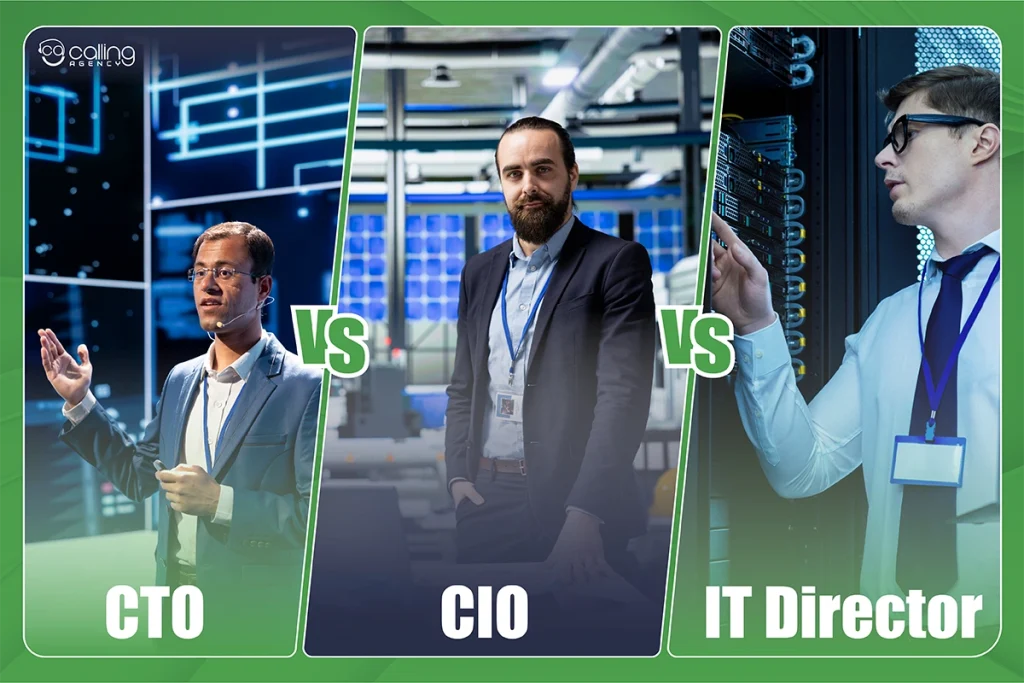
The CTO is responsible for technology strategy and product innovation. The CIO is responsible for the company’s internal IT systems, budget and technology investments. The IT Director manages the daily operations of IT to make sure all systems are working properly. If you know who owns the budget for your solution helps you start the conversation with the right person.
Many sales teams lose the lead because they knock on the wrong decision maker’s door.
The CIO is responsible for improving internal IT processes and ensuring they operate efficiently and support business processes. But the CTO is more concerned with technologies that can be used to drive innovation, products and business development.
This is exactly why targeting matters in IT lead generation services; reaching the right title is what turns outreach into a pipeline.
So, one must understand the individuals’ decision-making abilities, influence and priorities to be able to determine how to approach them successfully or get their attention.
Who Is This Guide For?
We made this guide for sales professionals who sell IT solutions to mid-market and enterprise businesses. It’s made for
- Account Executives (AEs)
- Sales Development Representatives (SDRs)
- Sales enablement leaders
- And ABM marketers who want to understand the differences between the CTO, CIO and IT Director.
So, they can target the right decision maker with the right message. Mainly, the strategies in this guide work best for teams selling SaaS, cybersecurity, cloud services and managed IT infrastructure.
They are also helpful for other B2B IT solutions with longer sales cycles and multiple stakeholders. It also assumes you’ve already defined your Ideal Customer Profile (ICP) and now want to improve persona-level targeting.
So, if your average deal size is $25,000 or more and your buyers are mid-market or enterprise companies, you’ll find these tactics especially useful.
| Tips:
IT decisions are often handled by a single person in companies with fewer than 50 employees. So, a simpler sales approach usually works better. |
What’s the Difference Between CTO, CIO and IT Director?
A CTO (Chief Technology Officer) is concerned with outward-facing technology and product innovation for customers. A CIO or Chief Information Officer handles internal IT systems, cybersecurity and enterprise operations. In contrast, an IT Director is responsible for all these IT strategies and also managing the day-to-day operations of the technical staff and infrastructure.
Rather than all those roles also differ in many levels, for example:
| Attribute | CTO | CIO | IT Director |
| Reports to | CEO (increasingly) or CIO | CEO or COO | CIO or COO |
| Primary focus | Product tech, external innovation | Enterprise systems, internal IT | Operations, infrastructure, help desk |
| Budget authority | Product tech budget, sometimes separate | Enterprise IT budget | Departmental IT ops budget |
| Buying triggers | Scale problems, build vs buy, roadmap | Compliance, consolidation, transformation | Operational pain, incidents, renewals |
| Deal blockers | Roadmap fit, integration risk | Security, vendor stability, procurement | Implementation load, admin overhead |
| Best outreach angle | Roadmap velocity, technical proof | Consolidation, business alignment | Immediate operational fix |
| Note:
According to Foundry’s 2026 State of the CIO report, 45% of organizations have the CTO reporting directly to the CEO, while 23% have the CIO in that role. This shift shows that many organizations are product-led. It gives technology leaders a bigger role in business strategy, product innovation and investment decisions, not just IT operations. |
What Does A CTO Buy And How Do You Sell To One?
CTOs buy technology that accelerates product velocity, opens new engineering capabilities or reduces build versus buy risk. They check on technical depth, roadmap maturity and integration cleanliness. Deal cycles run short when the CTO champions internally. It is often 30 to 60 days in deals we track.
So, you need to sell the roadmap and the proof of concept (POC), not the compliance story, to a CTO.
What CTOs Actually Own?
CTOs own the technology stack that powers customer-facing products. They don’t just write code anymore. Modern CTOs oversee long-term technical roadmaps, platform reliability and team building.
However, in product-led companies, they do engineering leadership, developer platforms, application infrastructure and increasingly, artificial intelligence (AI) tooling. And in service-based companies, the CTO is responsible for the technical delivery capability. They make sure the team has the people, processes and technology needed to deliver services successfully.
So, their roles are reversed depending on the company.
What Triggers a CTO to Buy?
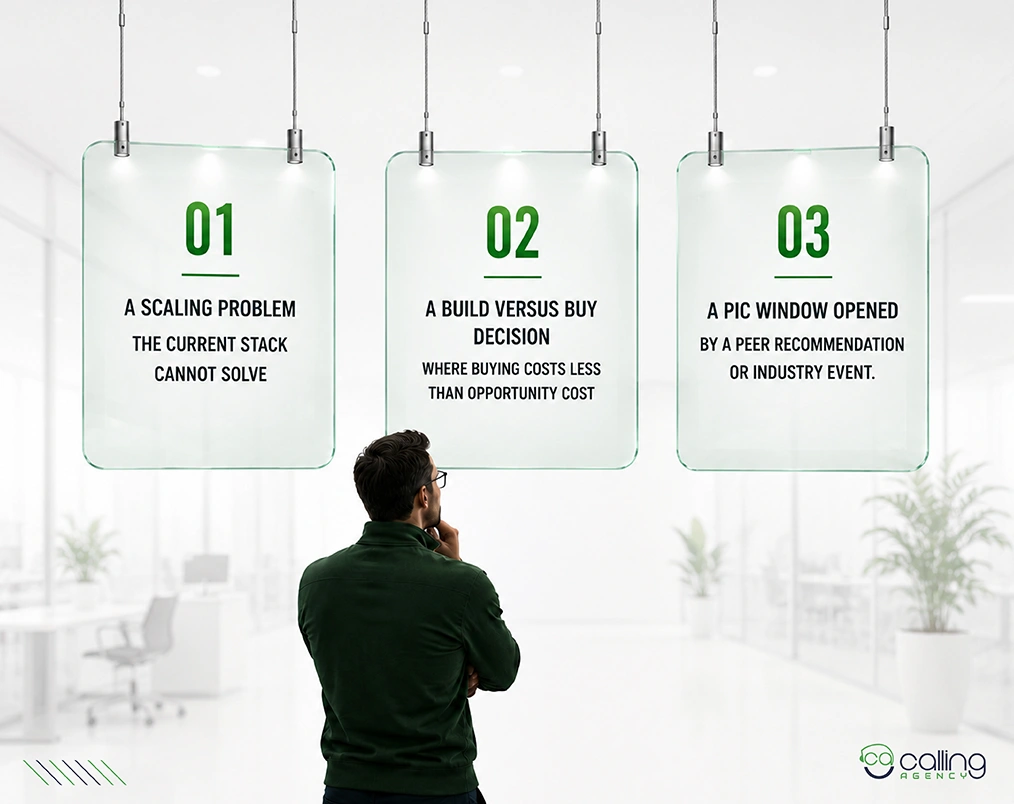
CTO has 3 buyer insights-
- A Scaling Problem The Current Stack Cannot Solve.
- A Build Versus Buy Decision Where Buying Costs Less Than Opportunity Cost.
- A Poc Window Opened By A Peer Recommendation Or Industry Event.
In deals, we have run across product-led verticals; CTOs buy when the trigger fires, not when the sales sequence lands.
How Do CTOs Evaluate Vendors?
CTOs evaluate vendors based on architectural compatibility, security compliance, integration capabilities and long-term ROI. They don’t just listen to the sales pitch. Instead, they look at the vendor’s technology stack, engineering practices and product roadmap.
CTOs run short POC cycles, with typical durations of 2 to 6 weeks.
They also check how easily the solution fits into their existing environment. This helps them reduce operational risk, avoid technical debt and choose a solution that supports their long-term technology strategy.
How to Open a Conversation With a CTO?
To open a conversation with a CTO starts with business value rather than a list of technical problems. Start with the business outcome you’re trying to help them achieve. CTOs care about technology. But they also want to know how it supports product growth, engineering efficiency and long-term business goals.
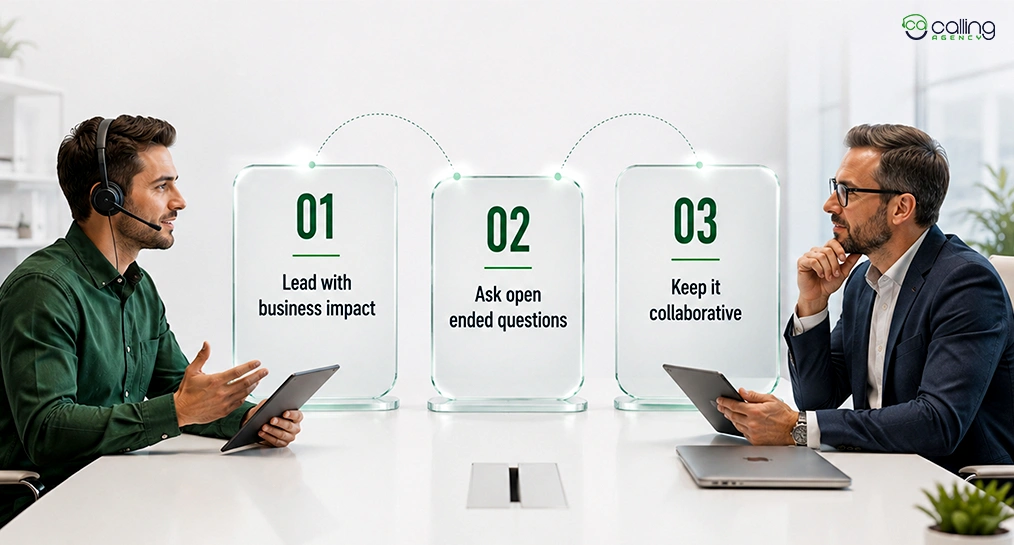
So, keep the conversation like this
- Lead with business impact. Show how your solution can improve product delivery, reduce engineering effort, speed up development or support revenue growth.
- Ask open-ended questions. Do not start with what is wrong. Instead, inquire about their technology priorities, engineering challenges, or upcoming projects to demonstrate your commitment to being a partner in their mission.
- Keep it collaborative. After looking into their requirements, conclude by discussing how you can support their strategic goals or speed up their project. It’s crucial to remind them of your concern about their success.
Remember, the most important conversations with CTOs begin with strategy rather than technology. By addressing strategic priorities first, you’re likely to get much further in the conversation before diving into solution selling or specific technical details.
What Does CIO Care About When Evaluating Vendors?
CIOs worry about business alignment, vendor consolidation, security posture and total cost of ownership over a 3 to 5 year window. They see vendors as long-term partners. Deal cycles for the deals we track are 6 to 12 months.
So, they sell the consolidation story, the compliance story and the reference customer list, not the technical benchmark.
What CIOs Actually Own?
The CIO drives company’s technology strategy, manages governance and handles key investment choices. They rarely manage individual systems directly but align technical tools with larger business targets. They help reduce risk across the business.
Most CIOs handle:
- Enterprise architecture
- Data strategy
- Artificial intelligence (AI) and automation
- Cybersecurity and compliance
- Vendor and SaaS management
- Customer experience (CX) technology
62% of CIOs manage their technology budget as part of the overall IT spend.
What Triggers A CIO to buy?
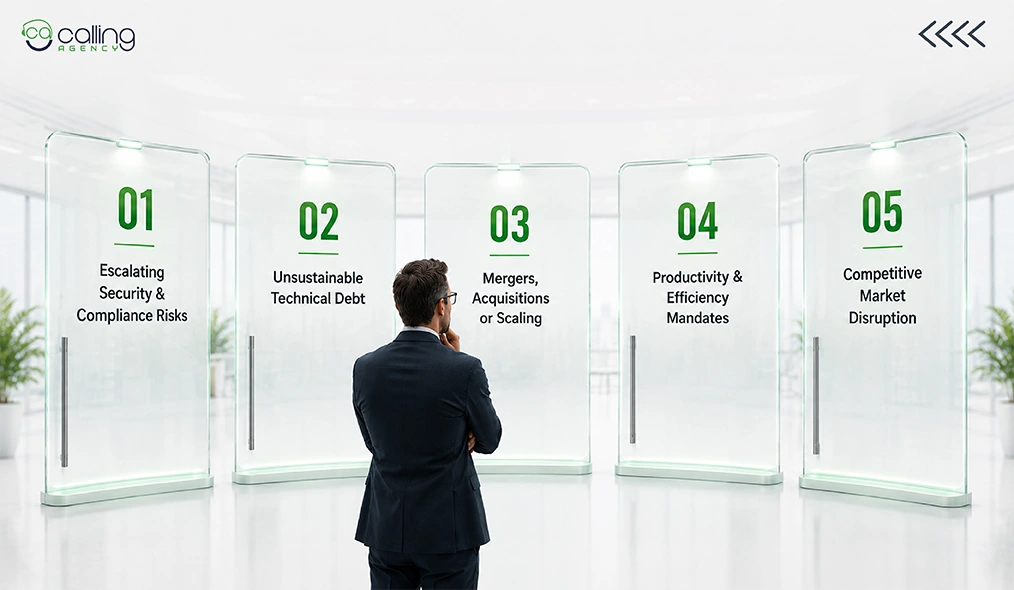
CIOs usually make buying decisions when there’s a clear business need, not just because a new technology looks interesting. CIO has 5 buying triggers, as in
- Escalating Security & Compliance Risks
- Unsustainable Technical Debt
- Mergers, Acquisitions or Scaling
- Productivity & Efficiency Mandates
- Competitive Market Disruption
The pattern we see across financial services and healthcare deals: CIOs rarely buy on discretionary interest. They buy against a specific board or executive commitment.
How CIOs evaluate vendors
CIOs evaluate vendors based on risk, business value and long-term cost, not just product features. They consider various factors like financial, security and compliance requirements, total cost of ownership, implementation risks and the vendor’s technology roadmap. They also evaluate the solution’s fit for purpose and ability to contribute to the organization’s overall IT strategy.
CIOs evaluate the total cost of ownership (TCO) over a three- to five-year window, not on sticker price. A weak return on investment (ROI) case kills deals in procurement review. A vendor with weak financial backing or a shallow customer base gets cut early.
Roadmap matters, but proven deployment in similar-scale orgs matters more.
How To Open A Conversation With A CIO
Focus on business results rather than hardware or software when meeting a CIO. Spend time understanding company needs before suggesting any specific path or tool. Tailor your message directly to their goals like security or cost reduction.
Clearly show how your solution achieves those targets through measurable financial returns. Keep the talk focused on long-term value rather than listing individual product features.
The IT Director is an IT buyer
The IT Director owns operational IT and reports to the CIO in most mid-market and enterprise orgs. They influence purchases, evaluate technically and often initiate deals.
But rarely sign above $50,000 ACV without escalation. In smaller companies, the IT Director is the buyer. Match your outreach to their operational reality, not a strategic frame that will not land.
What IT Directors Actually Own?
IT Directors manage the day-to-day IT operations that keep the business running. Their responsibilities include infrastructure management and endpoint management. It helps desk operations, service level agreements (SLAs) and vendor management for the tools their teams use.
In small organizations with no CIO, the IT director is the primary decision maker. On the other hand, in large organizations, the CIO tends to be more involved in setting strategic objectives related to IT. It leaves day-to-day decision-making and management duties to the IT Director.
What Triggers an IT Director to Buy?

IT Directors invest in technology to solve operational problems, not simply to adopt new tools. Their buying decisions are usually driven by issues that affect daily IT operations, such as
- Security Vulnerabilities
- Growing Technical Debt
- Compliance Requirements
- Budget Planning
- Executive Directives.
In many cases, an immediate operational challenge creates the buying opportunity. It could be a recent security incident, infrastructure that keeps failing, poor vendor support, capacity limitations or an upcoming software renewal.
Since IT Directors are focused on keeping systems stable and users productive, they’re often able to move faster than CIOs when a solution addresses an urgent operational need.
How do IT Directors evaluate vendors?
IT Directors evaluate vendors based on operational fit, security and long-term reliability. They compare vendors using structured evaluation criteria, review their security posture and test solutions in real-world environments.
Their goal is to choose a solution that reduces operational risk, fits existing workflows and delivers reliable performance over time.
How To Open A Conversation with an IT Director?
When starting a conversation with an IT Director, focus on the operational challenges they deal with every day instead of leading with product features. Show that you understand their IT environment and explain how your solution can improve system reliability, strengthen security, reduce downtime or make IT operations more efficient.
Make the conversation specific to their technology stack whenever possible. If they use platforms like Microsoft Intune, ServiceNow or Okta.
It explains how your solution fits into their existing environment rather than asking them to change the way they work. IT Directors appreciate vendors who understand the tools they already rely on.
Keep your message short, practical and action-oriented. Instead of spending the first meeting on a sales presentation, offer a live demo or a proof-of-concept (POC).
Or send a trial so they can see how the solution works in their own environment. The faster you show real operational value, the more likely you are to earn their trust and move the conversation forward.
How Are The 3 Roles Compressed Or Split By Company Size?
Company size is the strongest predictor of which persona owns IT decisions. This is what we call the Company Size Compression Model.
For example, with fewer than 500 employees, one person usually wears all three hats. Between 500 and 5,000, the CIO and IT Director split. Above 5,000, the full 3-role structure appears, along with the adjacent Chief Information Security Officer (CISO), Chief Data Officer (CDO) and Chief Digital Officer roles.
Under 500 Employees
Most companies this size have one technology leader with a hybrid title, such as VP of Technology, Head of IT or IT Director. They set strategy, buy tools and often deploy them personally. Sellers pitching this segment should skip title-based targeting and lead with pain-based targeting. Compression collapses the persona map.
500 To 5,000 Employees
A CIO or VP of IT appears at this stage. The IT Director runs operations under them. A CTO shows up only if the company is product-led or ships a technical product. In services companies and traditional enterprises at this size, there is often no CTO. Map the org chart before assuming a CTO exists.
5,000+ Employees
Full three-role separation appears. CIO, CTO and multiple IT Directors coexist. Adjacent roles emerge: CISO, CDO, Chief Digital Officer, Chief AI Officer. Reporting structures fragment. Matching outreach to the exact role that owns the budget for your product category becomes the difference between a booked meeting and a bounced email.
How To Read The Org Chart Before Your First Outreach
Check LinkedIn org structure. Read the last two years of the target’s public statements. Look at press releases naming the owners of what. If the CTO’s public commentary focuses on developer platforms and products, they own the product technology.
If it is about business transformation and cost, they likely own what a CIO would elsewhere. The title alone lies. Public statements do not.
Who Actually Signs Off On It Purchases?
IT purchase approvals usually follow a tiered approval process based on the purchase’s cost and scope.
Intense, low-cost items, such as standard peripherals or software licenses under $500, are often approved by a department manager.
Mid-sized purchases, including laptops or SaaS subscriptions up to $5,000, typically go through the IT team for technical and security review before the CIO, IT Director, Procurement or CFO approves the budget.
On the other hand, large enterprise investments, such as ERP implementations, major infrastructure upgrades or organisation-wide technology platforms, usually require approval from executive leadership, including the CEO and, in some cases, the Board of Directors.
But no matter what, every IT decision depends on those roles. This is the same pattern you see when you identify key decision makers in B2B companies.
| Role | Responsibility |
| Initiator | Identifies the business or technical problem and starts the buying process. |
| Evaluator | Reviews vendors, compares solutions and validates technical fit. |
| Approver | Makes the final purchasing decision and signs the contract. |
| Blocker | Can delay or stop the deal because of security, procurement, legal or compliance concerns. |
But these roles often overlap.
The CTO usually initiates and evaluates product and engineering purchases, the CIO approves strategic IT investments and enterprise-wide solutions and the IT Director identifies operational needs, evaluates vendors and oversees implementation. Depending on the deal, any of them can also block a purchase.
Don’t assume the first person you meet can sign the contract. Enterprise IT deals often involve multiple stakeholders, which is why frameworks like MEDDIC, MEDDPICC and multithreading are essential.
As deal size increases, so does the size of the buying committee.
Security projects often involve the Chief Information Security Officer (CISO), while data initiatives bring in the Chief Data Officer (CDO). Procurement, legal and finance also review larger purchases, especially during security assessments, compliance reviews and contract negotiations.
The larger the investment, the more people influence the final decision. Successful sales teams build relationships with the entire buying committee rather than relying on a single champion.
How Do You Multithread an IT Sales Deal Without Losing Your Champion?
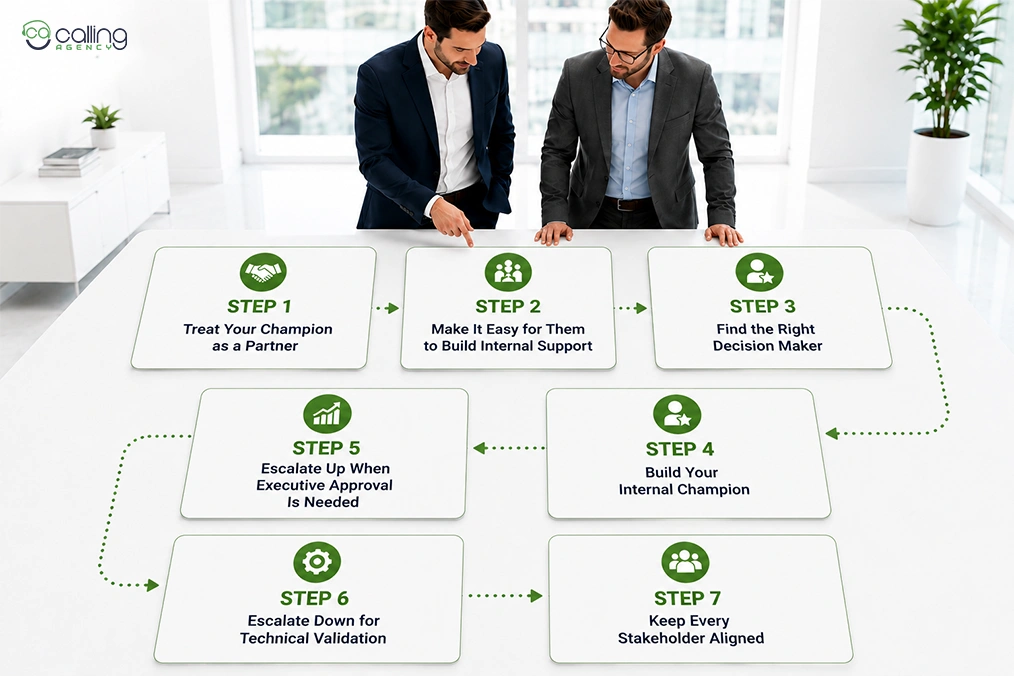
Multithreading doesn’t mean going around your champion. It means helping them build support across the buying committee. The best champions don’t want to carry the deal alone—they want help getting the right people involved at the right time.
Step 1: Treat Your Champion as a Partner
Your champion should feel like they’re leading the project, not being replaced. Before reaching out to anyone else, ask a simple question like, “Who else should we involve to get this approved without slowing things down?” This keeps them in control while helping you identify the next stakeholder.
Step 2: Make It Easy for Them to Build Internal Support
Don’t expect your champion to explain your solution to everyone else. Give them something they can easily share, such as a one-page business case, an ROI summary, a security overview or answers to common compliance questions. The easier you make their job, the more likely they’ll keep pushing your deal internally.
Step 3: Find the Right Decision Maker
Don’t start with the highest ranking executive. Start with the person whose problem your solution solves.
- Selling developer tools, APIs or engineering platforms? Start with the CTO.
- Selling enterprise IT, cybersecurity, cloud or MSP services? Start with the CIO.
- Selling endpoint management, monitoring or IT operations tools? Start with the IT Director.
Getting the right first conversation makes the rest of the sales process much easier.
Step 4: Build Your Internal Champion
Once you’ve found the right contact, focus on understanding their goals and challenges. Your champion is the person who believes in your solution and helps move the deal forward internally.
Keep them updated throughout the sales process. If they feel included, they’re more likely to advocate for you when other stakeholders get involved.
Step 5: Escalate Up When Executive Approval Is Needed
As the deal grows, you’ll usually need executive approval.
Bring in the CIO, CTO, or CFO when:
- The deal exceeds your champion’s approval limit.
- Executive sponsorship is needed to move the project forward.
- Procurement requests a business case or ROI justification.
Step 6: Escalate Down for Technical Validation
Executive support alone isn’t enough. The teams responsible for implementation also need confidence in your solution.
Bring in the IT Director, infrastructure team, or engineering leads for IT when:
- Technical validation is required.
- Implementation planning begins.
- Security or operations teams need to review the solution.
This helps prevent delays during implementation and security reviews.
Step 7: Keep Every Stakeholder Aligned
As more people join the buying committee, keep everyone working toward the same goal. Share updates, confirm evaluation criteria and make sure each stakeholder understands their role in the buying process.
Most importantly, tell your champion before involving someone else.
A simple message like “I’d like to bring the CIO into the conversation so we can move this project forward faster” helps them feel included instead of bypassed.
The strongest enterprise sales teams don’t rely on a single contact. They build relationships across the buying committee while keeping their champion informed from the first meeting to the final signature.
Outreach Hook Library
You need to stay up to date with Technology Trends to convert the lead. But at a glance, you can keep in mind these hooks-
| Persona | Subject Line | Opening Line | CTA | Goal |
| CTO | Mention a technical challenge or roadmap decision. | Reference a recent blog, conference talk, product launch or open source contribution. | Invite them to a technical discussion around a specific engineering challenge, not a product demo. | Secure a discovery call focused on technical fit and architecture. |
| CIO | Highlight a business outcome or mention results from a similar company. | Reference a digital transformation initiative, compliance requirement or other strategic business priority. | Offer a strategic conversation focused on business value, ROI, or long-term IT goals instead of a demo. | Secure a discovery call with an executive-level discussion. |
| IT Director | Mention an operational challenge or a tool they already use. | Show you understand their IT environment by referencing their technology stack. | Offer a hands-on demo or proof of concept (POC) using their real infrastructure. | Secure a discovery call that leads to a product trial or technical evaluation. |
FAQ
Does the CTO or CIO have more decision-making authority?
It depends on the company. In product-led and SaaS companies, the CTO often outranks the CIO. In traditional enterprises, the CIO owns technology purchasing authority. Foundry’s 2026 State of the CIO report shows 45% of CTOs report to the CEO versus 23% of CIOs, signaling a shift toward CTO authority in tech-forward orgs.
Who reports to whom between CTO, CIO and IT Director?
In traditional structures, the IT Director reports to the CIO. In most enterprises, the CIO and CTO both report to the CEO. Reporting lines vary in practice. CTOs increasingly report directly to the CEO in product-led companies. IT Directors sometimes report to a COO in orgs without a CIO.
What is the difference between a CIO and an IT Director?
The CIO sets enterprise technology strategy and owns purchasing authority. The IT Director runs operational IT, infrastructure, help desk and daily systems. Smaller orgs often collapse the two roles into one. Sellers pitching operational tools reach IT Directors. Sellers pitching strategic platforms reach CIOs.
Do all companies have a CTO, CIO and IT Director?
No. Companies under 500 employees typically have one technology leader wearing multiple hats. Mid market orgs of 500 to 5,000 employees usually split CIO and IT Director. Enterprise orgs above 5,000 run all three plus adjacent CISO, CDO and Chief Digital Officer roles. Company size is the strongest predictor.
Should I pitch the CTO or CIO first?
Match the buyer to your product category. If your product is developer-facing or engineering infrastructure, open with the CTO. If it’s an enterprise IT platform touching business operations or compliance, open with the CIO. If it solves an operational pain like ticketing or endpoint management, open with the IT Director. Escalate up or down based on deal size and buying committee structure.