


Call reluctance is a recurring behavioral pattern. A salesperson delays, avoids or reduces prospecting activity even when steady outreach is needed. It can look like fear. More often it shows up as over-preparation, endless research, repeated script edits or selective calling. Sometimes it means spending the call block on easier admin work.
The fix has four steps. Name the exact avoidance behavior. Lower the pressure on each call. Prepare a flexible talk track. Then protect a calling block and run it the same way each day. Confidence usually grows through preparation and repeated action. Waiting to feel fully confident before dialing tends to keep the avoidance cycle going.
For sales managers, the answer is not telling reps to “make more calls.” Good coaching combines clear expectations, accurate prospect data, realistic role-play, call reviews, supportive accountability and recognition for controllable behaviors.
Key Takeaways
- Call reluctance is a behavioral pattern, not a lack of talent. It often appears as procrastination, excessive research, script rewriting, selective dialing or avoided follow-ups.
- Find the specific cause before choosing a fix. Fear of rejection, poor preparation, perfectionism, weak prospect data and an unnatural script each need a different response.
- Do not wait to feel confident before calling. Confidence usually develops after repeated, hands-on practice, not before it.
- Use a flexible talk track instead of memorizing every word. Prepare the opening, reason for calling, discovery questions, common objections and next-step request.
- Schedule protected calling blocks with controllable goals. Aim to complete a set number of dials or conversations rather than judging success only by meetings booked.
- Rehearse difficult moments through realistic role-play. Practice interruptions, objections, short answers and unexpected questions, not just ideal conversations.
- Review real calls and improve one skill at a time. Specific feedback beats broad instructions such as “sound more confident.”
- Check the sales system before blaming the rep. Poor data, unclear targeting, weak tools or a weak offer can create or worsen call reluctance.
- Pair support with accountability. Clear expectations, private coaching, useful call reviews and regular follow-up help reps improve without shame.
- The goal is not to remove every uncomfortable feeling. The goal is a reliable process that lets salespeople act even when hesitation appears.
What Is Call Reluctance in Sales?
Call reluctance is a recurring behavioral pattern in which a salesperson hesitates to start contact with prospective buyers.
The rep may know the product, understand the target market and communicate well once a conversation starts. The trouble appears before the conversation. It shows up when starting the calling block, picking the next number, following up after rejection or reaching a senior decision-maker.
The term comes from sales psychologists George Dudley and Shannon Goodson. Their research framed call reluctance as the emotional hesitation to initiate contact, not simple fear of the phone. They identified 12 distinct types and built a diagnostic in 1982 to measure them. Their work also found that most salespeople experience at least one form during their careers.
This distinction matters. Call reluctance is not the same as being afraid to speak on the phone. A rep can sound calm and professional on calls while still making far fewer dials than planned. Another rep may complete the planned activity but feel real nerves before every dial.
The first case is mainly behavioral avoidance. The second may involve anxiety. The two can overlap, but they are not the same.
Understanding what cold calling is can lower some of the pressure. A cold call is not meant to close an entire sale. Its first job is to test fit, learn whether a possible need exists, and agree on a sensible next step.
What Are the Signs of Call Reluctance?
Call reluctance often hides behind activity that looks productive. Common signs include:
- Delaying the start of a scheduled call block
- Researching each prospect longer than needed
- Rewriting the same opening again and again
- Calling only familiar or junior contacts
- Avoiding follow-up calls after a hard conversation
- Spending call time on email or CRM admin
- Waiting for a “better time” without defining when
- Dialing inconsistently despite having enough leads
- Turning unusually critical of the script, list, offer or tools right before calling
One slow day does not always signal a lasting problem. Managers should look for a repeated gap between planned and completed outreach. This is clearest when poor data or technical issues have already been removed.
Why Do Salespeople Become Reluctant to Call?
Call reluctance has no single cause. Different salespeople can show the same avoidance for very different reasons.
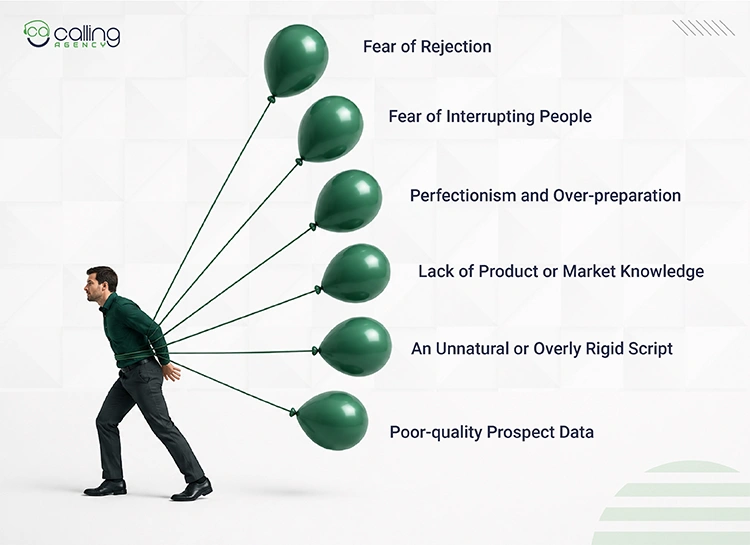
Finding the real cause is the key step, because the wrong fix can make things worse. Dudley and Goodson catalog 12 separate types. The groupings below cover the causes managers see most often.
Fear of Rejection
A flat “no,” a sharp reply or a hang-up can feel personal, especially to a new rep. When salespeople read every negative response as a judgment of their ability, each call carries too much weight.
A better reading is that the response gives information.
The prospect may not have the problem. They may not own it. They may already use another provider, hold different priorities, or simply be busy when the call lands.
None of that defines the rep’s personal worth or long-term ability.
Review rejection for useful feedback. Do not treat it as a verdict on the caller.
Fear of Interrupting People
Some reps hesitate because they think every unsolicited call is an unwelcome interruption. This is common among thoughtful people who do not want to pressure anyone.
The fix is not to grow less respectful. It is to make the call clearer, shorter, and permission-based.
A prepared caller can explain why they are reaching out, show a possible fit, give the prospect room to answer, and end the call well when there is no match.
A cold call can be direct without being aggressive.
Perfectionism and Over-preparation
Preparation becomes avoidance when another ten minutes of research no longer changes the likely quality of the conversation.
A rep may feel they are getting ready while quietly avoiding the uncertainty of a live conversation. They keep adding notes, rereading the company website, or rewriting questions because prep feels safer than action.
A firm research limit usually helps more than extra encouragement.
Before each call, a salesperson often needs to know only:
- The prospect’s role
- The company’s likely needs
- One business trigger that fits
- Why the offer could matter
- The next step to ask for
The cold calling prospecting process works when research, preparation, calling, qualification, and follow-up run as connected stages. Letting research eat the whole workflow stops the system from producing real conversations.
Lack of Product or Market Knowledge
Some reps avoid calling because they cannot confidently explain the offer, name the problem it solves, or answer common questions.
This is a training gap, not a motivation gap.
Managers can test for it directly. Ask the rep to:
- Explain the offer in plain language.
- Describe the ideal customer.
- Give two examples of business problems it solves.
- Explain the normal next step.
- Answer several common prospect questions.
Hesitation during this exercise shows where coaching is needed.
The rep does not need every detail. They do need to understand the customer, the problem, the value proposition, and the purpose of the call.
An Unnatural or Overly Rigid Script
A word-for-word script creates another problem. The rep starts worrying about remembering every sentence.
When the prospect answers in an unexpected way, the salesperson loses their place and grows more anxious.
A stronger talk track holds conversational landmarks instead of a full speech. These landmarks include:
- Opening
- Reason for calling
- Relevance statement
- Discovery question
- Common objections
- Next-step request
Reviewing cold call script examples can show a team how good scripts are built. The final version should still match the real offer, the audience and the caller’s natural speaking style.
Poor-quality Prospect Data
Call reluctance can be a rational response to a bad list.
Outdated numbers, wrong job titles, duplicate records, and off-profile companies create a steady stream of dead calls. Repeated failure then teaches the salesperson to expect another poor outcome.
Before diagnosing a mindset problem, managers should check the data.
Compare valid contact rates, target accounts, live conversations, and outcomes across the team. If several reps struggle with the same list, targeting or data quality may be the real issue.
Salespeople should answer for completing their work. Leadership should answer for giving them a workable audience and process.
What Is the Difference Between Call Reluctance and Call Anxiety?
Call reluctance is the repeated avoidance of starting sales activity. Call anxiety is the emotional or physical discomfort that appears before or during a call.
Call reluctance often produces:
- Procrastination
- Selective dialing
- Excessive preparation
- Incomplete activity
- Avoidance of senior prospects
Call anxiety may produce:
- A tense voice
- Racing thoughts
- Shallow breathing
- Difficulty listening
- Trouble remembering the opening
A salesperson can face either one or both.
The fixes overlap, but the emphasis differs. Reluctance usually needs behavioral structure and accountability. Anxiety may need preparation, gradual exposure, calming techniques, and a safe space to practice.
Reps who are unsure whether their discomfort is normal can review this discussion about becoming more comfortable making cold calls.
When phone anxiety is severe, lasts outside sales activity or affects daily life, professional support may help. A sales manager can coach at work, but should not try to diagnose a health condition.
How Do You Overcome Call Reluctance?
This process targets both the behavioral and the practical causes of call reluctance.
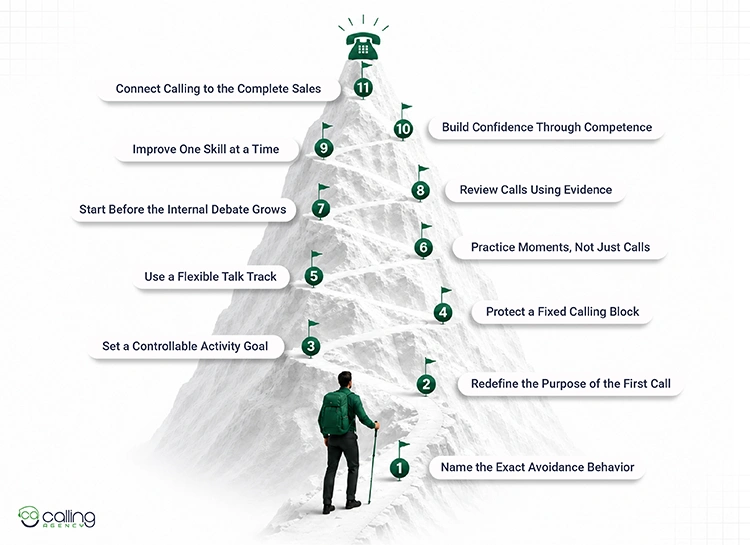
1. Name the Exact Avoidance Behavior
Do not stop at a broad line such as “I hate making calls.” Describe what actually happens.
For example:
- “I research for forty minutes before the first dial.”
- “I avoid senior decision-makers.”
- “I stop calling after one rude response.”
- “I rewrite my opening every morning.”
- “I complete follow-ups but skip new prospects.”
A precise description turns a vague worry into a behavior a manager can coach.
It also blocks the wrong fix. Someone short on product knowledge needs training. An over-preparer needs a time limit. Someone uneasy with senior contacts needs gradual practice at higher levels.
2. Redefine the Purpose of the First Call
A first call is not a demand for an immediate purchase. It is a short attempt to learn whether a real business problem exists and whether a longer conversation would help.
This reframing lowers the pressure on the rep and improves the prospect’s experience.
The salesperson no longer needs a flawless presentation. They need enough attention to ask a good question, hear the answer, and decide whether the next step makes sense.
Modern cold calling techniques work best when built around fit, curiosity, and discovery, not a long product monologue.
3. Set a Controllable Activity Goal
During a calling block, use a goal the rep can fully control.
Examples include:
- Complete 25 dials
- Reach five live conversations
- Ask the main discovery question in every qualified conversation
- Make all scheduled follow-up calls
- Test one opening across a set number of calls
“Book three meetings” can work as a weekly target. The rep cannot fully control another person’s decision during one session.
An activity goal gives the caller a clear finish line. It also lowers the urge to judge each call as a full success or failure.
4. Protect a Fixed Calling Block
Call reluctance grows stronger when prospecting is left to open time.
When calls can always happen later, messages, emails, research, and admin keep taking priority.
Pick a workable calling block and prepare the list before it starts. During the session:
- Close unrelated browser tabs.
- Silence non-urgent notifications.
- Keep the talk track in view.
- Open the first prospect record early.
- Start at the agreed time.
- Skip checking email between calls.
For a new or highly reluctant rep, two shorter sessions can beat one long block. The aim is to build a habit, not to make the work feel like punishment.
A cold calling checklist can remove avoidable decisions and make the routine repeatable.
5. Use a Flexible Talk Track
A good talk track should help the rep answer six questions:
- Who am I?
- Why am I contacting this person?
- Why could this matter to them?
- What question will start a useful conversation?
- How will I respond to common concerns?
- What next step will I ask for?
The language should be simple enough to say naturally.
Read the talk track aloud and cut anything that sounds like marketing copy. Prepare short transitions instead of full paragraphs. The rep should know the structure well enough to listen rather than worry about the next line.
A talk track is a safety net. It is not a performance that must land perfectly.
6. Practice Moments, Not Just Calls
Generic role-play often fails because the participants are too cooperative.
Realistic practice should include interruptions, uncertainty, short answers, objections, and unexpected questions.
Practice the first 30 seconds several times. Then rehearse responses to lines such as:
- “We already have a provider.”
- “Send me some information.”
- “I’m not the right person.”
- “We do not have the budget.”
- “Why are you calling me?”
- “I only have one minute.”
The goal is not to memorize aggressive rebuttals. It is to stay calm, acknowledge the concern, ask a good question, and know when to continue or exit.
Cold calling training works best when it combines explanation, demonstration, rehearsal, live application, and follow-up coaching.
7. Start Before the Internal Debate Grows
The gap between deciding to call and making the first dial is where avoidance often takes over.
Use a simple action sequence:
- Sit down at the scheduled time.
- Open the prepared list.
- Review the session goal.
- Read the opening once.
- Count down.
Do not add more preparation after the scheduled start.
The first call does not have to be the top account on the list. It can be a suitable prospect that helps the rep find the rhythm of conversation.
Speed should never replace research, good judgment, or compliance. Its job is to stop repeated hesitation after the prep is done.
8. Review Calls Using Evidence
After an uncomfortable conversation, salespeople often decide “that call was terrible” without naming what happened.
A short, simple review replaces that vague judgment with useful evidence.
Ask:
- Was the opening clear?
- Did the reason for calling fit the prospect?
- Was the value statement short?
- Did the rep ask a good question?
- Did they listen to the answer?
- Where did the conversation lose direction?
- What should be repeated next time?
- What should change?
Review a balanced sample of strong, average, and weak calls.
Focusing only on failures makes coaching feel punitive. Focusing only on wins hides the skills that still need work.
Call reviews should produce one or two clear actions, not a long list of criticisms.
9. Improve One Skill at a Time
Trying to fix tone, pacing, objection handling, discovery, qualification, product knowledge, and closing at once can overwhelm the rep.
Choose one focus for each coaching cycle.
For example:
- Week one: starting the call block on time
- Week two: delivering a short opening
- Week three: asking the first discovery question
- Week four: responding to “send me information”
- Week five: asking for a clear next step
This step-by-step method reflects the wider principles used to improve cold calling skills: focused practice, useful feedback, and repeated reps.
10. Build Confidence Through Competence
Lasting confidence is usually built on skill rather than pep talks.
Core calling skills include:
- Active listening
- Concise communication
- Emotional control
- Curiosity
- Preparation
- Qualification
- Note-taking
- Objection handling
- Regular follow-up
A strong caller does not need a loud or aggressive personality. Many effective salespeople win because they are prepared, attentive, calm, and able to explain value clearly.
Teams can use this overview of the skills effective cold callers need to build a development plan instead of treating confidence as a fixed trait.
11. Connect Calling to the Complete Sales
Reps call more steadily when they see what happens after a good conversation.
Show how each stage connects:
- Prospect selection
- Initial outreach
- Discovery
- Qualification
- Appointment setting
- Follow-up
- Sales conversation
- Closing or nurturing
A phone call is not an isolated performance. It is one stage inside a larger outbound sales process.
Companies without the capacity to build this process in-house can examine professional cold calling services. The page shows how targeting, trained callers, qualification, reporting, and pipeline handoff operate as one managed campaign.
What Is a Good Pre-Call Routine?
A good pre-call routine should cut uncertainty without turning into another form of avoidance.
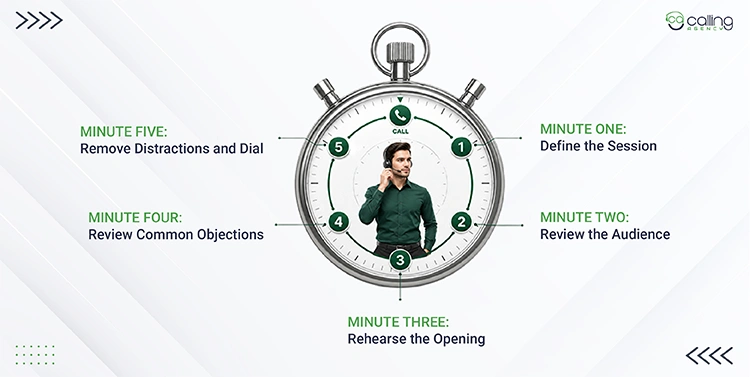
The routine below takes about five minutes.
Minute One: Define the Session
Write down:
- Start time
- End time
- Prospect list
- Activity target
- Coaching focus
Minute Two: Review the Audience
Confirm the prospect’s role, the likely business problem, how the offer fits, and the next step.
Do not start a new research project.
Minute Three: Rehearse the Opening
Say the opening and first question aloud. Replace any phrase that feels unnatural or hard to say.
Minute Four: Review Common Objections
Read short responses to the two or three concerns most likely to come up. Aim to understand the response, not memorize every word.
Minute Five: Remove Distractions and Dial
Open the first record, close unrelated tools, and start the session.
For a fuller explanation of preparation, openings, discovery, and objection handling, read this guide on how to successfully cold call.
How Should Sales Managers Address Call Reluctance?
Managers shape whether call reluctance improves or spreads across the team.
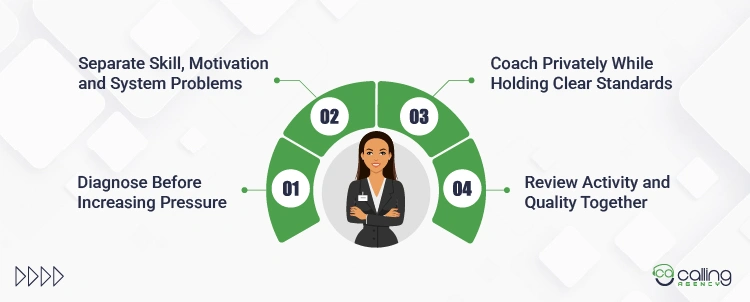
Diagnose Before Increasing Pressure
Review the rep’s activity, listen to several calls, inspect the prospect list, and discuss what happens just before the avoidance begins.
Do not assume the salesperson is lazy or uncommitted.
Separate Skill, Motivation, and System Problems
A skill problem means the rep does not know how to perform part of the call.
A motivation or execution problem means the rep knows the process but keeps choosing not to complete it.
A system problem includes poor data, unclear targeting, weak tools, a weak offer, unrealistic expectations, or conflicting priorities.
These can overlap, but separating them helps leadership pick the right response. Training cannot repair a bad list, and pressure cannot replace missing skills.
Coach Privately While Holding Clear Standards
Call reluctance can cause embarrassment. Public criticism may make the rep more defensive and less willing to practice.
Address the issue privately, define the expected behavior, agree on a measurable plan, and follow up regularly.
Support does not mean removing accountability. The rep should know both the performance standard and the help on offer to reach it.
Review Activity and Quality Together
Dial volume alone can reward rushed, low-quality outreach. Call quality alone can hide avoidance. Managers should review both.
Measures to watch include:
- Planned versus completed calls
- Live conversations
- Qualified conversations
- Qualified next steps
- Follow-up completion
- Opening quality
- Discovery quality
- Data accuracy
- Progress on the current coaching focus
Measurement should show where the process is improving or breaking down. It is not just another source of pressure.
What Mistakes Keep Call Reluctance in Place?
Several common responses keep call reluctance going. Each looks helpful, but reinforces the pattern it should break.
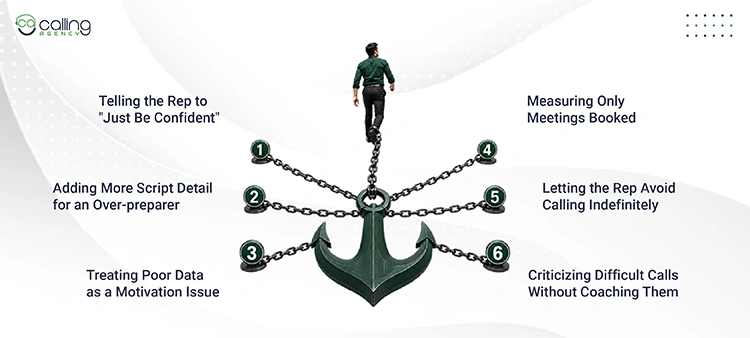
Telling the Rep to “Just Be Confident”
Confidence usually follows preparation, skill, and experience. It is not a switch someone flips on command.
Give the rep a concrete action instead of a vague instruction.
Adding More Script Detail for an Over-preparer
More information can deepen the avoidance pattern. Set a preparation limit and define the minimum viable talk track.
Treating Poor Data as a Motivation Issue
Salespeople should answer for their activity. Leadership must supply accurate data, sensible targeting, suitable tools, and a suitable offer.
Measuring Only Meetings Booked
When only final outcomes earn recognition, every call feels like a pass-or-fail test. Managers should also reward controllable actions and gains in call quality.
Letting the Rep Avoid Calling Indefinitely
Replacing every call with email may ease short-term discomfort, but it does not build the missing skill.
A better path is gradual exposure: hands-on practice, smaller calling blocks, realistic role-play, and slowly harder prospects.
Criticizing Difficult Calls Without Coaching Them
Pointing out that a call failed does not teach the rep what to do differently.
Feedback should name a specific moment, explain its effect, show a better response, and let the salesperson practice it.
How Long Does It Take to Overcome Call Reluctance?
There is no universal timeline.
Improvement depends on:
- The underlying cause
- How long has the behavior existed
- The rep’s skill level
- The quality of the prospect list
- The frequency of coaching
- How regularly they practice
- Whether the wider sales process works
A rep with a weak opening may improve after a few focused sessions. Someone with a long-standing avoidance pattern may need several weeks of protected calling blocks, review and gradual exposure.
The best signal is not whether the rep says they feel confident.
Instead, track whether they:
- Begin calling on time
- Complete the planned activity
- Recover after hard conversations
- Reach the full target group
- Use the agreed talk track
- Apply feedback over time
- Improve the quality of their conversations
Confidence can swing from day to day. Observable behavior gives a steadier measure of progress.
When Should a Business Outsource Cold Calling?
Outsourcing cold calling can fit when a company:
- Lacks internal calling capacity
- Needs to test a new market
- Cannot recruit or manage an SDR team
- Wants more regular prospecting activity
- Wants closers to focus on qualified conversations
- Needs a documented outbound process
- Needs more campaign reporting and oversight
Outsourcing should not hide an unclear offer or an undefined ideal customer profile. An outside provider still needs clear positioning, accurate targeting, qualification criteria and regular feedback from the client.
Even teams that keep calling in-house can learn from an outside process. It may reveal missing pieces such as list preparation, script testing, quality monitoring, reporting or regular follow-up.
Frequently Asked Questions
What is the fastest way to overcome call reluctance?
Name the exact avoidance behavior, prepare a short talk track, set a controllable activity goal, and start a protected calling block at the same time each day. Repeated action plus short, specific call reviews build confidence more reliably than waiting to feel motivated.
Is call reluctance the same as fear of cold calling?
No. Call reluctance is a recurring pattern of avoiding or reducing prospecting activity. Fear or anxiety is the emotional discomfort felt before or during a call. They can occur together, but call reluctance can also come from perfectionism, weak preparation, poor prospect data, unrealistic targets, or discomfort with the sales role.
Can experienced salespeople develop call reluctance?
Yes. Experience does not make someone immune to avoidance. An experienced rep’s behavior can shift for several reasons. A new market, unfamiliar offer, weak list, unrealistic target or run of negative calls can all do it. Experienced reps may also hide reluctance through heavy preparation or by working existing relationships instead of new outreach.
Should salespeople use a cold calling script?
Yes, but the script should guide the conversation rather than control every sentence. It should hold the opening, reason for calling, relevance statement, discovery questions, responses to common concerns, and next-step request. The rep should practice it until the structure feels familiar and the wording sounds natural.
How can a manager tell whether the problem is confidence or lead quality?
Compare results across the team and inspect the prospect data. If several reps hit invalid numbers, wrong accounts, bad contacts or unusually low connect rates, the list may be the main problem. If one salesperson avoids calls while colleagues hold normal conversations from the same list, individual coaching may be needed. Both problems can exist at once.
Should managers require a minimum number of calls?
A minimum activity standard can support steadiness, but it should reflect the market, call complexity, prospect quality, campaign goal, and the tools in use. Managers should pair volume targets with conversation quality, qualification, follow-up, and outcomes. A raw dial target without quality standards can reward rushed or off-target activity.
What should a salesperson do after a rude response?
End the interaction well, record any useful details, and move to the next suitable prospect. Do not spend the rest of the calling block replaying the conversation. A brief check may surface something useful, but long rumination gives one too much influence.
What if a salesperson freezes when the prospect answers?
Practice the first 30 seconds until the sequence feels familiar. Keep the opening and first question in view, slow the speaking pace, and focus on the prospect’s response. Realistic role-play can prepare the rep for interruptions and surprise questions. The aim is not to remove every nervous feeling. It is to make the next action clear even when nerves appear.
Does making more calls always solve call reluctance?
No. Repetition helps when paired with the right targeting, a usable talk track, realistic expectations, and useful feedback. Repeating a broken process can deepen negative expectations instead of building confidence. Diagnose the barrier first. Then use a set routine to build familiarity and evidence.
Can call reluctance be permanently overcome?
Call reluctance can be cut down and managed through steady habits. A salesperson may still feel occasional hesitation when entering a new industry, launching a new offer or reaching an important account. Success does not require the permanent absence of discomfort. The goal is a process that stops temporary discomfort from controlling behavior.
Final Answer: What Actually Works?
Call reluctance improves when salespeople stop treating confidence as a prerequisite and start treating calling as a trainable process.
The working formula is simple:
- Name the exact avoidance behavior.
- Confirm the list, offer, tools, and expectations are workable.
- Prepare a short, flexible talk track.
- Set a controllable activity goal.
- Protect a steady calling block.
- Practice difficult moments before they happen.
- Review real calls using specific evidence.
- Improve one skill at a time.
- Hold accountability without humiliation.
- Repeat until starting becomes routine.
A salesperson does not need to enjoy every dial to do well. They need a clear reason to call, a prospect that fits, a manageable next step and enough supported repetition to replace uncertainty with skill.
Call reluctance is not a character flaw. It is a behavioral pattern. Patterns change through better systems, focused coaching and steady action.