


Cold calling prospecting has been one of the most effective outreach channels for a long time in the B2B industry. By the time cold calling prospecting faced several rumors due to its low success rate, competitive marketplace & many more negative things. Even though cold calling prospecting is being used by top giant B2B companies till now & the market cap is increasing every year.
According to the RAIN Group, “almost 82% B2B buyers accept meetings with sellers who actively reach out to the prospects.” So this stat shows enough promise that cold calling prospecting can be effective.
But remember, cold calling does not work if you call someone randomly. It works when you understand the prospects, prepare the right message, ask qualification questions, and adapt the conversation according to the buyer’s intent.
In this guide, we will break down the complete anatomy of cold calling prospecting, from research and preparation to scripts, objections, follow-ups, and booked meetings.
What Is Cold Calling Prospecting?
Cold calling prospecting is a strategic process to identify potential customers and then contact them through a phone call. It can happen often through an in-house sales team or an outsourced cold calling service, even if the prospect has never heard or interacted with your or your company you are calling for. It is a “cold” interaction because the recipient is not expecting your call and has not expressed interest in your product or service.
Why Cold Calling Still Works for Prospecting?
Cold remains highly effective in recent times, even with the revolution of AI automation. Cold calling with an expert agent creates trust during conversation, identifies the pain point of the prospect, and then offer solution what they are looking for.
Let’s see some reasons why cold calling prospecting still works:
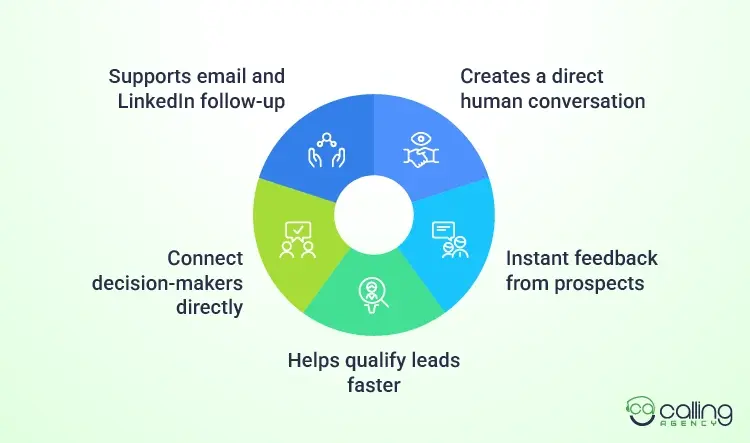
- It creates a direct human conversation
- Gives instant feedback from prospects
- Helps qualify leads faster
- It can reach decision-makers directly
- Supports email and LinkedIn follow-up
Although the average success rate of cold calling is 2% to 3% but, it returns huge results with this tiny number of successes for the B2B and B2C industry.
According to Business Research Insights, the outsourced telemarketing market cap in 2026 is $11.86 Billion*, and the total call center outsourcing market is $128.69 Billion*. So those numbers are answering why cold calling works for prospecting.
Cold Calling vs Prospecting
Cold calling and prospecting are connected with each other, but they are not the same thing. Prospecting is a complete process of finding and identifying potential customers, and cold calling is dialing a prospect’s number who might have no prior idea about your business. Both of them together create a smooth lead generation and appointment setting process.
Key Difference Between Cold Calling and Prospecting:
| Feature | Prospecting | Cold Calling |
| Scope | A broad strategy that includes research, list building, qualification, and outreach across multiple channels. | A specific outreach tactic where prospects are contacted by phone. |
| Preparation | High. It involves ICP research, data collection, segmentation, and lead qualification. | Moderate to high. It requires a quality lead list, call script, prospect context, and objection-handling preparation. |
| Pace | Long-term and funnel-focused. | Immediate and conversation-focused. |
| Scalability | High, especially with CRM tools, automation, data platforms, and multichannel outreach. | Moderate. It can scale with SDR teams, dialers, and outsourcing, but still depends on human calling capacity. |
| Success Rate | Depends on channel quality, targeting, offer, and how warm the prospect is. | Usually lower than warm outreach, but can perform well with strong targeting, timing, and call execution. |
You can use cold calling for prospecting, and at this time, you can say cold calling prospecting. Prospecting is a broad term, and cold calling is an outreach channel.
The 3 Core Elements of Successful Cold Calling Prospecting
Cold calling prospecting is a common B2B lead generation process, but this process is divided into three core parts or elements. Let’s talk about those three elements.
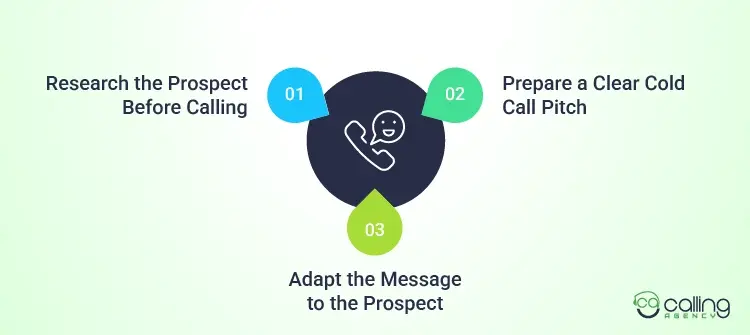
1. Research the Prospect Before Calling
Cold calling is only cold if you know nothing about the prospect you are calling. You as agent should research properly about the prospect, like you can go through the website if your prospect or their business has one, analyze social media profiles, CRM data, etc., while in conversation, if you address them by their name, mention their role or current business pain or campaign, they will feel related and things will become easier to drive them towards your sales funnel.
- The 3×3 Rule: spend three minutes to find key facts about the prospect or their company.
- What to look for: Recent company news (mergers, product launches), their specific job responsibilities on LinkedIn, or shared connections.
- The Goal: Prove within the first 10 seconds that you have not just dialed their number, but rather you have proper preparation and knowledge about their business.
You can this 3×3 rules to research the prospect before calling.
2. Prepare a Clear Cold Call Pitch
Pitching your sales on cold calling is very important, but not always. Cold should be dedicated to building rapport, and sales possibilities will come automatically. Let’s see how you can build rapport and pitch your sales on cold calling.
- The Hook: Hook means acknowledge the prospect’s interruption and state your call purpose within the first 10 seconds naturally.
- The Value Proposition: The value proposition is the heart of cold calling prospecting. It means how your service or product can mitigate the prospect’s problems.
- The Call to Action (CTA): Then, at the end, ask the prospect for further process with a smooth CTA. Don’t be too pushy for meetings.
While in conversation, notice carefully about prospects’ symptoms; if things go against you, most probably your value proposition is not strong enough. Take them as feedback and improve your value proposition for better results.
3. Adapt the Message to the Prospect
Your prospects are not all the same, even your are calling 2 person from the same company, their role might be different. A CEO will care more about ROI, and a manager will care more about workflow and operations.
- Listen for tone: Your prospect may sound rushed/busy or clipped, so listen to them carefully and build a quick rapport.
- Pivot on objections: If the prospect responds with an objection, treat them as data points, not rejection.
- Speak their language: Use industry-specific words that they are used to, so you also sound like a peer, not a solicitor.
You should know how to enjoy cold calling. Once you start doing it, your performance will get on the pick, because cold calling is about a sea of rejections. Catching your prospect’s situation, pain points, maintaining your tone during conversation, and handling objections altogether get you a successful call in prospecting.
Cold Call Prospecting Script
Let’s take a look at some samples of different types of cold calling prospecting below.
Simple Cold Call Prospecting Script Example
Opening
Hi {{Name}}, this is {{Your Name}} from {{Company}}. I know I am calling out of the blue, so I will be brief.
Reason for Calling
We work with {{type of companies}} that are trying to {{solve specific problem}}.
Relevance Line
I noticed your company {{context/research point}}, so I thought it might be worth a quick conversation.
Discovery Question
Are you currently looking for ways to improve {{specific area}}?
Value Proposition
We help companies like yours {{specific result}} without {{common pain/problem}}.
Meeting Ask
Would it make sense to schedule a quick 15-minute call to see if this is relevant?
Cold Call Script for B2B Prospecting
Hi {{Name}}, this is {{Your Name}} from {{Company}}. We help {{industry/company type}} generate more qualified sales conversations with {{target buyers}}. I saw that your team works with {{specific market}}, and I wanted to ask, are you currently trying to improve your outbound pipeline or appointment volume?”
Cold Call Script for Follow-Up Prospecting
Hi {{Name}}, this is {{Your Name}}. I reached out earlier because we help {{company type}} with [problem]. I know timing may not be right today, but I wanted to quickly ask if this is something your team is planning to review this quarter.
How to Build a Cold Calling Prospecting List
A strong cold calling prospecting list begins with the analysis of the prospect profile, pain point, interest, role, and other relevant information. So instead of calling random prospects or businesses, define your ideal customer profile(ICP) first. This includes the types of company, industry, size, location, pain points, buying authority, and interest.
Start by choosing the target industries that fit your offer. Then narrow the list by company size, revenue range, employee count, service area, or business type. Location also matters, especially if your service depends on local markets, time zones, state rules, or territory coverage.
After that, identify the right decision-maker roles inside each company. These are the people who can measure your offer, approve a meeting, or influence the buying process. Your list should include verified names, job titles, direct phone numbers when available, company phone numbers, email addresses, LinkedIn profiles, and basic company details.
Before calling, remove poor-fit companies that are too small, outside your service area, already using a competing solution you cannot replace, or unlikely to have the budget. Finally, segment the list before outreach, so your script, offer, and opening line match each prospect group.
Decision-Maker Roles to Target:
- Founder
- CEO
- President
- Owner
- Sales Director
- Marketing Director
- Operations Manager
- Procurement Manager
- Department Head
- Practice Manager
- Facility Manager
- IT Director
Adjust based on the industry.
How to Research Prospects Before a Cold Call?
When it comes to B2B sales, your pre-call preparation is the key to successful cold calling. If you hurry to make a call but you know nothing about the prospect, the result will be easy to accept for you. As a cold caller, you research the prospect before the call. The question now arises: what to research? Let’s show you some of the most important things that must be researched in the list below.
- LinkedIn profile
- Company website
- Recent funding
- Hiring activity
- New locations
- Product launches
- Industry events
- Competitor activity
- Technology stack
- Reviews or public complaints
The goal is not to spend one hour researching every prospect. The goal is to find one or two useful details that make the call relevant.
Best Questions to Ask During Cold Calling Prospecting
In the B2B generation process, lead qualification is one of the most important parts. During conversion, you can ask some questions to the prospect for prequalification, so while meeting with your SDRs, they do not find them unfit for your service or business. Cold calling prospecting is perfect for pre-qualification of a lead while outreaching to them.
Sample questions:
- How are you currently handling {{problem}}?
- Is this something your team is actively reviewing?
- What made you consider changing your current process?
- Who is usually involved in this decision?
- What would make a solution worth evaluating?
- Are you looking to improve this now or later?
- What challenges are you facing with your current provider?
- Would it make sense to explore this in a short meeting?
Those questions are most commonly used, but you should build a list of questions after researching the prospect’s profile and find which questions are required to ask.
5 Common Cold Calling Prospecting Mistakes
There are more than 5 five mistakes you can make as a beginner cold caller, but the most common and almost every agent does this mistakes at the beginning of their career. Let’s talk about those core 5 common cold calling prospecting mistakes.
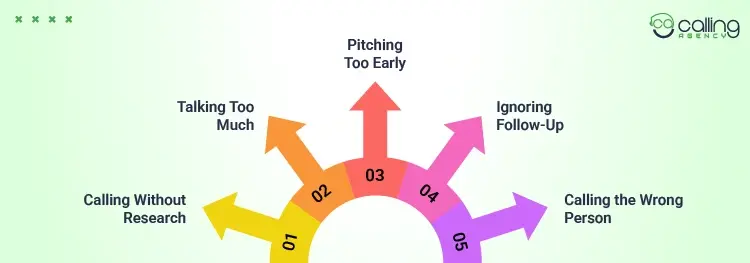
1. Calling Without Research
The most common mistake to avoid in cold call prospecting is calling without research. Let’s imagine what can happen if you don’t research the business or prospect and dial. Prospect can relate to you, and you can not build a rapid rapport. You don’t know which kind of solution they need, what their pain points are, and more.
2. Talking Too Much
2nd most common cold calling prospecting mistake to avoid is talking too much during the conversation. If you keep talking about your product or service and its features, prospects feel annoyed, and they can say anything about their needs. So avoid making this mistake and acknowledge the interruption.
3. Pitching Too Early
Pitching too early is also the most common mistake in cold calling prospecting. Cold calling prospecting should start with a catchy opening, then a value proposition, and a CTA. It has a step-by-step process, but if you start pitching at the opening or too early, then most of the prospects will hang up because of the lack of relevance or rapport.
4. Ignoring Follow-Up
A successful sale through cold calling prospecting, on average, takes 6 to 12 follow-ups. If you ignore follow-up, then your prospect will go to someone else. Most of the prospects are decision makers or C-suite executives, and generally spend busy days. So following up regularly is crucial.
5. Calling the Wrong Person
If you work for or run a health care device company and call an IT firm, your prospect is wrong and unqualified. So your prospect list must be refined. So avoid calling the wrong prospect, or your effort and time will go to waste.
How to Handle Objections in Cold Calling Prospecting
Handling cold calling objections is very important because in this industry, you will hear objections every day. But handling them takes patience and a set of skills. Let’s see what those common cold calling prospecting objections are below.
I am Not Interested
The “I am not interested” objection is common in cold calling prospecting. What you need to do is just acknowledge and ask one quick qualifying question.
Example script of handling the response:
“I am not looking to sell you anything right this second. I only called because we have been helping other {{Job Titles}} in {{Industry}} who were also “not interested” because they already had {{Competitor/Current Process}} in place.”
Send Me an Email
Agree, then ask what would be most relevant to include. When the prospect says, “Send me an email”, you have possibilities to drag them towards your sales funnel if you use this as data, not as rejection.
Example script of handling the response:
I can definitely do that. Usually, I send over our summary on {{Specific Benefit}}, but some people prefer the technical breakdown of {{Feature}}. Which one would be more helpful for your team right now?
We Already Have a Provider
If your prospect says “We already have someone”, then you can ask what your current vendor is doing up to the mark, and try to make the prospect answer this question. If they do, then you can offer that you can do better in that place.
Example script of handling the response:
I am not calling to convince you to go through the headache of switching today. But since it’s been a while since you looked at the market, would it be worth having a “Plan B” on file just to keep your current provider honest on pricing and service?
Now Is Not a Good Time
Ask for a better time or schedule a short follow-up. Sometimes prospects respond “Not a good time” just to hang up in a polite way, but many of them are actually saying it’s not a good time. So ask at the right time and channel and take the preferred contact.
Example script of handling the response:
I apologize, {{Name}}, I caught you in the middle of something. I will be brief: I am calling because {{Brief Value Hook}}. Would it be better if I gave you a shout back tomorrow morning at 10:00, or is there a better time later this week?
What Is This About?
Give a short, direct reason for the call.
Example script of handling the response:
Directly? It’s about how {{Your Company}} is helping {{Industry}} companies like yours solve {{Specific Problem}} specifically by {{Main Benefit}}. I was hoping to learn a bit about how you’re currently handling {{Process}} to see if we can do the same for you.”
Cold Calling Prospecting Follow-Up Strategy
Follow-up plays a significant role in cold calling prospecting because the main goal of your prospecting is to close a deal by setting an appointment with the prospect.
- Add every qualified prospect to CRM
- Set follow-up dates
- Send a short recap email
- Connect on LinkedIn
- Share relevant proof or case study
- Follow up based on timing
- Do not treat “not now” as “never.”
Without a proper follow-up strategy you effort will return nothing. After every call, update CRM with an exact note for the next step outreach.
How to Measure Cold Calling Prospecting Success
If you do not track the output of calls, you will not be able to improve the process and find the issues that are stopping the success. So if possible, weekly or monthly check the following things.
- Calls made
- Connect rate
- Decision-maker conversations
- Qualified conversations
- Meetings booked
- Show-up rate
- Conversion rate
- Follow-up opportunities
- Disqualified prospects
- Cost per appointment
Success should not only be measured by call volume. A smaller number of well-researched calls can often perform better than high-volume random dialing.
Final Thoughts on Cold Calling Prospecting
Cold calling prospecting is often portrayed as a dinosaur of B2B sales. There are some rumors sctteredly spread on the market. Even so, this market is expanding every day, and big companies are outsourcing telemarketing services. For businesses that need faster market feedback, booked meetings, or direct sales conversations, cold calling prospecting can still be a useful channel when done properly.
FAQs
What is cold calling prospecting?
Cold calling prospecting is the process of calling potential customers who have not contacted your business before. The goal is to introduce your offer, qualify interest, and start a sales conversation.
Is cold calling the same as prospecting?
No. Prospecting is the broader process of finding and reaching potential customers. Cold calling is one method of prospecting that uses phone outreach.
Is cold calling prospecting right for every business?
Not every business needs cold calling, but it works well for companies with a clear target audience and high-value sales. It is especially useful for B2B services, local services, SaaS, and appointment-based sales.
Does cold calling still work for B2B prospecting?
Yes, cold calling still works when the list is targeted and the message is relevant. It fails when businesses call random numbers without research or a clear reason for the call.
How do you build a cold calling prospecting list?
Start by defining your ideal customer profile, target industry, company size, location, and decision-maker roles. Then collect verified phone numbers and remove poor-fit companies before calling.
What should a cold call prospecting script include?
A good script should include a short opening, reason for calling, pain point, qualifying question, value statement, and soft CTA. It should guide the call, not sound like a robotic pitch.
How much research should you do before a cold prospecting call?
You should research enough to understand the company, industry, and likely decision-maker. The goal is not deep research on every prospect, but enough context to make the call relevant.
How do you personalize a cold call for different industries or markets?
Mention problems that are common in that industry or market. For example, logistics companies may care about shipping delays, while healthcare companies may care about compliance and patient acquisition.
What is the best time of day to make cold prospecting calls?
Mid-morning and mid-afternoon usually work better than early morning or late evening. The best time can vary by industry, so track pickup rates and adjust based on real call data.
How long should a cold prospecting call last?
A first cold call should usually be short, around 2 to 5 minutes. The goal is to qualify interest and book the next step, not explain the full offer.
How many follow-ups should you do after a cold call?
Most prospects need several touches before they respond. A good sequence includes 3 to 6 follow-ups through calls, voicemail, email, or LinkedIn.
How do you handle rejection during cold calling prospecting?
Do not argue with the prospect. Ask one short clarifying question, respect their answer, and move on if there is no fit. Rejection is part of the process.
What is the difference between a warm call and a cold call in prospecting?
A cold call is made to someone who has not interacted with your business before. A warm call is made to someone who already showed interest, downloaded something, replied before, or was referred.
What is the average success rate of cold calling prospecting?
Success rates vary by industry, list quality, offer, and caller skill. In general, targeted cold calling performs much better than calling broad, unqualified lists.
What metrics should you track for cold calling prospecting?
Track calls made, connect rate, conversation rate, qualified leads, appointments booked, show-up rate, and closed deals. These numbers show where the process is working or breaking.
What tools or CRMs help manage cold calling prospecting efficiently?
A CRM helps track prospects, call notes, follow-ups, and deal stages. Tools like dialers, call tracking software, email sequencers, and data verification tools also make prospecting easier to manage.