

To get invited to a 3PL Request for Proposal (RFP), reach the brand through 3PL lead generation before it writes the brief. Find out what it needs from its next provider. If late shipments are the problem, then suggest comparing each 3PL’s order cutoff times and on-time shipping record.
You need to do this for some RFP templates. Because it recommends inviting 3 to 8 providers after short screening calls. That helps you decide how many providers to shortlist.
But still, your chances of winning depend on how well you meet the brand’s needs.
Since price accounted for 15.9% to 30% of the total score in three published scorecards. If the brand worries about shipping delays during peak season, show the buyer how many orders your warehouse can ship on time on a busy day.
That gives them a way to compare your service alongside your rate.
How Do 3PLs Get Invited to RFPs?
3PLs get invited by being on the brand’s short list before the RFP goes out. They usually go through a pre-qualification call. Once the RFP goes out, you may have to request a place on a list the buyer has already settled.
4 of the 11 brand-facing RFP templates we reviewed in October 2026 gave a recommended invite count:
| Template | Recommended invite list |
| Warehousing and Fulfillment | At least 3 |
| Endless Commerce | 3-5 |
| SmartSMS Solutions | 4-6, pre-qualified on brief calls |
| Legacy Supply Chain Services | 5-8 |
| Odds for a cold bidder | 1 in 3 to 1 in 8, before scoring |
The shortlist tells you how many providers may be invited, but not your odds of winning. So, use the screening call to learn the brand’s-
- Order Volume
- Storage Needs
- Planned Start Date
Then explain what your warehouse can handle.
If the RFP is already out, contact the buyer to see if they’re still accepting proposals. If the brand has a supplier portal, register before the next opportunity.
Because some opportunities never reach an RFP process. You need to be prepared for all kinds of results.
Even in the 2026 3PL Study, just over half of shippers said they don’t rebid the work when contracts end. That’s why it helps to reach out before a formal request goes out.
It’s not just a random guess. We saw this result in the Dillon Logistics freight campaign. We booked 106 appointments, leading to more than 25 active contract discussions. Although this was a freight lead generation campaign rather than a 3PL RFP campaign, it shows how reaching logistics decision-makers can create opportunities for future contracts.
What to Ask on the Pre-Qualification Call
Use the call to learn when the RFP will land and what it will cover. Five questions do most of the work.
- What is driving the search now?
- When does your current contract end?
- Who will score the responses?
- What volume and products will the RFP cover?
- When do you plan to send it?
Also ask whether procurement, operations or finance will score the responses.
Add these questions to your logistics cold calling scripts so every rep asks them.
The contract end date tells you when an RFP is likely. The notice period tells you how early the process starts. Map who buys logistics services at the brand, since the scorer may not be your first contact.
How Are 3PL RFPs Scored?
Buyers can use a weighted scorecard to grade 3PL (Third-Party Logistics) proposals. Each category gets a share of the total score. Here is how it works in the 3 templates:
| Criterion | Endless Commerce | Buske Logistics | SmartSMS Solutions |
| Price | 30% | 25% | 15.9% |
| Technology | 25% | 20% | 9.1% |
| Operations and capacity | 25% | 20% | 20.5% |
| Everything else | 20% | 35% | 54.5% |
Only three of the 11 templates we reviewed published scoring weights. SmartSMS uses points, so we converted them to percentages for the table. It gives 4 points for competitive pricing and 3 for clear pricing, making price worth 7 out of 44 points, or 15.9%.
Before writing your proposal, see if the buyer can share its scoring criteria.
Give the most detail where it counts. If technology carries a lot of weight, name the system. Tell them your warehouse can connect to it and explain how you’ll test the integration before the first orders go out.
4 Tricks to Win 3PL RFPs
You can easily win 3PL RFPs with some easy tricks to increase win rate:
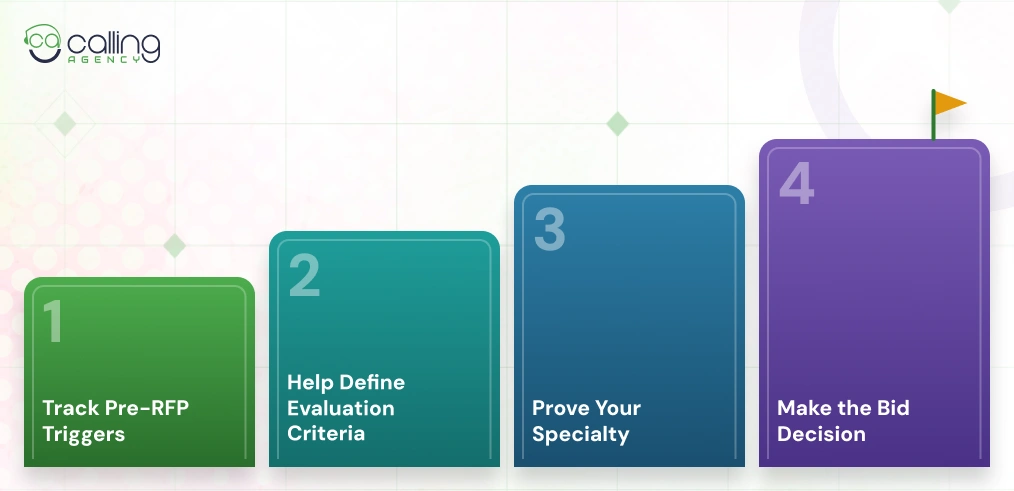
1. Track Pre-RFP Triggers
Find out some reasons to switch 3PLs. It can be anything like:
- A new VP of Supply Chain or Director of Operations may review vendor performance.
- A Series A or B funding round, a new sales channel.
- Sometimes, a reversal of open supply chain roles can signal growth that pressures the current fulfillment setup.
Service disruptions at an incumbent 3PL are another reason to reach out.
So are repeat visits to your pricing, case study, or integration pages if you track account-level intent. Use these signals to decide who to contact first. On the call, find out if the shipper is reviewing providers or simply gathering information.
2. Help Define Evaluation Criteria
Use a pre-RFP discovery call with the operations lead to find out where the current setup falls short. Then suggest KPIs that help the buyer compare providers on that problem. For example:
- Dock-to-stock time shows how long it takes for received inventory to become available for sale.
- Zone-skipping savings show the impact of moving parcels in bulk closer to their destinations before handing them to a delivery carrier.
- Kitting accuracy shows how often kits are assembled with the right items and quantities.
If the buyer needs help gathering the data, share a parcel-zone audit, a slotting checklist, or a template for cleaning up order and SKU data. That gives the buyer a way to put clear requirements in the RFP and compare each proposal using the same information.
3. Prove Your Specialty
Only call the leads whose needs match your service and be specific with your sales pitch like:
- If your team handles cold-chain DTC fulfillment, explain how you monitor temperature from receiving through dispatch.
- If you support B2B and B2C fulfillment from the same warehouse, show how you manage retail routing requirements alongside daily parcel orders.
You can also use LinkedIn or trade groups to share examples from your work, such as a Warehouse Management System (WMS) integration or a staffing plan for a flash sale.
If the shipper has a small project, offer a pilot for seasonal overflow or a limited batch of B2B orders. Agree on what you’ll measure, such as receiving time or order accuracy.
Use all that info to make logistics cold calling scripts. So, the buyer has results to review before moving more volume.
4. Make the Bid Decision
Do a bid/no-bid review before building a custom proposal. How so? Well,
- Start with your Ideal Customer Profile (ICP)
- Then check product type, warehouse capacity, integration needs, and expected margin.
If the incumbent is still in place and you’ve had no prior contact, find out what prompted the review and what the buyer wants to change.
Then use the pre-bid call or formal RFP Q&A to confirm peak order volumes, SKU count, Service-Level Agreements (SLAs), and pricing assumptions.
Find out who will score the proposal and which criteria carry the most weight. If key details are still missing and you can’t price the work with confidence, pass before finance and operations spend time building the bid.
Can You Shape an RFP Before It Is Written?
Yes, an early discovery call can help the brand turn its fulfillment needs into clear RFP requirements. SC Logistics, WSI, and SmartSMS all include volume and service requirements in their templates. Start with these details:
- Monthly orders and peak volume
- SKU count and product types
- Sales channels and system integrations
- Problems with the current 3PL
You need to use the buyer’s own words in a one-page follow-up. If slow receiving is a problem, for example, suggest dock-to-stock time as a KPI and define when the clock starts and stops. That gives the buyer a fair way to compare providers.
You can also offer a warehouse tour before the RFP goes out.
So, use it to show how your team handles the work you discussed. Suggest requirements that solve the buyer’s problem and can be applied to every bidder.
Build Your 3PL RFP Response Kit Before the RFP Arrives
To build a 3PL RFP response kit with answers about your technology, pricing, and Key Performance Indicators (KPIs). Make sure each of these topics appears in 9 or 10 of the 11 templates we reviewed.
Response windows ranged from 7 days to 6 weeks.
It naturally leaves a good impression if you have an answer ready. But still be prepared for delayed responses because some 3PL RFPs give you just a week to respond.
Some buyers also split the process. That’s why buske’s template uses a Request for Information (RFI) to review capabilities and a Request for Quote (RFQ) to compare pricing.
So, keep your capability answers and rate card separate so you can send each at the right stage as mentioned:
- A rate card for storage, receiving, pick and pack, returns, and accessorial charges.
- A list of Warehouse Management System (WMS) capabilities and supported integrations, including e-commerce platforms and Electronic Data Interchange (EDI).
- KPI definitions and your last 12 months of results.
- Current certificates and proof of insurance.
- Two client references who have agreed to take calls.
- A standard implementation timeline you can adjust to the buyer’s start date.
- A mutual nondisclosure agreement (NDA), which Legacy includes at the start of its template.
Add a short note on scalability, too. Endless Commerce asks about growth planning, so explain what your team can do if the buyer’s peak volume rises or it adds a new sales channel.
Assign one person, such as your sales operations lead, to own the kit. Keep it in a shared folder and review it each quarter so the team works from current rates, KPI results, and certificates.
When to Skip a 3PL RFP?
Skip an RFP when you had no pre-qualification call, the brand doesn’t fit, or the window is too short. A rushed bid can pull your team away from better-fit accounts.
So, do 4 checks before you do:
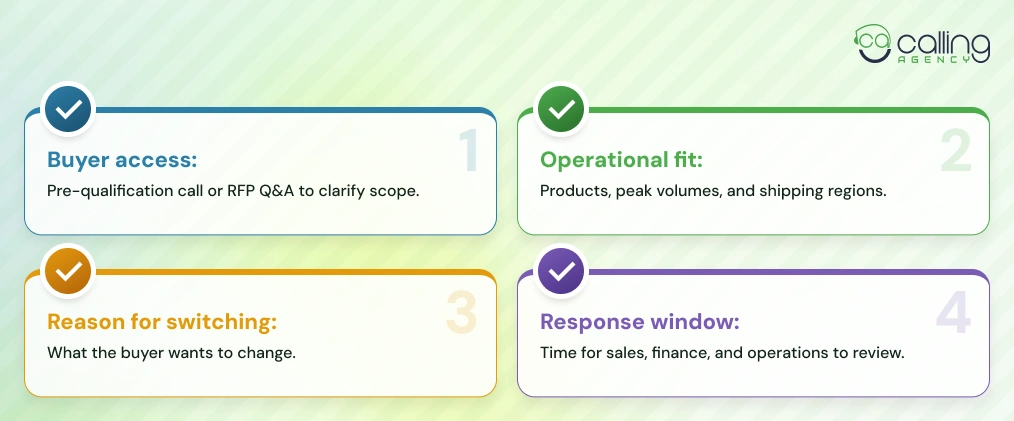
- Buyer access: Did you have a pre-qualification call, or can you clarify the scope through the RFP Q&A?
- Operational fit: Can your warehouse handle the brand’s products, peak volumes, and shipping regions?
- Reason for switching: Has the buyer explained what it wants to change about the current setup?
- Response window: Can sales, finance, and operations review the bid before it’s due?
A short deadline and questions built around the incumbent’s setup may suggest the buyer is benchmarking its current rates.
Those signs alone don’t prove it. But if you can’t confirm the scope or price the work with confidence, pass. Record the contract end date and any notice period you know so you can reach out earlier next time.
If you bid and lose, request a debrief. Find out which criteria cost you points, then use that feedback to update your RFP response kit.
Conclusion
Keep a record of what your team promised in the bid. If you win, hand those commitments to the onboarding team along with the assumptions behind them. For example, if your same-day shipping promise applies only to orders received before 2 p.m., make sure that cutoff is in the launch plan.