

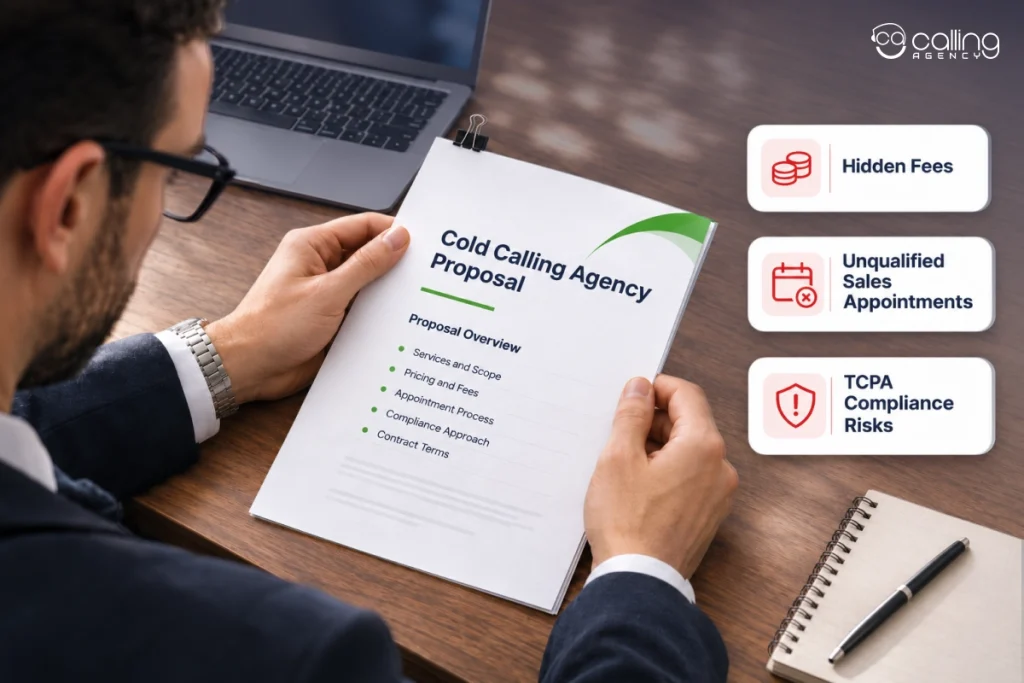
Before hiring a cold calling agency, check for some warning signs that some agencies show. These can be showing unclear pricing, poor contact lists or proving unqualified meetings. These problems can waste your money and even create legal trouble for your business.
So, whenever you hire a cold calling agency, check how it finds people to call and if it contacts the right people. Also, check the cold calling agency red flags before you sign. As a result, you can avoid wasting money. This guide will tell you everything you need to do before hiring an agency and during its first few weeks of work.
What Are the Biggest Red Flags on the First Sales Call?
The first sales call may have some red flags, such as:
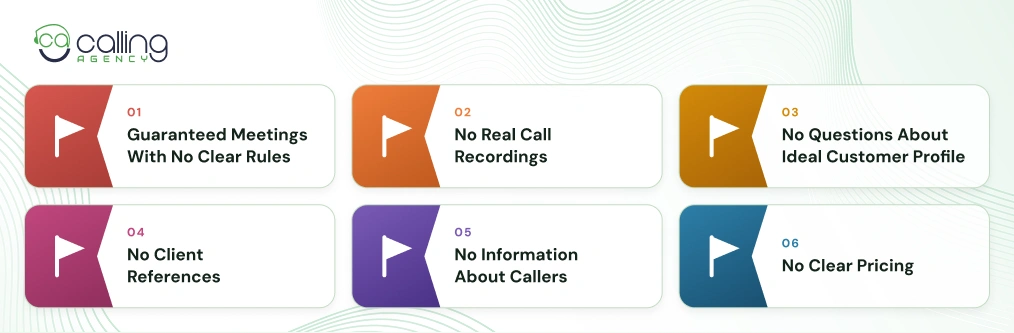
- Guaranteed meetings with no clear rules: Some meetings don’t have any rules. That’s why I ask what kind of people the agency will book meetings with. Do they need to be company owners or managers? Also, ask what happens if someone does not attend. Get all these rules in writing.
- No real call recordings: Some sales calls don’t have any recording at all. To be sure, ask to hear calls the agency has made for other clients. Listen to how callers talk to people and explain the service. Ask to hear both good and bad calls. Also, ask if you can listen to your own campaign calls.
- No questions about your Ideal Customer Profile (ICP): Your Ideal Customer Profile (ICP) means the type of customer you want to reach. Agencies need it for ICP and list building. They might also want to know about your company size, location and the people you want to reach. If it does not ask these questions, that’s a red flag.
- No client references: A sales call must be done with current client references. That’s why I ask to speak with someone who has used the agency’s service. Find out if they were happy with the results. If the agency cannot share client contacts, ask for reports and call recordings instead.
- No information about callers: A calling agency should have information about callers. So, ask them who will call your potential customers. How much experience do they have? Who trains them and checks their calls? Also, ask if the same callers will work on your campaign.
- No clear pricing: The agency may need more details before giving you an exact price. That is normal. But it should explain how much you may pay. Compare monthly fees and extra charges with standard lead generation pricing. Also, ask what happens if a booked prospect does not attend the meeting.
What Else Should You Check?
After checking for red flags of an agency, check who will manage your campaign there. Your weekly report should track the B2B appointment setting KPIs below :
- How many calls does it make?
- How many people answered?
- How many people showed interest?
- How many meetings did it book?
- How many people attended the meetings?
- How many meetings were with the right customers?
- Why did some people reject your offer?
More importantly, check whether the agency’s B2B outbound compliance follows US rules. For that, you have to ask:
- Does it call people at allowed times?
- Does it stop calling people who ask it to stop?
- Does it follow the rules for recording calls?
Remember, these rules can change depending on the state and type of call.
Which Proposal and Pricing Terms Should Worry You?
You should be careful if an agency has unclear prices because you may end up paying for meetings that bring no value to your business. That’s why you should check these points before signing.
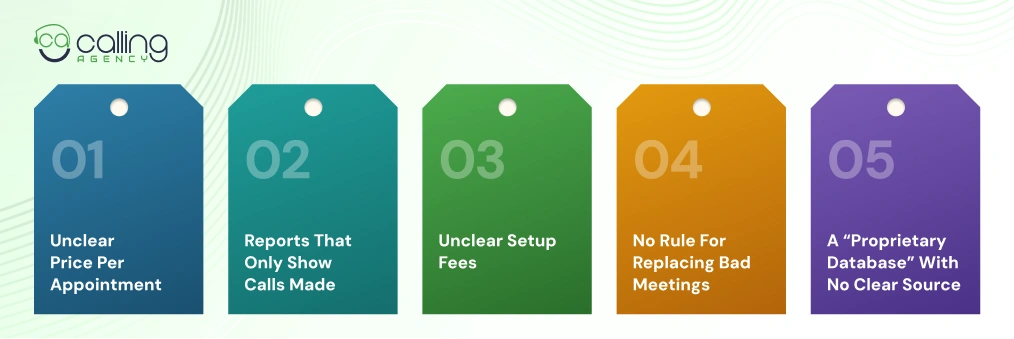
- Unclear price per appointment: An agency should not be unclear about the price per appointment. So, ask them what kind of person must attend for the meeting to count. For example, should the person be a manager or business owner? Then ask if you still have to pay when someone cancels or does not attend.
- Reports that only show calls made: A report should show more than the number of calls. Ask the agency for a weekly report that shows how many calls were answered and how many meetings were booked. It should also explain why some calls did not lead to meetings.
- Unclear setup fees: Unclear setup fees are a big red flag. So, always be certain about why the agency charges a setup fee. Does it cover contact lists or CRM setup? Also, ask if you can get your money back if the agency does not complete the agreed work.
- No rule for replacing bad meetings: A relevant calling agency shall have rules to replace bad meetings. That’s why ask them what happens if a meeting is with the wrong person. Will the agency book another meeting or give you credit? Also, ask how many days you have to report a bad meeting.
- A “proprietary database” with no clear source: some agencies say they have their own contact database but do not explain where the information comes from. So, ask where the agency gets its cold calling lists and how it checks them. Also, ask if they use the same contacts for other clients.
Contract Red Flags: Lock-In, Exit Terms, and Shared Numbers
Before signing a contract, check how long you must stay and what happens to your phone numbers and customer information. These three things can cause problems later.
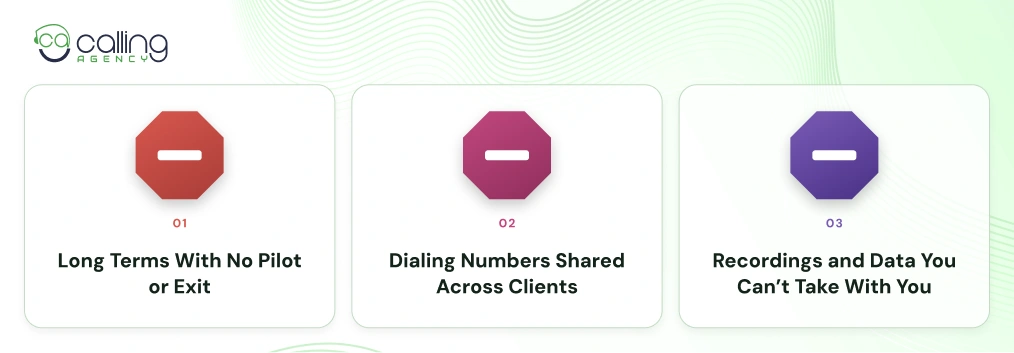
Long Terms With No Pilot or Exit
Be careful if an agency asks you to sign a long contract but does not let you leave early. So, ask for a short trial first. Also, check what work the agency will do, how it will show its results and how often it will send reports.
Dialing Numbers Shared Across Clients
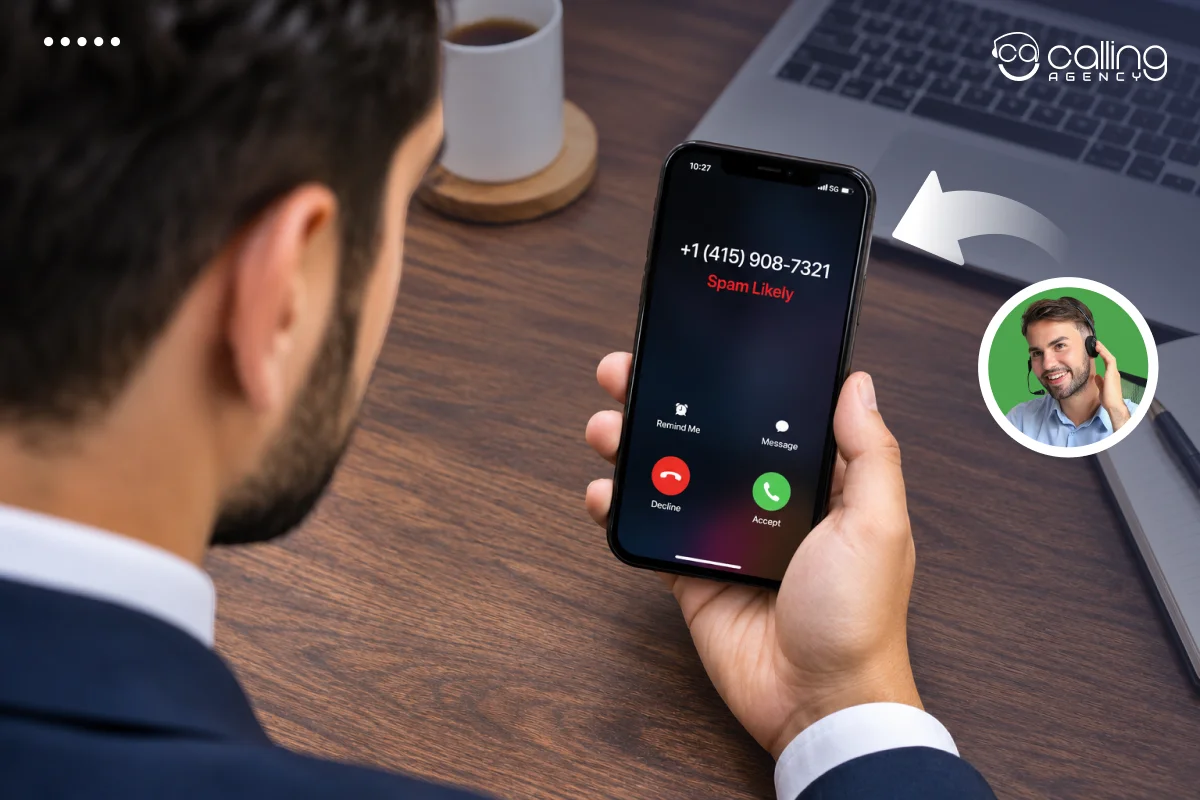
Ask if the agency uses the same phone numbers for different clients. If their current client gets spam complaints, those numbers may also create problems for your calls.
Also, ask what happens when someone calls back after your contract ends. The agency may keep the phone numbers, so the callback may go to them instead of your business.
You may say, “Does each client get separate phone numbers?” or “Who answers customer callbacks?”
The FCC caller ID rule requires telemarketers to show a number that people can call back to ask not to be called. It means you can use that number to ask the business to stop calling.
Recordings and Data You Can’t Take With You
You need to ask the agency what happens to your customer information when you leave the agency. In that case, they must hand over a list of contacts, call recordings and campaign reports. Also, ask the agency can you download these files and can you move them to your own CRM? Get everything written, and then sign the contract.
Compliance Red Flags That Shift Risk Onto You
Some agencies ignore the rules that make cold calling legal and expose your business. That’s why always look for these warning signs in the agency:
| Red flag | What to ask | Rule or source to check |
| Opt-outs stay in the agency’s system | How do you record a person’s request to stop calls? How do you make sure they are not called again? | 47 CFR 64.1200(c)(2) and (d) |
| Rotated numbers nobody answers | Can prospects call the displayed number back and request no further calls? | 47 CFR 64.1601(e) |
| No DNC screening for potentially residential cell numbers | Do you check phone numbers against the national Do Not Call (DNC) list before calling? | Chennette v. Porch.com |
| No recording disclosure | Which state laws apply, and how do callers obtain the required consent? | California Penal Code 632 and Florida Statute 934.03 |
| AI voices without the required consent | Do you use AI voices or recorded messages? If yes, how do you get permission? | FCC 24-17 |
Opt-Outs That Never Reach Your List
If someone says, “Stop calling me,” the agency must write down that person’s request.
The FCC Rules give businesses up to 10 business days to stop calling someone after they ask to be removed from the calling list. Your company may also face legal problems if the agency keeps calling that person.
Just ask these simple questions to the agency:
- Do you write down every request to stop calls?
- Do you remove those people from your cold calling list?
- Do you check the US national Do Not Call list before making calls?
- Do you train callers to follow these rules?
The agency should also use a recent copy of the national Do Not Call list. It must be downloaded within the last 31 days.
Masked or Rotated Caller ID
When the agency calls someone, that person should be able to see the phone number on their screen. The agency must not hide the number. Also, if someone calls that number back, they should be able to reach the agency and ask it to stop calling them.
So, what you should mainly do is ask the agency which phone number people will see when it calls and look at the number that appears on your screen.
Call that number back. Check whether someone answers and whether you can ask them to stop calling.
No DNC Check on Business Cell Numbers
Some people use one mobile number for both work and personal calls. It doesn’t mean that it’s safe to call them.
In Chennette v. Porch.com (2022), a US court said that a phone number used for both work and personal calls may still be protected by the Do Not Call rules. That’s why whenever you hire an agency to make calls, ask them, “How do you check mobile numbers before calling them?”
Remember, the agency should have a clear process for handling all of these.
Recording Without a Disclosure
Some agencies record phone conversations. But recording calls without proper consent can create legal problems.
It depends on the state how extreme the legal consequences could be. For example, California and Florida generally require everyone on certain calls to permit recording.
That’s why ask the agency how it handles call recording. Does it tell people that the conversation is being recorded?
AI Voices on Cold Calls
Some agencies use AI voice agents, recorded messages or automated voicemail systems. But using AI does not mean the agency can avoid TCPA rules.
In 2024, the Declaratory Ruling FCC 24-17 confirmed that calls using AI-generated voices must follow the same rules as calls using recorded or artificial voices. Marketing calls that use these voices to mobile phones generally need written permission from the person before calling.
If an agency uses AI voices, ask how it gets written permission before making marketing calls. Also, find out whether it uses automated messages or prerecorded voicemails. And before you sign a contract, ask for the agency’s written compliance policy. It should clearly explain how the agency checks phone numbers and handles call recording.
Red Flags You Can Only Catch in a Pilot
A pilot means a short test period before you fully hire the agency. During this test, you can find problems with the agency’s work. So, check these three things every week:
- Bad-number rate: Check how many phone numbers on the agency’s list are wrong. For example, the number does not exist or maybe the phone is disconnected. The agency calls 200 numbers, but 20 are wrong. This means 10% of the numbers are bad. In that case, ask the agency, “Do you replace wrong numbers for free?”
- Rep swaps: Sometimes, an agency changes the person who makes calls for your business. That’s why ask them to tell you whenever they change your caller. Listen to the new caller’s phone conversations and check whether they understand your product.
- Vague call dispositions: After making calls, the agency should tell you what happened during each call. They must tell you about meetings booked, wrong contact, etc. The agency should not use unclear words like “follow up” without explaining what happened. Also, check if the meetings are with the right companies and how many people attended the meetings. Lastly, listen to some recorded calls and compare them with the agency’s reports.
Conclusion
An outsourced calling agency can put your business at risk. It can happen when the agency ignores TCPA rules, calls people on the Do Not Call Registry, ignores opt-out requests or records calls without proper consent. These are serious red flags, especially because your business may also be held liable for calls made on your behalf.
So, make sure the agency you hire has clear rules for checking phone numbers and handling opt-out requests. And don’t forget to ask for its written compliance policy. But before hiring one, check the price, contact list, reports, calling rules, customer information and cancellation.
Test B2B cold calling services for a short period first. Check how many meetings it arranges and whether those meetings can help you get new customers. If the agency cannot explain its work clearly, do not hire it.
Frequently Asked Questions
Is a guaranteed number of appointments a red flag?
A guaranteed number of appointments is not always a red flag. But be careful if the agency promises a lot of meetings but can’t explain how they can make qualified appointment settings. That’s why always make sure it agrees to replace unqualified meetings or refund a part of your payment.
How long should a cold calling agency contract be?
Some agencies need a few months to learn about your business and improve their calls. So, a long contract is not always bad. But be careful if the agency does not let you test its service first or leaves the contract.
Do I keep the call recordings and data if I cancel?
You can keep call recordings and data after canceling only if your contract allows it. To be on the safer side, ask the provider if you can get customer names, phone numbers, and recorded phone calls before signing the contract. Also, ask how the agency will send these files to you.
Can I be fined if my cold calling agency breaks the rules?
Yes, you can be fined if your cold-calling agency breaks US calling rules. For example, someone may tell the agency to stop calling them. If the agency ignores that request, your business may also face problems under FCC rules.