



To sell commercial cleaning services, it’s crucial to find the right point of contact. This varies by property. For commercial cleaning contracts, approach the facility manager in large or multi-tenant buildings where unified operations or a property management company holds signing authority.
On the other hand, in single-tenant offices and small businesses without a dedicated facilities team where spending authority stops at a set threshold, commercial cleaning contracts route to the office manager.
This guide explains the right focal point for commercial cleaning contracts between facility manager and office manager and how to confirm who actually handles vendor-related decisions. Understanding this will help cleaning companies avoid unnecessary hassles and meetings with contacts who cannot actually approve a contract.
Why the Right Contact Decides Whether You Win the Contract
Pitching your all-time best pitch to an office manager on a multi-tenant building’s cleaning contract will just add weeks of delay but no instant recognition, as the decision usually routes through the facility manager or property management company instead. This applies in reverse to the mistake too.

- A customized facility-manager-style proposal sent to a 12-person office without any facilities department wastes the document because it didn’t go to the right person for the cleaning contract.
- Also, a misrouted proposal sits unread or gets forwarded without context.
- Even this kind of generic decline often goes through the motions of closing the door for future outreach.
That’s why, if your company needs a consistent pipeline of the right prospects, commercial cleaning lead generation can help pinpoint who handles cleaning-vendor decisions and who has authority to approve the agreement.
Who is a Facility Manager?
A facility manager manages daily building operations, which includes property maintenance, security and vendor contract management across various service categories. Depending on the company, a facility manager’s responsibilities cover HVAC (heating, ventilation, and air conditioning), janitorial services, landscaping and other facility-related vendors under one contract-signing authority.
Facility managers generally work in larger offices, corporate campuses, hospitals, schools, manufacturing sites and properties where operations span more than one building or department. It typically depends on the company structure and the authority assigned to the position.
What a Facility Manager Controls
A facility manager helps run the property efficiently by overseeing maintenance, daily operations, safety compliance and contractor management. This position generally handles multiple vendor categories at once, including HVAC, security, and landscaping alongside janitorial services.
The signing authority for annual service contracts is held by facility managers. That means they have control of approving a cleaning vendor without forwarding the decision through a separate finance department. Evaluation criteria for vendors rely on service consistency, contract terms and quality control procedures rather than focusing only on the lowest price.
When to Contact the Facility Manager
To secure a cleaning service deal, try first contacting the facility manager for large corporate buildings, multi-tenant buildings or industrial facilities. This can also include hospitals, schools, manufacturing sites and some institutional properties.
Facility managers should be a priority to contact when a commercial cleaning business is looking for new cleaning contracts, reviewing its current service or preparing to renew a contract.
Facility managers own the office maintenance budget and have the direct authority to sign vendor contracts or replace poor-performing cleaning services. To approach, focus on relevance to the specific company you want to provide your service to; share proof of insurance, compliance and consistent quality control checklists to gain trust rather than just aligning budget packages.
Example: “Hi {{Facility Manager’s Name}}, this is {{Rep Name}} with {{Cleaning Company}}. We work with properties similar to {{Property Name}}. May I ask if you’re the person who oversees cleaning contracts for {{Property Name}} or is there someone else I should reach out to?”
Who is an Office Manager?
An office manager handles daily business operations, administrative workflow and employee management of the office. Even though office managers don’t usually oversee contract management but in smaller companies, office managers may maintain duties for building-related vendors, including commercial cleaning services.
Office managers oversee smaller corporate offices, agencies and business firms. Their purchasing authority can differ depending on the company. The role typically covers purchasing authority for vendors when no facility team exists.
What an Office Manager Controls
Office managers control office functions, schedules and administrative procedures. Such as keeping inventory stocked, processing invoices and supervising administrative employees, etc. Also, they act as a central point of contact between staff, department heads and external vendors.
But having duties regarding vendors does not always define having final signing authority for commercial contracts. An office manager can collect proposals, compare pricing according to the needs and recommend a commercial cleaning company, while the business owner, operations director, finance department or other executive provides final approval.
When to Contact the Office Manager
You can contact the office manager when that company doesn’t have a dedicated facilities team. Typically, some small businesses, corporate offices and smaller medical practices with comparatively undersized teams don’t need to integrate a facilities team into their workflow. It is often the entry point covered in broader janitorial marketing strategies that actually gets clients.
That means office managers become the point of contact in single-tenant offices, professional services firms and other businesses operating from a single location.
Example: “Good {{morning/afternoon}}, this is {{Your Name}} calling from {{Your Company Name}}. May I ask who would be the best person to speak with regarding your current cleaning arrangements.”
What’s the Difference Between a Facility Manager and an Office Manager?
At a base level, an office manager facilitates the work employees do and a facility manager oversees the place in which that work happens. Surely there are more duties than this. And by understanding the differences, you can make better decisions about what you need and who to approach to win commercial cleaning contracts.
| Facility Manager | Office Manager |
| Organizing activities needed to ensure a perfect workspace layout. | Organizing meetings and arranging appointments. |
| Controls budgets at the facilities level. | Controls all overspending in the office. |
| Provides final verdict on maintenance or service contracts. | May suggest service for the office but the final decision comes from the facilities department. |
| Coordinates on space management and relocation. | Coordinates on administrative work, policy implementation and management. |
| Usually has contract-signing authority. | Limited to a set spending threshold. |
How to Determine Which Contact Applies to a Specific Property
Selecting between a facility manager and an office manager depends on the office layout size and management structure of the site. Building type and management structure can specify helpful clues but they don’t assure who has the purchasing authority.
To get office building cleaning contracts first, investigate who is responsible for handling cleaning services and vendor-choosing decisions. Pitch your commercial cleaning contract after finding out the right point of contact. If you can target the right contact, you can save time and increase your chances of winning the contract.
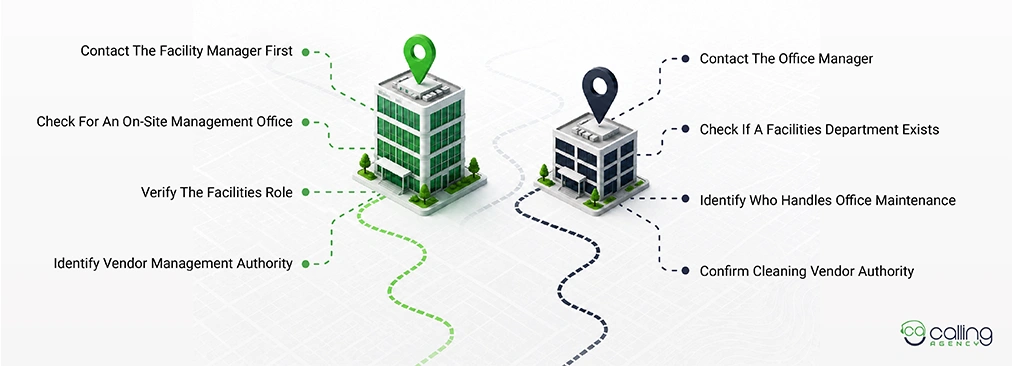
Large Commercial Buildings and Corporate Campuses
As we discussed earlier, a facility manager should be the first choice when targeting to close a commercial cleaning service. Especially for large commercial buildings, office towers, corporate campuses and multi-tenant properties, the facility manager is usually the right contact.
But before pitching look for an on-site building management office to verify if a dedicated role exists. The core duty of a facility manager is to oversee office layout operations and communicate with service providers for office maintenance. Facility managers also manage vendor relationships or work with procurement teams to evaluate cleaning companies.
Small Offices and Single-tenant Spaces
For smaller offices, professional suites and single-tenant spaces, the office manager is often the more practical right contact if the facility manager doesn’t exist. No separate facilities department usually means a single point of contact handles the entire decision.
A smaller office may not have a dedicated facilities department, so reaching the person who handles daily office operations can be a faster route to the decision-maker. In smaller offices, generally office managers handle day-to-day operations and remain responsible for arranging office maintenance services, including cleaning services and coordinating with vendors.
What if the Title is Something Else Entirely
Some businesses may not use “office manager” or “facility manager” as the literal title. There can be some other designations with the same functions at some small to mid-size companies. Such as operations manager, administrative manager, office coordinator, office assistant, practice manager, etc.
- If the title does not match either default, then ask who handles vendor or building-related services rather than asking for a specific name and designation.
- Frame the question around function, not the title. This will get you to the right route faster.
Example: “I’m not sure of the exact title on your end, but is there someone who handles vendor purchases like cleaning or building maintenance?”
How to Find and Reach the Right Contact
Companies looking to get commercial cleaning leads should prioritize prospects where the service offering and property requirements align before investing significant sales time.
Finding the right contact is much more crucial than making more calls. So before reaching out, take some time to identify who actually controls the facility and oversees office operations. In this scenario, most importantly, who has authority over cleaning vendors.
Finding Contact Information
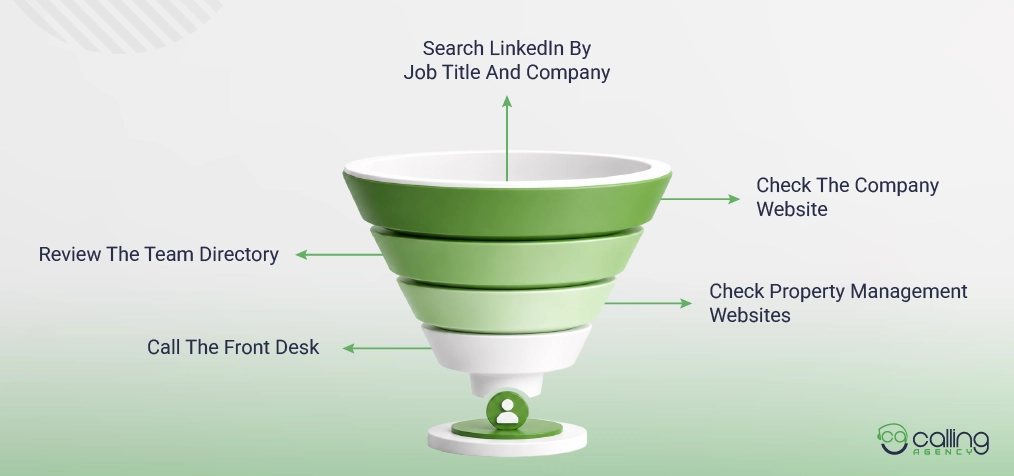
- To find the right prospect, start by using LinkedIn to win commercial cleaning contracts. Search on LinkedIn by job title plus company name to spot who currently holds the role.
- Go through the company website and the company’s team directory.
- Review property management company websites, which often list the assigned facility manager.
- Call the front desk directly for small businesses with no dedicated facilities page.
What to Say When You First Reach Them
After collecting the contact, don’t assume their title means that employee alone can approve a cleaning contract. That’s why confirming authority in the first 30 seconds prevents a bidding proposal from getting to someone who can’t approve it.
Start with a simple opening:
“I’m reaching out about cleaning services for {{property/company}}. Are you the person who handles decisions about your current cleaning vendor?”
If they are, continue the conversation. If they are not, ask:
“Who would be the best person to speak with about that?”
This approach helps you reach the person who actually controls the vendor decision. So, when following up by email, instead of using a cold email for commercial cleaning companies, start the email by answering the same questions the authority asked.
Ready to Stop Guessing Who Signs
Confirmation of who has the authority to approve a cleaning contract, whether a facility manager or an office manager, can save weeks of wasted follow-up. In this case, CallingAgency helps commercial cleaning companies to detect the right decision-maker, verify facility details and understand the current vendor situation before a walkthrough ever reaches the calendar.
Recently, CallingAgency ran a campaign for Squeegee Squad that booked 118 qualified appointments and converted 42% of walkthroughs within 6 months.
Frequently Asked Questions
Can the same person be both facility manager and office manager?
Yes. In small-to-mid-size companies, one employee may handle both facility-related and administrative operational activities. Especially in a company with under 50 employees. The actual dealing authority depends on the company’s organizational structure and approval process.
Who do I contact for a hospital, school, or government building?
These properties may have a facilities director, procurement department, operations department or any other designated purchasing authority. Government and institutional facilities can require formal vendor registration, bidding or procurement procedures rather than a direct pitch.
What if the receptionist will not give me a name?
Ask to be connected to whoever manages janitorial or facility service decisions without insisting on a specific name. Requesting around the work function angle rather than asking for a name will usually get forwarded to the right person.
Does the office manager need owner approval to sign a cleaning contract?
Often yes, but that depends on the company’s internal purchasing policy and the office manager’s spending authority. Ask upfront at the first meeting to verify the spending threshold and avoid a contract that stalls at a second approval step.