


Janitorial marketing is the process of promoting a commercial cleaning company to reach its target audience and build brand recognition. It includes local SEO, content marketing, paid advertising and other activities. A focused commercial cleaning lead generation strategy connects these efforts with qualified inquiries, walkthroughs and sales opportunities.
Janitorial marketing strategies usually involve defining a niche, setting a budget, aligning campaigns with seasonal buying cycles and publishing useful content. Our guide on how to get commercial cleaning leads explains how different channels can work together to build a consistent pipeline.
Quick Answer:
Strong janitorial marketing starts with a clearly defined commercial niche and a specific value proposition. Focus your budget on a small number of measurable channels and align campaigns with the commercial buying cycle. Use free assessments to start sales conversations, publish useful content and track each stage to identify which activities generate qualified leads and contracts.
Key Takeaways
- Build a clear niche and specific value proposition. This can make your marketing more relevant to property managers.
- Use three or four well-managed channels. They are easier to measure and optimize.
- Plan your marketing around contract renewals, budget cycles and seasonal demand.
- Do a useful free assessment. This can make the first conversation feel less pressured.
- Go for reviews, case studies, certifications and service evidence. They reduce the risk of hiring a new janitorial provider.
- Always make fast responses and follow up in a structured way. This will keep interested prospects engaged.
- Track qualified leads, contracts and acquisition cost to identify which marketing activities actually produce revenue.
Top Janitorial Marketing Strategies To Follow
While implementing janitorial marketing strategies, you have to define your niche, brand foundation, build a marketing budget and respond fast. But this is not where it ends. There are some minor, yet necessary tasks involved in these strategies. Let’s check them out.
Define Your Niche and Brand Foundation
A clear niche and brand foundation help commercial buyers understand who you serve, which facilities you know and why your company is a lower-risk choice.
Facility managers usually choose a janitorial company when they can quickly see relevant experience with their property type and service requirements. A focused strategy helps building service contractors stand out in a competitive market.
Start by choosing one or two priority commercial segments such as medical offices, corporate offices, warehouses or retail properties. Each segment has different needs. Medical facilities may prioritize sanitation procedures, while offices may require reliable after-hours cleaning.
Next, define your ideal customer using these criteria:
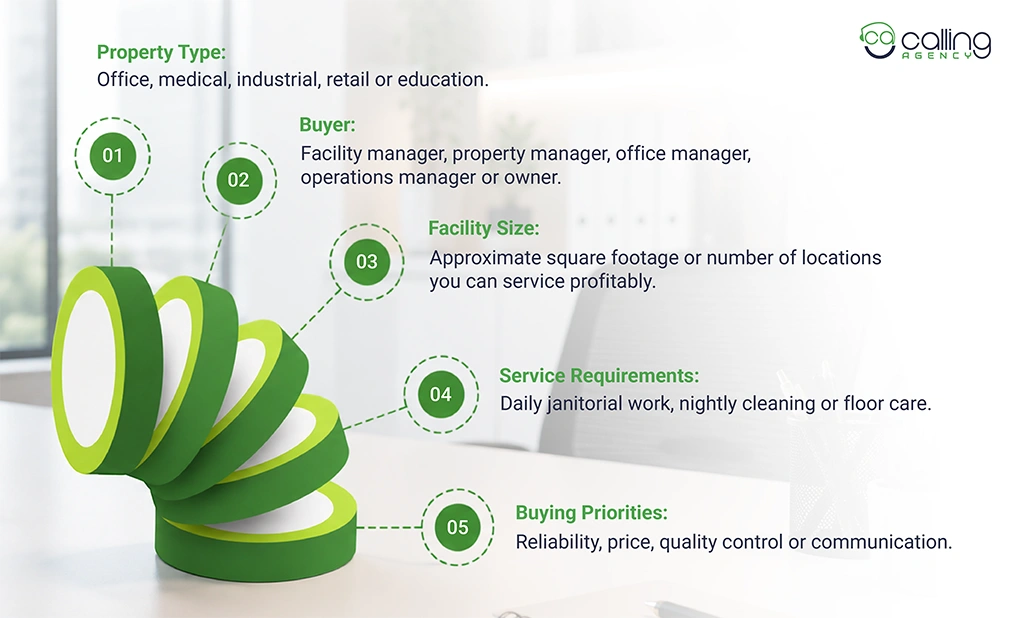
- Property type: Office, medical, industrial, retail or education
- Buyer: Facility manager, property manager, office manager, operations manager or owner
- Facility size: Approximate square footage or number of locations you can service profitably
- Service requirements: Daily janitorial work, nightly cleaning or floor care
- Buying priorities: Reliability, price, quality control or communication
A detailed B2B persona cheat sheet for janitorial sales teams can help you connect these criteria with the right buyer roles, concerns and service expectations.
Turn these details into a specific positioning statement. For example: “We provide after-hours office cleaning for professional buildings with scheduled inspections and rapid issue resolution.”
Support your positioning with proof instead of broad promises. Include CIMS certifications, insurance details, staff training and documented cleaning procedures where relevant. Strong janitorial company branding strategies also keep your company name, service descriptions and contact information consistent across your website and Google Business Profile.
Build Your Marketing Budget and Channel Mix
Set your marketing budget around contract value, sales capacity and acquisition cost. Only then can you acquire profitable recurring accounts. Start by calculating the maximum amount you can spend to acquire one new client.
How much should a janitorial company spend on marketing? For example, if a commercial cleaning contract is worth $1,300 per month and the expected initial contract period is 12 months, its first-year revenue is $15,600. You can then set an acquisition-cost ceiling based on your gross margin and the amount of that revenue you are prepared to reinvest in growth.
One commonly cited small-business benchmark, reported by marketing consultant Nuphoriq from U.S. Small Business Administration guidance is 7% to 8% of gross revenue. It’s relevant for a cleaning business with less than $5 million in annual sales and a 10% to 12% net profit margin after expenses.
Choose Channels Based on Your Sales Goal
Don’t invest across every marketing platform. Choose three or four channels that match your sales cycle.
| Channel | Main Purpose |
| Local SEO / Google Business Profile | Capture existing local search demand |
| Google Search Ads | Reach high-intent prospects faster |
| Cold calling/email | Proactively reach commercial decision-makers |
| Reviews/case studies | Build trust and support conversion rates |
| Content marketing | Answer buyer questions and demonstrate expertise |
Allocate More Budget to Channels That Produce Contracts
Track each channel separately. Measure cost per lead, walkthrough-booking rate, proposal-to-contract rate and customer acquisition cost (CAC).
Consider a hypothetical example. Google Ads generates 20 leads at $50 each while cold calling generates 10 qualified walkthroughs at $80 each. Google Ads has the lower cost per lead, but that does not automatically make it more profitable. If cold calling produces more proposals and contracts, it may deliver a stronger return.
Revenue and profit per acquired account matter more than lead cost alone. This contract-focused approach also helps you evaluate where cold calling fits within your wider outbound lead generation strategy.
Review the numbers monthly, but give slower channels enough time to produce results.
Align Marketing With the Seasonal Buying Cycle
Make sure your marketing approach aligns with a seasonal buying cycle as commercial cleaning demand is not the same throughout the year. So, do janitorial marketing before a buyer needs a vendor.
Spring: Promote Deep Cleaning and Facility Refreshes
Spring is a natural period for post-winter maintenance. At that time, you can target offices, healthcare facilities and commercial buildings. You can also promote a specific service package, saying carpet extraction + hard-floor maintenance.
Summer: Target Schools, Offices and High-Traffic Properties
Summer can be useful for reaching universities and businesses that experience increased activity later in the year. Here, you can promote periodic deep cleaning.
For offices, you can offer scheduled floor maintenance and carpet cleaning. Again, for educational facilities, you can build campaigns around summer cleaning programs for the new academic year.
Fall: Start Contract and Budget Conversations Early
Fall is a useful time to reach facility managers. Many commercial cleaning buyers begin reviewing vendors before the next contract period. For larger facilities and institutional accounts, this may involve an RFP (Request for Proposal) and a formal bid cycle. Start outreach before the RFP is released. This gives you enough time to understand the facility and prepare for the scope of work.
Winter: Focus on Illness-Prevention Cleaning
Winter comes with increased foot traffic, moisture, salt and grit into commercial buildings. At that time, marketing can focus on entrance matting programs, floor maintenance and high-touch cleaning for facilities that experience heavier winter traffic.
Here is a simple planning system you can follow:
Identify the seasonal need → determine when buyers typically plan → launch educational content and outreach early → offer an assessment or walkthrough → follow up during the decision window.
Use the “Free Audit” Door-Opener
A free audit gives a prospect a low-risk way to evaluate your expertise before discussing a cleaning contract. During the audit, review the facility’s current cleaning conditions, service frequency and other relevant requirements.
After the walkthrough, provide a short written summary of your findings and recommended services. Also, mention them about the areas that require additional attention. This gives the facility manager something useful to evaluate before receiving a proposal.
Show Findings Instead of Just Giving a Quote
Find and note areas that need additional attention. Afterward, provide a short written assessment that says:
- What you observed
- What should be improved
- How frequently the area should be serviced
- What services you recommend
- What will be the proposed cleaning program?
Next, you must confirm the approximate square footage, facility type and major pain points. Then send a tailored proposal based on what you actually found. If the prospect agrees, record the expected decision date and follow up.
Build Content and Social Proof Consistently
When you have content and social proof to show, a facility manager gets a reason to trust your company. But what content actually helps a janitorial company win commercial clients? To win, you have to focus on information that helps facility managers evaluate cleaning vendors.
You may include these sections in your commercial cleaning content:
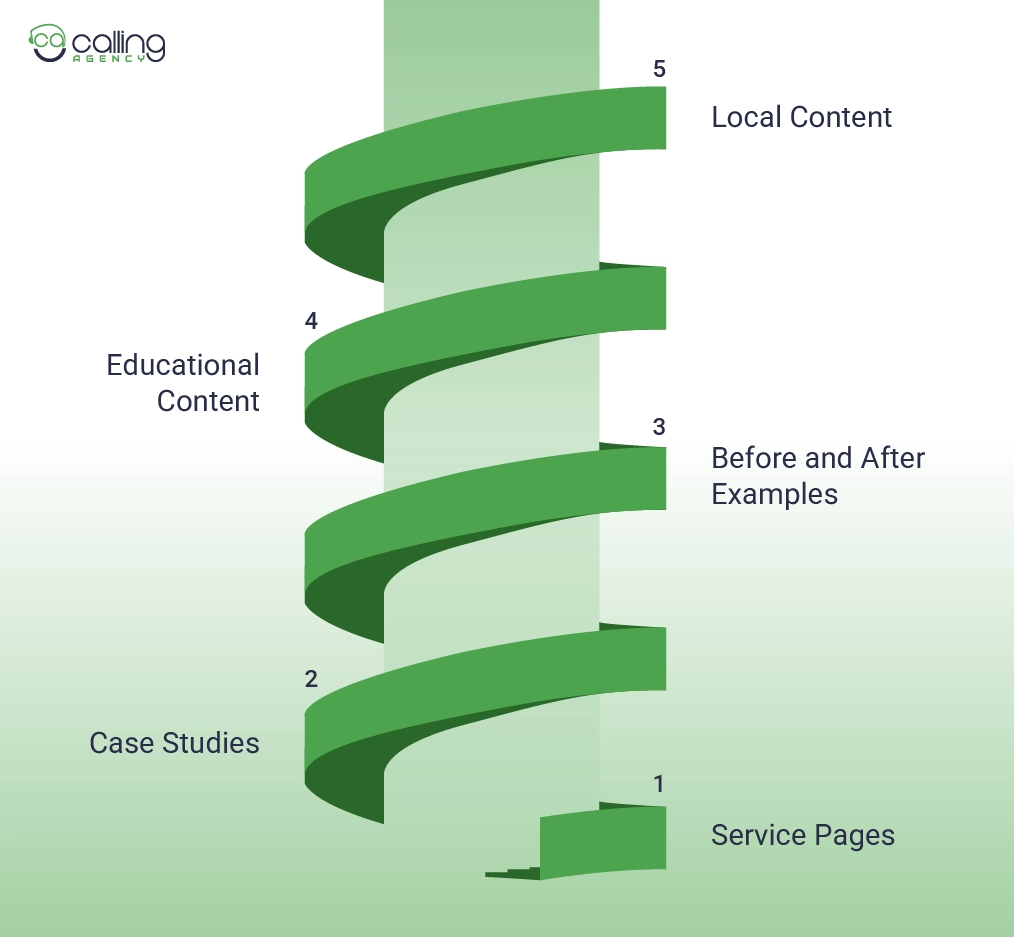
- Service pages: Explain exactly what is included in office, medical or retail cleaning.
- Case studies: Show the property type, cleaning problem and services you will provide.
- Before-and-after examples: Use real photos to demonstrate improvements you made so far.
- Educational content: Explain cleaning frequencies, inspection processes or infection-control practices where relevant.
- Local content: Show experience of your services in particular commercial areas or industries.
You can also ask clients whether you can document details such as the size and type of facility. For example, you can say “cleaned a 25,000-square-foot office five nights a week and reduced recurring restroom complaints.”
Ask satisfied clients for a review within a short time after you provide the service. Direct review links or QR codes make it easier for satisfied clients to leave feedback.
The path for janitorial marketing is simple:
Helpful content → proof of results → trust → assessment/walkthrough → proposal.
If you want a broader content strategy for janitorial marketing, see our content marketing strategy for cleaning companies.
Respond Fast and Track Everything
Fast response matters because commercial cleaning prospects often contact several vendors. Respond to every inquiry within a few business hours whenever possible. Responding quickly gives your sales team a better chance of reaching prospects.
Use a CRM or simple spreadsheet. There, you should record lead source, property type, response time and follow-up dates. This makes it easier to identify which marketing channels are producing qualified opportunities and signed contracts.
Track the funnel separately for each channel. Here’s a sequence to follow while calculating:
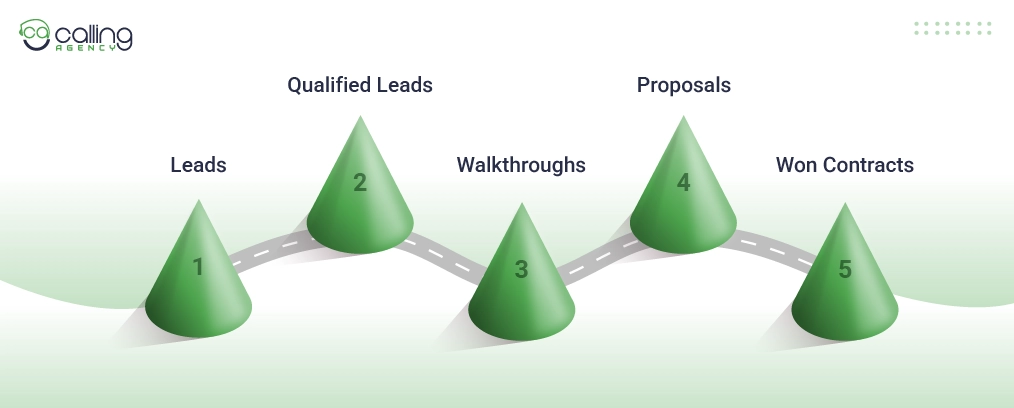
Leads → Qualified Leads → Walkthroughs → Proposals → Won Contracts
For example, Google Ads may generate 30 inquiries, but only 5 become walkthroughs and 1 becomes a signed contract. Referrals may generate only 8 inquiries, but 6 become walkthroughs and 3 become signed contracts. Google Ads produces more initial inquiries, while referrals produce more qualified contracts.
This is why you should track the full journey from lead source to qualified lead. The numbers will tell you which channels are producing actual customers.
Lastly, review the numbers monthly and shift budget toward channels that consistently generate qualified leads. If you want a deeper follow-up system, see our repeatable lead engine guide.
Frequently Asked Questions
How is janitorial marketing different from lead generation?
Janitorial marketing is a broader process, whereas lead generation is a more specific activity. Both factors help build trust for a commercial cleaning company and can turn potential buyers into sales opportunities. With marketing, prospects can recognize your company. And with lead generation, you can create meetings.
How much should I budget monthly for marketing when starting?
There is no one exact monthly amount for every janitorial company. Well, what your budget is going to be depends on your average contract value, gross margin and sales capacity. So, start your janitorial marketing with a small number of channels first. Then track contracts from each. Eventually, increase spending when a channel can start acquiring profits.
Do I need a professional logo and branding before I start marketing?
A professional appearance helps in marketing, but expensive branding is not so necessary. You just need to clearly communicate. Mention who you serve, what services you provide and which locations you cover. Remember, your website and Google Business Profile should present information. Only then can you improve visual branding.
How often should I post content to stay visible?
There is no proven posting frequency to get commercial cleaning contracts. All you need to do is post useful and relevant content. For a janitorial company, you can publish a case study or service explanation. Then repurpose it into LinkedIn posts or email content and sales material. That’s it.
Conclusion
Janitorial marketing is not about using every available platform. It is about reaching the right commercial buyers with a clear message and giving them enough evidence to trust your company.
Start by defining your niche, target buyer, service offering and value proposition. Then build a focused marketing budget around channels you can measure. They must align your campaigns with budget planning and seasonal demand. Use free assessments to create low-pressure sales opportunities. Case studies, Google reviews, certifications and service evidence can also help reduce the risk of choosing a new janitorial provider.
Finally, respond quickly to inquiries and track the full journey from marketing source to qualified lead. That is how you identify which strategies actually get clients.