


Prospects say “we’re not interested” because they are reacting to the interruption, not the offer. This response happens before they know what you’re calling about, so it’s a reflex, not a real decision.
According to Gong’s analysis of more than 300 million cold calls, dismissive objections like this one account for 49.5% of all objections, nearly half.
This matters because the prospect hasn’t heard your offer yet. They’re pushing back on the call itself, not on what you’re selling. So this is not the end of the conversation. It’s your chance to keep talking.
Key Takeaways
- “Not interested” is the single most common cold call objection, part of the dismissive category that makes up 49.5% of all pushback (Gong, analysis of 300M+ calls).
- It is usually a reflex, not a decision. The prospect is responding to an unexpected interruption before processing your message.
- Tone tells you more than words. A clipped, annoyed “not interested” needs a different response than a tired, distracted one.
- The winning response is Acknowledge, then ask one question. Validate the objection, then ask a single curious question to surface the real concern.
- Know when to stop. After three genuine rejections on one call, exit professionally. Persistence past that point damages your brand and wastes dials.
What Does “Not Interested” Actually Mean?
“Not interested” rarely means the prospect has weighed your offer and declined it. In most cases, they have not heard enough to evaluate anything. The phrase is a defense mechanism people use to regain control of an unexpected call.
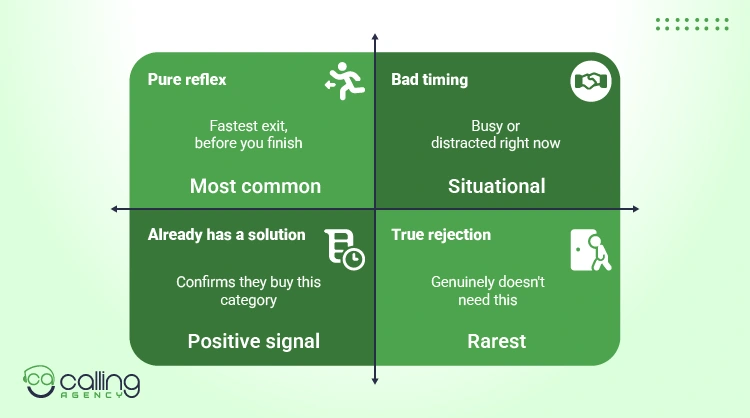
There are four distinct things a prospect can mean when they say it:
- “I don’t know who you are yet.” The most common meaning. This is pure reflex. The prospect’s brain defaulted to the fastest exit available before you finished your opening sentence.
- “This isn’t a good time.” A situational signal disguised as a flat no. The prospect might be interested under different circumstances, but is busy, distracted or mid-task right now.
- “I already have a solution for this.” An existing solution objection. This is actually a positive signal. It confirms the prospect buys in your category. The door is not closed; it is just guarded.
- “I genuinely don’t need this.” The rarest meaning, and the only one that is a true rejection. A well-qualified list keeps these to a minimum.
The skill is telling these four apart in the first few seconds of the response. For a broader look at every objection type you will encounter, see our guide on how to handle cold call objections.
Why Prospects Say “Not Interested” So Quickly
Most of the time during a cold call, prospects say “we’re not interested” in the first 15 seconds, but are analyzing whether they want to hear about your solution, if at all, based on the interruption.
In that case, they did not have enough information on your offer to make a purchase decision. Instead, their brains reflexively defended those things to the best of their limited ability, their time, attention, and current priorities. If you know about this psychological response, SDRs will not take the objection personally and will respond in a better way.
| Psychological Trigger | What It Means During a Cold Call | What the SDR Should Do |
| Status quo bias | The prospect prefers how they are currently doing it. | In place of the push for change, produce curiosity. |
| Loss aversion | Time lost seems like too high a price to pay for the possible gains. | Your opening should be short and to the point. |
| Fear of the unknown | An unfamiliar caller creates uncertainty. | Give an instant, credible value proposition. |
| Psychological reactance | Nobody likes to feel forced or controlled. | Request authorization and provide low-pressure inquiries. |
These responses are often automatic and occur even before the prospect has processed your message.
A key takeaway for SDRs is simple: never argue against the objection. Accept it, stay calm and earn another 20 to 30 seconds of attention. When a prospect says “not interested” after hearing little more than your company name, they are rarely rejecting your value and almost always responding to the fact that you interrupted their day.
How to Respond to “We’re Not Interested”
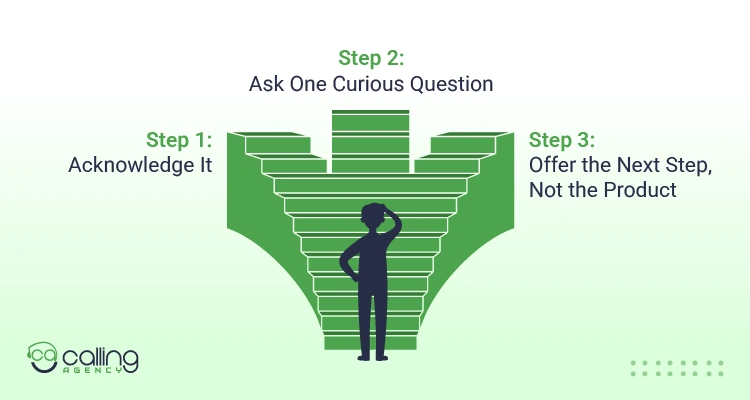
The best way to respond to “we’re not interested” is to acknowledge the objection, ask one simple question and suggest a small next step instead of trying to sell immediately. This works because it treats “not interested” as a reflex, not a final decision. The goal is to keep the prospect talking, not push for a sale right away.
Step 1: Acknowledge It
Firstly, you repeat back what the prospect said to communicate that they were heard. People can be resistant to change, so a quick acknowledgement reduces hesitation as you are respecting their time. This also makes the dialogue much more natural rather than sounding like a sales script.
For example:
- “That’s completely fair.”
- “I understand.”
- “People usually think of that at the beginning.”
Just because you acknowledge the objection doesn’t mean you’re going to agree with it. All that tells the prospect is you listened, and so they are willing to listen to one more sentence.
Step 2: Ask One Curious Question
Forget the 15-minute sales pitch and replace it with one simple question to uncover the true nature of the objection. The problem is that you see a lot of prospects say “not interested” before they know why you called, so using one simple question to get to the root cause, like whether it is an issue of timing, budget constraints, priorities or even a better solution already in place
For example:
- “May I ask what you mean by this not being a good match?”
- “Are you implementing some other solution?”
- “Are you satisfied with the amount of qualified leads your team is getting today?”
You change the conversation from a two-word dismissal into a discussion merely by asking one very simple question. And it allows you to determine if the prospect is qualified before proceeding.
Step 3: Offer the Next Step, Not the Product
For a cold call, the aim is not to close a sale on the first call. The idea is to get a conversation going and then get a small commitment, like scheduling for a few-minute call, product demo or permission to send you something useful, maybe even a case study.
For example:
“We’ve worked with a lot of companies like yours to help them increase the number of qualified meetings by optimizing their outbound process. Can we hop on a quick call for 15 minutes to see if it makes sense for you?”
A small next step is less threatening than a purchase. For more on framing that first conversation, see our guide to the best cold call opening lines.
Read the Tone Before You Respond
The best response to “we’re not interested” depends on the real reason behind the objection. During a cold call, the same words can have different meanings, so using the right response improves objection handling and keeps the sales conversation moving. When SDRs listen between the lines really well, they can select the appropriate objection-handling strategy to help them engage better and move onward with their prospects.
| Prospect’s Tone | What It Usually Means | Recommended Response |
| Annoyed or abrupt | A reflexive brush-off after an interruption. | Use a calm pattern interrupt or an honest response. |
| Tired or distracted | Poor timing rather than genuine rejection. | Acknowledge it and offer to call back later. |
| Flat “I’m good” | They want to end the conversation. | Ask one brief question, then exit professionally if needed. |
| Thoughtful pause | A genuine objection or concern. | Ask a clarifying question before discussing your solution. |
Ensure that the tone matches professionalism, not emotion. You have to stay calm and friendly to build prospects’ trust. It’s also efficient for handling objections and growing the chances of booking qualified meetings.
Sample Responses to “Not Interested” by Situation
Mostly, the response for “not interested” depends on the exact situation you are dealing with. Here, we have discussed three tested common scenarios.
When it’s a pure reflex: “Totally fair, most people aren’t until they realize what we do. Since I’ve got you for 30 seconds, can I ask: are you happy with how many qualified meetings your team is booking right now?”
When it’s really “I’m busy”: “I completely understand, sounds like I caught you at a bad moment. Would it make more sense to grab 15 minutes on Thursday so I’m not interrupting your day?”
When it’s really “we already have someone”: “That’s great, you’ve got that covered. Most of our clients did too before they realized they were leaving 20 to 30 meetings a month on the table. Would it hurt to see if there’s a gap worth closing?”
We have organized each response based on different objection-handling strategies. Each one acknowledges the objection, then reframes the ask around a problem the prospect already feels. For help building these patterns into a repeatable skill across your team, see our cold calling training guide.
When to Stop: The Three-No Rule
The best time to stop responding is after three genuine rejections, not three quick brush-offs. This approach is known as the three-no rule and is widely used in cold calling and objection handling. It helps SDRs stay persistent without becoming pushy or damaging their brand.
A reflexive objection and a genuine rejection are not the same. If a prospect says “we’re not interested” within the first 15 seconds of a cold call, they are often reacting to the interruption rather than your offer. However, if they clearly say, “This isn’t relevant to us,” or “Please take us off your list,” after hearing your value proposition, it is a genuine rejection that should be respected.
When that happens, end the conversation professionally.
“I completely understand, and I appreciate you taking the time. I’ll leave you to your day, and if anything changes, I hope you’ll keep us in mind.”
Respecting a genuine no fast protects your brand and keeps your contact list warm for future outreach. The data support knowing when to move on: 93% of conversations happen by the third call attempt and 98.6% by the fifth, so grinding past a clear rejection produces near-zero return (Cognism, WHAM dataset, via Prospeo, 2026).
After each conversation, review the call outcomes and maintain strong CRM discipline. Save important call recordings in your call recording software so your sales team can evaluate what happened. Compare different talk tracks, call scripts, role-based openers, and resistance statements to see which approaches keep conversations alive. Modern sales intelligence tools and AI solutions can also identify patterns that improve your outbound function over time.
Stopping one call does not mean ending the relationship. A consultative salesperson focuses on relationship selling by using SPIN selling, open-ended questions, and mirroring techniques whenever the prospect is willing to engage.
If the answer is a genuine “no,” move the prospect into an email follow-up, email outbound, or future email campaigns as part of an omni-channel approach. Combined with the right call timing, consistent call cadence, and multi-touch call plans, this creates more opportunities without putting unnecessary pressure on the buyer.
For real estate SDRs and other outbound teams, rejection is part of the job. Building emotional callouses helps sales reps stay confident without becoming discouraged. Many teams review call recordings, test new talk track ideas, refine every call script, and even use a rejection jar to encourage consistent prospecting. In real estate, respecting genuine objections while continuously improving your process leads to stronger call outcomes than arguing with prospects who have already made their decision.
Why “Not Interested” Is Actually a Good Sign
An objection means the prospect is still on the line. The worst outcome on a cold call is not an objection; it is silence followed by a hang-up. A prospect who pushes back is still listening and still mentally engaged.
There is also evidence that objections correlate with better outcomes when handled well. The presence of an objection signals engagement rather than indifference, and reps who treat objections as the start of a conversation rather than the end consistently book more meetings. Across B2B teams, the gap between an SDR who books 8 meetings a month and one who books 25 often comes down to how they handle the first reflexive objection (Skipcall, 2026).
It helps to remember the buyer’s pyramid, a framework popularized by sales author Chet Holmes: at any given moment, only about 3% of your market is actively buying and another 7% is open to it (Chet Holmes, The Ultimate Sales Machine, cited via Cognism). The remaining 90% are not actively looking, which means most cold calls start from low intent, and a reflexive “not interested” is simply the statistical norm, not a sign you are doing something wrong.
Successful SDRs treat every objection as valuable feedback rather than failure. They combine pre-call research, a proven call framework, and strong lead qualification to understand why prospects push back.
Over time, pattern recognition helps them identify which objections appear most often, which responses create the most Social Proof, and which conversations move prospects closer to a sales deal. This approach strengthens lead generation by turning every objection into a learning opportunity.
The same mindset applies across long-term outbound campaigns. Teams making high-volume calls should regularly review call metrics to identify trends, improve messaging, and create more Level 4 Value Creation for prospects instead of simply pitching products.
Whether you are calling business owners, targeting expiring listings in real estate, or building long-term business relationships, focusing on the prospect’s market value and real business challenges makes objections easier to handle and increases future conversion rates.
For the full set of benchmarks on cold call conversion and objection frequency, see our cold calling statistics page and our B2B sales call statistics guide.
Final Words
“Not interested” is the most common thing you will hear on a cold call, and almost never a real rejection. It is a reflex that happens before the prospect has processed your message. Acknowledge it, ask one curious question, and pitch a small next step rather than the product. Read the prospect’s tone to choose your response, and respect a genuine no when you hear one. Handled well, the most common objection in cold calling becomes the start of your most productive conversations.
If your team needs consistent, professional handling of objections like this one at scale, CallingAgency’s appointment setting services put trained SDRs on your campaign who turn reflexive objections into booked meetings.
Frequently Asked Questions
What is the best response to “I’m not interested”?
Acknowledge the objection, then ask one curious question. Try: “Totally fair, most people aren’t until they hear what we do. Curious, are you happy with how many qualified leads you’re bringing in each month?” The acknowledgment lowers the prospect’s guard, and the question moves them from dismissive mode to reflective mode without pressure.
Why do prospects say “not interested” so fast?
Because it is a reflex, not a choice, you have interrupted them, they do not recognize you and their brain defaults to “no” as a safety precaution. This is the time when most objections occur, not enough time to give the prospect an adequate basis for deciding whether your offer has merit. Understand, this is a response to the interruption and not about rejecting you.
How many times should I push back on “not interested”?
Use the three-no rule. If you hear three genuine, considered rejections on one call, exit professionally. But distinguish a reflexive brush-off in the first 15 seconds (worth working past) from a clear, considered no after you have explained your offer (respect it immediately). Two to three objection responses per call is the practical maximum before you risk being seen as pushy.
Is “not interested” a real rejection?
Usually not. Gong’s analysis of 300M+ cold calls found that dismissive objections like “not interested” make up 49.5% of all objections, and most are reflexive rather than reasoned. A genuine rejection, where the prospect has heard your offer and decided it is not relevant, is far rarer, especially when you are calling a well-qualified list.
What is the difference between a reflex objection and a real objection?
Timing is the tell. Objections in the first 15 seconds of a call (“not interested,” “send me an email”) are almost always reflexive brush-offs. If the prospect raises objections after listening to your pitch, those tend to be real concerns that may benefit from further exploration with curiosity questions. The tone also matters: an abrupt, irritated protest is often second nature; a carefully qualified answer is more likely sincere.
Should I have a script for handling “not interested”?
Yes, but as a reference, not a teleprompter. Build a short list of the responses that work for your most common scenarios (pure reflex, “I’m busy” and “we already have someone”) with two to three options each. Keep it visible during call sessions. Within a few weeks, you will internalize the patterns and stop needing the script. For team-wide skill building, structured training accelerates this.