

Cold email and cold calling are both outreach channels, and they are used to contact prospects who have not previously interacted with you or your company. But the right choice depends on several parameters such as target audience, service or product pricing, complexity, sales complexity, offer type, industry, goal, and location.
Cold calling has a solid history, and it was started in the 19th century, but the process was different than now. With the digitization and tech revolution, cold calling has become much more tech-driven. On the other hand, cold email outreach started 25 years ago with the rise of the internet and its simplicity and bulk outreach; cold email has become popular. Both have made outbound outreach very prosperous.
This guide compares both outreach methods clearly so you can decide which one fits your sales strategy.
What Is Cold Email?
Cold email is an unrequested personalized message to a prospect with whom you have never interacted or no previous business relationship. It’s a kind of one-to-one outbound outreach method for introducing a business offer, product, or service, but it’s not like mass email marketing.
Common Uses of Cold Email:
- B2B lead generation
- SaaS demo booking
- Appointment setting
- Link building
- Partnership outreach
- Recruiting
- Content promotion
- Follow-up after LinkedIn or phone outreach
The above list is not the end of everything. You can use email for any industry, any kind of business, to generate leads and set appointments.
What Is Cold Calling?
Cold calling is the process of contacting a potential customer by phone without prior interaction. It gives sales reps a chance to speak directly with prospects, ask questions, handle objections, and qualify interest in real time.
Common Uses of Cold Calling:
- Appointment setting
- Sales prospecting
- Local business outreach
- High-ticket service outreach
- Follow-up after email
- Lead qualification
- Re-engaging old leads
Cold calling has been widely used for lead generation and appointment setting in the B2B and B2C industry widely.
Cold Email vs Cold Call: Main Difference
Cold email is a written, asynchronous outreach channel. The prospect can read and reply when they have time. Cold calling is a live, real-time conversation where the prospect responds immediately. Cold email is scalable written outreach, but cold call is direct verbal outreach. Cold email is easier to automate, and cold calling is better for lead qualification. Let’s take a look at the table below for more differences.
Cold Email vs Cold Call Comparison:
| Difference | Cold Email | Cold Call |
| Communication style | Written | Verbal |
| Response speed | Slower | Immediate |
| Scalability | High | Lower |
| Personal connection | Moderate | Stronger |
| Cost per contact | Usually lower | Usually higher |
| Objection handling | Limited | Real-time |
| Automation | Easier | Limited |
| Prospect pressure | Lower | Higher |
| Best for | Scale, awareness, nurturing | Qualification, appointments, urgency |
| Main challenge | Inbox deliverability | Low answer rate |
Pros and Cons of Cold Email
Not only cold email, but also for every outreach channel has some pros and cons. Cold email is not an exception.
Pros of Cold Email
You can personalize the message, add proof, case studies, etc., for building more trust. Cold email is useful because it helps your sales teams to contact more prospects faster using less manual effort. Also its easier to scale, track, and personalize at volume.
Pros cold email:
- Lower cost per contact
- Personalization opportunities
- Easier to automate
- Measurable metrics
- High scalability
- Better for reaching large lists
- Gives prospects time to respond
- Easy to test subject lines and messaging
- Useful for sharing links, case studies, and proof
Cons of Cold Email
Cold email can fail when the message is generic, the list is poor, or the email never reaches the inbox.
Cons of cold email:
- Can be ignored
- Can land in spam
- Harder to create personal trust
- No real-time objection handling
- Requires deliverability setup
- Follow-ups are often needed
Pros and Cons of Cold Calling
You will hear a lot of rumors about cold calling, such as cold calling is dead, it’s not effective now, and many more, but those people says these things use cold calling themselves. So let’s see the cold calling advantages and disadvantages.
Pros of Cold Calling
Cold calling has many advantages. And it works best when your goal is to create a direct conversation with decision makers. It directly helps your agents to qualify prospects faster compared to any other outreach channels. And you can handle objections in real time.
Pros of cold calling:
- Direct access ot decision makers
- Immediate feedback and engagement
- Faster qualification and lead generation
- Real-time objection handling
- Better for urgent offers
- Better for appointment setting
- Helps understand buyer pain points quickly
Cons of Cold Calling
Cold calling requires more time, training, and human effort. It can also feel intrusive if the prospect is not a good fit.
Cons of cold calling:
- Conversion rate is lower, like 1% to 3% on average
- High rejection and negative morale
- More labor-intensive
- Many calls go unanswered
- Time-consuming and inefficient
- Gatekeepers can block access
- Requires skilled callers
- Poor scripts can damage trust
Cold Email vs Cold Call by Buyer Type
If you are calling a very busy decision-maker, then the possibility of picking up a cold call for them has a 50/50 chance, sometimes even then pick, but after realizing it’s a cold call, they hang up or give objections. So let’s discuss which type of decision maker is fit for cold calls and who is fit for cold email.
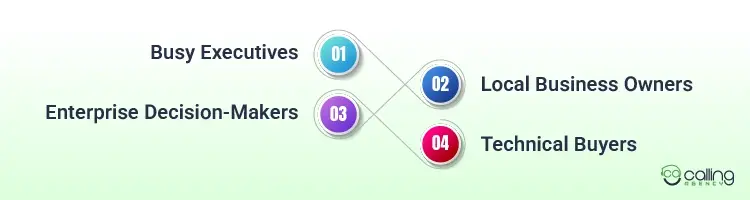
Busy Executives
Busy executives may prefer cold email because they can read it later and forward it to the right person. Most of the instant shutdown, call me later, or send me an email types of objections are raised by busy executives.
Local Business Owners
Local business owners, such as restaurant owners, cleaning service providers, plumbers, retailers, etc., may respond better to calls because many still handle business by phone. They don’t open emails normally on a regular basis. So cold calling fits them the most.
Enterprise Decision-Makers
Enterprise buyers often need multiple touches, so cold email can introduce the offer, while cold calling can follow up with the right contact.
Technical Buyers
Technical buyers may prefer email because they often want details, documentation, and proof before speaking.
Cold Email vs Cold Call by Sales Cycle
Let’s now compare cold email and cold calling by their sales cycle.
| Sales Stage | Better Channel | Why |
| First touch | Cold email | Less intrusive and scalable |
| Awareness | Cold email | Good for introducing the offer |
| Qualification | Cold call | Faster answers |
| Objection handling | Cold call | Real-time conversation |
| Nurturing | Cold email | Easier to follow up over time |
| Appointment setting | Cold call | Easier to confirm a meeting |
| Re-engagement | Both | Email reminds, call pushes action |
Cold email is usually better at the top of the funnel, while cold calling is stronger when the prospect needs qualification or direct follow-up.
Cold Email vs Cold Call by Industry
One of the more important differences between cold email and cold calling is their industry. Let’s now compare them according to their serving or best-fit industry.
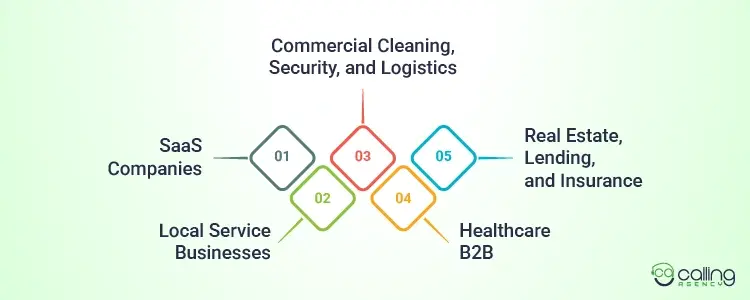
SaaS Companies
Cold email works well for SaaS lead generation because you can introduce your product’s demo, use cases, and case studies without forcing an immediate conversation. And most of the SaaS decision-makers are active in replying to emails, so it helps pretty much.
Local Service Businesses
Local services like plumbers, therapists, etc., are a good fit for cold calling. Most of the local generation is done by cold calling because their owners are active and comfortable taking business over the phone, and less active in email.
Commercial Cleaning, Security, and Logistics
Cold calling can be effective when targeting facility managers, property managers, operations managers, and business owners because these services often depend on direct appointment setting.
Healthcare B2B
Cold calling is a good channel for healthcare lead generation and appointment setting. Because it allows you to introduce your offer formally, reach hospital and clinic administrators, practice managers, and procurement heads. During a conversation your can follow PHI regulations. In this case, cold is also very useful to showcase case studies, previous reports, and proof. But it will be best if you combine them for a complete outreach strategy.
Real Estate, Lending, and Insurance
Cold calling can create faster conversations, but cold email can support follow-ups and documentation.
Cost Comparison: Cold Email vs Cold Call
Cold email seems cheaper, but a real cold email requires more than just an email address. Cold calling looks expensive, but reality is difrenent is some cases. Let’s compare their real costs in the discussion below.
Cold Email Costs
Cold email costs are huge, technically and front-loaded, because of current deliverability standards like Google and Yahoo’s strict SPF/DKIM/DMARC requirements. So you can no longer simply send a cold email from your primary domain.
- Infrastructure ($200 to $600 Setup + $150+/mo): You need secondary domains (3 to 5 minimum) and specialized sending software (like Smartlead or Instantly) to rotate inboxes.
- Data & Verification ($100 to $300/mo): High-quality, verified data is the only way to keep bounce rates under the 2% danger zone.
- Deliverability Monitoring ($50/mo): Continuous “warm-up” tools to ensure your emails land in the primary inbox, not the spam folder.
- Copywriting & Strategy: Automated emails fail without a human-led strategy. High-quality personalized copywriting or “AI-SDR” orchestration usually adds $500 to $1500/mo in labor or advanced tool costs.
Real CPL (Cost Per Lead): Usually ranges from $20 to $150, depending on the industry and the level of personalization.
Cold Calling Costs
Cold calling costs mostly for the caller’s salary and incentives. While the per-contact cost is higher, the quality of the lead is often a qualified discovery meeting rather than just an interested reply.
- Salary and Commission: The salary of a full-time agent, including benefits and commission, is higher. For example, it costs $5000 to $8000 per month for one SDR, but it depends on the location and experience.
- Tech Stack: High-velocity dialers, call recording for training, and mobile-direct data. It costs $150 to $300 per month for a single seat.
- Management & Training: Cold calling requires consistent training and team management, and it also needs script improvement, personalization, and regular quality assurance.
- Connect Rates: In recent times, call rate lower, but if your SDR team is bigger, navigating gatekeepers and at the end of the month, it becomes a big number.
Real CPL (Cost Per Lead): Typically ranges from $350 to $1000 per booked meeting. But it can be different according to your deal size, location & industry.
Which One Is More Cost-Effective?
Use cold email if your deal size is under $10000. You need a high volume of leads at a low cost to maintain your margins. Use cold calling if your deal size is over $50000. When a single closed deal brings in five figures, spending around $800 to book a high-quality meeting with a VP of Finance is a steal.
In 2026, the most cost-effective teams use multi-channel sequences. They use email to warm the prospect and identify signals (like clicks), then have their SDRs call only the prospects who have engaged. This lowers the cost of calling while increasing the ROI of email.
Deliverability vs Answer Rate of Cold Email and Cold Calling
Cold email success depends heavily on deliverability. Even a strong email can fail if it lands in spam. Cold calling success depends heavily on answer rate. Even a strong script cannot work if prospects do not pick up.
| Challenge | Cold Email | Cold Call |
| Main barrier | Spam filters and ignored inboxes | Voicemail and unanswered calls |
| Main technical issue | Deliverability | Phone reputation |
| Main human issue | Weak copy | Weak opening line |
| Main improvement | Better targeting and inbox setup | Better timing and call training |
Which Has a Better Response Rate?
Cold-calling can bring faster responses. Because the prospect reacts during the conversation. So you get a chance to handle their objections if they raise one. On the other hand, cold email has a slower response rate, but it can reach more prospects faster and at a lower cost.
Even if your business ideals are in a larger amount than old calling might bring better success than cold email. These depend on your list quality, personalization, timing, and follow-up process.
Which Is Better for Appointment Setting?
Cold calling fits better for appointment setting. Because your agent can ask them qualification questions, know prospects’ interests, can handle objections, and schedule the appointment, building trust and rapport.
Best Appointment Setting Strategy
If you want to get the best result, send a cold email to introduce the offer, then use cold calling to follow up with the most relevant prospects.
Which Is Better for B2B Lead Generation?
Cold email is useful for generating awareness and starting conversations at scale. Cold calling is useful for qualifying prospects and moving serious leads into appointments. For B2B lead generation, the strongest approach is usually a combined outbound system.
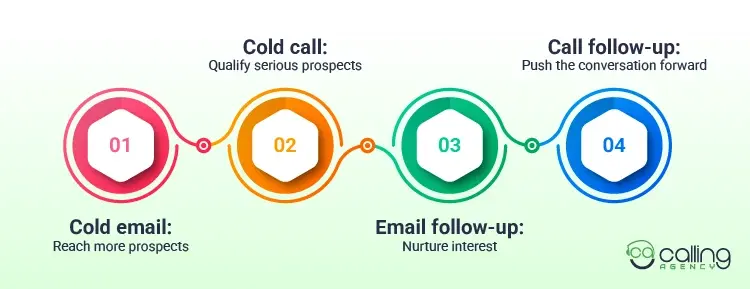
Best Use of Each Channel:
- Cold email: Reach more prospects
- Cold call: Qualify serious prospects
- Email follow-up: Nurture interest
- Call follow-up: Push the conversation forward
If you use email where calling is good, the result will be affected. So, understand your business, goal, and prospects’ requirements.
Best Cold Email and Cold Call Outreach Sequence
If you combine cold calling and cold email for prospecting, your outcome will be better. Sometimes you can integrate social media like LinkedIn outreach, also, so your strategy becomes stronger.
| Day | Channel | Action |
| Day 1 | Cold email | Send a short personalized intro |
| Day 2 | View or connect with the prospect | |
| Day 3 | Cold call | Reference the email and start a conversation |
| Day 5 | Send a value-based follow-up | |
| Day 7 | Cold call | Try to qualify and book a meeting |
| Day 10 | Send a final check-in | |
| Day 14 | Call or email | Close the loop or move to nurture |
The goal is not to spam the prospect, but the goal is to create multiple relevant touchpoints across different channels.
Which one builds more trust? Cold calling is focused on building trust and rapport with the high-value decision-makers. This process becomes easier because you directly make conversation with the prospect. In contrast, cold email also builds trust, but it takes time, and it’s slower than cold calling. It helps you add proof, case studies, testimonials, and clear written details.
Cold Email vs Cold Call: Which One Should You Choose?
The choice of taking a cold email or a cold calling service depends on your average contact value (ACV) and market density. If you are selling a high-volume, lower-cost solution where the number or volume is important, cold email is your most suitable option. But if you are chasing big deals with complex requirements and higher lifetime value, cold calling works better for live qualification and solving the confusion of the prospect.
The most effective is the hybrid outreach model, where you use the email to filter for intent and warm up the inbox, then make cold calls to convert the interest into a high-value meeting.
Final Verdict: Cold Email vs Cold Call
Cold email is not automatically better than cold calling, and cold calling is not automatically better than cold email. Cold email works best for scale, awareness, and follow-up. Cold calling works best for direct conversations, qualification, and appointment setting. The best B2B outreach strategy often uses both. Cold email opens the door, and cold calling helps move the conversation forward.
FAQs About Cold Email vs Cold Call
Is cold email better than cold calling?
Depends on the specific need and situation. Cold email is better for scalable outreach, while cold calling is better for direct conversations and faster qualification.
Is cold calling still effective?
Yes, cold calling can still work when the prospect list is targeted, the message is relevant, and the caller knows how to handle objections.
Should I cold email before cold calling?
In many B2B campaigns, yes. A cold email can introduce your offer before the call, making the call feel more relevant.
Which is better for appointment setting?
Cold calling is usually stronger for appointment setting because the rep can confirm interest and schedule the meeting during the conversation.
Which is cheaper, cold email or cold calling?
Cold email is usually cheaper per contact, but cold calling may justify the cost when the deal value is high.
Which is better for B2B lead generation?
Both can work. Cold email helps reach more prospects, while cold calling helps qualify and convert serious prospects.
Can cold email and cold calling work together?
Yes. Many outbound campaigns perform better when cold email, cold calling, and follow-up are used together.