


Cold calling gets blamed for a lot. Reps call all day, leaving voicemail after voicemail, being hung up on, and walking away feeling like they had wasted hours of their life. Leaders look at the numbers and begin to wonder if they should shut this channel down altogether.
But this is what the data really says. Businesses that stop cold calling grow slower contrasted with organizations that utilize it. According to Gong Labs, the open rates nearly double from 1.81% to 3.44% when the cold call is in front of the email.
So if cold calling is still effective, why do so many teams struggle?
The answer is almost always execution. The channel is not broken. How most teams use it is.
Outbound sales have been cold calling for decades. And it still produces meetings and revenue in almost all of the B2B sectors. Unfortunately, calls die when teams run them with lousy data, weak openers, no personalization, and without any solid follow-up plan. In this article, we shall cover the seven fundamental causes of cold call failures and how you can tackle each of them.
Key Takeaways
- Cold calling fails because of execution, not the channel. Bad data, weak openers, poor preparation, and giving up early are the most common issues.
- Most calls go unanswered. Based on Hiya’s 2024 report, as many as 46% of unknown calls are rejected, and 92% of people assume those calls are a scam.
- Your opening line decides the call. Gong’s data has “Did I catch you at a bad time?” The success rate of drops is 0.9%, while “How have you been? lifts it 6.6 times.
- Don’t quit after one try. On its data for 2025, Cognism says most of the conversations that result from cold calls occur within one to three attempts.
- A system beats a script. What gets results is verified data, personal messaging, and multi-channel follow-up.
What Does It Mean When People Say Cold Calling Doesn’t Work?
If you hear sales reps or managers saying cold calling doesn’t work, they usually mean one thing: that it is not successfully booking meetings or filling the pipeline. That result virtually always relates more to the manner in which the calls are executed than to the channel itself.
The most common causes are calling the wrong people, using a vague value message, and not preparing before each dial. Many decision makers receive dozens of sales calls every week. A generic, unprepared call is easy to ignore. Most people today screen calls from numbers they don’t recognise.
There is also a trust problem. Robocalls and spam have made people suspicious of unfamiliar numbers. A legitimate sales rep now starts every call at a disadvantage and has to work harder just to get a fair hearing.
The frustrating part is that this is not unique to any one company. Cold calling consultants who work with struggling outbound teams almost always find the same patterns: wrong lists, weak openers, and no real system around follow-up. The channel is not the issue. The approach is. And that is something you can fix.
What Are the Real Reasons Why Cold Calling Doesn’t Work?
Cold calling as a concept is not flawed. If it were, cold calling agencies would not exist at all. The problems are in strategy and execution. Here are the seven most common reasons calls fail.
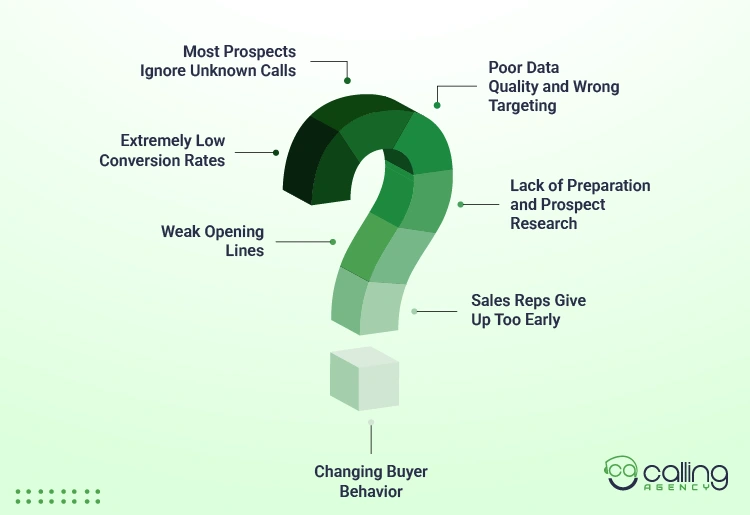
1. Extremely Low Conversion Rates
Low conversion rates are one of the most cited arguments against cold calling. Cognism’s 2026 State of Cold Calling report puts the average success rate at around 2.7%. Many calls never even reach the decision maker.
Reps can go through dozens of dials to book a single meeting. That feels like a poor return on time, and companies often write off the whole channel based on those numbers alone.
But here is the problem with that thinking. A 2.7% average includes a large number of teams doing it badly. Top performers do far better. Gong’s research, which analysed cold calling performance data from 300 million calls, found that the average rep connects on just 5.4% of dials. The top 25% connect on 13.3%. That is more than double.
Set rates tell the same story. The average rep converts 4.6% of conversations into meetings, which works out to roughly two meetings per month from an hour of calling each day. The top 25% hit 16.7%, which is about 18 meetings per month.
Low conversion rates are not a cold calling problem. They are a process problem. And process problems have solutions.
2. Most Prospects Ignore Unknown Calls
People do not answer calls from numbers they don’t recognise. That is the simple reality of cold calling today.
Hiya’s 2024 State of the Call report found that 46% of calls from unidentified numbers go unanswered, even when a real business is making them. And 92% of consumers believe those calls are fraudulent.
This is a direct result of the spam call epidemic. Robocalls have trained people to treat any unfamiliar number as a threat. Your legitimate sales call gets grouped in with the noise before you even say a word.
Voicemail is also less useful than it once was. Most people don’t check voicemail regularly. A thoughtful message you spent time on may never get heard.
This doesn’t mean the phone is useless. It means you need to make your name familiar before you dial. Outbound sales teams that add even one email or LinkedIn touch before calling see a real difference in answer rates. When a prospect has already seen your name somewhere, you are not a stranger anymore, and that changes how the call starts.
3. Poor Data Quality and Wrong Targeting
Bad prospect data is one of the most overlooked reasons cold calls fail. Reps call numbers that are disconnected. They reach people who left the company months ago. They contact businesses that are the wrong size, wrong industry, or nowhere near a good fit.
When this happens, the best opener in the world cannot save the call. You are talking to the wrong person.
B2B contact data goes stale faster than most teams expect. People change roles. Companies restructure. A list that was accurate last year may already be significantly out of date. Calling from a stale list means burning through rep time and energy with nothing to show for it.
The fix requires discipline. Use data that gets verified and cleaned on a regular basis. Define your ideal customer profile clearly and build your lists around it. B2B prospecting programs that audit contact data regularly tend to see much higher connect rates, even without changing anything else about their process. If you are not sure who you should be calling, work that out before you touch the phone.
When a cold calling agency takes over a struggling program, bad data is often the first thing they find. The script is fine. The reps are capable. The list is just wrong.
4. Lack of Preparation and Prospect Research
Many cold calls fail before the conversation even starts. The rep dials with no idea who they are calling or why that specific person should care about what they offer.
Not researching the company. Using a script that could apply to anyone. Delivering a pitch that doesn’t connect to anything the prospect actually deals with. These are all signs of poor preparation. Prospects notice immediately.
When you don’t know anything specific about the person you’re calling, it shows. You sound like everyone else who called that day. The prospect feels like a name on a list, not someone whose situation you actually understand.
The fix is simpler than most reps think. Spending a few minutes researching before each call makes a real difference. Check their LinkedIn profile. Look at recent company news. Note what their role likely involves and what problems they probably face. Find one specific thing you can reference at the start of the call.
You don’t need a long script. You need one relevant thing to say that shows you put in some effort. Sales reps who research their prospects before dialing consistently report longer conversations and better outcomes than those who go in cold with no context.
Preparation also means knowing what you want from the call before you start. Are you trying to book a meeting? Qualify a potential fit? If you don’t know your goal going in, the conversation will drift. And calls that drift end without results.
5. Weak Opening Lines
The first few seconds of a cold call decide almost everything. A weak opener ends the conversation before it starts.
Gong’s research makes this very clear. The opening line has a dramatic effect on outcomes. Reps who started calls with “Did I catch you at a bad time?” saw their success rate drop. That question hands the prospect an easy exit before the conversation has even begun.
Reps who opened with “How have you been?” saw results rise above the baseline. That opener sounds like a real person having a real conversation. It creates a small moment of connection.
Most reps use the same tired lines. “Is this a good time?” or “I just wanted to introduce myself” or “I’m calling about our services.” These openers do nothing to earn the prospect’s attention. They signal a standard sales call, and that is when most people hang up. So the opener must be strong before the prospect hears the value.
A good opener does three things. It shows you are a real person, not a robot reading from a list. It gives a clear reason for the call. And it makes the prospect feel like this conversation might actually be worth their time.
Try leading with something specific. Reference something about their role, their company, or a recent piece of news. “I noticed your team just expanded into a new market. We work with a few companies that went through something similar, and getting the sales motion right quickly was one of their biggest early challenges. Is that something you are thinking about?” Cold calling trainers who study opener performance consistently find that specific, relevant openers outperform generic ones by a wide margin.
That kind of opener earns more time. And in cold calling, earning a few more seconds is how real conversations get started.
6. Sales Reps Give Up Too Early
This is one of the most common and most costly mistakes in cold calling. Reps make one or two attempts, get no answer, and move on. The prospect goes cold. The opportunity disappears.
Most teams underestimate how much persistence matters. The following is from Cognism’s 2025 data: the majority of cold call conversations take place in one of the first three attempts. Which means that reps abandon the vast majority of reachable prospects, and only give up after one or two dials. Consider what that means in practice.
After one phone call without a response, you have not made an effort. You’ve barely started. The prospect could have been in a meeting, on another call, or even away from their desk. That is not a signal that they are uninterested.
Most sales teams don’t have a structured follow-up plan. Reps decide on their own when to stop chasing a contact. Without a system in place, the default is to give up early.
A consistent follow-up strategy changes this. Outbound calls that define a minimum number of attempts before treating them as inactive, typically three or more, often go on to book far more meetings than outbound calls, leaving the decision to each rep, so work some phone calls in with your emails and LinkedIn messages so they see your name all over again. By the time the prospect hangs up, they already know who you are.
7. Changing Buyer Behavior
Buyers have changed. Below is a copy of the impact of consumer behavior on communication, research, and decision modes, which has changed significantly over the past five years.
The majority of buyers complete extensive research before even speaking with a sales rep. The reading reviews, soliciting peer recommendations, checking LinkedIn, and comparing options on their own. Often, they will have a hit list in their mind before they even pick up the phone to speak with someone. In that context, an unsolicited cold call can seem even more jarring.
The buyer is not in buying mode. They didn’t invite the conversation. They hang up on the call if you do not give a reason to remain in the first seconds of the conversation. Then we have the way that spam calls changed how people answer the phone.
As covered earlier, nearly half of all calls from unidentified numbers go unanswered, and that wariness doesn’t disappear just because your call is legitimate.
This doesn’t make cold calling obsolete. It means cold calling needs to sit inside a wider strategy. The best B2B outbound teams leverage the phone, email, and LinkedIn together rather than treating cold calling like a standalone tactic. They create a little instinct with a prospect first before calling. They make sure their number is registered and won’t get flagged as spam.
The call becomes one part of a sequence rather than a standalone attempt. In that context, it lands differently. The prospect has some sense of who you are, and the conversation starts from a better place.
What Makes Cold Calls Succeed Instead of Fail?
Cold calling is not the problem. How it gets run is.
The same factors that cause calls to fail, when you flip them, are what make them work. Calls succeed when you are talking to the right people, with a message that is personal to them, using clean and verified contact data, and reaching out across more than one channel.
The numbers support this. When a cold call precedes an email, reply rates nearly double, from 1.81% to 3.44%, according to Gong Labs. That is a 90% lift from adding one phone call to the sequence. And 82% of buyers accept meetings at least sometimes with sellers who proactively reach out, according to RAIN Group’s Top Performance in Sales Prospecting research.
Cold calling works when it is part of a system. Cold calling specialists who build structured outbound programs consistently outperform teams that treat cold calling as a high-volume dial exercise with no process around it. The issue is rarely the method. It is how the method gets implemented.
How to Fix Cold Calling That Doesn’t Work
You can improve cold calling results by matching each failure point to a specific fix.
| Why calls fail | How to fix it |
| Low conversion rates | Focus on qualified lists, not raw volume. Set realistic per-dial expectations. |
| Prospects ignore unknown numbers | Use a verified caller ID. Warm leads first. Give a clear reason for calling. |
| Poor data and wrong targeting | Clean your contact data regularly. Build lists around a tight ideal customer profile. |
| Lack of preparation | Research the company and role before every dial. Tailor the call to the person. |
| Weak opening lines | Open with a specific and relevant reason for the call. Skip the standard openers. |
| Giving up too early | Make at least three attempts before moving on. Pair calls with email and LinkedIn. |
| Changing buyer behavior | Run calls inside a multi-channel sequence that fits where the buyer is right now. |
Focus on these consistently, and you will steadily turn cold calling into a more reliable outbound lead generation channel. There is no single fix that solves everything at once, but each improvement builds on the last.
Why Your Data Matters More Than Your Script
Most teams go straight to the script when calls are not working. A script matters, but it is seldom the primary cause of disappointing outcomes.
The more important question is whether you are calling the right people, at the right time, and with something to say. A cold call to a well-qualified prospect, poorly delivered in two maybe three sentences, will far surpass any length-overwrought pitch delivered seamlessly to the wrong person.
This is where the majority of cold calling campaigns fail. They spend time on the script and ignore the list. They train reps on handling objections but never clean the data. They run high-volume call days with no structure around follow-up.
If you want better results, start with data quality. Then targeting. Then your opener. The script comes last.
Conclusion
Cold calling works only if it is based on accurate, targeted data, personalized brainstorming scripts, and proper commitment. And that is the truthful answer to the question we opened this article with.
But none of those problems are built into the channel. They are execution problems. And execution problems can be fixed.
The seven reasons covered here share a common thread. They all come back to doing less than the job actually requires. Calling the wrong people. Saying the same thing to everyone. Giving up after one or two tries.
Falling out of touch with how buyers today behave. Get those things fixed, and cold calling is a staple in your outbound strategy. Not easy. Not perfect. But consistent when it is run the right way.
Frequently Asked Questions
Why do most cold calls fail?
Cold calling is a wasted practice for most, as they contact the wrong prospects, use weak openings, are not prepared enough, and operate on outdated data. All of these are execution problems you can correct and not flaws in the channel itself.
Is cold calling really ineffective?
No. Cold calling is not ineffective, but it does have a low average conversion rate of around 2.7% (Cognism, 2026). That number improves a lot when reps use clean data, personal messaging, and a consistent follow-up process.
What industries still benefit from cold calling?
Cold calling mostly works in B2B and high-value service domains (e.g., SaaS, consulting, and financial services) where a 5-minute phone call can advance a real decision.
How many cold calls are needed to get a sale?
In most campaigns, reps need dozens of dials and several follow-ups before booking a meeting. Accurate data and persistence reduce that number. Most conversations happen within the first three attempts (Cognism, 2025).
How do you fix cold calling that isn’t working?
Start with your data. Ensure you are calling the correct individuals. After that, personalize every call, improve your opener, add email and LinkedIn in your sequence, and keep track of your metrics so you know what to adjust.