


Selling payment processing to a repair shop is different from selling to a dealership. In a repair shop, the owner usually makes the decision. In a dealership, the controller, CFO, general manager, or dealer principal may make the decision. You can find them through fixed operations.
The payment partner or opportunity is also different. In a repair shop, you will see customer-paid repairs. And in a dealership, you will get to experience service, OEM auto parts, digital vehicle inspections and fleet payments.
This guide shows reps how to find the right businesses and buyers. Then you can check card volume, find commercial-card opportunities, and check if the business can switch processors.
Auto Repair and Dealerships Are Two Different Sales Motions
Auto repair shops usually have one main decision-maker and dealerships have several people involved in the decision. The key differences are who makes the decision, who approves the agreement and how many locations the departments are involved.
| Attribute | Independent repair shop | Franchise dealership |
| Signer | Owner or owner-operator | Controller |
| Sponsor needed | None | Fixed operations director |
| Repair orders written | Varies by bay count | 15,924 per year at the average rooftop |
| Departments involved | One | Service, parts, body shop, sales, finance and insurance |
| Card volume driver | Customer-pay repair orders | Customer-pay repair orders and wholesale parts |
| Approval path | One conversation | Store approval, sometimes group approval |
NADA reported 270 million repair orders and $156.46 billion in service and parts sales at franchised dealerships in 2024. The average dealership handled 15,924 repair orders, with an average customer repair order of $466. NADA’s 2025 data shows more than 276 million repair orders and more than $164 billion in service and parts sales.
But total dealership revenue is not the same as card volume. Some work is paid by manufacturers or handled internally. What matters to a payment processor is how much customers actually pay by card.
For an independent shop, you should start with the owner first. Then understand how the shop handles all the payments, including its merchant services and payment processing, average repair ticket, card volume, fleet business and shop software.
For a dealership, you may need two people. The person who wants the change and the person who approves it. When you have fixed security service you can identify the problem. Meanwhile, the controller or finance team approves the agreement. However, the payment system may also need to connect with the dealership’s DMS.
Bay count helps qualify repair shops, but card volume matters more. A six-bay shop with fleet customers may be a better opportunity than a six-bay shop with low card usage.
On the other hand, dealer groups add another layer. Fifteen rooftops may still mean one payment decision if the group uses a finance team.
The biggest mistake is using the same script for both. So, do not call a dealership asking for “the owner” when the controller or finance team handles the agreement. Also, do not treat a small repair shop like a large corporate account.
Who Do You Ask For at a Repair Shop Versus a Dealership?
At a repair shop, ask the owner, and at a dealership, ask for the person who handles payment decisions, like the controller or finance leader.
| Segment | Title to ask for | What they control | Your first ask |
| Single-bay independent | Owner | Business and payment decisions | Statement review |
| Multi-bay independent | Owner, then office manager | Payment records and daily administration | Statement review |
| Franchise rooftop | Controller | Accounting and vendor agreements | Effective-rate review |
| Dealer group | Group controller or chief financial officer | Multi-rooftop contracts | Portfolio-level rate review |
| Any rooftop | General manager or dealer principal | Overall store decisions | Ask who handles payment processing |
At auto repairs, the site owner usually makes the decision and the office manager handles the statement. At a dealership, fixed operations handles service and parts, which can point you to the right person. Here, the controller or finance team usually handles the payment agreement.
Do not start with a service advisor. They work with repair customers but usually do not choose the processor. At a dealer group, one finance team may control payments for several dealerships. If you are unsure, ask, “Who handles your payment processing?”
Where Does a Dealership’s Card Volume Actually Sit?
A dealership’s card volume sits at customer-paid service, parts and accessories. NADA’s 2024 data shows dealerships had $156.46 billion in service and parts sales, or about $9.2 million per dealership. The average customer repair order was $466.
| Pay type | Dollars | Share of the base | Card status |
| Customer-pay service and parts | $60.52 billion | 37.6% | Consumer card volume |
| Wholesale parts | $24.48 billion | 15.2% | Commercial card eligible |
| Warranty and internal | $47.43 billion | 29.5% | No card volume |
| Sublet, counter and other | $28.55 billion | 17.7% | Mixed |
Do not treat $9.2 million as card volume. Warranty work is generally paid by the manufacturer, and internal work happens between dealership departments.
Vehicle sales are different too. Do not use the total vehicle sales patterns to estimate card volume here. Cars may be paid through financing, checks or wires.
Wholesale parts can create a commercial-card opportunity, but check the card type and electronic payment setup before you promise savings. So, before quoting, ask these questions:
- How much service work is customer-pay?
- How much is paid by card?
- How much does the parts counter process cost?
- How much wholesale or fleet business do you have?
- What cards do customers use?
Lastly, check whether the payment system connects with the DMS, repair orders, parts purchase report, parts usage report and accounting.
What Are the Per-Rooftop Savings Claims Actually Worth?
Per-rooftop savings depend on the dealership’s actual card volume and current processing costs. You will need to calculate savings from its statements.
Some payment companies claim large savings like:
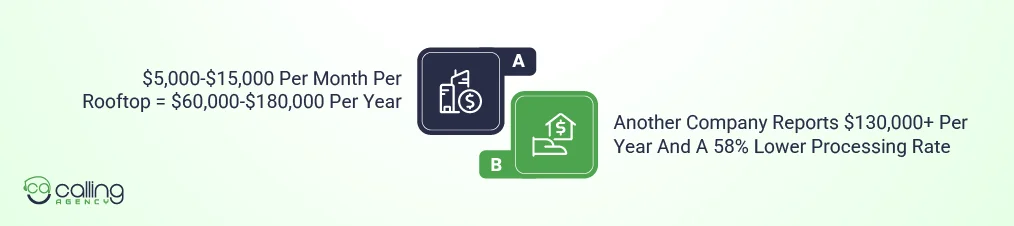
- $5,000-$15,000 per month per rooftop = $60,000-$180,000 per year
- Another company reports $130,000+ per year and a 58% lower processing rate
These are vendor claims, not industry averages. NADA Data 2024 reported 15,924 repair orders per dealership collection, with an average customer repair order of $466. That equals about $7.4 million in customer-pay repair sales.
If $7.4 million were card volume and processing costs fell by 0.30%, the savings would be about $22,300 per year. So, don’t promise savings based on another company’s claim.
Ask for three months of statements. Then check card volume, processing fees, PCI, gateway, and collision shop equipment fees, chargebacks and so on. Then compare the old cost with the new cost to get interchange costs. If needed, these merchant services sales scripts can help you out.
The Commercial Card Lever Most Auto Reps Never Pitch
Auto dealerships can save money by checking whether their business customers use commercial cards for parts payments. Also, wholesale parts can create extra savings when business customers pay with commercial cards. If you look, dealerships sell about $24.48 billion in wholesale parts to fleets and auto repairs.
Visa USA Interchange Reimbursement Fees of April 2026 rates show 1.75% + $0.10 for some eligible commercial transactions versus 2.50% + $0.10 for standard commercial card-present transactions. The difference is 0.75%, or $15 on a $2,000 payment, before other fees.
The dealership will not automatically save 0.75%. The card must qualify, and then the payment system may need extra data.
| Requirement | What to check |
| Cards eligible | Corporate, purchasing and fleet cards where applicable |
| Consumer cards | Not part of the commercial-card pricing opportunity |
| Transaction data | Check whether the gateway can send the required enhanced data. |
| Parts counter | Speak with the parts manager. |
| Customer type | Ask whether customers include fleets or other businesses. |
| Pricing | Compare the actual effective cost, not just the interchange category. |
When Surcharge Pitching Belongs in Your Opening
Pitch surcharging when a dealership has high card volume and large repair bills. Remember, a $466 repair bill with a 3% surcharge adds $13.98.
So, before pitching it, check:
- Is it legal in that state?
- Does the dealership take many credit cards?
- Does the processor support it?
- Can the dealership clearly show the surcharge?
Debit and prepaid cards cannot be surcharged. Dealer groups must check each location. If surcharging is not suitable, you can use the cash discount.
Visa’s proposed 2026 settlement could change the rules, but it still needs court approval. You just need to add big card volume with big repair bills, which means discussing surcharging.
How Do You Answer the Shop Software and DMS Objection?
Ask if the shop management system can change payment processors without changing its software, if it can, you can sell your processing service. Repair shops use shop reputation management software and dealerships use a DMS. This software connects payments with repair orders and invoices.
| Platform type | What it means | Sales opportunity |
| Captive processor | Payment processing is tied to the platform or approved provider. | Not winnable on the merchant account |
| Open gateway | The platform accepts an outside account. | Usually requires a vendor or POS integration conversation |
| Hybrid | Outside processing may be possible under certain conditions. | Verify integration requirements. |
The common systems are:
- Tekmetric
- Shopmonkey
- Mitchell 1
- CDK
- Reynolds and Reynolds
- Dealertrack
- Tekion
Their payment rules can change, so check the current requirements before making a claim.
If a prospect says their current system makes switching difficult, treat that as a sales objection rather than assuming the opportunity is closed. Merchant services objections can help reps understand how to keep the conversation moving.
So, you can ask:
“Can you change your payment processor without changing your software?”
If yes, continue the sales conversation. If not, move on.
Also check whether a change would affect payments, refunds, accounting or chargebacks.
Building an Auto Prospect List Worth Calling
Find automotive sales businesses with enough card payments and a chance to change processors. That’s why you must check:
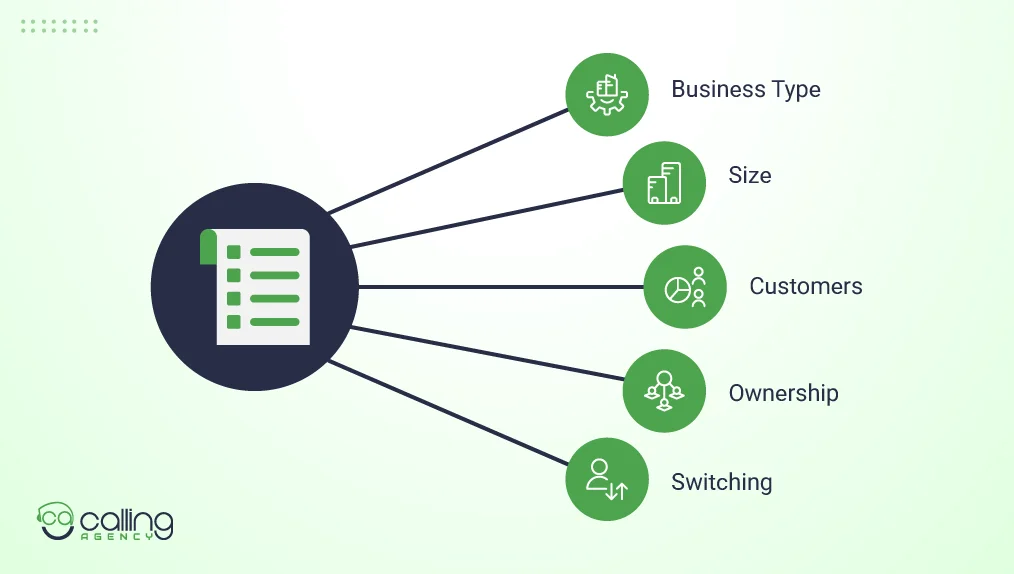
- Business type: Use the right MCC to find auto repair shops and dealerships, not car washes or towing companies.
- Size: Check bays for auto repairs and locations for dealerships.
- Customers: Look for fleet customers and wholesale parts sales.
- Ownership: Separate independent shops from franchises.
- Switching: Check whether the business can change processors.
Build a merchant-services ICP by using a minimum card-volume target before buying leads. Many specialized teams use $8,000+ per month for some merchant services leads and marketing campaigns.
For dealer groups, target the group decision-maker because fifteen locations may have one payment decision-maker. CallingAgency booked 373 sales-qualified appointments in five months for US Card Solutions, with a 35% conversion rate.
So, what you need to do is find the right business, check its card volume, check if it can switch, find the buyer, and call.
Conclusion
To sell payment processing, you need to find the right auto business first. A small repair shop and a dealership do not work the same way. They have different people, payment workflows and software.
So, before you call, find out who makes the decision, how much they take by card, and whether they can change their payment company.
You just need to find the right business. Then talk to the right person and show them how you can improve their payment processing.
Frequently Asked Questions
Is automotive high risk for merchant accounts?
Automotive solutions are not always high risk for merchant accounts. Some processors consider it higher risk because of large payments and chargebacks, but others do not. So, check the processor’s rules first.
Can a customer pay for a car with a credit card?
Yes, a customer can pay for a car with a credit card, but the dealership decides how much. It may accept a card for a deposit, part of the price, or the full price. Visa generally does not allow random maximum payment limits, except in limited cases. That’s why you should ask, “How much can customers pay by card?”
What is the average repair order at a franchise dealership?
As per NADA 2024, $466 per is the customer repair order in 2024, so warranty auto repairs averaged $512. You can use $466 for customer-pay work, but do not assume all of it is card volume.
Who signs the merchant services agreement?
It depends on who signs the merchant services agreement. It can be the controller, CFO, general manager, dealer principal, or another authorized person. For dealer groups, it can be group finance or the central office. You can know that by asking, “Who handles your payment processing?”
Do auto repair shops need integrated payments?
Auto repair shops do not always need integrated payments. So, it’s important that you ask, “Can you change processors without changing your software?” If yes, you may have an opportunity. If not, the software may require its own processor. Also check whether changing processors affects payments, refunds, or repair orders.