


Manufacturers say ‘No’ faster than almost any other B2B buyers. That doesn’t necessarily mean they are rude.
A plant manager who switches a supplier and gets it wrong could face a line stop, a scrap batch and an uncomfortable conversation with the controller. Saying no is often the safer choice when the cost of a bad decision can affect the entire plant.
The words you hear are predictable. What changes is the channel. A phone objection needs an answer in three seconds. A cold caller has only that brief window to keep the conversation moving. An email objection arrives as a reply or as silence. A LinkedIn objection arrives softer, with your profile already open in another tab.
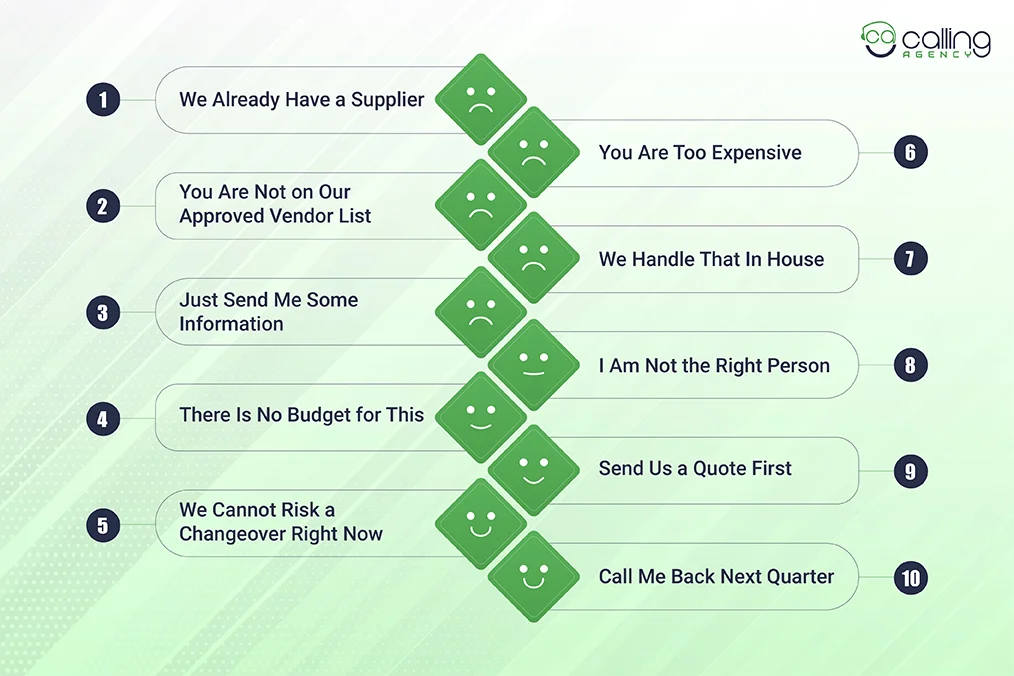
Below are the ten objections manufacturing sales teams hear most, with a response for each channel and one thing to avoid.
10 Manufacturing Sales Objections And How To Handle Each One
Manufacturers rarely change suppliers or partners without a good reason, so manufacturing lead generation and sales often come with a range of objections. Here are 10 common objections manufacturing sales teams face and how to handle each one.
1. We Already Have a Supplier
When prospects say, We already have a supplier, it is their reflection, not a verdict. It may mean they are satisfied with the current supplier, locked into a contract or simply trying to end the conversation.
Phone: “Most plants of your size do. I am not asking you to replace anyone. Who do you call when your primary supplier runs long on lead time?”
Email: Do not ask for a comparison. Ask about overflow capacity and second-source coverage instead.
LinkedIn: “Not looking to displace anyone. Curious how you cover it when lead times slip past schedule.”
Avoid: Asking them to rank you against the incumbent on the first touch.
2. You Are Not on Our Approved Vendor List
This is a process objection, not a preference. The path is usually already defined, so your job is to find out how to enter it.
Phone: “Understood. What does your qualification process look like, and who owns the AVL?”
Email: Attach nothing. Ask one question: What documentation opens a vendor qualification file?
LinkedIn: Connect with the quality or supply chain manager, not only procurement. Quality usually owns the standard.
Avoid: Treating it as a rejection. It is an instruction.
3. Just Send Me Some Information
This is in most cases a polite exit, but sometimes the prospect genuinely wants more information. When they say, Just send me an email, ask one question before sending anything.
Phone: “Happy to. So I sent the right thing, is this for a current line or one you are planning?”
Email: Send one page, not a catalog. End with a specific question that gives the prospect a reason to reply.
LinkedIn: Send a link, not a file. Attachments in a first message can feel like spam.
Avoid: Sending a full deck and treating it as progress.
4. There Is No Budget for This
This usually means the purchase is not in the current capital cycle. It is often a timing answer rather than a firm budget limit. The right budget objection response starts by finding out whether the issue is truly budget or simply timing.
Phone: “Is that CapEx or operating budget? If it is CapEx, when does your next planning cycle open?”
Email: Reframe the discussion around costs they already carry, such as scrap, expedited freight and overtime.
LinkedIn: Ask which budget line this category normally falls under at their site.
Avoid: Discounting. Lowering your price does not solve a timing problem.
5. We Cannot Risk a Changeover Right Now
This is the real objection behind many manufacturing rejections. Change means risk, and risk means downtime.
Phone: “That is exactly why I would not start on a critical line. Which line has the most schedule slack?”
Email: Propose a trial on one part number or a secondary line. Name the smallest possible scope in the first paragraph.
LinkedIn: Describe in one sentence how a comparable plant phased it in. Do not paste a case study.
Avoid: Promising a smooth transition. Every vendor promises that. Offer a small one instead.
6. You Are Too Expensive
Price is rarely the real objection. The issue is often that the buyer is comparing unit price without considering the total cost of ownership.
Phone: “Compared to what number? I want to be sure we are pricing the same scope.”
Email: Break the math down by cost per good unit produced, not cost per unit purchased. Include scrap, rework and changeover time.
LinkedIn: Do not negotiate here. Move the discussion to a call in one line.
Avoid: Defending the price. Change the denominator instead.
7. We Handle That In-House
This may be completely true, and it may still leave room for outside support. The better question is where the internal process starts to feel the strain.
Phone: “Makes sense. Where does it strain first, peak season or a new product launch?”
Email: Ask about the overflow scenario, not the base case. Most companies do not outsource the base case.
LinkedIn: Engage with their hiring or capacity posts before you message. It shows you did the work.
Avoid: Arguing that outsourcing is cheaper. Ask where the in-house process starts to break instead.
8. I Am Not the Right Person
This is one of the most useful objections you can hear because the prospect is telling you the decision maker is someone else and you have a chance to connect with him or her.
The goal is to get the right name before ending the conversation. If the prospect is not the decision maker and controls access to that person, you are dealing with a gatekeeper objection.
Phone: “Understood. Who owns that decision at this site?”
Email: Ask for a name, not an introduction. Names are easier to give than introductions.
LinkedIn: Map the plant before you message. Production, maintenance, quality and procurement each hold a piece of the decision.
Avoid: Ending the call politely without a name. That call was worth something, and you left it there.
9. Send Us a Quote First
This can be a genuine buying signal or a way to end the conversation with paperwork. The scope usually tells you which one.
Phone: “I can. I need three things first: volume, tolerance and required lead time. Do you have those handy?”
Email: Reply with a short scoping list, not a number. A quote without enough scope turns into a price comparison you may lose.
LinkedIn: Move the discussion to email immediately. LinkedIn is the wrong place for specifications.
Avoid: Quoting blindly just to look responsive.
10. Call Me Back Next Quarter
Sometimes this is genuine because plants run on planning calendars. Other times, it is a soft not now rather than a firm rejection. One question can help you tell the difference.
Phone: “Will do. What changes next quarter that makes it the right time?”
Email: Set a dated follow-up and include the date in your message so it becomes a small commitment.
LinkedIn: Stay visible without messaging. Engage with their posts during the gap.
Avoid: Disappearing for 90 days and starting the conversation cold again.
The Four-Step Pattern Behind Every Response Above
Every answer in this guide follows the same basic pattern. Once a rep understands it, they can handle objections that are not listed here. The key is to understand what the objection is really telling you before deciding how to respond.
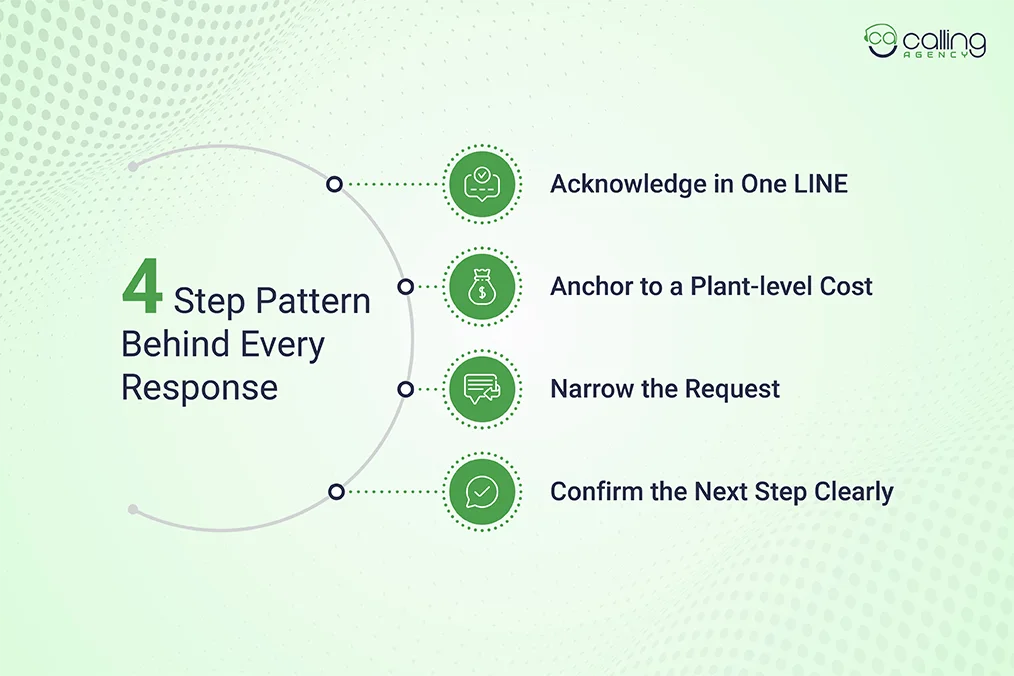
1. Acknowledge in One LINE
Do not argue or correct the prospect. Agreeing with the terms earns you the next sentence and keeps the conversation open.
2. Anchor to a Plant-level Cost
Talk about downtime, scrap, rework, expedited freight, overtime or lead time instead of leading with your feature list. This keeps the response tied to a problem the plant already understands.
3. Narrow the Request
One line, one part number, one site or 15 minutes. Small requests are easier to move through a buying committee and create less perceived risk. These principles also form the basis of a practical objection handling framework.
4. Confirm the Next Step Clearly
A vague yes can become a no that you discover three weeks later. Confirm what happens next, when it happens and who needs to be involved. This is also where disciplined lead qualification separates a real opportunity from a polite one.
What Objection Handling Looks Like At Real Volume?
Objection handling matters even more when your team is making thousands of outbound calls or sending emails. At that volume, the goal is not to find one perfect response. It is to give reps a consistent way to recognize the objection, respond and move the conversation forward.
In the Avalon campaign, the CallingAgency team made 25,200+ calls, sent 14,900+ emails and had 3,650+ conversations. Those conversations produced 123 qualified appointments, 85 qualified opportunities and more than $4.2M in estimated pipeline over seven months.
The numbers show why consistency matters. Reps will hear the same objections repeatedly, but each prospect may need a different response based on their role, timing and situation. A simple framework gives the team a common starting point without forcing every conversation into the same script.
Final Thoughts
An objection from a manufacturing prospect is rarely the end of the conversation. It often tells you something about the prospect’s supplier, budget, timing, authority or perceived risk. Understanding the nature of the objection helps you get a better outcome.
The job is not to overcome every objection. It is to understand what is behind it, because then you can respond to the real concern and decide whether there is a reason to continue the conversation.
Frequently Asked Questions
What is the most common objection when selling to manufacturers?
“We already have a supplier” is a common objection because manufacturers often have established vendor relationships. It can signal satisfaction with the current supplier, a contract commitment or simply a quick way to end the conversation. The response should depend on what is behind it.
How is objection handling on cold email different from the phone?
Cold email gives the prospect more time to consider your response, while a phone objection needs an answer immediately. Keep email responses short, address the specific concern and end with one clear question that makes replying easy.
Is LinkedIn worth using for objection handling in manufacturing?
Yes. LinkedIn can help you identify the right people, understand their roles and stay visible between conversations. It works especially well for softer objections, while technical questions and detailed discussions are usually better handled by email or phone.
How many follow-ups should you send after a manufacturing objection?
There is no fixed number. Manufacturing sales often follow longer planning and purchasing cycles, so follow-ups should match the prospect’s stated timing. Set a specific date when possible and use each follow-up to add context rather than repeating the same pitch.
Is price ever the real objection in manufacturing?
Yes, but price can also mask concerns about value, risk or timing. A buyer comparing only unit prices may overlook scrap, rework, downtime or expedited freight. Before defending your price, find out what the prospect is actually comparing.