


Many business owners often confuse merchant services and payment processing. They assume that these two mean the same thing. However, they are not the same thing. Before you start a business, you have to understand the difference between merchant services vs payment processing. Only then can you choose the right provider which will reduce your costs, and optimize your payment operations.
In simple terms, payment processing is one part of merchant services. It mainly processes transactions. But merchant services go far beyond just processing transactions. It is an ecosystem of financial transactions. In this guide, we will tell you how they differ and how they work together. And ultimately, you will know which one suits your business needs.
What Are Merchant Services?
Merchant services are basically a complete set of financial tools and services that support merchant service lead generation efforts. These help businesses accept, manage, and optimize payments very easily. Usually, banks, payment providers, or specialized companies offer such merchant services. Here, you may see multiple components like:
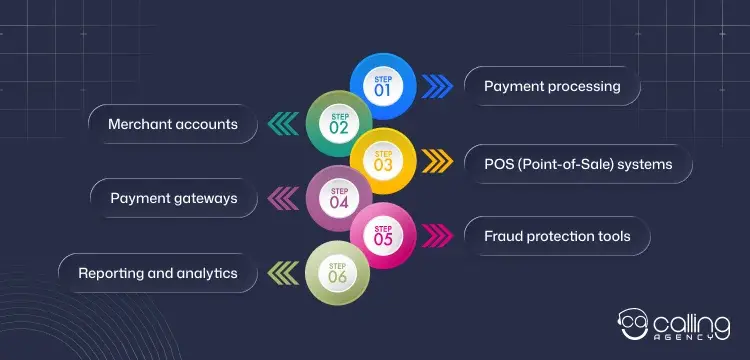
- Payment processing
- Merchant accounts
- POS (Point-of-Sale) systems
- Payment gateways
- Fraud protection tools
- Reporting and analytics
In short, merchant services are the entire ecosystem. An ecosystem that enables businesses to accept payments both online and offline.
What Is Payment Processing?
Payment processing is a specific function within merchant services. It’s like technology and systems. These handle the actual transaction flow when a customer pays.
Now let’s see what payment processing does:
- It transfers payment data from the customer to the merchant
- It communicates with card networks like Visa, Mastercard, etc.
- It gets approval from the issuing bank
- It completes the transaction and settles funds
Without payment processing, no transaction can be completed. Because there won’t be any broader business tools that you need. Like you will need analytics, POS systems, or customer management that only payment processing offers.
Merchant Services vs Payment Processing: Key Differences
| Feature | Merchant Services | Payment Processing |
| Scope | Broad ecosystem | Single function |
| Includes | Accounts, POS, gateways, analytics | Transaction handling only |
| Purpose | Manage entire payment system | Process payments |
| Complexity | Comprehensive solution | Technical backend system |
| Usage | Full business payment operations | Core transaction flow |
Key takeaway:
Payment processing is just a component. But merchant services are the complete solution.
How Merchant Services and Payment Processing Work Together?
Merchant services and payment processing are closely connected. One cannot function without the other. But why? For that, we have to know how they work together. Here are the steps of it:
- A customer makes a payment
- Payment processing handles the transaction made by the customer
- Then merchant services tools store, analyze, and manage the data
- Lastly, funds are deposited into the merchant account
This is like a complete integration. Because of it, businesses can do a lot of tasks easily. Like they can:
- Track sales performance
- Manage transactions
- Improve customer experience
- Reduce fraud risks
What Components Are Included In Merchant Services?
Merchant services provide a complete infrastructure. They have everything you will need to make transactions or payments. Now, let’s know what are its key components:
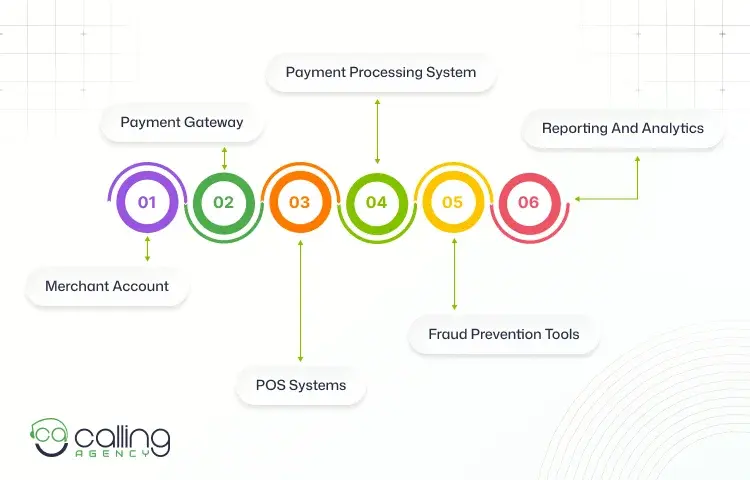
Merchant Account
It is a special bank account. Here funds come from card payments. This process is held before the payment is transferred to your business account.
Payment Gateway
Payment gateway is like technology. It securely captures and transfers payment data from customers to processors.
POS Systems
POS systems are the hardware and software. They are used to accept in-store payments.
Payment Processing System
The payment processing system handles everything related to transactions. Such as, authorization, clearing, and settlement.
Fraud Prevention Tools
Fraud prevention tools protect businesses from scams. These can be chargebacks or fraudulent transactions.
Reporting And Analytics
Reporting and analytics provide insights. These insights are made into sales, customer behavior, and transaction trends.
When Do You Need Merchant Services vs Payment Processing?
Whether you need merchant services or payment processing, depends on your needs. Let’s get to it in detail.
It’s better you go for merchant services If:
- You want a complete payment solution
- You run a retail store, restaurant, or eCommerce business
- You need POS systems, analytics, and reporting
- You want to scale operations
It’s better you go for payment processing if:
- You already have a system in place
- You only need transaction handling
- You are integrating payments into existing software
Most businesses benefit from merchant services, not just standalone payment processing. So, see which one suits your requirements the most.
Pros and Cons Of Merchant Services
Pros
- It’s an all-in-one solution
- It has better reporting and insights
- It’s scalable for business growth
- It offers improved customer experience
Cons
- Can be more expensive
- May include features you don’t need
- The setup can be complex
Pros and Cons Of Payment Processing
Pros
- It’s simple and focused
- It has lower cost in some cases
- It is super easy to integrate
Cons
- The functionality is limited
- Has no analytics or advanced tools
- Requires additional services
What Are The Common Mistakes Businesses Make While Choosing A Transactional Tool?
Many businesses can’t choose the right platform to make their transactions. Maybe they misunderstand these terms, leading them to make poor decisions. However, the common mistakes you will see that most businesses make are:
- Choosing only payment processing without support tools
- Overpaying for unnecessary merchant services
- Not understanding fee structures
- Ignoring scalability needs
If you want to avoid these, you have to evaluate certain terms first. Like your business size, goals, and growth plans. Then choose the one that fits your business requirements perfectly.
Which One Is Better For Your Business?
There is no one-size-fits-all answer. Because what type of business you are running has a lot to do with which payment medium you will choose. But we can consider some terms for it. Such as:
- Small businesses may start with basic payment processing
- Growing businesses shall go with full merchant services
- Large businesses should always seek for advanced, customizable solutions
Don’t choose a solution that only aligns with your current needs. Choose the one that aligns with your future growth too.
Conclusion
It’s true that merchant services and payment processing are closely related. But they are not the same. Merchant services are like an ecosystem. And payment processing is just a part of it.
If you want to run a modern business efficiently, processing payments won’t be enough. You will also need tools that will make your task easier. They must help you manage, analyze, and optimize your transactions.
Once you understand the difference between merchant services strategies and payment processing, you can make smarter decisions. It will then reduce your costs, and build a stronger payment infrastructure for you.
Frequently Asked Questions
What is the main difference between merchant services and payment processing?
Merchant services include a full range of payment tools. Meanwhile, payment processing only handles the transaction itself.
Do I need both merchant services and payment processing?
Yes, most businesses need both merchant services and payment processing. Payment processing is part of merchant services. So they usually work together.
Can I use payment processing without merchant services?
In some cases, you can use payment processing without a merchant. But you may miss out on important tools for that. Like you may not be able to use analytics, fraud protection, and POS systems if you use only payment processing.
Are merchant services more expensive than payment processing?
Generally, merchant services are more expensive than payment processing. But they offer more value. It’s because they have additional features and more scalability.
Which is better for small businesses?
Small businesses can start with basic solutions. But still, they will benefit more from merchant services as soon as they start growing.