

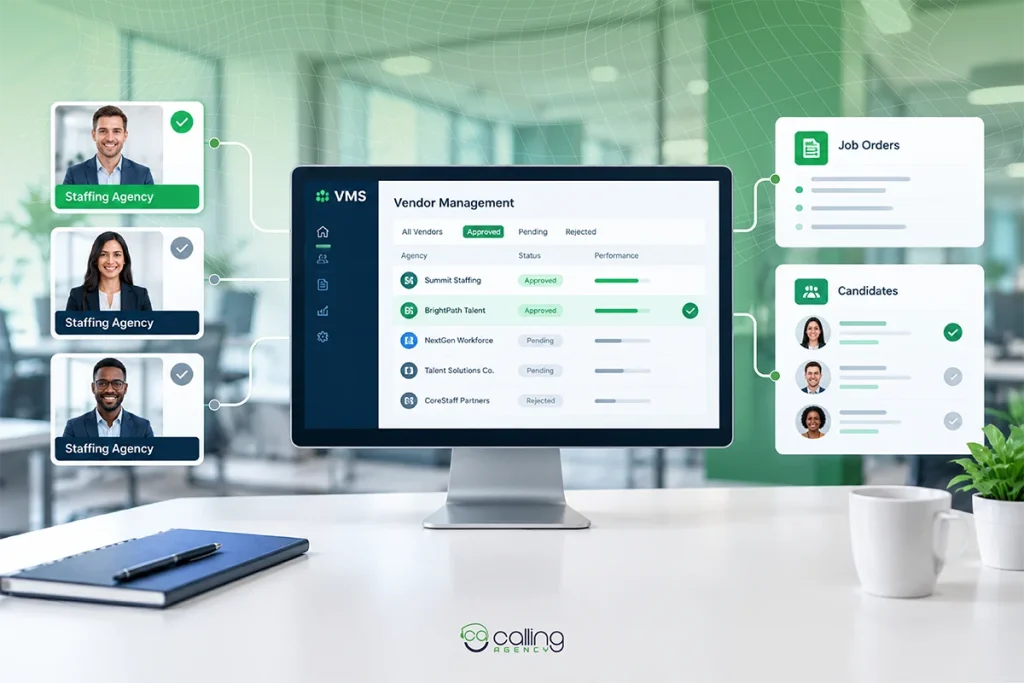
To get on a vendor list, you join the supplier network of the client’s managed service provider (MSP). The MSP runs the hiring program in a vendor management system (VMS). In all four states we checked, that is how agencies get in.
A client can ask for your agency by name, but that rarely happens. Many big clients buy temp staff only through their program, so you need the MSP.
We read public MSP documents from Mississippi, Virginia, Tennessee and Massachusetts. Each rule below comes from one of those state documents, so you can check it yourself. You will see who approves suppliers, what to prepare, when programs open and what a placement earns.
Who Actually Decides Which Agencies Get on the List?
The MSP decides which agencies join its network, and only those agencies see the jobs. The client still approves each hire. If you are not in the network, you won’t see the order. A client can ask for you by name, but the rules are strict.
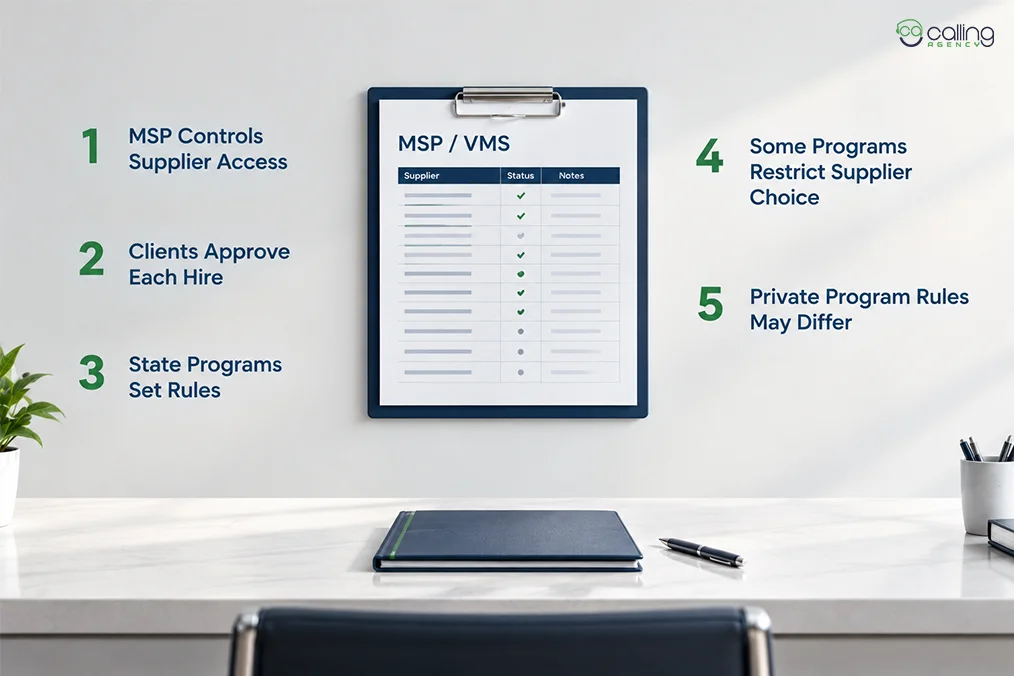
Each state does it a bit differently. In Virginia, clients are told not to name a supplier. For SOW work, the head of the state agency has to say yes. SOW means statement of work, a project billed by deliverable. Hourly work is called staff augmentation.
Tennessee’s draft contract says every open job goes to all suppliers. End users can still ask for one by name. Massachusetts goes a step further. The MSP can’t choose which supplier gets which order. The state sets the rules for each request.
| State program | MSP | VMS | How agencies get in | Naming an agency |
| Mississippi | Knowledge Services | dotStaff | Answer RFP 3850, then register with Knowledge Services and HireRight | Not addressed |
| Virginia (IT) | Computer Aid, Inc. (CAI) | VectorVMS | Join CAI’s subcontractor network | Discouraged. State agency head must sign off for SOW work |
| Tennessee (draft) | Rebid in 2026 | One VMS required | MSP builds a neutral supplier network | End users may request specific suppliers |
| Massachusetts | Sevenstep | VectorVMS | Pre-registered suppliers | MSP cannot route orders on its own |
Public Programs Run Through One MSP, Private Ones Are Unclear
In all four states, the client owns the budget and the hire. The MSP owns the supplier list. So start with the MSP.
- In Mississippi, answer request for proposal (RFP) 3850, then register with Knowledge Services. Intake closed September 30, 2026, so watch for a reopening.
- Massachusetts keeps adding suppliers during the contract. So new agencies can still get in.
Private programs are harder to read. We found no public rules for how they pick suppliers. So we can’t promise a client sponsor will get you in. You’ll hear that a hiring manager’s request opens the door. That may be true at some companies. Ask the program for its rules before you count on it.
What to Have Ready Before a Program Says Yes
Get your paperwork ready before you apply. Programs move fast when they need staff. If your papers aren’t ready, another agency gets the job.
Start With the Basics
Most programs ask for the same things. Get these first.
- IRS Form W-9.
- Insurance certificates at the program’s required limits.
- Staffing agency registration in each state where you place workers.
- Workers’ compensation coverage in every state you serve.
- Current licenses for any regulated roles.
- An account with the program’s background check company.
- E-Verify enrollment, if the program asks for it.
Then Check What Each State Adds
Each state has its own extra rules. Here is what we found.
- Mississippi wants HireRight, a background check company, to list your agency as active first. Then the MSP adds you. You also pay a $150 state fee to answer RFP 3850.
- In Tennessee’s draft, prescreening costs pass through to the state agency. Each job lists its checks. Your insurance must also name the state as an additional insured.
- Virginia wants a national criminal background check on every candidate. You run E-Verify and send CAI the result. State law requires it for firms averaging over 50 employees on contracts over $50,000.
- Massachusetts makes you register even if you have no office in the state.
Why Speed Matters
In Virginia, CAI sends screened candidates to state agencies within 4 days. You can’t make that window if your checks aren’t done. So set up your accounts and run your checks before the first order comes in.
Who to Contact and in What Order
Call the MSP first. Then reach the hiring managers whose roles stay open. In every public program we looked at, the MSP adds new agencies to its VMS. A hiring manager helps later, when you can fill a role they struggle with. A decision-maker map helps you identify the right contacts and understand who approves suppliers versus who makes hiring decisions. Booking those manager meetings is core staffing lead generation work.
Follow this order:
- Confirm the client runs a program and which MSP manages it.
- Get your supplier paperwork ready.
- Contact the MSP’s supplier or program manager.
- Reach out to hiring managers whose roles stay open.
- Time your push to a rebid or enrollment window.
- Track your scorecard from the first order.
What to Say on the Call
Lead with the job types and locations you can fill fast. A general pitch gives the manager nothing to act on. Massachusetts even tells you who to ask for. Its contract guide lists the Sevenstep program manager for questions from new suppliers.
Match Their Speed
Each program runs on a clock. In Virginia, CAI sends screened candidates to state agencies within 4 days. In Massachusetts, the MSP must send resumes within 3 business days, with at least 3 resumes per position. If you can’t submit that fast, you don’t help the MSP. So pitch the roles you can fill inside those windows.
How to Find Which MSP Runs a Program and Who Supplies It
Check the state’s procurement records. Public contracts name the MSP. Virginia’s policy names CAI. Mississippi’s checklist names Knowledge Services. For a private client, ask procurement or the hiring manager directly.
You can also see who is already in:
- Massachusetts publishes its MSP’s list of 24 supplier agencies, as of July 2025. It adds new suppliers during the contract. Those agencies are based in places like Alabama, Georgia, Indiana, New Jersey and Texas.
- Virginia’s CAI posts its approved SOW suppliers by category.
- One MSP can run more than one state. CAI runs Indiana’s contingent labor program on VectorVMS, just like Virginia’s.
Some programs use other VMS platforms, such as SAP Fieldglass and Beeline. These records make it easier to build prospect lists of MSPs, staffing programs, and potential clients that match your agency’s services.
Timing Your Entry Around Rebids and Supplier Reviews
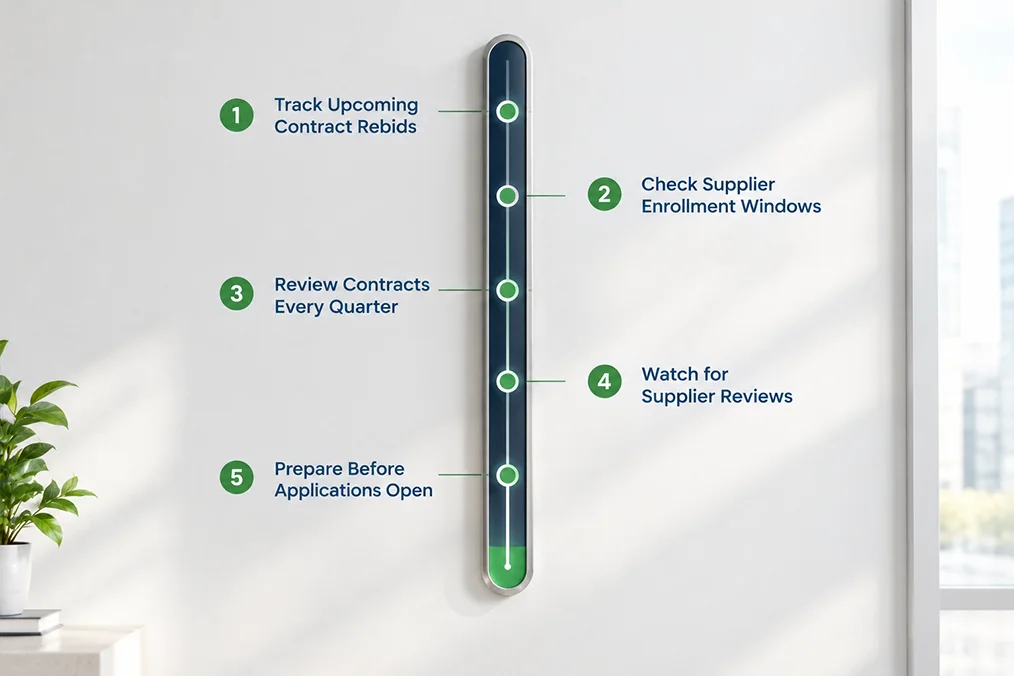
Programs let new agencies in at two times. One is when the MSP gets rebid. The other is when suppliers enroll. Outside those times, many programs already have the staff they need. So watch for both and you reach the MSP while it is building its pool.
Rebids
Tennessee rebid its MSP in 2026. Its draft tells the winning MSP to build its own supplier network. The base term is 60 months. It can run up to 84 months.
- The request for information got 30 responses by January 16, 2026.
- Proposals closed September 1, 2026. Signing is now set for November 30, 2026.
- Mississippi took new vendor proposals for RFP 3850 through September 30, 2026.
Enrollment and Supplier Reviews
- Virginia opens enrollment for SOW suppliers twice a year, based on a 2024 VITA briefing. Staff augmentation suppliers sign up on CAI’s Virginia site. CAI’s contract was restated June 26, 2026.
- Tennessee reviews suppliers at least twice a year and can drop one who skips a requested review.
- Massachusetts runs its MSP contract from July 1, 2025 to December 31, 2031. It keeps adding suppliers.
Where to Check
A contract’s end date tells you when the network gets rebuilt. Tennessee posts its RFP documents and amendments on the state procurement site. Massachusetts posts its contract files on COMMBUYS, no login needed. Check both each quarter.
What Does a Program Placement Actually Earn?
You earn what is left of the spread. The spread is the gap between the bill rate and the pay rate. Massachusetts caps markup at 36.5% over pay. Payroll costs, any MSP share and your profit all come out of that gap.
Massachusetts posts a top bill rate and a lowest pay rate for each job. So you see the spread before you bid. Take Administrative Support. It bills at $27.04 an hour and the pay floor is $19.81. That leaves $7.23. Payroll taxes, workers’ compensation, any MSP share and your profit come out of that $7.23. Every rate pair we checked on the rate card works out to 36.5%.
What the MSP Takes and How Fast You Get Paid
Tennessee’s draft fixes the MSP fee for the whole contract. It also bans registration and invoicing fees for suppliers. The MSP keeps its fee from the bill rate and pays you the rest. The draft leaves the fee blank. None of the documents we read show a real MSP fee.
Virginia shows how pay terms can look. CAI’s June 2026 agreement pays you in 15 days for a 1% fee. Faster pay costs more.
- 7 days costs 2%.
- 2 days costs 3%.
- Or you can pick net 10 days after CAI gets paid.
Read These Terms Before You Sign
Check the fee, conversion and non-compete terms first. They decide what each placement earns. Some programs call this document a preferred supplier agreement. A conversion fee is what you earn if the client hires your worker. Tennessee’s draft sets it by hours worked. Massachusetts sets it by days.
| Stage | Tennessee draft (hours worked) | Massachusetts (days) |
| Early hire | 18% (0–320 hours) | 15% (30 days) |
| Middle hire | 12% (321–640 hours) | 10% (60 days) |
| Late hire | 6% (641–959 hours) | 5% (90 days) |
| After threshold | None (after 959 hours) | None (over 90 days) |
After 959 hours, Tennessee’s draft also says you must free the worker from any non-compete.
Can a Small Agency Get Onto a Big Program?
Yes. Public contracts limit how much work the MSP can give its own agencies. Most work goes to outside suppliers. Without that limit, an MSP could fill jobs with its own staffing arm. Tennessee and Massachusetts both put this in their contracts.
How the Contracts Protect Outside Agencies
- Tennessee’s draft caps the MSP and its affiliates at 10% of workers per job category.
- The same draft wants 90% or more of workers to come from suppliers the MSP does not own.
- The MSP must tell the state if it has money in any of its suppliers.
- Massachusetts’ MSP employs no temp workers on the contract, so it doesn’t compete with you.
Massachusetts keeps adding suppliers during the contract. Its list has agencies based in Alabama, Georgia, Indiana, New Jersey and Texas. You don’t need an office in the state, but you do have to register. A small agency with a clear niche and fast submittals fits well.
Routes for Small and Diverse Suppliers
Virginia’s SOW tiers start at $300,000, so small and SWaM firms can compete. SWaM means small, women-owned and minority-owned. Tennessee’s draft requires a quarterly report on diverse business use. Massachusetts wants 30% of program spend to go to diverse suppliers. Its MSP marks 16 of its 24 listed agencies as diverse. You don’t need certification to join the list.
How Scorecards Decide Your Order Flow After You Are in
Getting on the list is just the start. Your scorecard decides if you stay. Losing a listing wastes the staffing agency lead generation cost behind it, so watch your numbers from day one. One bad quarter can lose you the spot you worked hard to get. Be careful with your first orders. Send workers who fit the job and can start now.
What Gets Scored
Tennessee’s draft reviews suppliers at least twice a year. Those reviews also decide who stays. It looks at three ratios.
- Requests to submittals
- Interviews to submittals
- Hires to interviews
Skip a requested review and Tennessee can remove you.
Massachusetts also has each hiring agency rate the MSP every month. Those ratings go into the MSP’s scorecard, not yours. In Mississippi, approved vendors can join a weekly call about current and coming jobs. Be on every call.
Who Sees Jobs First
Some programs show jobs to top scorers first. Tennessee and Massachusetts don’t. Every supplier gets the same shot at each job. So the agency that is fast and fits best wins.
In Massachusetts, the MSP must send resumes within 3 business days, with at least 3 for each position. If you’re slow, the MSP looks bad. Both programs also track the MSP’s fill rate. So every job you fill helps the MSP too.
Frequently Asked Questions
Who pays the MSP fee?
You do. In Tennessee’s draft contract, the MSP takes its fee out of the bill rate. Then it pays you what is left. The documents we read don’t show the percentage. So check your own supplier agreement.
Can an MSP charge me to register?
In Tennessee’s draft, no. The MSP can’t charge you to register or send invoices. Other programs are different. Mississippi charges a $150 state fee to answer RFP 3850. In Virginia, CAI takes registration, administrative and transaction fees out of your pay.
What happens if the client hires my worker?
You may get a conversion fee. In Tennessee’s draft, it is 18%, 12% or 6% of the worker’s yearly base salary. The rate depends on hours worked. After 959 hours, you get nothing. Massachusetts pays 15% at 30 days and nothing after 90 days.
Do all programs release jobs in tiers?
No. Some programs show jobs to top suppliers first. Tennessee’s draft sends every open job to all suppliers. Massachusetts gives every pre-registered supplier the same chance at each job.
Can an out-of-state agency join a state program?
Yes, at least in Massachusetts. Its list has agencies based in Alabama, Georgia, Indiana, New Jersey and Texas. You still need registration and insurance for the state where your workers will work. Get those before they start.