



Manufacturing firms are utilizing multi-channel marketing to draw potential clients as opposed to just one channel. The buyers in this industry take time in the decision-making process and need multiple interactions through different channels before making a purchase. The ideal system is where SEO, cold emailing and LinkedIn outreach, cold calling and SMS marketing come together.
SEO brings in traffic from engineers and procurement managers who are searching for a solution. Cold email initiates outreach to a specific target audience directly. LinkedIn builds trust by its professional interaction with decision makers. Cold calling is a strategy that qualifies and converts interesting leads into genuine opportunities. Marketers use SMS marketing for doing prompt follow-ups & reaching users with meeting confirmations.
Manufacturers tie all these channels into a CRM system and improve lead tracking, follow-up before the right time and better conversion rates. This holistic approach helps for a repeatable process for generating high-quality B2B manufacturing leads each time.
Why Do Manufacturing Companies Need Multiple Channels?
Manufacturing companies need multiple marketing and sales channels because before contacting a supplier, buyers research products from different places. One channel limits your reach, your leads and customer confidence. Several channels exist to allow manufacturers to reach distributors, wholesalers, procurement mangers and industrial buyers at different steps in the purchase process.
Reach Buyers at Different Stages
Industrial buyers take their time. They study the suppliers regarding their costs, maintainability, shipment time and offering technical assistance. There are buyers who search on Google, or those who search on LinkedIn, trade shows, email or B2B marketplaces. For manufacturers, this means employing a multi-channel approach to ensure that they are where buyers are looking.
For example:
- SEO provides organic traffic that lasts over time.
- LinkedIn is a great tool for connecting with procurement managers.
- Email marketing nurtures leads
- Trade shows create direct connections.
- Paid ads bring in fast leads
Less Dependency on a single Lead Source
One channel is a dangerous game to play. Sales can plummet if Google rankings fall or leads for exhibitions dry up. Having multiple channels gives you a steady flow of leads and diversifies risk in your business.
Improve Brand Trust
Consumers depend on manufacturers that they have encountered multiple times on different platforms. Having a company appear on search engines, social media, industry directories, or other email campaigns helps to adds credibility.
Generate Higher Quality Leads
Different channels draw different types of buyers. SEO pulls in buyers who want to research and learn, and LinkedIn puts you in front of decision-makers who are ready to talk contracts. Having more channels usually leads to better quality of leads and ultimately better conversion rates.
Support Long Sales Cycles
The manufacturing sales cycle is usually long. Multi-channel marketing helps the company to stay on the minds of the potential buyer while being retargeted through ads, follow-up emails, case studies, and technical content throughout the entire buying process.
Expand global market reach
Several manufacturers are on the lookout for overseas buyers. Websites in multiple languages, export directories and digital advertising are some of the different channels for reaching both local and global markets at the same time.
Best Multi-Channel Marketing channels for Manufacturing Lead Generation
Using multiple marketing channels combined gets higher-quality leads for manufacturing companies than relying on a single method of lead generation. Manufacturers and B2B buyers are able to connect with plant managers, procurement teams, distributors, or engineers at various points of the buying funnel through a robust multi-channel strategy.
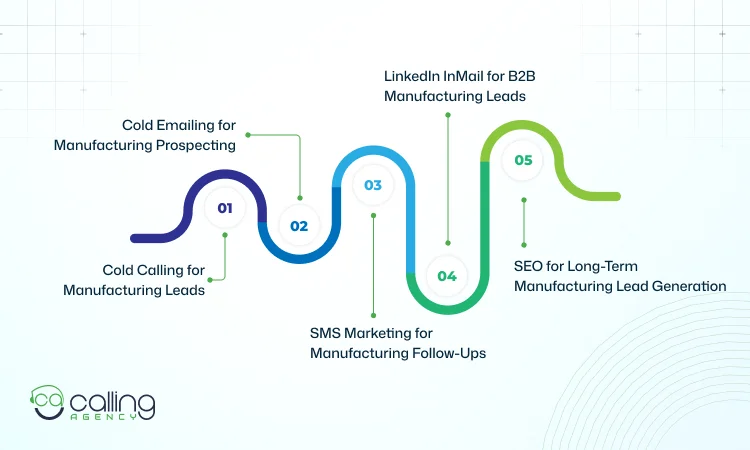
The top lead generation channels for manufacturing are:
- Cold Calling
- Cold Emailing
- LinkedIn InMail
- SMS Marketing
- SEO
When these channels collaborate, manufacturers can get quality B2B leads, RFQs (Request for Quotes) puppies from search engines and reduce the sales cycle.
Cold Calling for Manufacturing Leads
Cold calling still works well in manufacturing because many industrial buyers prefer direct communication before making large purchases.
Why It Works
Manufacturing products often involve:
- High investment
- Technical discussions
- Long buying cycles
- Custom requirements
A phone call allows sales teams to explain solutions quickly and qualify prospects faster.
Best Practices
- Call operations managers, procurement officers, plant heads, and engineers.
- Use industry-specific scripts.
- Mention production problems you solve.
- Focus on cost reduction, efficiency, or supply chain benefits.
Practical Example
Instead of saying:
“We provide industrial equipment.”
Say:
“We help food factories reduce packaging downtime by 25% with automated conveyor systems.”
Best Use Cases
- Industrial machinery
- OEM manufacturing
- Packaging equipment
- Automation systems
- Metal fabrication
Cold calling works best when supported by email and LinkedIn outreach.
Cold Emailing for Manufacturing Prospecting
Cold emailing is one of the most scalable manufacturing lead generation methods.
Why It Works
Industrial buyers research vendors before replying. Email gives them time to review:
- Product catalogs
- Certifications
- Case studies
- Technical specifications
What Makes Manufacturing Emails Effective
Good manufacturing emails are:
- Short
- Technical
- Problem-focused
- Personalized by industry
Best Email Structure
- Mention the prospect’s industry
- Identify a production challenge
- Explain your solution
- Add proof or case study
- Include a simple CTA
Practical Example
A CNC machining company can target:
- Aerospace manufacturers
- Automotive suppliers
- Medical device companies
Email subject example:
“Reducing CNC Production Delays for Automotive Suppliers”
Important Tips
- Avoid generic templates
- Use follow-up sequences
- Add product images or PDF brochures
- Segment by industry type
Cold emailing works extremely well when combined with SEO and LinkedIn.
LinkedIn InMail for B2B Manufacturing Leads
LinkedIn is one of the best platforms for manufacturing decision-makers because most procurement and operations professionals actively use it.
Why LinkedIn Works
You can directly target:
- Factory owners
- Supply chain managers
- Procurement directors
- Industrial engineers
- Manufacturing consultants
Best LinkedIn Strategy
- Optimize company profile
- Share factory videos and case studies
- Connect with industry professionals
- Send personalized InMail messages
Effective InMail Formula
- Mention their company
- Reference industry pain points
- Offer a short solution
- Keep message under 120 words
Practical Example
A robotics manufacturer can target warehouse companies struggling with labor shortages.
LinkedIn is especially powerful for:
- High-ticket manufacturing services
- Industrial automation
- B2B partnerships
- Export manufacturing
SMS Marketing for Manufacturing Follow-Ups
SMS marketing is highly effective for follow-ups because text messages have very high open rates.
Best Use Cases
- Appointment reminders
- RFQ follow-ups
- Demo scheduling
- Trade show follow-ups
- Production updates
Why SMS Works
Industrial buyers are busy. Short messages get attention faster than long emails.
Example SMS
“Hello John, this is Alex from ABC Manufacturing. Following up regarding the custom aluminum parts quotation sent yesterday.”
Important Rules
- Keep messages short
- Never spam
- Use SMS mainly after first contact
- Include clear action steps
SMS works best as a support channel, not the main lead generation channel.
SEO for Long-Term Manufacturing Lead Generation
SEO is one of the highest ROI channels for manufacturing companies because industrial buyers search Google before contacting suppliers.
Why SEO Is Important
Buyers search terms like:
- “industrial valve manufacturer”
- “custom metal fabrication company”
- “OEM plastic injection molding supplier”
If your website ranks on Google, you get consistent inbound leads.
Best SEO Strategies
- Create service pages for each product
- Publish technical blogs
- Add industry case studies
- Optimize for local and global keywords
- Use fast and mobile-friendly websites
High-Converting Manufacturing Content
- Product comparison articles
- Industry guides
- Technical specifications
- Cost breakdowns
- Maintenance tips
Practical Example
A solar panel manufacturer can rank for:
- “commercial solar panel supplier”
- “high-efficiency solar panels”
- “solar panels for factories”
SEO takes time but produces long-term lead flow without depending fully on paid ads.
How to Generate Manufacturing Companies Leads with Multi-Channel Marketing?
Step by step manufacturing lead generation framework is a systematic method of generating new leads and converting prospective buyers into loyal customers in the manufacturing industry. Buyers in this case consist of procurement managers, plant heads, engineers, and distributors who buy slowly. They require multiple touch points across channels to make a decision. This will be a pipeline that ties all of these together–one funnel where SEO, cold emailing, LinkedIn InMail, cold calling, and SMS marketing are all baked into the same connected framework supported by the right tools and automation.
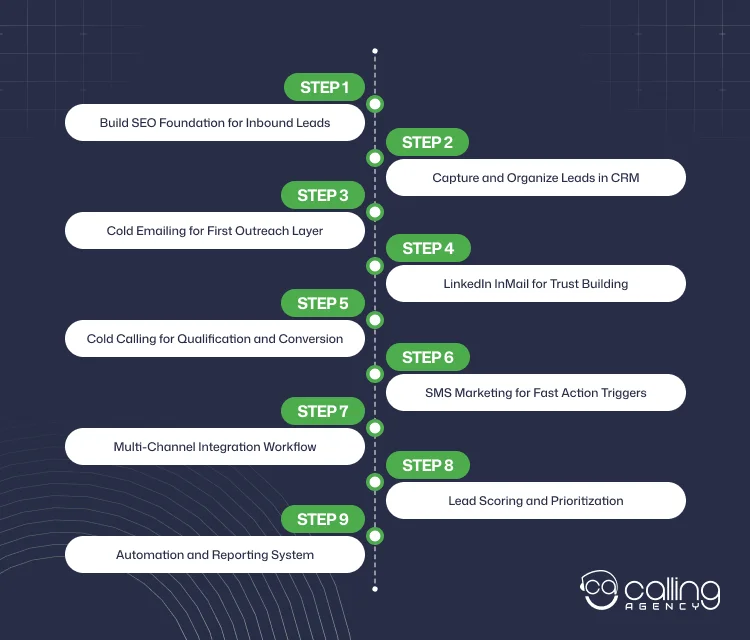
Step 1: Build SEO Foundation for Inbound Leads
SEO is the starting engine of manufacturing lead generation since it generates high intent buyers coming from search engines.
What to do:
- Build product-centric pages (a search like “supplier of an industrial packaging machine”).
- Create solution pages (e.g. when searching for solutions to reduce factory downtime).
- Spec, certification, load capacity and use cases — Add technical content
- Write blog posts that solve problems for buyers.
Tools:
- Keyword performance tracker using Google Search Console
- Ahrefs / SEMrush (keyword research)
- WordPress or Webflow (website building)
Practical outcome:
SEO brings in leads who come with buying intent already. They flow straight into your CRM for follow up.
Step 2: Capture and Organize Leads in CRM
Companies store all traffic from SEO, ads, or outreach in a CRM system.
What to do:
- Add Website forms: “Request Quote,” “Download Catalog” as a trainer
- Analyze user activity (pages viewed, spent time).
- Segment leads by interest level: cold, warm, hot.
Tools:
- HubSpot CRM
- Zoho CRM
- Pipedrive
Practical outcome:
You create a systematic database rather than random contacts. Keep track of every lead history for multi-channel followup.
Step 3: Cold Emailing for First Outreach Layer
Sales teams use cold email to start communication with new or semi-warm leads.
What to do:
- Build 3–5 step email sequence.
- Email 1: identify pain point (cost, delay, efficiency).
- Email 2: case study or proof of performance.
- Email 3: product benefit comparison.
- Email 4: direct meeting request.
Best practices:
- Keep emails under 120–150 words.
- Use personalization (company name, industry type).
- Focus on ROI, not branding.
Tools:
Practical outcome:
Cold email turns unknown leads into engaged prospects.
Step 4: LinkedIn InMail for Trust Building
Marketing teams that want to reach the top decision-makers in manufacturing companies use LinkedIn.
What to do:
- Role Identify: Procurement Manager, Plant Head, Operations Director
- Write value Add InMail Messages in short.
- Engage with posts before messaging.
- Show evidence: factory images, diplomas or client case.
Example message:
“We make packaging plants 25% more productive by reducing machine downtime.” Can I share a case study?”
Tools:
- LinkedIn Sales Navigator
- Expandi / Dux-Soup (automation)
- Shield Analytics (engagement tracking)
Practical outcome:
LinkedIn establishes trust first before using sales outreach.
Step 5: Cold Calling for Qualification and Conversion
Sales teams use cold calling after digital engagement, not before.
What to do:
- Call leads who opened emails or visited pricing pages.
- Ask qualification questions:
- What machines are you currently using?
- What challenges do you face in production?
- What is your purchase timeline?
Script structure:
- Introduction (10 seconds)
- Problem identification
- Solution positioning
- Meeting or quotation request
Tools:
- Aircall / CloudTalk (calling system)
- CRM integration (call tracking)
Practical outcome:
Cold calling filters serious buyers and speeds up conversion.
Step 6: SMS Marketing for Fast Action Triggers
Businesses use SMS for urgent communication with warm leads.
What to do:
- Send meeting confirmations.
- Share quotation alerts.
- Send limited-time offers or delivery updates.
Example:
“Your industrial compressor quote is ready. Reply YES to schedule a call today.”
Tools:
- Twilio (SMS automation)
- TextMagic
- Zapier (automation workflow)
Practical outcome:
SMS increases response speed and reduces lead drop-off.
Step 7: Multi-Channel Integration Workflow (Core System)
This is where all channels work together in one system.
Flow:
- SEO attracts visitor → landing page conversion
- CRM stores lead automatically
- Cold email sequence starts
- LinkedIn engagement builds trust
- Cold call triggered after engagement
- SMS sent for urgency or confirmation
Tools:
- HubSpot / Zoho (central CRM)
- Zapier / Make (automation between tools)
- Google Analytics (traffic tracking)
Practical outcome:
Every lead moves through a structured journey instead of random contact.
Step 8: Lead Scoring and Prioritization
Not all leads are equal in manufacturing sales.
What to do:
- Assign scores based on actions:
- Website visit = +5
- Email open = +10
- Reply = +20
- Call request = +30
Tools:
- HubSpot Lead Scoring
- Zoho Automation Rules
Practical outcome:
Sales team focuses only on high-value leads.
Step 9: Automation and Reporting System
Automation reduces manual work and increases speed.
What to do:
- Auto-send emails after form submission.
- Trigger LinkedIn message after email open.
- Schedule SMS after call booking.
- Generate weekly performance reports.
Tools:
- Zapier / Make (workflow automation)
- Google Data Studio (reporting dashboards)
- CRM analytics tools
Practical outcome:
The system runs continuously without manual effort.
Common Manufacturing Lead Generation Mistakes
Many manufacturing companies are not generating steady leads because their B2B marketing strategy and follow up systems are not effective. The industrial buyers of today are searching suppliers on the internet, comparing capabilities side by side and expecting fast communication. Understanding these traps will help improve lead quality for manufacturers and in turn, sales conversions.
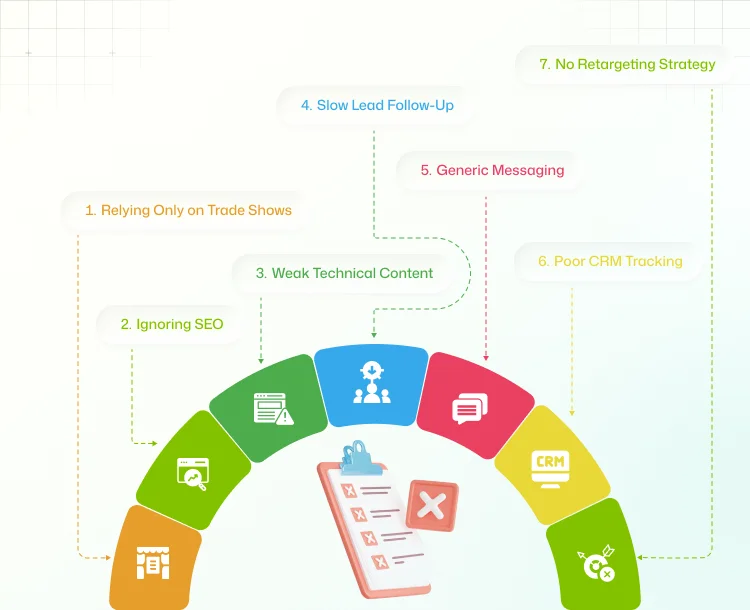
Relying Only on Trade Shows
All manufacturers lean on trade shows to get leads. That decreases the lead flow since this only happens a few times a year. Before exhibitions, buyers will also search suppliers online. Manufacturers must use trade shows in tandem with SEO, LinkedIn, cold email and follow-up campaigns.
Ignoring SEO
No SEO means a manufacturing company is losing people looking for them on Google for them as their suppliers and as an OEM service. Many industrial buyers search for the following terms:
- “CNC machining supplier”
- “Metal fabrication company”
- “Plastic injection molding manufacturer”
Without optimization, your website is missing out on those leads.
Weak Technical Content
In manufacturing, generic marketing content is ineffective. Purchasers want technical information like:
Certifications
- Tolerance capability
- Materials supported
- Machine capacity
- Production lead times
- Technical content fosters trust and boosts conversions.
Slow Lead Follow-Up
Manufacturing companies often lose leads since they are slow to respond. Industrial buyers are usually going to contact a few suppliers at once. Faster response times lead to a higher chance of contracts.
Generic Messaging
Mass emails with robotic, repetitive sales messages will be ignored by the recipients. Manufacturing outreach should focus on industry concerns, speed of delivery, quality assurance and cost reduction.
Poor CRM Tracking
In long sales cycles companies lose leads without CRM tracking. The manufacturers should track calls, mails, quotations, and buyers interactions too over one system.
No Retargeting Strategy
Many buyers visit manufacturing sites and yet fail to contact sales. The other thing is, retargeting ads can catch those visitors over time and convert them.
Using AI and Data Analytics for Manufacturing Lead Generation
The AI and data analytics used in manufacturing also help many companies gain higher-quality leads, cut out wasted outreach, and improve conversion rates. Businesses have moved from random prospecting to data driven systems which find out high-intent
buyers and predict demand while offering personalization in outreach across. cold calling, cold emailing, Linkedin InMail, SMS marketing and SEO
AI-Based Lead Identification in Manufacturing
There are; AI tools that collect and analyze data from websites, trade directories, CRM systems and buyer behavior. This is helpful in manufacturing, so you find companies looking for parts, machines or industrial services.
Key actions:
- Use AI scraping tools to collect B2B company data (industry, size, location)
- Apply intent data to find companies visiting product pages or searching industrial keywords
- Filter leads based on production capacity, procurement cycle, and budget signals
This ensures sales teams focus only on high-probability buyers.
Predictive Lead Scoring with Data Analytics
Data analytics assigns scores to leads based on behavior and fit. This removes guesswork from sales.
Important scoring factors:
- Website visits to technical pages (spec sheets, pricing pages)
- Email engagement (opens, clicks)
- Past purchase patterns in similar industries
- Company growth signals like hiring or expansion
Manufacturers can prioritize leads with high scores for immediate outreach.
Cold Calling Using AI Insights
Cold calling becomes effective when guided by AI data.
Practical use:
- AI provides decision-maker names (procurement heads, plant managers)
- Shows best calling time based on past engagement data
- Suggests pain points (cost reduction, supply delays, capacity issues)
Targeted and relevant calls increase conversion rates.
Cold Emailing with Personalization
AI improves cold email success by generating personalized content.
How it works:
- Segment leads by industry (automotive, construction, electronics)
- Auto-generate email content based on company needs
- Use A/B testing to optimize subject lines and response rates
Example: emails for machinery buyers highlight efficiency and downtime reduction instead of generic product lists.
LinkedIn InMail Targeting
Data analytics identifies high-value LinkedIn profiles.
Best practices:
- Target procurement managers, engineers, and plant directors
- Use AI to match skills, job roles, and company size
- Send personalized InMail based on recent company updates
This builds trust before direct sales contact.
SMS Marketing for Fast Engagement
SMS works well for urgent updates and re-engagement.
Use cases:
- Product availability alerts
- Trade show invitations
- Follow-up reminders after quotes
AI helps schedule SMS at optimal response times.
SEO for Manufacturing Lead Generation
SEO brings long-term inbound leads.
AI supports SEO by:
- Finding high-intent keywords like “industrial machine suppliers”
- Analyzing competitor rankings
- Optimizing content for buyer search intent
This ensures manufacturing companies attract organic B2B traffic consistently.
Future Trends in Manufacturing Lead Generation
Manufacturing lead generation is becoming more digital, data-driven, and AI-powered. Today, industrial buyers are researching suppliers online before reaching out to sales teams. Automation, personalized marketing, predictive analytics, and multi-channel engagement will be key areas of emphasis for future manufacturing marketing. Modern lead generation methods will bring in more qualified B2B buyers and increase conversion rates for companies.
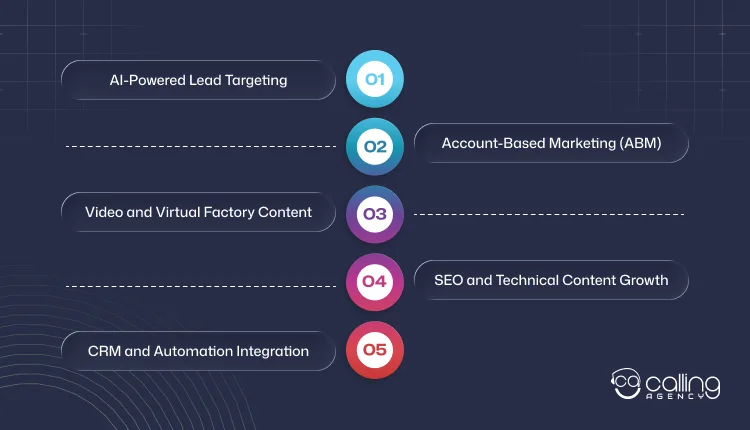
AI-Powered Lead Targeting
AI is playing a significant role in manufacturing marketing. AI tools are being leveraged by companies to find buyers who are actively looking for suppliers, to understand buyer intent, and to tailor outreach campaigns automatically. Predictive targeting enables sales teams to target quality leads rather than random prospecting.
Account-Based Marketing (ABM)
Manufacturers are moving toward account-based marketing instead of mass marketing. ABM focuses on specific companies and decision makers, delivering personalized content, LinkedIn outreach, and custom email campaigns. This helps to increase the response rate from procurement managers and industrial buyers.
Video and Virtual Factory Content
Video content is becoming a top choice for industrial buyers before reaching out to suppliers. Factory tours, machine demonstrations, quality inspections, and videos about the production process help to establish trust more rapidly than a text-only website.
SEO and Technical Content Growth
SEO will keep expanding as most buyers will search Google before reaching out to manufacturers. Companies that have detailed technical content, industry-specific pages, and case studies will generate more inbound leads.
CRM and Automation Integration
CRM automation will be a key element in future manufacturing lead generation. Systems automatically track website visits, email opens, calls, quotations, and buyer behavior to improve sales follow-up efficiency.
Final Words
It’s not just about one channel, it’s about creating a system of channels that work together to generate manufacturing leads. SEO generates targeted traffic, cold email initiates conversations, LinkedIn establishes trust, cold calling turns interest, and SMS ensures immediate responses.
By connecting these channels through a CRM, manufacturers can monitor all leads and follow up with them at the right time. This makes things more efficient and boosts the conversion rate. When it comes to B2B leads service, it’s better to create a system of marketing channels than to send out random emails.
Test, test, and test some more – begin with a small amount, test each channel and then scale what works for your industry. Use this approach to generate a steady stream of qualified customers and ensure long-term growth for your manufacturing company.
FAQs
How Do Manufacturing Companies Generate B2B Leads?
Manufacturing companies create B2B leads through SEO, cold emailing, LinkedIn outreach, cold calling, trade shows, and referrals. They use these channels to connect with procurement managers and engineers, and then use CRM systems and follow-up sequences to nurture leads.
What Is The Best Marketing Channel For Manufacturing Companies?
There is no one right channel. SEO is for inbound leads, LinkedIn is for decision makers, and cold email is for outreach. The most effective approach is to use several channels together within a single lead generation system.
Does SEO Work For Industrial Businesses?
Yes, SEO is very effective for industrial businesses. Buyers look for suppliers, machines and technical solutions online. In the long term, SEO can help manufacturers rank for these searches and attract high-intent leads without paid ads.
What Is The Best CRM For Manufacturing Companies?
Some of the most popular CRMs for manufacturing companies are HubSpot, Zoho CRM, and Salesforce. Businesses use them to monitor leads, track sales funnels, automate follow-ups, and integrate marketing channels such as email, phone calls, and website visits into a single platform.
Are Trade Shows Still Effective For Manufacturing Marketing?
Yes, trade shows are still good for manufacturing marketing. They are useful for establishing direct relationships, promoting products and creating quality leads. But they are most effective when used in conjunction with digital marketing for follow-up and lead nurturing.
How Much Should Manufacturers Spend On Marketing?
Typically, manufacturers allocate 3% to 8% of their annual revenues to marketing. New or emerging businesses can invest more. The budget will vary based on objectives, competition, and whether it’s digital, trade shows or outbound sales.
What Is Account-Based Marketing In Manufacturing?
Account-based marketing (ABM) is a marketing strategy that focuses on specific high-value companies rather than a wide audience. Emails, LinkedIn, ads and calls are used to tailor campaigns to key accounts. It is all about quality leads and increased conversion rates.
Which Digital Marketing Channel Gives The Best ROI For Manufacturers?
For manufacturers, the best ROI is typically from SEO and LinkedIn. SEO brings long-term organic leads, while LinkedIn helps reach decision makers directly. They, along with email outreach, form a high return, low cost lead generation system.