

Cold calls and hope do not land B2B clients in tech. Because software buyers can’t touch or test a product the way they can a physical one, tech client acquisition runs on a logical, step-by-step process built on trust, proof, and precise targeting.
IT and tech companies build a B2B pipeline through eight core channels:
- Account-based marketing (ABM)
- LinkedIn prospecting
- Cold email
- SEO and content marketing
- Referrals and partner networks
- Events and analyst relations
- Software review platforms
- Cold calling with outsourced SDR support
Who this guide is for: Founders and sales leaders at IT services, SaaS, and software companies that have clients and now need scalable IT lead generation service outside of referrals. It illustrates what truly generates a qualified pipeline, by when, and for what buyer roles.
Most IT and tech companies get their first clients by the same path:
- An introduction by a co-founder,
- A former colleague who is looking for a vendor or recommendation from a happy customer.
A satisfied client refers someone they know. That motion carries most tech firms through their first five to fifteen clients. Then it slows.
The channel that worked when you knew every prospect personally completely fails when you need to find people you have never met before. Your product and your pricing are not the problem.
Referrals are random. They cannot be scheduled, and they cannot fill a quarter that needs twelve new qualified appointments. That’s exactly where a deliberate mix of the eight channels below takes over. That is where a careful blend of channels comes into play.
ABM dictates accounts to target. The other channel targets contacts at different stages in the funnel. SMB deals take weeks to close via product-led growth (PLG) and self-serve trials, whereas enterprise takes 3–9 months due to multi-stakeholder approval, security compliance checks (SOC 2, ISO 27001), and proof-of-concept (POC) tests.
At the heart of solving problems with tech companies is trust. A CFO is not going to approve spending without an ROI proof. The CTO would not sign off on integration until it was technically validated. None can be accessed by a CISO without compliance certifications.
This is exactly why tech client acquisition is a longer, more complex process than the average B2B purchase and why, when relying on one channel, almost all efforts fail.
This guide charts the 8 channels that IT and tech companies use to build a B2B pipeline, what buyer roles respond to each, how long each takes to show results, and how best to select the ideal mix of these for your stage.
Why Tech Client Acquisition Is Different From Other B2B Sales
For tech companies, this means their ability to simplify the acquisition problem is tougher than that of the vast majority of B2B sellers. The core offering is much more tangible, simple, and not often subject to multiple stakeholder reviews and purchases.
With no physical presence to your software, you can’t touch it, see it on a shelf, or demo it in a five-minute meeting. Buyers must see proof: technical validation, evidence of ROI, assurance of security, all before they will commit budget. It is this requirement for proof that turns tech sales cycles from weeks into months and pushes CAC as far as in other industries.
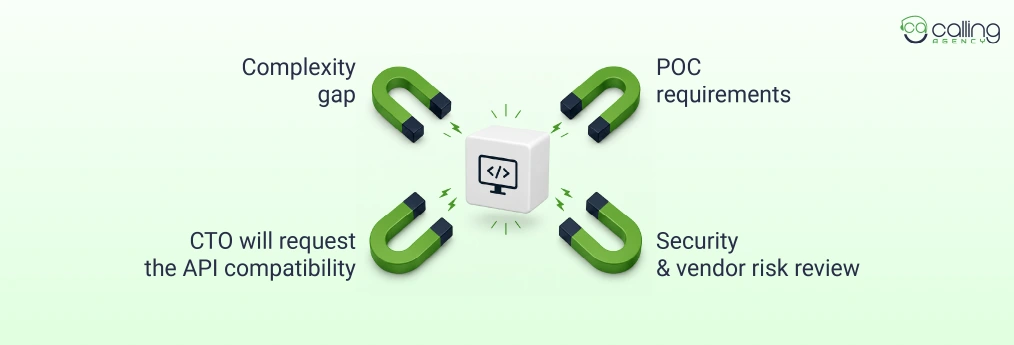
Four forces drive this complexity:
- Complexity gap: It takes multiple sales conversations to get a yes from a buyer – demos, integration checks, security reviews, etc.
- A CTO will request API compatibility: one CFO will ask for the minimal feasible TCO, and the end user will inquire about usability. Very few, perhaps no, pitches can deliver all 3 on a single pitch.
- POC requirements: Many of the enterprise deals include a pilot first, which consumes engineering effort, takes time, and delays revenue recognition.
- Security & vendor risk review: As software deals with sensitive data, the buyers look for certifications (SOC 2, ISO 27001, etc.) as well as Service Level Agreement (SLA) terms to be audited, extending the checklist of due diligence activities that are standard with any software purchase.
Who Signs Off on a Tech Vendor Deal?
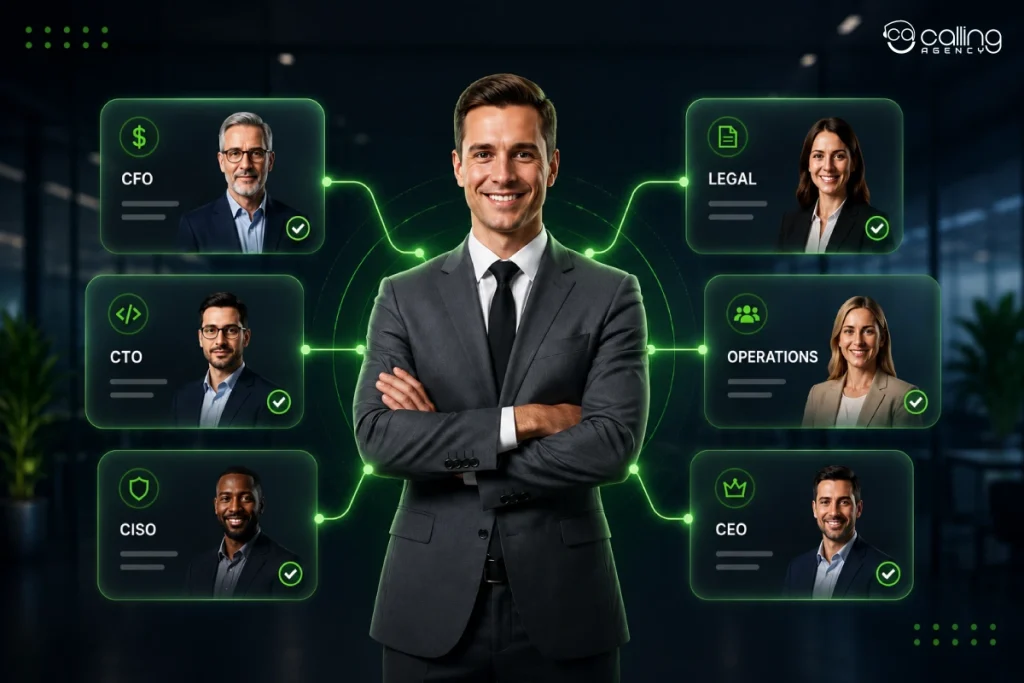
A standard technology vendor deal must get approval from 5 to 8 stakeholders across IT, finance, security, legal, and operations, which is why B2B tech sales cycles take 3–9 months longer than a conventional business purchase. This means that no deal can be approved by one champion, as each stakeholder owns a different risk.
| Stakeholder | Role in Deal | Primary Concern | Deal-Breaker Trigger |
| Economic Buyer (CFO / Procurement Head) | Approves budget and final spend | ROI, Total Cost of Ownership (TCO) | Pricing exceeds budget or lacks cost justification |
| Technical Buyer (CTO / VP Engineering) | Validates architecture fit | Scalability, API compatibility, integration ease | Poor documentation or incompatible tech stack |
| CISO / Security Lead | Assesses data and infrastructure risk | Compliance certifications (SOC 2, ISO 27001), data residency | Failed security audit or vague SLA terms |
| End-User Champion (Team Lead / Ops Manager) | Represents daily users | UX friction, adoption ease, training overhead | Poor usability feedback from POC |
| Legal / Procurement Team | Reviews contracts and liability | Contract terms, vendor risk, indemnification | Unfavorable liability or termination clauses |
| IT Operations | Manages deployment and maintenance | Uptime, support responsiveness, SLA guarantees | Weak support or escalation process |
| C-Suite Sponsor (CEO/COO, strategic deals) | Final strategic approval | Alignment with the company roadmap | Deal doesn’t support long-term business goals |
Why does this matter?
Modern B2B tech sales are multi-threaded because no one wants to take on the operational or security risk on their own. The team seeks to engage several stakeholders simultaneously instead of relying on a single internal champion. Companies that identify this committee early shorten the sales process and reduce deal friction.
Providing ROI calculators to the Economic Buyer and the Technical Buyer or End-User Champion with relevant case studies is two ways to ensure each stakeholder can validate the decision within their own circle of influence, which expedites the deal through the committee.
The 8 Channels IT and Tech Companies Use to Get B2B Clients
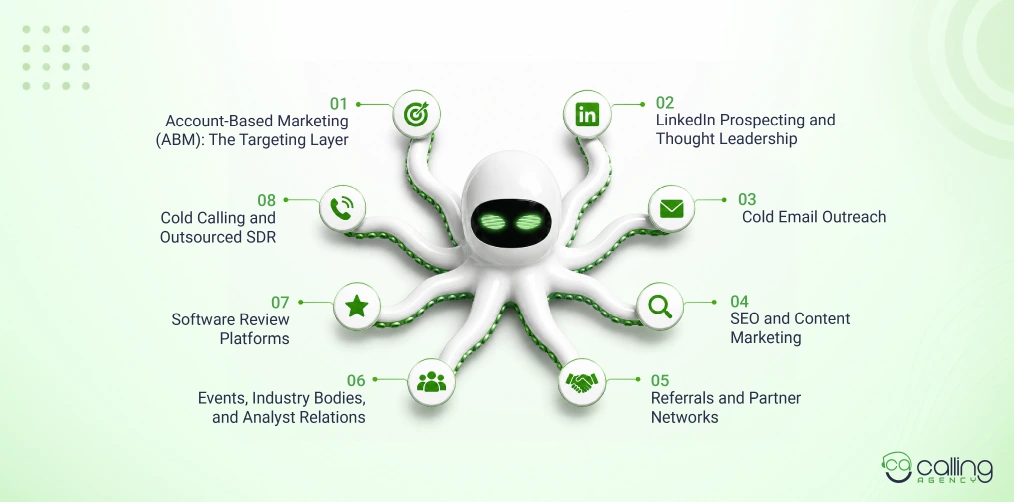
IT and tech companies build B2B pipeline through eight core channels: Account-Based Marketing (ABM), LinkedIn, cold email, SEO and content marketing, referrals and partner networks, events and analyst relations, and cold calling. Companies that combine three to four of these channels see shorter sales cycles and lower CAC than companies relying on just one.
Channel Summary Table
| Channel | Typical Timeline | Effort Level | Primary Buyer Reached | Relative Cost |
| ABM (Targeting Layer) | Ongoing; 3–6 months to mature | High (strategic setup) | All stakeholders (multi-threaded) | Medium–High |
| LinkedIn Prospecting & Thought Leadership | 2–4 months to build traction | Medium | Technical & economic buyers | Low–Medium |
| Cold Email Outreach | Immediate to 1 month | Medium | Economic buyer, end-user champion | Low |
| SEO & Content Marketing | 6–12 months to mature | High (sustained) | All stages, self-educating buyers | Medium (long-term ROI) |
| Referrals & Partner Networks | Ongoing, compounding | Low–Medium | Economic & technical buyer | Low |
| Events, Industry Bodies, Analyst Relations | 3–9 months (enterprise cycles) | High | C-suite, technical buyer | High |
| Software Review Platforms | Ongoing, builds over time | Medium | End-user, decision-stage buyer | Low–Medium |
| Cold Calling & Outsourced SDR | Immediate | High (labor-intensive) | Economic buyer, gatekeepers | Medium |
1. Account-Based Marketing (ABM): The Targeting Layer
ABM is not just an independent channel; it is actually the strategy layer on top of every other channel. ABM focuses on the 20% of accounts that will drive 80% of your revenue.
After identifying your ICP and target account list, everything else LinkedIn, email, events, even SEO content should direct its focus on those accounts specifically. This is also why many B2B tech marketing teams describe ABM as “a filter, not a channel.” More importantly, it aligns sales and marketing, since both teams work off one account list instead of separate lead pools.
ABM is most effective for enterprise deals characterized by long sales cycles and many stakeholders, as it allows a company to tailor its messaging for both the technical buyer, economic buyer, and end user simultaneously the multi-threading tactic outlined above.
2. LinkedIn Prospecting and Thought Leadership
LinkedIn works for tech companies in two ways.
- Prospecting: With LinkedIn Sales Navigator, reps can filter by job title, company size, and industry to get targeted or customized connection requests. It does this best when attached to the ABM target list (not random).
- Thought leadership: Almost everyone on LinkedIn has an opinion that the only way to get your message across is through spam, so founders and sales leaders post permeating memes with the latest industry trends and customer wins, drafting an equity account in their personal brand to make it easier for a rep to reach out.
LinkedIn is mostly in the awareness and consideration stages of the funnel. Slower than paid channels, but establishes the long-term trust that really drives tech sales. Vendor risk is a genuine consideration for buyers. For role-specific message frameworks, CallingAgency maintains a set of LinkedIn message templates for IT companies.
3. Cold Email Outreach
Cold email remains one of the most scalable outbound channels, but generic blasts rarely convert in tech B2B. Effective cold email depends on personalization at scale, referencing a recent funding round, tech stack, or job posting.
A typical tech cold email sequence includes:
- An opening email referencing a specific trigger (funding, new hire, product launch)
- A follow-up highlighting a relevant case study or ROI metric
- A final “breakup” email to prompt a response
Cold email performs best alongside email deliverability tools and warmed-up sending domains, since spam filters penalize poor sending practices. SDRs (Sales Development Representatives) typically own this channel and hand off replies to the sales pipeline.
4. SEO and Content Marketing
SEO and content marketing form the inbound backbone of tech client acquisition because tech buyers self-educate extensively before contacting sales. Common formats include:
- Comparison pages (“Tool A vs. Tool B”) targeting bottom-of-funnel search intent
- Technical documentation and guides that rank for problem-aware searches
- Case studies that prove real-world results
- Whitepapers and gated content that convert visitors into Marketing Qualified Leads (MQLs)
This channel has a longer ramp-up; SEO results typically take 6–12 months to mature but produce compounding returns: once content ranks, it keeps generating leads without ongoing spend.
5. Referrals and Partner Networks
Referrals are the best-converting channel because they come with built-in trust. There are two primary sources of tech referrals:
- Referrals from customers: When customers are satisfied, they will refer fellow companies to you, either through a formal program or as an informal social proof.
- Partner networks: Tech companies form channel partnerships through system integrators, consultants, and complementary software vendors who recommend their product as a vendor during related engagements.
Marketplace listings: AWS Marketplace, Microsoft AppSource, and Salesforce AppExchange serve as a warm referral pipeline, as buyers already trust the vetting process of the parent platform. Referral-based deals close within shorter cycles since they bypass the entire trust-building component.
6. Events, Industry Bodies, and Analyst Relations
In-person and virtual events remain important for enterprise tech sales, including:
- Industry conferences and trade shows for showcasing products and networking with target accounts
- Webinars and virtual summits that generate MQLs through registration data
- Industry body memberships that build sector credibility
Analyst relations: engaging with firms like Gartner, Forrester, or IDC is a specialized but powerful channel. A placement in a Magic Quadrant or Wave report gives enterprise buyers third-party validation that’s often required during vendor risk assessment. This channel works best for companies with mature products targeting large enterprise accounts.
7. Software Review Platforms
Platforms like G2, Capterra, and TrustRadius have become critical decision-stage channels that enterprise buyers check the way consumers check product reviews before buying. Tech companies invest in this channel by:
- Actively requesting customer reviews to build rating volume
- Responding to both positive and negative reviews to show responsiveness
- Running paid placements in comparison grids and “Best Of” lists
This channel is especially influential for Product-Led Growth (PLG) companies, where self-service buyers research independently before signing up.
8. Cold Calling and Outsourced SDR
Cold calling is not dead. It’s just moved onto a focused, data-driven strategy. Most of the technical companies outsource this function to SDR agencies, or create in-house teams that combine calls with mailing and LinkedIn touches for a multi-channel cadence. Outsourced SDR teams typically:
- Qualify inbound leads before passing them on to AEs (Account Executives)
- Run outbound campaigns against the ABM target list.
- Book discovery calls and demos
Although cold calling has a lower response rate than inbound channels, it is still worth targeting decision makers who do not engage on digital channels using IT and tech-specific scripts, rather than generic B2B openers, as technical buyers do tend to respond well to language that mimics their operational reality.
Why Do Referrals Stop Scaling for Tech Companies?
Referrals stop scaling because they depend on the existing customer network size, not marketing effort. A company can’t manufacture referrals on demand; volume is capped by how many happy customers exist and how connected those customers are within their industry.
Three factors drive this ceiling:
- Limited customer base ceiling: Early on, the ratio of happy customers to the total addressable market is high, so referral rates look strong. As the company grows, that ratio shrinks and referral volume plateaus.
- No systematic demand generation: Referrals lack a repeatable engine; there’s no controllable input like ad spend or content output, so they can’t function as a primary growth channel.
- Network saturation: Once a company has tapped its customers’ immediate networks, new referrals dry up. Reaching new ICP segments requires other channels, since existing customers’ networks rarely extend there.
How Long Does It Take to Get a B2B Tech Client?
Getting a B2B tech client typically takes 1 to 9 months, depending on deal size and channel.
| Deal Type / Channel | Typical Timeline | Key Stages Involved | Main Bottleneck |
| SMB / Self-Serve (PLG) | 2–6 weeks | Free trial → in-product upgrade prompt → payment | Low urgency; needs strong onboarding |
| SMB via Inbound (SEO/Content) | 3–8 weeks | Content discovery → demo request → close | Lead qualification speed |
| Mid-Market via Outbound (Cold Email/LinkedIn) | 6–12 weeks | Prospecting → discovery call → proposal → close | Getting past gatekeepers |
| Mid-Market via Referral | 4–8 weeks | Warm intro → discovery call → close | Referral volume unpredictability |
| Enterprise via ABM | 3–6 months | Target account research → multi-thread outreach → POC → sign-off | Stakeholder alignment |
| Enterprise via RFP/Analyst-Driven | 6–9+ months | Shortlist → RFP response → security review → legal/procurement | Compliance and legal review |
| Enterprise via Events/Analyst Relations | 4–9 months | Initial contact at event → nurture → formal evaluation | Long nurture cycle before sales engagement |
What extends these timelines?
Deals stretch longer when security compliance checks (SOC 2, ISO 27001) are required, when legal must review procurement contracts, or when the buying committee includes a CISO or C-suite sponsor. POC phases alone can add 4–8 weeks if engineering resources are limited.
How to Choose the Right Channel Mix by Company Stage
Choose your channel mix based on company stage, since the trust requirements of each deal size differ:
- Early stage – trust first, scale second: With few case studies to reference, early companies must prioritize founder-first sales, referrals, and LinkedIn thought leadership. Converts well without any preexisting social proof on these channels
- Growth stage – predictable pipeline: After validating product-market fit, layer on SEO/content marketing, cold email, and paid ABM for repeatable, controllable demand generation.
- Enterprise stage – deal precision: Six- and seven-figure transactions need a multi-threaded approach to buying committees. Enterprise buyers want credibility, and ABM, industry events, and analyst relations (Gartner, Forrester) provide the evidence they crave.
Estimate your pipeline potential. Use CallingAgency’s outbound ROI calculator to estimate the pipeline your budget can produce.
What Actually Works in Cold Outbound for Tech Companies?
The old outbound playbook is dying, but cold outbound itself isn’t. When your buyer’s inbox is already gorilla’d, it’s no longer effective to just throw emails and hopes at the wall and see what sticks. What works now is sequencing: knowing what comes first on what channel, who in the buyer role responds to what, and when to bring in an outsourced SDR team that already understands how to run this sequence.
Why Cold Email Alone Misses the IT Buyer Cycle
Cold email struggles as a standalone channel for senior IT buyers. A CIO or IT Director at a mid-to-large company gets dozens of prospecting emails every single week. The inbox has become the most crowded battlefield in B2B outreach, and most messages simply blend into the noise.
Data on outreach cadences show most replies land within the 1-3 days follow-ups over a 7-14 days window, meaning it often takes one to two weeks just to get a response, if one comes at all.
Here’s the real insight:
Cold email works far better as a follow-up to a phone call, not as the opening move. A prospect who’s already spoken with a rep replies to email at a noticeably higher rate than someone getting cold-contacted for the first time. Flip that sequence:
- Email first,
- Call second
- Response rates drop.
The takeaway is simple: the IT Director’s inbox is full, but their phone still rings.
Cold Calling to IT Directors and CTOs: What the Data Shows
IT Directors and CTOs respond to calls that open with something specific to their world. A generic “just checking in” opener gets a hang-up. But an opener referencing a tech migration, a headcount change, a new leadership hire, or a visible capability gap earns 30–60 seconds of real attention.
A tighter cold calling sequence for IT and tech buyers looks like this:
- Pre-call research: confirm the role, tech stack, and any trigger event (new CTO, recent funding, job postings)
- Opener: one sentence tied to a specific operational context, never a generic intro
- Problem-first value statement: lead with their likely pain point, not your product pitch
- Transition question: one diagnostic question that earns the right to keep talking
- Meeting ask: propose an exact time, not a vague “open to a call sometime?”
This structure works because it respects the buyer’s time while proving relevance fast, something a scripted, generic call never does.
In-House SDR vs Outsourced SDR for Tech Companies
A U.S. in-house SDR carries a median base salary near $55,000 – $60,000, but once you add benefits, CRM tools, sequencing software, and intent data subscriptions, the fully loaded cost climbs to $90,000 annually.
Cost isn’t the only issue; ramp time is the bigger one. A new in-house SDR typically takes three to six months to reach full productivity. During that window, you’re paying full price for partial output.
An outsourced SDR team, by comparison, starts producing prospecting activity within two to four weeks, since they bring pattern recognition from running multiple IT and tech campaigns already; scripts, objection handling, and buyer-role responses come pre-built.
In-house makes sense once your ICP is proven, a sales manager is in place, and you have 12+ months of runway. Until then, outsourced SDR gets you moving faster with less risk.
Book qualified IT and tech appointments with an outsourced SDR team that has run campaigns in your vertical.
Should You Build In-House or Outsource Your B2B Outbound?
This is one of the most common questions founders and sales leaders ask when scaling the pipeline. There’s no universal right answer; it depends on where your company stands in terms of process maturity, budget, and how fast you need results. Here’s how to actually make that call.
The Real Trade-Off Behind This Decision
Building in-house gives you control and long-term ownership of your outbound motion. Outsourcing gives you speed and immediate execution without the ramp-up pain. The mistake most companies make is choosing based on cost alone, when the real deciding factor should be readiness.
In-House vs Outsourced SDR: Quick Comparison
| Factor | In-House SDR | Outsourced SDR |
| Time to Productivity | 3–6 months ramp time | 2–4 weeks to start prospecting |
| Cost Structure | Fixed, fully loaded cost of $90,000–$100,000+/year | Flexible, contract-based pricing |
| Best Suited For | Proven ICP, stable playbook | Testing ICP, new markets, or messaging |
| Management Requirement | Needs a sales manager in place | Managed by the outsourced agency |
| Institutional Knowledge | Builds deep, long-term product expertise | Limited long-term product depth |
| Pattern Recognition | Built from scratch internally | Pre-built from multiple similar campaigns |
| Risk Level | Higher upfront risk if ICP is unproven | Lower risk, easier to pause or pivot |
| Long-Term Ownership | Full control over process and data | Less control, dependent on the agency |
Signs You Are Ready to Build In-House
You’re likely ready to hire in-house if most of these are true:
- Your ICP (Ideal Customer Profile) is proven and documented; you’re not still guessing who your best-fit buyer is
- A sales manager or team lead is already in place to coach, monitor calls, and refine messaging
- You have 12+ months of runway to absorb the ramp period, since a new SDR typically takes three to six months to reach full prospecting productivity
- Your messaging and playbook are stable, not still being tested from scratch
- You need long-term institutional knowledge an in-house rep builds deep product and industry expertise over time that compounds
In-house makes the most sense when outbound is becoming a core, permanent part of your growth engine, not an experiment.
Signs Outsourcing Is the Faster Path
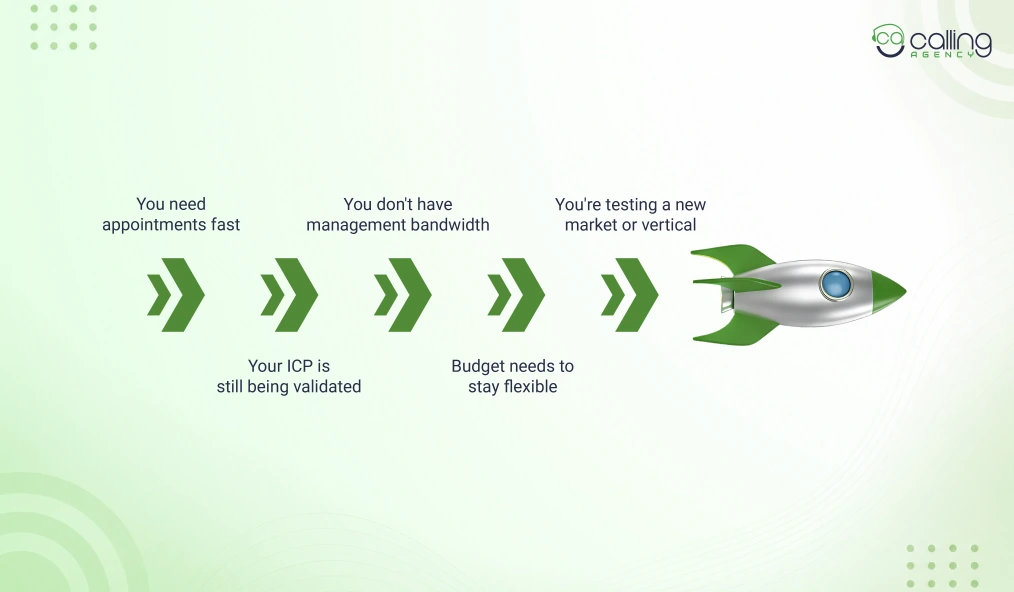
Outsourcing is usually the smarter move if:
- You need appointments fast: outsourced SDR teams typically start producing prospecting activity within two to four weeks of campaign launch, compared to months of ramp time for a new hire
- Your ICP is still being validated: testing messaging and targeting through an outsourced team avoids the sunk cost of training an internal hire on an unproven playbook
- You don’t have management bandwidth: outsourced teams bring built-in pattern recognition from running multiple campaigns across similar industries, meaning scripts, objection handling, and buyer-role responses already exist
- Budget needs to stay flexible: outsourcing avoids the fixed cost and long-term commitment of a full-time hire
- You’re testing a new market or vertical: before committing internal resources to it
Outsourcing works best as a way to move quickly and de-risk the process before scaling internally.
CallingAgency runs outbound SDR campaigns for IT and tech companies. See what a qualified appointment looks like with cold calling services built for the vertical, and review CallingAgency’s IT and tech case studies before you commit.
A Hybrid Approach Often Works Best
Many growing tech companies don’t pick one permanently. They start with an outsourced SDR team to validate messaging and ICP fit, then transition to in-house once the playbook is proven and volume justifies a dedicated internal hire. This sequencing avoids paying full-loaded in-house costs during the experimentation phase.
FAQ
How long does it take to close a B2B tech deal?
SMB deals close in 2–6 weeks, mid-market deals take 1–3 months, and enterprise deals take 3–9 months or longer due to multi-stakeholder sign-off and security review.
Why do referrals stop working as a primary growth channel?
Because referral volume is capped by existing customer network size, not marketing effort, it isn’t a repeatable, scalable demand-generation engine like paid or content channels.
What’s the difference between ABM and other B2B tech marketing channels?
Account-Based Marketing is a targeting strategy that defines which accounts to pursue; the other channels (LinkedIn, email, SEO, events) are execution tactics that deliver ABM’s targeting to those accounts.
Key Takeaway
No single channel drives B2B tech client acquisition alone. ABM sets the targeting foundation, while SEO, cold outreach, referrals, partnerships, events, and review platforms each execute a different stage of the buyer’s journey. The companies that scale rather than stall sequence these channels to match company stage and deal complexity: trust-heavy tactics (founder-led sales, referrals) early on, and scalable, repeatable systems (content marketing, outbound cadences, analyst relations) as the business matures.