


Only the script is not nearly as important a factor in the success of your cold calling as how good your voice sounds when speaking it.
For outbound sales, tone can make a prospect stay on the phone, object right away, or hang up within seconds after getting in touch.
Maintaining the cold calling tone helps SDRs, BDRs & sales reps:
- Capture attention quickly
- Build trust with decision-makers
- Lower buyer resistance
- Improve objection handling
- Increase appointment-setting rates
This playbook outlines the mindset, voice exercises, sales tactics, and methods that top-performing reps use to clean up their cold calling voice.
What Cold Calling Tone Really Means?
Cold calling tone refers to the way your voice sounds to prospects during outbound sales dialogues. It is more than just your script and it influences how prospects assess your professionalism, confidence, and credibility.
- Perfect tone combines pitch, speed of speaking, level of confidence, pauses, and emotional control
- Connect rates, objection handling, and lead qualification be damned
- Prospects’ opinion before hearing your full value proposition
Tone is a huge factor for SDRs, BDRs, and sales reps as they try to navigate their pitch.
“According to the research, 82% of buyers focused on accepting the meetings depending on the cold call tone, value proposition and messages matched with conversation intent.” – SalesHive
A confident, natural tone and they are going to think your outreach is trusted, but a weak or robotic one can raise resistance. When you cold call, your voice becomes an instrument for sales.
The Psychology of How Tone Moves Prospects
Every cold call initiates fast psychological decisions in the prospect’s mind. Your tone signals confidence, intent, and credibility before your message is processed.
Win Or Lose The Prospect In The First 7 Seconds
Those first few seconds of a cold call are pivotal. Prospects make that decision in less than 5 seconds whether or not they want to keep listening.
- Nervous tone can create distrust
- Scripted delivery may sound robotic
- This energy can be a little too pushy for buyers
There is an effective framework that you can strategically implement in the first 7 seconds of your calls.
R-Relevance(0-2sec) → I-Intent(2-4sec) → S-Specific Hook(4-6sec) → E-Engagement Request(6-7sec)
Check out this video to understand this framework and use it within 7 seconds.
How to NAIL the first 7 seconds of a Cold Call
A relaxed, assured opener is an indication of professionalism. This is crucial in B2B sales, where decision-makers filter interruptions at all times.
Your tone should:
- Sound prepared
- Feel conversational
- Communicate confidence immediately
Get Prospects To Mirror Your Energy
Because of what sales psychology teaches us, people mirror back the tone and energy they hear.
- Calm energy leads to calm responses
- Positive confidence can encourage openness
- Overexcitement may trigger distrust
What separates successful SDRs is their ability to regulate emotional energy on calls. They do not run on prospects but balance them.
This means:
- Matching buyer communication style
- Energy calibration for gatekeepers and executives
- Keeping conversations comfortable
When prospects match your tone, you build rapport faster and qualification and discovery go much more easily.
Don’t hesitate to check out this video shorts to use the mirroring technique to build rapport for your sales process.
Mirror Your Way to Sales – YouTube
Send Trust Signals Buyers Pick Up On Instinctively
Trust begins with voice delivery even before any product discussions begin.
Key trust-building vocal signals include:
- Lower vocal pitch
- Controlled pacing
- Clear pronunciation
- Strategic pauses
These signals project power, certainty, and capability. On the flip side, shady tone habits can destroy credibility.
Common trust-killers include:
- Filler words
- Apologetic phrases
- Fast speech
- Unsteady voice
Specifically, when you are using cold calling for B2B lead generation and appointment setting, trust is the biggest factor. The right cold calling tone allows prospects to feel at ease, which leads to more quality conversations and sales-qualified opportunities.
5 Tones Best SDRs Deploy and Exactly When to Use Each
Well, here we are going to explain to you 5 best SDRs tonal approaches that are often practiced and use them at the right time during cold calling.
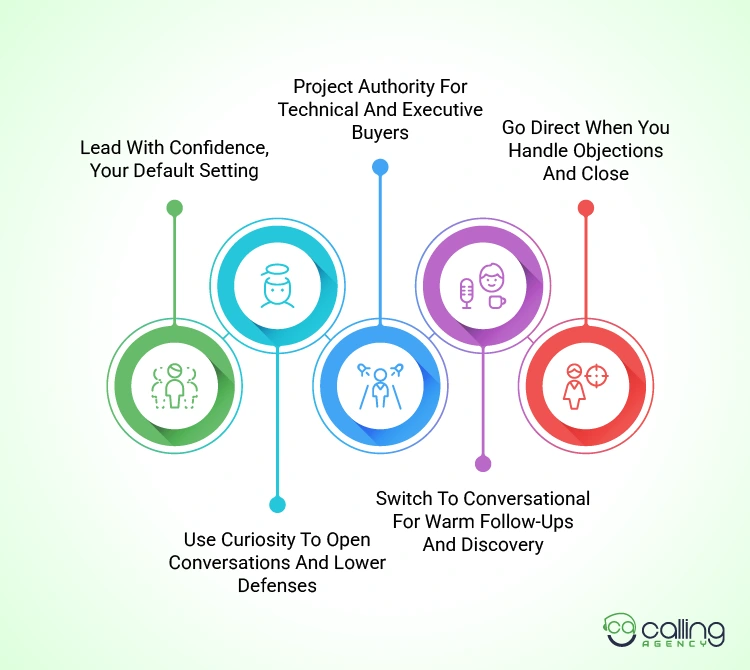
Lead With Confidence, Your Default Setting(0–15 seconds)
For a cold call, confidence sets the stage for the rest of that conversation during its first 0–15 seconds.
- Use constant pacing
- Sound prepared and professional
- Do not speak too nervously or too excitedly
An assertive opening lets the prospect know that you respect their time and that you have a real purpose for making the call. This tone is most appropriate in introductions and opening statements.
Example:
“Hi John! This is Mike from Apex Solutions. We save logistics teams’ shipping costs up to 20%. I wanted to quickly connect.”
This approach feels direct, authoritative, and organized.
Use Curiosity To Open Conversations and Lower Defenses(15–30 seconds)
Curiosity can drop resistance. So create conversation between 15–30 seconds.
- Sound genuinely interested
- Ask thoughtful questions
- Reduce sales pressure
It sounds less like a pitch and more like problem-solving and just with a curious tone.
Example:
“So I am asking you, how are you generating leads for your sales team right now?”
Using this style invites prospects in rather than putting their guard up.
Project Authority For Technical and Executive Buyers(30-60 seconds)
Go for an authoritative approach in the first 30-60 seconds of cold calls its critical when dealing with senior decision-makers or technical stakeholders.
- Lower vocal pitch
- Speak with certainty
- Focus on business outcomes
SDRs who sound knowledgeable & solution-focused get better responses from executives.
Example:
“We work with SaaS companies to improve pipeline efficiency by targeting qualified decision-makers directly.”
This tone is more focused and authoritative in the projects and improves sales-generating conversations.
Switch To Conversational For Warm Follow-Ups and Discovery(60-120 seconds)
Once a trust is built, conversational tone makes relationships stronger during the last 60-120 seconds of the call.
- Relax your conversational approach
- Sound approachable
- Match prospect energy
It is effectively used during discovery calls and follow-up outreach.
Example:
“The last time we spoke with you, there were challenges in hiring. How has that been going lately?”
This gets to feel natural and leads the open conversation.
Go Direct When You Handle Objections and Close
Directness matters in terms of dealing with objections or gaining next steps.
- Stay calm
- Be clear
- Avoid overexplaining
A direct tone enables narrowing down the conversations. Specifically, you can follow this objection handling framework.
P-Pause → A-Acknowledge → Q-Question
Example:
“I understand timing is tight. How about a quick strategy call next Thursday at 2 PM instead?”
This method leads the conversation to an eventual commitment without being forceful.
Read More –
- “Not Now” – Timing Objection Patterns in B2B Sales
- How To Handle Instant Shut-Down Objections On Cold Calls
- How To Handle “We Don’t Need It” Cold Calling Objections?
- We Do Not Take Cold Calls: Why Your Prospects Say It and What to Do Next?
- How To Handle Budget Objections On Cold Calls: 5 Tricks to Overcome Objections
- How to Handle Competition and Alternatives Objections In Cold Calling?
- If Prospects Say “Not Interested” Instantly, What’s Really Happening
- How to Handle “Just Send Me an Email” Objection in Cold Calling?
Pull the Four Vocal Levers That Separate Top-Quartile SDRs from Everyone Else
Many SDRs follow the same script, but top performers sound better on calls. The difference comes from how they use their voice. Small changes in pitch, speed, energy, and tone can make a big impact on how prospects respond.
Drop Your Pitch To Ditch The “Telemarketer” Sound
A lot of SDRs, BDRs & outbound sales reps are raising the pitch of their vocal blend during cold call openers due to the anxiety related to the call or pressure from the script.
However, high pitch has the air of conventional telemarketing, instruct instant push-back from the prospect.
To improve sales call tonality:
- Speak with your natural speaking tone, but in a just slightly lower voice
- Lean into chest voice for more power in your delivery
- Be more controlled by keeping it slow on your opening lines
A lower pitch communicates:
- Confidence
- Authority
- Professionalism
- Executive presence
B2B prospecting, SaaS sales and B2B lead generation campaigns see this minor adjustment improve connect rates, objection handling and strengthen pattern interrupts.
Hit The 150–160 Words-Per-Minute Pace Sweet Spot
Pace of speech is one essential cold calling performance indicator.
Common pacing issues include:
- Speaking too quickly from nerves
- Sounding robotic from over-rehearsal
- Losing urgency and moving too slowly
For this reason, top-performing sales teams frequently train reps to stay at 150–160 WPM because it allows them to:
- Better prospect comprehension
- Stronger script delivery
- Improved objection handling
- More natural sales conversations
To optimize pacing:
- Prioritize clarity over speed
- Pause after key value propositions
- Maintain steady conversational flow
That ever-so-quick pace allows SDRs to sound smooth, while having buyers wanting for more.
Match Your Prospect’s Volume and Energy
When you cold call for the first time, much of whether your pitch carries as intended is based on emotional standardization.
Strong reps:
- Mirror prospect energy levels
- Volume adjusted by the way buyers act
- To retain authority, just keep the level of calmness in your mind a little lower.
For example:
- Gatekeepers may require concise professionalism
- Executives often prefer controlled authority
- SMB owners may prefer warmer approaches
Energy matching improves:
- Rapport
- Qualification conversations
- Discovery call effectiveness
- Appointment-setting outcomes
When prospects know they have been heard, they will stick around longer and drop their guard.
Land Statements, Flat and Lift Questions Deliberately
The first one is vocal modulation. Another irrelevant approach is uptalk, or the way we format statements as if they are questions/concerns.
Instead:
- End statements with downward certainty
- Hike tone only on real, qualified questions
- Avoid sounding unsure
Example:
Weak: “We help eliminate inefficiencies in the pipeline?
Effective: “To a great extent, we tackle pipeline inefficiencies.”
This improves:
- Trust
- Sales authority
- Buyer confidence
- Closing strength
7 Tone Mistakes Tanking Your Connect Rate Right Now
To improve your cold calls connection rates, you must focus on avoiding tonal mistakes. Most importantly when the approaching tone is scripted, monotonous and contains filler words, it will turn down the prospects interest.
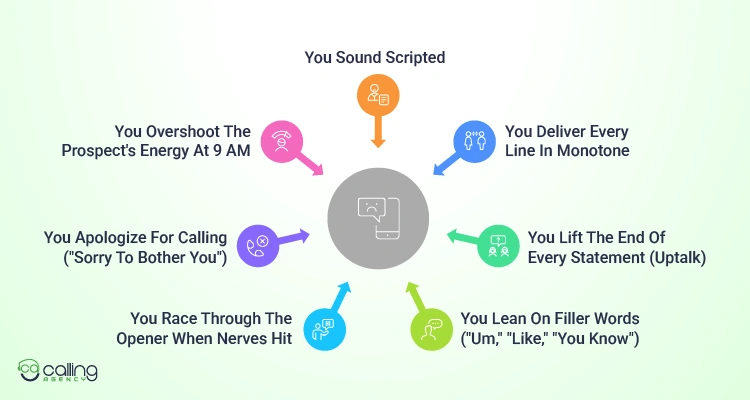
You Sound Scripted
Sales scripts that are over-rehearsed sound robotic.
This can:
- Lower trust
- Hurt personalization
- Reduce sales engagement
Most of the expert SDRs more or less memorize scripts but sound natural.
You Deliver Every Line In Monotone
Monotone delivery weakens prospect attention.
It often signals:
- Burnout
- Disinterest
- Low confidence
Use vocal variety to improve engagement and buyer retention.
You Lift The End Of Every Statement (Uptalk)
Uptalk undermines authority, particularly with decision-makers.
It can:
- Reduce credibility
- Weaken confidence
- Lower conversion potential
Flat endings improve executive-level communication.
You Lean On Filler Words (“Um,” “Like,” “You Know”)
Fillers reduce professionalism.
They often reveal:
- Nervousness
- Weak preparation
- Poor objection control
Clarity in communication supports greater trust signals, however.
You Race Through The Opener When Nerves Hit
Aggressive cold call openers overwhelm prospects.
This often causes:
- Missed messaging
- Reduced clarity
- Lower connect quality
Controlled pacing improves first impressions.
You Apologize For Calling (“Sorry To Bother You”)
Imagine how much more powerful your outbound sales position would be if it started with apologetic language.
It can:
- Lower authority
- Invite dismissal
- Reduce perceived value
- Lead with relevance, not apology.
You Overshoot The Prospect’s Energy At 9 AM
Excessive enthusiasm can be invasive early in prospecting blocks.
This may create:
- Resistance
- Skepticism
- Call shutdowns
In contrast, professional SDRs modify their energy to match the buyer’s mindset in that moment of sales time in a given industry.
Run These Drills to Sharpen Your Tone Before Your Next Power Hour
In the same way as measurable skills, improving cold calling tone requires practice and repetition.
Leading SDRs, BDRs, and outbound sales reps use the same vocal warm-up drill day in and day out to build confidence prior to calls, practice confident call delivery for high connect rates.
Warm Up Your Voice In 5 Minutes Before You Dial
The best sales reps hardly ever start prospecting without a vocal warmup in dedicated cold calling service. Just like athletes warm up before competition, SDRs need to loosen their voice before dialing.
Your pre-call warm-up can be as simple as:
- Breathing exercises for calming your nerves
- Reading cold call scripts aloud
- Pitch-lowering practice for stronger resonance
- Exercises for vocal fluency
This routine improves:
- Vocal stamina
- Script confidence
- Tonal consistency
- Early-call performance
Outbound lead generation teams are also trained to have a stronger readiness, making sure weak first impressions do not lose the attention of the prospects.
Test The Smile-And-Dial Method On Your Next 20 Calls
Seems simple and even almost stock, but smiling while dialing can make you seem warmer and more approachable in your voice.
Benefits include:
- Friendlier tonality
- Better conversational flow
- Improved prospect comfort
- More natural delivery
This method especially shines through during:
- Initial outreach
- Follow-up sequences
- Appointment-setting conversations
Monitor the effects of smiling on connect rates, responsiveness from prospects, and quality of conversations across a lot of calls.
Use the Read-Aloud Method to Practice Strategic Pauses
This is why a good majority of SDRs fail, they hammer through scripts with no inflection in their voice. Strategic pauses improve delivery precision.
To practice:
- Read sales scripts aloud daily
- Pause after value propositions
- Pause after qualifying questions
- Eliminate rushed transitions
This helps improve:
- Clarity
- Authority
- Listening space
- Confidence
Strategic pauses strengthen buyer engagement and enhance sales communication as a whole.
Record Your Calls And Review Them With This Framework
Self-review is one of the quickest methods to develop cold-calling tone.
Evaluate your calls for:
- Pitch control
- Pacing
- Filler words
- Energy matching
- Objection handling confidence
Sales call reviews help pinpoint weak tonal habits that are costing you conversions, successful appointment-setting cadence, or even trust from the prospects.
Adjust Your Tone As The Situation Requires
The tone of cold calling should not be static. Optimum tonal effectiveness in prospecting requires different strategies for various prospect types, industries and stages of the sales funnel.
Shift Your Tone Between B2B And B2C Calls
Communication style is very much dependent on the type of audience.
For B2B prospecting:
- Use authority
- Prioritize professionalism
- Focus on operational pain points
- Emphasize ROI
For B2C outreach:
- Sound warmer
- Be conversational
- Build emotional trust
- Use simpler messaging
A tone that you adjust to meet your target market makes a lot of sense and this improves message alignment which also helps with looking at sales performance.
Read The Room: Gatekeeper Vs Decision-Maker
The prospect role is important in outbound sales.
For gatekeepers:
- Be concise
- Sound respectful
- Focus on efficiency
For decision-makers:
- Lead confidently
- Prioritize strategic value
- Maintain authority
With the right tonal adaptation, there is a more natural progression of the call and less resistance from potential sales leads to be qualified.
Rework Your Tone For Voicemails (It’s Not The Same)
Voicemail is different because you’ll have to get people intrigued with just your voice.
Strong voicemail tone should be:
- Slower
- Clearer
- Slightly more energetic
- Highly focused
Key goals include:
- Delivering concise value
- Building curiosity
- Encouraging callbacks
Weak voicemail tone tends to be forgettable while a powerful vocal delivery can increase the response rates.
Measure Whether Your Tone Actually Works
You should treat the cold calling tone like any other metric in your outbound sales process. Top-performing SDR teams use data to validate whether voiced improvements are contributing to pipeline generation.
Track Connect Rate and Conversation Duration
Cold calling metrics demonstrate whether your tone is helping or harming performance.
Track:
- Connect rates
- Average talk time
- Appointment-setting rates
- Objection frequency
- Qualification outcomes
For example:
If they reach 80 percent (or more) and talk less than five minutes to gain a great trust, it probably means you were a little weak in building the trust.
Longer conversation duration is often a sign of better tonal control. That gives you something useful to work with in terms of how well the tone is performing.
Score Your Tone With Conversation Intelligence Tools
To achieve high levels of SDR performance, modern sales organizations have depended heavily upon conversation intelligence software.
These tools evaluate:
- Speaking speed
- Tonal consistency
- Talk-to-listen ratios
- Interruption patterns
- Objection responses
Gong, Chorus, and call analytics systems give you data to coach.
If we have defined cold calling tone as a sales skill that can be measured, then improvement in outreach performance, conversion rates, and resultant sales pipeline results can all be better by identifying how to perfect this skill.
Final Words
The cold calling tone you use directly impacts how well prospects trust, engage with and get converted through the call.
Strong tone mastery focused on the major sales drivers, which we have discussed in this article:
- Building Trust in Seven Seconds or Less
- Strategically using confidence, curiosity, authority, and adaptability
- Pitch control, pace, voice volume, and pronunciation
- Tone blunders that impact connect rates
- Training the SDR drills
- Changing tone per buyer type, stage of the call, and sales setting
If your sales team (SDRs) prospect and book appointments for outbound, making iterative improvements to tone itself consistently will have a positive impact on appointment-setting rates, pipeline production, and ultimate company performance.
Frequently Asked Questions
Which tone wins the most cold calls?
Using a tone that is calm, confident, and conversational seems to work best. It inspires trust rapidly and reduces prospect resistance by improving engagement while keeping outbound sales conversations professional.
How do I stop sounding nervous on the phone?
Warm up your voice, breathe normally, pace yourself and rehearse as you would talk. Training and practice bring down call anxiety, and confidence levels rise.
Should I sound scripted on cold calls?
There are no specific scripts and messaging should serve as a guide, they should not be prescriptive on how to deliver your content. In fact, natural and flexible conversations build higher buyer trust over robotic scripts.
How fast should I speak on a cold call?
We target 150–160 wpm speed during the conversation period of the call. This speed comes across sounding clear, confident, and conversational without being quick or unnatural.
Does smiling on the phone really change anything?
Yes. When you smile, your tone becomes warmer, more energetic, and more likable and it sounds much more inviting to prospects.