



Real estate investors make cold calls to find property owners who may consider a cash offer, off-market sale, or direct acquisition conversation. Agents usually cold call to win listings, but investors call to find motivated sellers and off-market properties before they hit the open market.
That is why cold calling for real estate investors needs a different script, list strategy, and qualification process. Here, finding the right timing, equity, property condition, and seller motivation is the key.
This guide breaks down who investors should call, how to build a call flow (from planning to execution), and what scripts to use for different types of leads.
You will also get a qualification framework, objection-handling process, follow-up structure, compliance basics, and practical guidance for wholesaling, acquisition, and investor outreach.
Who Real Estate Investors Should Call?
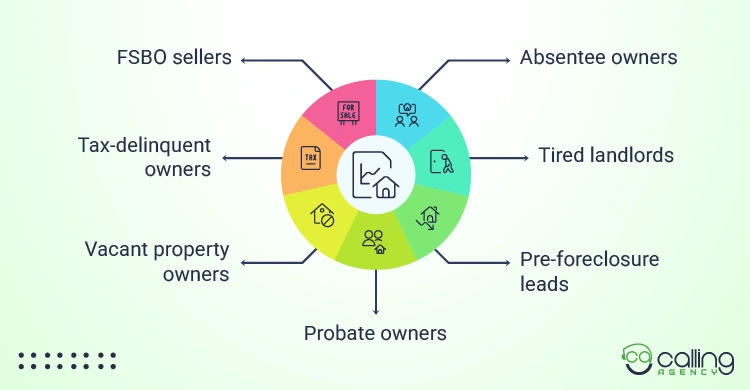
Real estate investors should call those property owners who have shown motivation to sell. These motivated prospects include absentee owners, tired landlords, pre-foreclosure leads, probate owners, vacant property owners, tax-delinquent owners, and FSBO sellers.
Every type of owner is in a different situation. For example, an absentee owner may be tired of managing a rental property, while a pre-foreclosure owner may be dealing with timing pressure.
That is why investor cold calling needs list-based angles rather one general script for every property owner.
When the list enriches and call volume increases, real estate cold calling services for investors can help keep outreach consistent.
Absentee Owners Cold Calling
Absentee owners are property owners who own a home but do not live in it. They are strong targets for investors because the property may already feel like extra work, a burden, and not a home anymore.
Many absentee owners also live in different states and rent the property to tenants or just leave it vacant. The call should focus on whether the property is still worth keeping for them.
What investors should not do is make a cash offer on the first call because the target is to make a relationship with the seller and understand their situation.
| Absentee owner situation | How to frame the call |
| Out-of-state owner | Mention the challenges of managing a property from far away. |
| Rental property owner | Focus on tenant issues, repairs, or turnover that may have made the property harder to keep. |
| Vacant property owner | Check whether they still have plans for the property or would consider selling. |
| Long-term hold owner | Open the conversation around current property value and whether selling now is worth reviewing. |
When cold calling absentee owners, the script should start with the property and ownership status.
If you want the full call flow and word-by-word examples, see our detailed guide on absentee owner cold calling scripts.
Cold Calling to Tired Landlords
Tired landlords are property owners who may want to sell because the rental property has become harder to manage.
They may still collect rent, but tenant turnover, repairs, late payments, or property management issues can make the property feel less worth keeping. The better angle for cold calling tired landlords is to understand whether the rental is still working for them or becoming a burden.
| Landlord situation | How to frame the call |
| Frequent tenant turnover | Focus on the stress of finding and replacing tenants. |
| Repair-heavy rental | Mention the cost and time involved in keeping the property rentable. |
| Out-of-area landlord | Bring up the challenge of managing tenants and repairs from a distance. |
| Long-term rental owner | Open the conversation around whether they still want to hold the property. |
The goal is to find out if landlord burnout has created real seller motivation.
Pre-Foreclosure and Distressed Owners
Pre-foreclosure and distressed owners normally remain under pressure because of a default notice, missed payments, or a foreclosure timeline.
This is one of the most sensitive lists for investor cold calling, and the tone has to be very careful from the first line.
The call should not sound like the investor is trying to take advantage of someone’s problem. First, check whether the owner is open to reviewing options. Then explore equity, selling interest, and a possible way out.
Use this list with extra care:
- Start with ownership and property context.
- Avoid language that sounds like pressure or fear.
- Ask about timing only after the owner feels comfortable.
- Keep the conversation around options.
- Be clear that the owner can say no.
- Never promise legal, financial, or foreclosure advice.
A pre-foreclosure script real estate investors use should sound calm, direct, and respectful. If the tone is wrong, the call can feel predatory fast.
If you are comparing outreach support for sensitive lead types like this, our guide on top cold calling companies for real estate can help you review providers before choosing one.
Vacant and Tax-Delinquent Properties
Vacant and tax-delinquent properties are homes where the owner may have financial, maintenance, or legal pressure to sell. This is a potential list for investors because a vacant home or unpaid property tax can create a stronger reason to consider an offer.
When cold calling vacant properties or tax delinquent property leads, the call should start with the property situation. The goal is to understand whether the owner still has a plan for the property or would consider selling before the problem gets heavier.
For these leads, the list quality matters as much as the script because wrong numbers, old records, or missed follow-ups can kill the opportunity before the first real conversation. For investors who want a broader pipeline beyond one list type, real estate lead generation services can help build and manage seller outreach more consistently.
Cold Calling to FSBO Sellers
FSBO sellers are owners trying to sell without an agent. For investors, this can be a huge opportunity because the owner already has selling intent and may be open to a direct buyer, cash offer, or faster closing.
When cold calling FSBO sellers for investors, the script should respect that they are already trying to sell without an agent. The angle is not to challenge that decision. It is to see whether they are open to a direct buyer, a cash offer, or a faster sale with no agent commission.
Where to Get Your Calling List?
Real estate investors can get calling lists from property records, MLS data, county records, data providers, skip tracing tools, and list-stacking platforms. The best source depends on which motivated seller list you want to target.
A good list should connect the property owner, property situation, and motivation signal before the call starts.
| Lead type | Best data source |
| Absentee owners | Property records, county records, or data providers |
| Tired landlords | Rental records, eviction data or landlord lists |
| Pre-foreclosure leads | County records or foreclosure data providers |
| Probate owners | Probate court records or estate data providers |
| Vacant properties | County records, code violation data or vacant property lists |
| Tax-delinquent owners | County tax records or tax delinquency lists |
| FSBO sellers | FSBO platforms, marketplace listings, or public seller listings |
Skip tracing helps investors find phone numbers, emails, and contact details behind a property record. It is useful, but it does not make a bad list good.
When a list starts producing real seller conversations, the next step is turning those calls into appointments. That is where real estate appointment setting can help investors manage follow-up and move qualified sellers into the next conversation.
The Investor Call Flow
A real estate investor cold call should start moving from an opener to a reason for calling, discovery, qualification, and booking the next step. The caller should first make the context property clear, then find out whether there is real seller motivation.
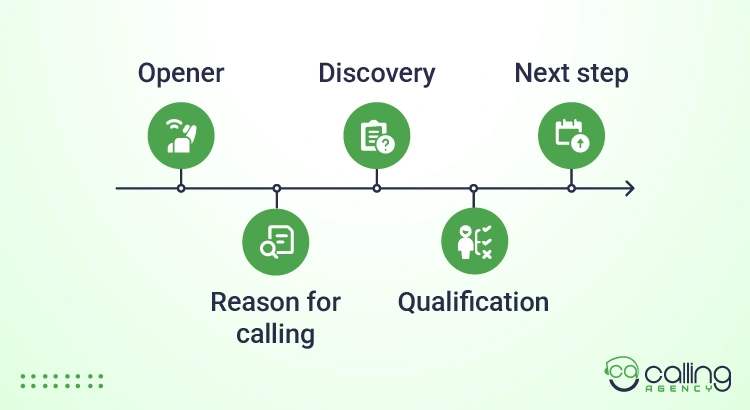
A good real estate investor call flow should not heavily focus on offering cash on the first attempt. It should build enough trust, ask the right discovery questions, and only move to a meeting when the owner shows timing, interest, or fit.
| Call stage | Purpose | Example line | What to avoid |
| Opener | Introduce yourself and confirm the property | Hi, this is James. I’m calling about the property on Oak Street. | Starting with a hard cash offer before the owner understands the call |
| Reason for calling | Explain why you reached out | I work with investors looking at properties in that area and wanted to see if you had any plans for this one. | Giving a vague pitch like we buy houses |
| Discovery | Understand the owner’s current situation | Are you still planning to keep the property long term? | Asking too many questions before the owner feels comfortable |
| Qualification | Check motivation, timing, property condition, and offer fit | If the numbers made sense, would you consider selling? | Treating every owner as a motivated seller |
| Next step | Move the right prospect toward a clear follow-up or appointment | Would tomorrow afternoon work for a quick call to review the property details? | Ending with I’ll send details without setting a follow-up |
Quick Tips to Boost Your Connect Rate from The Call Flow
These tips will help you in the overall call flow:
- Local area codes get answered more often than out-of-state numbers.
- Match your caller ID to the property’s area code. This can boost your connect rate more than any script change.
- Not every list should be dialed the same way.
- Predictive dialing works well for high-volume lists like absentee owners.
- Sensitive lists like pre-foreclosure or probate need a slower, more personal approach.
- Most calls end in voicemail.
- Leave a short, clear message under 30 seconds.
- Follow up with a quick text within minutes, while the call is still fresh in their mind.
Cold Calling Scripts by Lead Type
A real estate investor cold calling script should change based on the lead type. A tired landlord, pre-foreclosure owner, and FSBO seller all need a different opener line, discovery question, and objection handling.
Use the script as a call guide, not a word-for-word speech. For a deeper understanding and more ideas about different lead types, see our cold call script for real estate.
Tired Landlord Script
Hi {{First Name}}, this is {{Your Name}}. I’m calling about the rental property on {{Street Name}}.
I work with investors who buy rental properties in that area. I wanted to see if you still plan to keep this one long-term.
Are tenants, repairs, or management becoming harder than before?
If selling ever made sense, would you be open to reviewing a direct offer?
Would tomorrow afternoon work for a quick call to look at the property details?
Pre-Foreclosure Owner Script
Hi {{First Name}}, this is {{Your Name}}. I’m calling about the property on {{Street Name}}.
I understand this may not be the easiest time, so I’ll keep this brief. I wanted to see if you are reviewing any options for the property.
Are you still trying to keep the home, or are you open to looking at a sale before the timeline gets tighter?
If there is enough equity, we may be able to make a direct offer.
Would it make sense to schedule a short call to understand the property and your situation?
FSBO Seller Script
Hi {{First Name}}, this is {{Your Name}}. I saw the property on {{Street Name}} listed for sale by owner.
I’m not calling to challenge that. I work with investors looking for direct seller opportunities in the area.
How has the selling process been so far?
If a buyer could move without an agent commission and keep the process simple, would you be open to a direct offer?
Would you have 10 minutes this week to review the property and see if there is a fit?
Key Things to Remember
Pause after asking a direct question in the conversation. Let the seller answer first; don’t rush to fill the silence.
A quick mention of the property’s condition, tenants, or ownership length makes the call feel researched, not random.
Not all calls go in the same direction. Once you have made a bunch of calls, it will be clear what to do or not.
For more formats across different sales situations and to understand how it goes, listen to our actual cold calling recordings.
Handling Objections in Real Estate Investor Cold Calling
Real estate investor cold calling objections usually come from seller hesitation, trust issues, timing problems, or fear of a lowball offer. The goal is not to argue but to understand what is behind the objection and keep the conversation open.
Before using any response line, the caller should know why the seller is pushing back. This is where a clear objection-handling framework for cold calling helps keep the call calm instead of turning it into a debate.
| Objection | Response angle | Why it works |
| I’m not interested | Ask if selling is off the table completely or just not a priority now. | It separates a hard no from a timing issue. |
| Are you just trying to lowball me? | Acknowledge the concern and explain that any offer depends on the property, condition and numbers. | It lowers the defence wall and shows the offer is not random. |
| I already have someone interested | Ask if they already have a signed agreement or are still reviewing options. | It finds out whether the lead is truly gone or still open. |
| How did you get my number? | Be direct and explain that the call came from property records or public lead data. | Trust building starts with not hiding the source. |
| Call me later | Confirm a clear callback day and reason for the next conversation. | It turns a brush-off into a tracked follow-up. |
A good objection response should slow the call down, not rush into a comeback. For more examples across common sales pushbacks, see our guide on how to handle cold call objections.
Follow-Up Process in Real Estate Investor Cold Calling
A good real estate cold calling follow-up process keeps the conversation active without pushing the seller too hard. People are more attached to their properties, so selling decisions take time.
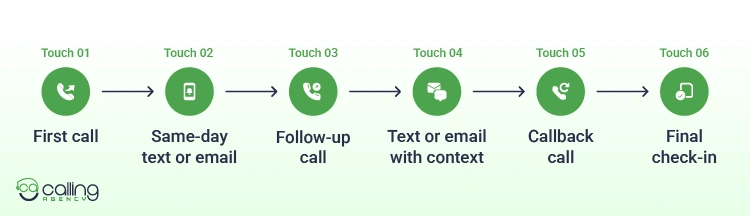
The follow-up should match the owner’s situation, timing, and interest level. For a deeper structure, see our guide on cold calling follow-up strategy.
| Touch | Channel | Purpose |
| Touch 1 | First call | Start the conversation and check seller motivation |
| Touch 2 | Same-day text or email | Remind the owner who called and why |
| Touch 3 | Follow-up call | Continue the conversation if they showed interest |
| Touch 4 | Text or email with context | Give a simple reason to reconnect, such as property review or timing |
| Touch 5 | Callback call | Check if their plan, timeline or interest has changed |
| Touch 6 | Final check-in | Ask if they want to keep the conversation open or close it for now |
A follow-up cadence for motivated sellers should be consistent, but not random. The biggest mistake is starting strong and then disappearing after one call.
That is why inconsistent follow-up kills cold calling results, especially with owners who need more time before they are ready to talk seriously.
Common Mistakes and How to Fix Them
The most common cold calling mistakes for real estate investors are calling bad lists, skipping qualification, weak follow-up, ignoring compliance, and using agent-style scripts on investor leads.
These mistakes just waste the calls you made because the caller reaches the wrong owners, asks the wrong questions, or loses interested sellers after the first touch.
Here are the main mistakes to avoid:
- Calling an old lead list: Old numbers, wrong owners, and over-called records can hamper the campaign.
- Using agent-style scripts: Investor calls should not sound like listing calls. The script needs to focus on seller motivation, property situation, and possible acquisition.
- Skipping qualification: Not every owner is a motivated seller. Ask about timing, condition, price flexibility, and selling interest before moving to the next step.
- Giving up after one call: Many sellers need more than just one touch. Weak follow-up practice means good leads can disappear.
- Pushing the offer too early: A cash offer makes more sense after the owner’s situation is clear.
- Ignoring compliance: DNC, consent, and calling rules still apply. Investors should not treat cold calling as a non-restricted channel.
- Reading the script too tightly: Too much script dependency makes the call sound unnatural.
Tools and Data You’ll Need
Real estate investor cold calling needs a clean list, accurate contact data, a dialer, a CRM, and a way to track every lead. The tools do not close deals by themselves, but they keep the calling process organized.
- List source: Use property records, data providers, or list-stacking tools to build a motivated seller list.
- Skip tracing: Use skip tracing to find phone numbers and emails behind the property record. Examples include BatchSkipTracing, PropStream skip tracing, or other real estate data providers.
- Dialer: A dialer helps manage call volume, callbacks, and lead tracking. For tool options, see our guide on dialers for cold calling real estate.
- CRM: Use CRM software to save notes, lead status, follow-up dates, and other details. Investors often use tools like REsimpli, Podio, Follow Up Boss, or HubSpot for these purposes.
- Lead tracking: Track call result, motivation, timeline, property condition, and next step after every conversation.
Keep this simple at the start. A good list and clean follow-up system matter more than using too many tools too early.
Is Cold Calling Legal for Real Estate Investors?
Cold calling is legal for real estate investors. But it has to follow the DNC, TCPA, consent, opt-out, and state rules.
Key compliance points include:
- DNC Registry: Scrub calling lists against the Do Not Call Registry before dialing and keep the list updated regularly.
- TCPA rules: The Telephone Consumer Protection Act can apply to phone calls, texts, auto-dialers, prerecorded voices, and AI-generated voice calls.
- Opt-out handling: If a property owner asks not to be contacted again, record it and remove them from future outreach.
- State-level rules: Some states have stricter telemarketing or mini-TCPA rules, so investors should check local requirements before calling.
- AI or recorded voice: AI-generated voices and prerecorded messages can trigger stricter consent rules.
For broader compliance understanding, see our guide on TCPA, GDPR, and CCPA compliance. If you are comparing privacy rules across regions, this CCPA vs GDPR compliance breakdown may also help.
This section is general information, not legal advice. Real estate investors should confirm current TCPA, FTC and state-level rules with a qualified attorney before running a calling campaign.
Should You Outsource Your Cold Calling?
Investors should outsource cold calling when daily call volume starts taking time away from deals, follow-up, and property review.
Calling on your own makes sense when you are testing one small list. But it gets hard once you need 100+ dials a day and consistent seller follow-up.
A solo investor making 30–50 calls a day caps the pipeline fast. An outsourced calling team can keep dial volume moving, qualify sellers, and lower the real cost per deal when the list and offer are strong.
This is where cold calling services for real estate investors can get you the ROI.
Instead of hiring and training an in-house caller from scratch, many investors work with a successful cold calling agency to handle calls, follow-ups, and seller qualification more consistently.
Final Thoughts
Cold calling for real estate investors works best when the list, script, qualification, and follow-up all match the seller type. The goal is not to pitch every owner, but to find real motivation and set the right next step.
With clean data, careful compliance, and consistent follow-up, cold calling can help investors find more motivated sellers and off-market opportunities.
FAQs
How many cold calls does it take to find a motivated seller?
There is no fixed number, actually, because list quality, skip tracing, market, and script all influence the result. A strong list may produce motivated seller conversations faster, while weak data can waste hundreds of calls. Most investors should track calls, connects, conversations, and qualified seller leads separately.
Is cold calling still effective for real estate investors in 2026?
Yes, cold calling still works for real estate investors in 2026 when the list, script, and follow-up are strong. It works best when investors call specific lead types like absentee owners, tired landlords, vacant property owners, tax-delinquent owners, and FSBO sellers instead of random property owners.
What’s the difference between investor and agent cold calling scripts?
Investor cold calling scripts focus on finding sellers open to a direct offer, cash sale, or off-market deal. Agent scripts usually focus on winning listings. Investors qualify based on motivation, equity, property condition, and timing. Agents usually focus more on listing interest, home value, and representation.
Is real estate investor cold calling legal?
Real estate investor cold calling is legal. But the callers must follow TCPA, DNC, consent, and local calling rules. Investors should avoid misleading claims, respect opt-outs, and keep records of call activity. Compliance matters more when calling large lists or using dialers.
Should I cold call myself or hire a cold calling service?
Cold call yourself if you are testing a small list and want to understand seller conversations. Hire a service when call volume, follow-up, and qualification take too much time. A good team can keep outreach consistent while you focus on offers, appointments, and deals.