

Key Takeaways
- Yes, if you do so in accordance with the TCPA and FTC’s Telemarketing Sales Rule (as well as state/industry/channel rules that could be significantly stronger).
- At a minimum, as part of standard practice, you must scrub against the National Do Not Call (DNC) Registry; call only between 8 a.m and 9 p.m. local time; identify yourself and honor opt-out requests.
- Statutory damages under the TCPA are $500 per violation ($1,500 for willful violations), but there is no overall cap on statutory damages.
- A more stringent standard of consent was due to come into force. In January 2025, a federal appeals court shot down what would have become the FCC’s “one-to-one consent” rule.
- While B2B calls are less regulated than consumer-related calls, those calls can’t just ignore the law.
Is Cold Calling Legal?
Yes. Under the TCPA, the FTC’s Telemarketing Sales Rule, and any state or industry regulations, cold calling in the US is a legal outbound sales practice. The most important rules are to straight check the Do Not Call Registry, call only during appropriate hours, identify yourself, and cease if someone chooses to opt out.
What Laws Govern Cold Calling in the US?
Cold calling is subject to many rules by federal, state, and international law in the US. That truly is the number one thing that you need to keep in mind because complying with these laws ultimately equates to safeguarding your outbound sales program long-term, and avoids fines.
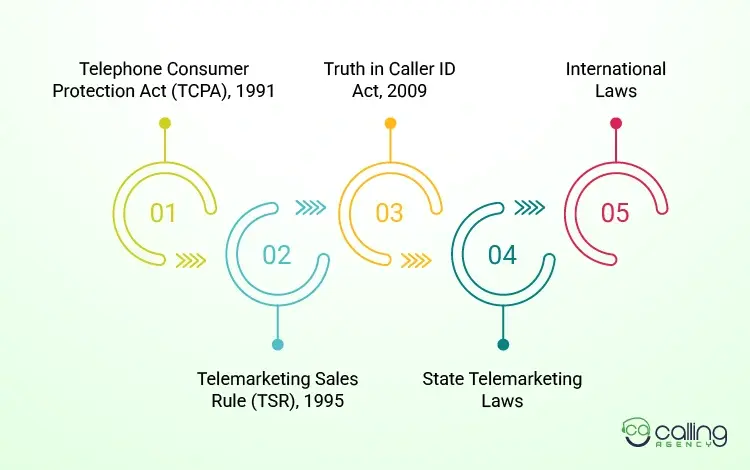
Telephone Consumer Protection Act (TCPA), 1991
The Telephone Consumer Protection ACT is the primary federal statute regulating telemarketing calls, text messages, and automatic outreach. Enforced by the Federal Communications Commission FCC, which defines consent rules for autodialed calls, pre-recorded messages, caller identification type, and hours within which calls may be made. This means that a business must obtain an appropriate opt-out agreement before using an automatic telephone dialing system or artificial voice technology. But TCPA violations entail $500 in statutory damages per call, or up to $1,500 for willful violations
Telemarketing Sales Rule (TSR), 1995
The Telemarketing Sales Rule, which is enforced by the Federal Trade Commission (FTC), regulates the operation of telemarketing campaigns. The National Do Not Call (DNC) Registry is established, and there is mandatory identification of the telemarketer, disclosure of the purpose of the call, opt-out honoring, and a ban on deceptive sales practices. Companies of all sizes are required to follow the TSR in their consumer-focused cold calling campaigns.
Truth in Caller ID Act, 2009
Truth in Caller ID Act prohibits the use of caller ID spoofing to commit fraud, cause injury, or obtain anything of value. Cold callers need to provide accurate caller ID information, and must not misleadingly spoof their identity to trick prospects. Serious FCC enforcement actions and financial fines can arise from violations.
State Telemarketing Laws
US federal laws impose a baseline standard; many states apply stronger standards than those under the applicable federal law. These kinds of “mini-TCPA” laws might add registration requirements, restrict calling times to a smaller window of time each day, impose stricter consent protocols, and allow for private rights of action. Florida, Oklahoma, Maryland & Texas are known for their stricter telemarketing regulations.
International Laws
Businesses outside the United States must comply with local legislation concerning calling prospects. These regulations include the GDPR in the EU, PECR in the UK, and Australia’s Do Not Call Register and Spam Act. Also, cross-border calling campaigns will commonly take on additional levels of consent, disclosure, and privacy protections.
According to the Telephone Consumer Protection Act (47 U.S.C. § 227), the baseline requirements include prior consent for certain automated calls, time-of-day limits, caller identification, and a working opt-out mechanism.
What Are The TCPA and TSR Rules For Cold Calling?
Cold calling practices are primarily governed by two laws, the federal TCPA (Telephone Consumer Protection Act) and TSR (Telemarketing Sales Rule). If outbound sales, appointment setting, lead generation, telemarketing, or business development is your thing, then these rules are necessary to know.
Note that the TCPA is about the method used to place calls. It provides for the regulation of autodialers, pre-recorded messages, artificial voice technology, text messaging, caller identification, and consent requirements.
You are subject to TCPA rules if your sales team utilizes a predictive dialer, power dialer, robocall system, or automated SMS platform.
Generally speaking, both federal law and many state laws require that you receive the prior express written consent of someone receiving a call made using an automated technology before marketing to them.
The TSR defines how a telemarketing call must be made. The FTC enforces, it and compels any businesses to meet consumer protection norms when going outbound with calling campaigns.
- Start with your name, why it is important to call, and who you work for.
- Call during this time: 8:00 a.m. to 9:00 p.m in the prospect’s time zone.
- Scrub your number lists with the National Do Not Call (DNC) Registry and maintain an internal suppression list.
- You will quickly process opt-out and do-not-call requests
- Display accurate caller ID information and never engage in unlawful caller ID spoofing.
- Record consent and call logs to keep track of compliance.
Certain TSR-exempt outreach domains (e.g., B2B cold calling) and some privacy proposals have lighter burdens than currently required.
Sales development reps (SDRs), business development reps (BDRs), call centers, and lead generation agencies will still be stopped from the TCPA rules that apply to their efforts, state telemarketing laws where they operate, and industry-specific compliance guides.
What Changed For Cold Calling In 2026?
Two FCC moves changed the consent landscape, and they should know all of them.
- Rejected the “one-to-one consent” rule. Jan. 24, 2025. The U.S. Court of Appeals for the Eleventh Circuit held that the FCC tried to squeeze both consumer opt-in and approval altogether through one seller at a time only. A few days earlier, the court had bogged down the rule that was supposed to come into effect Jan. 27, going through 2025. Later, the FCC entirely repealed the rule (Womble Bond Dickinson, 2025). It alleviated the significant compliance burden for lead generators and marketers.
- A new regime for revoking consent came into effect in part. To that end, the FCC’s revocation rule included a 10-business-day deadline to honor a do-not-call request and the necessity to include clear opt-out instructions in marketing texts, but many key aspects of it did not go live until April 11, 2025, according to ActiveProspect’s 2025 compliance analysis. The FCC also identified industry-standard opt-out keywords such as stop, quit, cancel, unsubscribe, and end (America’s Credit Unions, 2025).
One piece is still on hold. The “revoke-all” provision, which would enforce a blanket opt-out across all future messages of a company on the basis of a single request to stop receiving that company’s communications, has been deferred further until January 31st, 2027 (Wiley, 2026). Opt-out obligations that exist continue to apply in the meantime.
| Date | Change | Impact |
| Jan. 24, 2025 | The Eleventh Circuit struck down the FCC’s one-to-one consent rule | The stricter consent standard never took effect |
| Apr. 11, 2025 | New opt-out compliance requirements began | Businesses must process DNC requests within 10 business days |
| 2025–2026 | Continued growth of state mini-TCPA enforcement | Multi-state compliance became more important |
| Jan. 31, 2027 | FCC revoke-all provision delayed until this date | Existing opt-out procedures remain in place |
Do You Need Consent for Cold Calling?
Not always. However, under certain circumstances and subject to various federal telemarketing rules, businesses can make live cold calls first. But if your system uses automated dialing, a prerecorded message, or marketing texts, the TCPA may require that you obtain prior consent.
Businesses must also consult with the National Do Not Call (DNC) Registry, identify themselves during a call, and discontinue calling those who request not to be called again.
When Is a Cold Call Illegal?
A cold call is illegal when it violates telemarketing laws. Common examples include:
- If you end up calling a person whose number is in the Do Not Call Registry
- Placing calls using a prerecorded voice or an artificial voice without proper consent
- Contacting them before 8 a.m. or after 9 p.m in the person’s local time zone
- The practice of continuing to call after someone has requested that you stop calling
- Supplying false or misleading information while the call is being made.
- Masking your identity or masking the caller ID information
In the U.S., cold calling is legal, provided businesses comply with federal and state regulations.
B2B vs. B2C: What’s the Difference?
Cold-calling rules are generally stricter for business-to-consumer (B2C) calls than for business-to-business (B2B) calls. While both must follow telemarketing laws, consumer calls typically face more restrictions.
| Factor | B2B Cold Calling | B2C Cold Calling |
| Who you call | Business owners and employees | Individual consumers |
| Do Not Call (DNC) rules | Fewer restrictions in some situations | Stricter DNC requirements |
| Consent requirements | Usually less restrictive for live calls | Often stricter, especially for automated calls |
| Calling hours | Must follow applicable laws | Must follow federal and state calling-hour limits |
| Legal risk | Lower in many cases | Higher due to consumer protection laws |
| State law impact | Still applies | Often more heavily regulated |
State-Law Warning: Florida, Oklahoma, Maryland, and Indiana
The State of Federal telemarketing regulations exist across this country, but many other states have stricter requirements. If your business will be calling prospects through multiple states, you need to understand federal and state requirements before turning on your campaign.
| State | Additional Requirements | Why It Matters |
| Florida | It adds provisions restricting certain marketing calls and texts under the Florida Telephone Solicitation Act (FTSA). | This means that consumers could sue businesses if they think a violation has occurred. |
| Oklahoma | Many also have their own telemarketing rules that add extra consent and compliance hurdles. | The three states risk greater legal liability if rules are disregarded by businesses. |
| Maryland | Has stricter telemarketing regulations than federal law in certain cases. | Legitimate calling practices under federal law may still be against state law. |
| Indiana | Forces businesses to verify against the state’s Do Not Call list in addition to the national registry. | Failing to scrub both lists can lead to penalties. |
A compliant campaign, in terms of TCPA and FTC rules, may still breach state laws. Any business planning to make such cold calls should check the rules in every state in which it intends to operate.
What Are the Consequences for Making Unlawful Cold Calls?
Telemarketing law violations can be costly, leading to fines, lawsuits, and compliance issues. Since each violation can usually be fined individually, this means the bill adds up very quickly.
Potential penalties include:
- $500 for any TCPA violation per unsolicited call or message (non-compliant).
- For each TCPA violation determined to be willful or knowing, up to $1,500
- State telemarketing laws that will apply, but some may only impose fines or private lawsuits, depending on the state.
- Multiple infractions that trigger regulatory scrutiny from either federal or state agencies.
- Damage to reputation, which can result in loss of customers and business.
Because penalties often accumulate by the call when a violation occurs, even a selective compliance problem can turn into a multi-million dollar fine over hundreds of thousands of contacts. Following the telemarketing regulations is invariably less expensive than the consequences of not doing so when actionable spam occurs.
Final Thoughts
While cold calling is technically still legal in the USA, there are a few things that are taken into consideration when picking up the phone. An entrepreneur needs to be aware of federal, state, or industry-specific regulations that may lead to compliance issues and high costs.
Make sure you do this first before cold call campaigning:
- Abide by TCPA and FTC Telemarketing rules.
- What do you plan to do with the information from the National Do Not Call (DNC) Registry?
- Call only during permitted hours.
- Honor opt-out requests promptly.
- Review state-specific telemarketing laws.
- Track consent and compliance activities.
As regulations have continued to evolve, the fundamentals have remained constant. Provided businesses act within the law, keep good records, and understand what they’re legally obliged to do, they can continue to make these kinds of calls where leads are generated, meetings booked, and new business relationships created.
Frequently Asked Questions
Is cold calling legal in the United States?
Yes. In the United States, under Federal law, as long as a business complies with federal and state telemarketing laws of the industry it operates in, cold calling is legal. This includes complying with TCPA rules, checking DNC lists, calling during the permitted hours, identifying yourself, and taking action on opt-outs.
Is it illegal to cold call without consent?
Not always. Consent is generally not required before a live manual call is dialed to an individual who is not on the Do Not Call Registry. However, the TCPA usually requires express written consent in advance of making autodialed or prerecorded marketing calls.
Are TCPA rules applicable to a B2B cold call?
Yes. The particulars of B2B calls enter a whole other, not always entirely legal realm of the telemarketing universe. Users of these services, however, would still be subject to independent TCPA requirements or anti-fraud rules and corresponding state statutes.
What are the hours telemarketers can legally call?
Federal telemarketing laws ban sales calls except between 8 a.m. and 9 p.m in the time zone of the recipient of the call. Calling during those times could break the telemarketing law.
What is the penalty for a TCPA violation?
Typical TCPA cases may result in penalties of up to $500.00 per violation. Should you act with willfulness and/or knowledge of both violations, it can run as much as $1,500 for each violation.
When we go one-to-one, consent rules were implemented by?
No. The one-to-one consent rule the FCC proposed on January 24, 2025, was thrown out and never enforced by the Eleventh Circuit Court of Appeals. That rule was later rolled back by the FCC.
Cold calling in the UK & EU: is it legal?
Cold calling regulations are a little different here. Under the Privacy and Electronic Communications Regulations (PECR) in the UK, organizations have to ensure they screen against the Telephone Preference Service (TPS). Within the EU, GDPR means organizations must get prospects’ permission and a realistic legal basis. Review their state and local laws before calling businesses in other countries.