

Not all buyers think alike in janitorial sales. The facilities manager is much more focused on compliance and operational stability. A procurement officer is concerned with cost control and contract terms.
A property administrator is concerned about tenant satisfaction.
Stated differently, if to all of that audience your sales message is more or less the same, you’ll lose deals.
B2B buyer personas are important for this reason.
Throughout this article, we are going to explain:
- What is a buyer persona for janitorial sales
- The decision-makers you will encounter the most
- The targets that they are aiming for, their challenges, and the authority on purchases
- Creating and using a practical persona cheatsheet
When your team knows your target market, messaging becomes clearer, objections are easier to overcome, and close rates improve.
What Is A B2B Buyer Persona In Janitorial Sales?
A B2B buyer persona in janitorial sales is an idealized characterization of the sort of decision-maker who buys commercial cleaning services.
It goes beyond a job title. For example, it will detail what the person is accountable for doing, what drives them from a pressure of their role perspective, how they are measured in terms of success, and how they make buying decisions.
The buyer in janitorial contracts is rarely “a manager.” They could manage such things as compliance, tenant satisfaction, cost control, safety audits, and vendor performance.
A proper persona includes:
- Their work title and where it falls in the reporting structure
- The industries they work in
- Budget responsibility level
- Key performance indicators (KPIs)
- Common operational challenges
- Typical objections during sales conversations
For janitorial sales forces, a persona to go from generic selling to focused messaging specifically for the commercial cleaning lead generation.
And rather than delivering high-quality cleaning, you respond to audit scores, infection control, staffing reliability, or tenant complaints, depending on your audience.
Why Janitorial Sales Teams Need Persona-Specific Messaging?
The one message does not fit all buyers in commercial cleaning. A facilities manager wants compliance and operational continuity.
A procurement officer is concerned with cost savings and contract terms. Also, a property manager cares about the tenant having what they want.
When your pitch comes across the same to all, it sounds generic and weak.
Persona-based messaging enables sales teams to:
- Address the buyer’s real priorities
- Explode the list of common objections before they surface
- These service positioning as the solution to operational risk
- Speak the industry language
In hospitality, infection and sanitation protocols are crucial in healthcare facilities. Presentation and daily attendance matter more in office buildings.
As sales teams learn to apply persona differences, they can customize pricing negotiations, service scope descriptions, and follow-up approaches.
This builds credibility and improves close rates for competitive janitorial bids.
Read More –
- 11 Proven Strategies For Building a Long-Term Cleaning Relationship and Partnerships!
- How to Get Commercial Cleaning Leads? [11 Proven Strategy Explained]
- 11 Strategies to Write a Perfect Janitorial Service Proposal
- How to Sell Cleaning Services in Your Local Market
The Core B2B Personas Janitorial Sales Teams Encounter
Across industries, janitorial sales teams work with a small universe of the same recurring decision-makers. Companies come in all shapes and sizes, but b2b buyers’ journeys often look the same.
You have to define the performance metrics, authority levels, and objections.
When reps recognize these dynamics, they know who they are dealing with and can align their interactions in cold calls, on-site visits, and proposals accordingly.
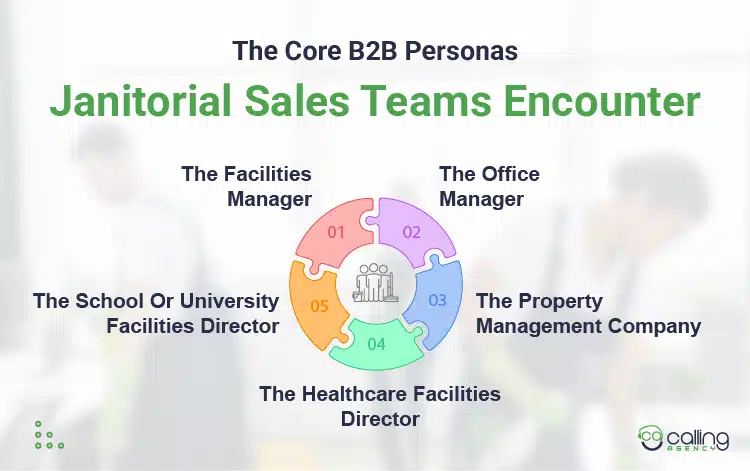
The Facilities Manager
Lets analysis the buyer’s persona of a facility manager.
Title Variations
Facilities Managers may go by different names based on company size and industry.
- Facilities Manager, Head of Facilities, Building Services Manager, Operations Manager, Maintenance Manager, and Site Manager are all common variations.
- In large organizations, titles such as Regional Facilities Manager or Facilities Director are also widely used, especially with multi-site corporate portfolios.
Primary Goals
Facilities managers work to ensure the building is functional, safe, and compliant. Their key goals include:
- Meeting health and safety standards
- Taking a regular high inspection or audit score
- Preventing service disruption
- Managing maintenance and cleaning budgets
- Ensuring smooth daily operations
- They are judged on their operational efficiency and risk management
Top Pain Points
Their greatest hurdles typically pertain to compliance risks and reliability. Common pain points include:
- Missed cleaning shifts
- Poor washroom hygiene complaints
- Slippery floors cause hazards
- Failed internal or external audits
- Rising costs without improved performance
- Poor communication from vendors
Cleaning failures can lead to serious operational challenges in manufacturing, healthcare, or corporate campuses. They cannot afford inconsistency.
Buying Authority
Even though facilities managers usually control vendor selection, the final approval might be based on budget size. In mid-sized companies, they might actually sign janitorial contracts themselves.
Final contracts may need to be approved by procurement or senior leadership in a large enterprise.
They typically:
- Shortlist vendors
- Conduct site evaluations
- Review compliance documentation
- Monitor service-level performance
They have a huge influence over the decision, even if they don’t sign the contract.
Best Sales Angle
Operational credibility is the best of all possible approaches. Focus on:
- Compliance systems and documentation
- Structured supervision and inspection routines
- Staffing continuity plans
- Risk reduction strategies
- Clear service level agreements (SLAs)
Talk in grown terms about response times, reporting mechanisms, and metrics.
Facilities managers in every industry have a connection to structured, process-driven cleaning service providers.
Common Objection
“We already have a cleaning provider.” This is an objection that Facility Managers will often raise.
They tend to be hesitant about making a switch. It may not mean satisfaction. The biggest concern is the risk of missed shifts, complaints, or operational disruption during transition.
Acknowledge stability and transition planning clearly in your response.
The Procurement Officer
The procurement officer focuses on controlling costs, evaluating suppliers, and ensuring compliance with the terms of contracts.
In big corporations, manufacturing plants, health care networks, and universities, vendor selection is handled formally through procurement departments.
They care less about daily cleaning details and more about commercial terms.
Their priorities usually include:
- Competitive pricing and cost savings
- Contract length and renewal terms
- SLA clarity and penalty clauses
- Insurance and compliance documentation
- Vendor financial stability
- Risk management and liability coverage
Procurement officers regularly issue RFPs (Request for Proposals) and compare multiple bids side-by-side. They take a close look at labour hours, scope breakdowns, and pricing structures.
One of their biggest concerns is overpaying or choosing an untrustworthy vendor. They might call for price cuts or demand itemised breakdowns.
A good sales approach is systematic and analytic. Provide:
- Clear cost breakdowns
- Defined service levels
- Proof of regulatory compliance
- References and performance metrics
Avoid emotional selling. Emphasize quantifiable value, long-term cost efficiency, and contractual transparency.
The Office Manager
The office manager is also common among small to mid-sized offices (e.g., niche consulting firms), corporate branch money-centers, and coworking spaces.
Unlike facilities managers, they may lack technical knowledge of cleaning standards. But they directly handle the complaints of employees and daily presentation issues.
Their priorities include:
- Clean washrooms and kitchen areas
- Fresh-smelling office spaces
- Clean desks and meeting rooms
- Reliable daily attendance
- Quick response to complaints
Sometimes, office managers work with administrative budgets. They want cleaning to “just work” without endless chasing.
Their main pain points are:
- Cleaners missing shifts
- Visible dust or bin overflow
- Employees are complaining about hygiene
- Inconsistent standards
The most successful sales approach is simple and responsive. Emphasize:
- Clear cleaning schedules
- Direct contact points
- Fast issue resolution
- Friendly and professional staff
These types of communication resonate more with the office managers who prefer not to read pages of technical compliance language. Make proposals simple, focusing on tangible metrics.
The Property Management Company
Property management companies manage the buildings of several landlords.
They manage office buildings, shopping centers, residential communities, and mixed-use projects. Cleaning plays an essential role in tenant satisfaction and a property’s reputation.
Their priorities include:
- Clean and presentable common areas
- Controlled service charge budgets
- Reliable contractor attendance
- Reduced tenant complaints
- Consistent standards across multiple properties
They frequently control multiple vendors together and value contractors who are able to service several sites. Adaptivity and communication are important.
Pain points typically include:
- Tenant complaints about hygiene
- Poor lobby presentation
- Missed cleaning in communal areas
- Contract disputes over scope
Stability and portfolio coverage sell best. Highlight:
- Multi-site management capability
- Area-based scope planning
- Regular inspection reporting
- Clear escalation processes
Property management companies prefer easy-going vendors who care for the building image, meaning we don’t ruin the aesthetics of a place and keep daily oversight to a minimum.
The Healthcare Facilities Director
Healthcare facilities directors work in hospitals, clinics, and medical facilities.
For them, cleaning is essentially tied to infection prevention and patient safety. This persona is very compliance-oriented and risk-averse.
Their priorities include:
- Infection prevention standards
- Disinfection protocols
- Compliance with healthcare regulations
- Proper chemical handling (COSHH)
- Detailed cleaning documentation
Poor cleaning can result in health hazards and regulatory fines. They need trained staff who understand clinical environments, isolation zones, and cleaning of high-touch surfaces.
Pain points often include:
- Inconsistent disinfection routines
- Poor documentation for inspections
- Non-healthcare trained staff
- Cross-contamination risks
The leading sales approach is specialist knowledge. Emphasize:
- Healthcare-trained staff
- Colour-coded cleaning systems
- Audit reporting tools
- Strict compliance procedures
This persona uses evidence, certificates, and formalized quality control systems.
The School or University Facilities Director
School and university facilities directors oversee campuses, classrooms, dormitories, and sports facilities. Cleaning impacts student health and institutional reputation.
Their priorities include:
- High-touch surface sanitization
- Washroom hygiene
- Waste management in large campuses
- Controlled funds within the limits of public funding
- Cleaning during the holidays and term breaks
They contend with seasonal changes in demand and heightened daily foot traffic. Budgetary constraints are not unfamiliar in public institutions.
Pain points include:
- Rapid spread of illness
- Graffiti and damage
- Extreme wear and tear in corridors and communal areas
- Pressure from parents or administration
Flexibility and preventive hygiene are the best sales angles. Focus on scalable staffing, term-based scheduling, and proactive sanitation programs.
Demonstrate how your janitorial service aids student wellbeing, even if budgets are tight.
Read More –
- Top 5 Janitorial Bidding Software You Need to Grow
- Top 10 Tips to Win Janitorial Bids
- 10 Proven Lead Generation Strategies for Janitorial Services
Industries and Verticals By Persona
Knowing which persona overrides in every industry allows janitorial sales teams to prospect more quickly and pitch smarter. Sectors tend to have predictable buying behavior.
Common persona-industry alignment includes:
- Facility Manager – Factory, office, warehouse, critical energy systems.
- Procurement Officer – Enterprise corporations, government contracts, universities, and hospital networks.
- Office Manager – Small to mid-sized offices, startups, coworking spaces, branch offices
- Property Management Company – Multi-tenant office buildings, retail centres, residential complexes
- Director of Healthcare Facilities – Hospitals, private clinics, medical laboratories
- School or University Facilities Director – K–12 schools, colleges, large campuses
Persona to vertical mapping helps sales reps predict concerns easily. For instance, infection control is key in healthcare, while tenant satisfaction matters more in property management.
This allows for conjecture to be less guesswork during prospecting and ensures targeting is more accurate.
How to Build Or Customize Your Own Persona Cheatsheet?
Every janitorial company serves a slightly different market. This is exactly why your persona cheatsheet should be based on your actual customer base.
To create or improve your own version:
- Review your top 20 clients
- Job titles for all parties involved in each deal
- Note common objections raised
- Document decision timelines
- Maximum contract size and number of approval layers
- Highlight industry-specific compliance needs
Talk to your operations team as well. They typically have a better grasp on client pain points than sales reps.
Make it a cheatsheet that is handy and workable. You may want this to fit one or two pages, with information on key goals, pain points, authority level, and best sales angle for each persona.
Add to it annually as you break into additional target industries.
How to Use The Persona Cheatsheet In Your Sales Process?
This persona cheatsheet should be your guiding tool to engage in sales conversations at every step, from prospecting to closing.
We are not talking about an ordinary training document. It is a practical tool.
Sales teams can use it to:
- Adjust cold call scripts
- Personalise email messaging
- Prepare site visit talking points
- Anticipate objections
- Structure proposals
There are some necessary factors your sales team should focus on.
- Prior to any meeting, figure out who you are speaking with.
- Read up on their goals and possible line of thinking.
- Validate assumptions during discovery by asking the right questions.
- Use the language of their priorities in your proposal after you meet.
A structured approach builds credibility and increases close rates in competitive janitorial bids.
Final Words
Cleaning quality is not the only thing that matters in janitorial sales. It is about knowing who the decision maker is and what shaped their priorities.
- Facilities managers focus on compliance and operations.
- Procurement officers care about costs and contracts.
- Tenant satisfaction matters to property managers.
- Healthcare and education leaders fear for the safety of hygiene standards.
Providing the sales team with a structured persona cheatsheet prevents them from doing generic pitches.
Instead, they address real concerns and industry pressures head-on. This minimizes objections, expedites sales cycles, and makes for longer contracts.
Understanding buyer personas helps janitorial sales go from reactionary quoting to strategic, targeted selling.