



To win a commercial cleaning contract, complete these essential steps:
- Secure the required business licenses, insurance and local licensing requirements.
- Build a local targeted list of facility decision-makers
- Execute direct outreach to site walkthroughs
- Create and submit itemized proposals
Winning recurring contracts for commercial cleaning services depends on replacing unreliable vendors by offering reliable quality control, a clear scope of work, competitive pricing and proof of liability coverage. A consistent flow of commercial cleaning leads also gives you more opportunities to reach facility managers before they start comparing multiple vendors.
Most contracts come from direct outreach, not posted bids. Posted bids draw the most competition and the slowest decisions.
Who This Guide Is For: This guide is for three types of readers:
- The owner is chasing a first commercial account.
- The owner holding a few contracts who wants a repeatable way to add more.
- The sales lead carrying a contract target into next quarter.
It assumes you already know what a commercial cleaning contract is, so nothing below defines one.
The Seven Steps to a Signed Commercial Cleaning Contract
Getting a commercial cleaning contract becomes easier when you follow a clear and strategic process. You should not jump straight into pricing. First, make sure the building is a good fit, visit the site and learn exactly what the client needs. Here are the seven steps you should follow.
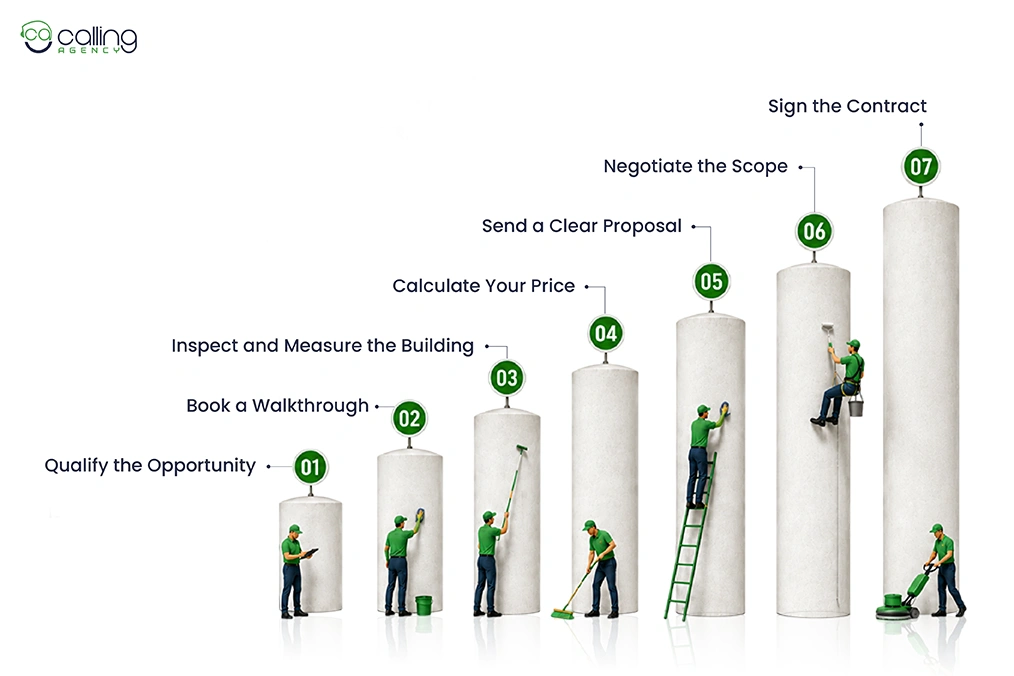
1. Qualify the Opportunity
Before you invest your time on calls with the prospect, and before walkthroughs and proposals, check if the deal is worth pursuing. Then, look at the building size, location, contract timeline and who can make the decision. Make sure the account fits your service area and your minimum contract rules. Lead qualification is a significant task before attempting a physical walkthrough.
2. Book a Walkthrough
Ask the prospect to set up an on-site walkthrough after qualifying the opportunity. If your current prospect is not the only decision-maker, try to meet the other person who manages the cleaning service or can approve a new vendor. This is how you can measure the possibilities and get a chance to check the building and learn why they want a change.
3. Inspect and Measure the Building
While visiting the property physically, walk through each part of the property and note what needs cleaning and other key challenges. Measure offices, hallways, restrooms and special areas on their own. Each area takes a different amount of time and may need different cleaning supplies or equipment.
4. Calculate Your Price
Use what you saw on the walkthrough to estimate the labour hours and labour costs the job needs. Then add employee costs, supplies, equipment, overhead and your profit margin. This gives you a price based on the real work, not a rough guess. It also helps you during the negotiation of pricing.
5. Send a Clear Proposal
Write a janitorial service proposal that clearly explains the cleaning scope, frequency, price and service terms. You can also offer two or three service options. This gives the buyer some choice without forcing you to lower your rate.
6. Negotiate the Scope
When the client asks for a lower price, don’t rush to offer a discount. Cut the cleaning frequency, drop an optional task or adjust the service package. This helps you protect your profit while still giving the client a workable option.
7. Sign the Contract
Before you sign, confirm the final scope, price, payment terms, start date, insurance requirements and cancellation terms. Once both sides agree, sign the contract and set the service start date. Also record the renewal date, so you can prepare for the renewal talk early.
Follow these steps in order. A professional proposal won’t help if the building is a poor fit or the wrong person is reviewing it.
Where Do Commercial Cleaning Contracts Come From?
Most of the commercial cleaning contracts usually come from five places.
- Open bids for federal contracts on portals such as SAM.gov.
- Private Requests for Proposal (RFPs) and Invitations to Bid issued by property management firms.
- Cold calling for commercial cleaning companies and other direct outreach to buildings carrying no posted opportunity.
- Referral partnerships with trades working the same buildings.
- Contract renewals for cleaning accounts you already hold.
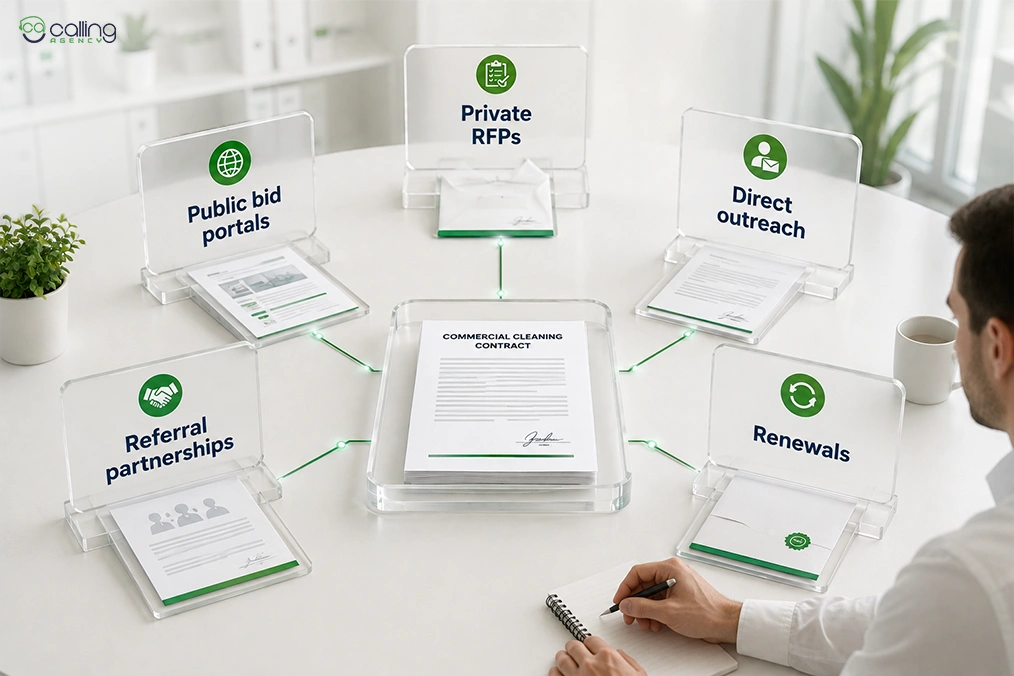
| Source | Competition | Decision speed | Suits you if |
| Public bid portals | Highest | Slowest | You carry bonding and references |
| Private RFPs | High | Slow | You know the property management firm |
| Direct outreach | Lowest | Fastest | You can work a call list weekly |
| Referral partnerships | Low | Varies | You already serve buildings nearby |
| Renewals | None | Immediate | You have accounts coming up for renewal |
Your competition increases with visibility of the job post. A posted cleaning job reaches every cleaning company in your area at the same time, so every company tries to grab the opportunity. A building with no posted opportunity reaches whoever calls it first. That is why unposted buildings for cleaning services stay open to you even without bonding or a long reference list.
Federal government contracts appear on SAM.gov, while state, county and city cleaning contracts may use separate procurement portals. NAICS stands for North American Industry Classification System, and the codes listed in your business profile help you find relevant solicitations. NAICS 561720 covers janitorial services.
Who Actually Signs a Commercial Cleaning Contract?

The person who answers your call or replies to your message may not be the person who approves or signs your cleaning contract. Commercial cleaning decisions commonly involve five roles. Understanding the differences between facility managers and property managers can help you contact the right person.
- Facility managers
- Property managers
- Office managers
- Operations managers
- Business owners
Across all commercial cleaning lead generation campaigns run by CallingAgency, these same five roles consistently came up on the targeted prospect list. The final decision-makers change from one campaign to another.
You cannot identify the right person based only on the property type. Office buildings, healthcare facilities and warehouses may each use a different approval process. Even two similar buildings may assign the cleaning decision to different roles.
Ask about the decision process during your first conversation instead of guessing. You should also prepare for common facility and property manager objections.
What Each Role Cares About in the Decision-Making Process
Each role has different priorities. Your message should focus on the problem that matters most to the person you are speaking with.
| Role | What They Care About |
| Facility manager | Cleaning quality and how quickly problems get resolved |
| Property manager | Tenant satisfaction and protecting the building’s value |
| Office manager | Reliable service, clear communication and budget control |
| Operations manager | Preventing cleaning work from disrupting operating hours |
| Business owner | Cost, accountability and overall service quality |
For example, a property manager may care most about reducing tenant complaints. A business owner may focus more on cost and whether one person takes responsibility when something goes wrong.
Larger contracts may also involve procurement, finance or senior management. This can add more approval steps and make the decision take longer.
During the first call, ask:
“Who reviews, approves and signs the cleaning agreement?”
That one question can help you avoid sending proposals and follow-up messages to someone who cannot make the final decision.
How Many Buildings Do You Contact to Win One Cleaning Contract?
There is no standard industry average for the number of unique buildings you must contact to win one commercial cleaning contract. Cleaning companies track their sales pipeline differently. Some count buildings, while others count calls, conversations, walkthroughs or submitted proposals.
It can take 1,500 to 3,000 dials to win one signed contract from a fresh list. And the walkthrough-to-contract close rate is between 15% and 25%. At that rate, you need around four to seven walkthroughs to win one contract. BSCAI reports that fewer than one in four submitted bids becomes a signed contract.
CallingAgency’s campaign results sit near the stronger end of that range.
Across three fully documented commercial cleaning campaigns, contacting 55 to 100 buildings produced one signed contract. The campaigns required at least 275 calls to book one walkthrough and 4.4 walkthroughs to win one contract. That puts at least 1,200 dials behind each signed contract.
Industry Benchmark vs CallingAgency Results
| Stage | Available Cleaning Benchmark | CallingAgency Results |
| Buildings contacted per contract | On average, it’s 50 to 300. But no specific standard public benchmark. | 55 to 100 |
| Dials per signed contract | 1500 to 3000 | 1,200 or more |
| Walkthroughs per contract | Around 4 to 7 | 4.4 |
| Walkthrough-to-contract close rate | 15% to 25% | 23% |
CallingAgency converted 23% of its walkthroughs into signed contracts. This means about one contract was won from every four to five walkthroughs. It also took at least 1,200 calls to win one contract. Compared with the estimated range of 1,500 to 3,000 calls, CallingAgency used fewer calls per contract.
Note: Treat this as a directional comparison rather than a guaranteed industry standard. Results change based on building type, list quality, location, contract timing, competition and how strictly each company qualifies a walkthrough.
The Numbers Behind Signed Contracts by CallingAgency
Six CallingAgency commercial cleaning campaigns ran for a combined 30 months across the United States and Canada.
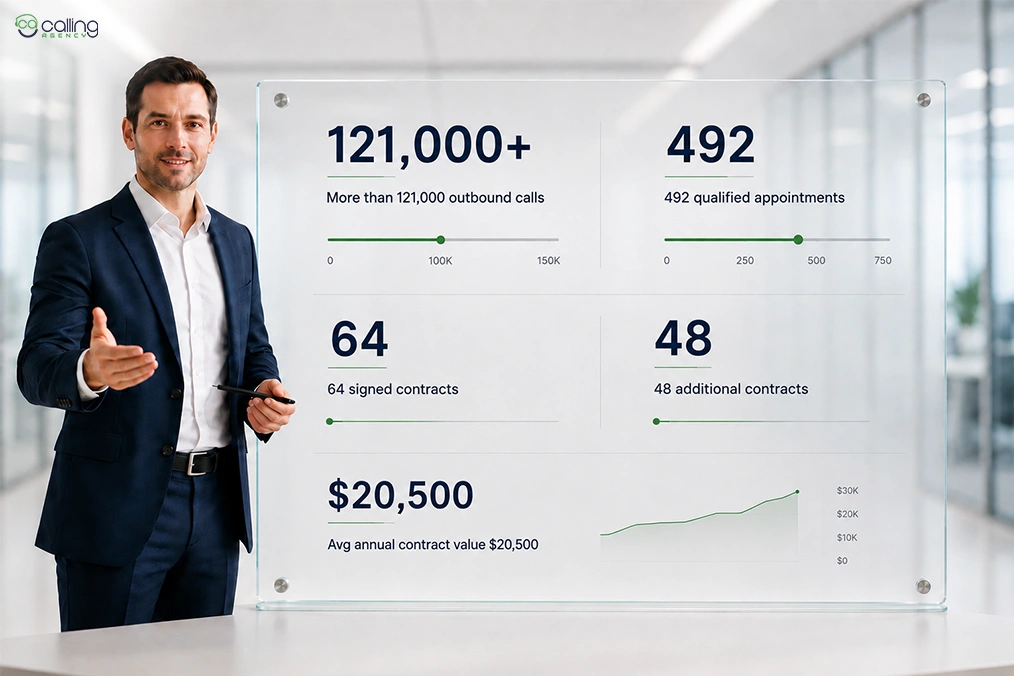
Together, they generated:
- More than 121,000 outbound calls
- 492 qualified appointments
- 64 signed contracts
- 48 additional contracts reported as estimates
- An average annual contract value of about $20,500 from the three campaigns that shared contract values
The 64 signed contracts came from Next Level Cleaning Group, Armored Cleaning Solutions and Office Pride. These campaigns reported 22, 18 and 24 signed contracts.
The other three campaigns reported estimated results. PCS1210 estimated 17 or more contracts, Smell Fresh Cleaning estimated five or more and Executive Pro Cleaning estimated 26 or more.
This means the combined result was 64 signed contracts and at least 48 estimated contracts. It should not be described as 112 confirmed signed contracts.
The three campaigns that shared contract values reported:
- Next Level Cleaning Group: $18,500 average annual contract value
- Armored Cleaning Solutions: $21,000
- Office Pride: $22,000
Across their 64 signed contracts, the weighted average annual contract value was approximately $20,500.
The call totals are minimum figures because the case studies use numbers such as “17,600+ calls” and “21,600+ calls.” These results show what CallingAgency reported across its campaigns and should not be treated as an industry-wide average.
Why Qualified Opportunities Are Not Walkthroughs
A walkthrough means visiting the building and discussing its cleaning needs. A qualified opportunity means the building is a good fit, the right decision-maker is involved and the prospect is ready for a proposal.
How to Qualify an Opportunity Before You Spend a Day on It
Qualifying an opportunity is super important in the process of sourcing a cleaning client. Qualifying the prospect before scheduling a walkthrough prevents you from wasting time on opportunities that are unlikely to close.
Look for these four warning signs:
- Do not spend more time on prospects who refuse a site walkthrough.
- Avoid leads that will not explain why they want to replace their current cleaning company.
- Be cautious when a prospect invites many bidders but provides no clear selection criteria.
- Focus on buildings within your existing service area or route cluster.
Four Reasons to Walk Away
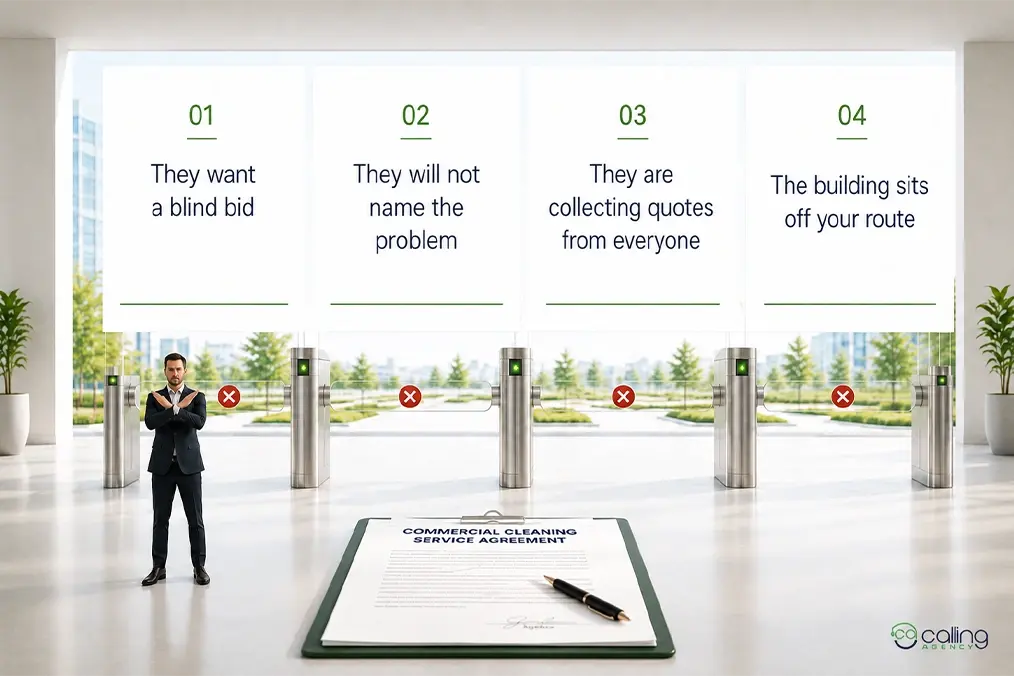
- They want a blind bid: No walkthrough means no measurements, and no measurements means you are pricing on hope.
- They will not name the problem: A buyer who cannot explain what is wrong with the current provider is likely only looking for the lowest bid.
- They are collecting quotes from everyone: Volume bidding with no criteria means the cheapest number wins.
- The building sits off your route: Extra travel time adds labour and fuel costs that may not be covered by your bid
Route clustering protects your profit by reducing travel and logistics costs. Two nearby buildings cost less to service than two buildings an hour apart, even when both contracts pay the same.
Four Questions That Qualify
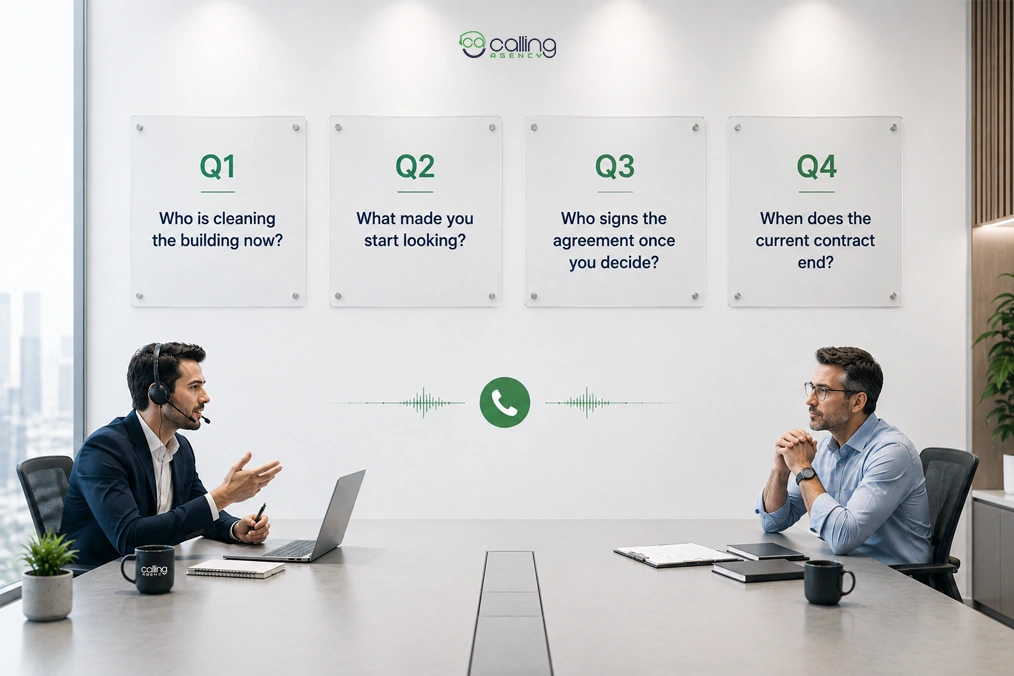
- Who is cleaning the building now?
- What made you start looking?
- Who signs the agreement once you decide?
- When does the current contract end?
Set a minimum contract size and stick to it. Do not schedule walkthroughs for buildings that fall below that limit. Before cold calling, review the federal and state rules that apply to your campaign. B2B calls may face fewer restrictions than consumer calls, but they are not exempt from every rule.
What the Walkthrough and the Bid Have to Capture
The walkthrough captures square footage by area type, floor surface, restroom fixture counts, soil level, access hours and security requirements. The bid converts those into labour hours using published production rates. Then you add payroll burden, supplies, overhead and margin.
The Walkthrough Checklist
- Square footage, broken out by area type rather than one building total
- Floor surface in each area, since carpet and tile clean at different speeds
- Restroom fixture counts, meaning toilets, urinals and sinks
- Soil level and furniture density in each space
- Access hours, security screening and key or badge requirements
- Who provides consumables, paper goods, cleaning chemicals and equipment
- Current condition, including any special cleaning techniques or deep cleaning needed before you start
You should count fixtures also, not just floor area. Restrooms get priced per fixture in the standard tables, so a square footage figure alone will not price them.
Turning the Walkthrough Into a Price
You do not have to invent a production rate. ISSA, the cleaning industry association, already published one in the Official ISSA Cleaning Times & Tasks. Divide your area by that rate and multiply by 60. That gives you minutes.
Mopping 1,000 square feet with a flat mop takes you 11.2 minutes. Restrooms price per fixture at 3 minutes each, so ten fixtures cost you 30 minutes. Hours make a bid defensible, more than a price per square foot. ISSA calls these benchmarks for bidding rather than measured studies of your crew.
Once you hold the hours, the pricing is arithmetic. Labour cost, then supplies, then overhead, then your margin. Your service level agreement, or SLA, sets the response times you are promising alongside that price.
What Belongs in the Contract Document
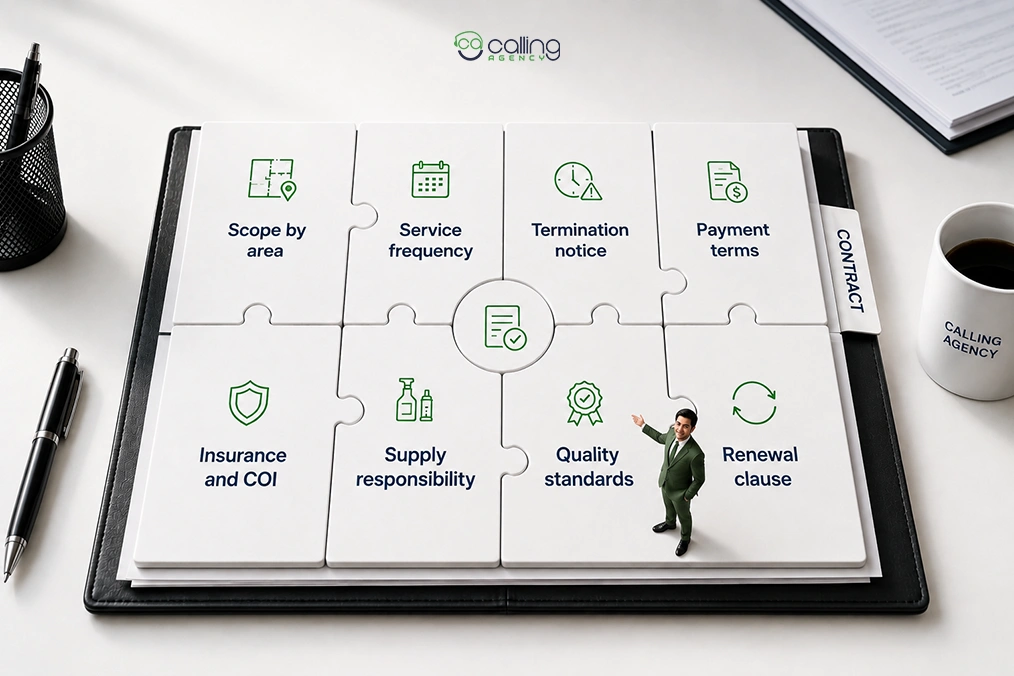
Your contract needs scope by area, service frequency and clear start and end dates. It also needs price and payment terms, a termination notice period and insurance requirements. Then supply responsibility, quality standards and a renewal clause. Miss the scope clause and you will absorb work you never priced.
| Clause | What it protects you from |
| Scope by area | Scope creep, meaning added tasks nobody agreed to pay for |
| Service frequency | A buyer expecting nightly service on a three-times-weekly price |
| Termination notice | Losing a route with no warning and no time to backfill |
| Payment terms | A cash flow gap you did not plan for |
| Insurance and COI | A dispute over who carries the liability after an incident |
| Supply responsibility | Paying for consumables you assumed the client provided |
| Quality standards | Arguments about whether the work met expectations |
| Renewal clause | An automatic exit you find out about too late |
COI stands for certificate of insurance, and your client will ask for one before your crew gets a key. Watch the payment terms closely. Commercial buyers routinely pay on net 30, net 60 or even net 90 terms after invoice. Your payroll does not wait that long. Write the notice period as a specific number of days rather than leaving it open. It’s always better to have a lawyer read the document before you sign it.
How to Keep the Contract at Renewal
Keeping an existing contract usually costs you less than finding a new client. A simple renewal plan can make the process easier.
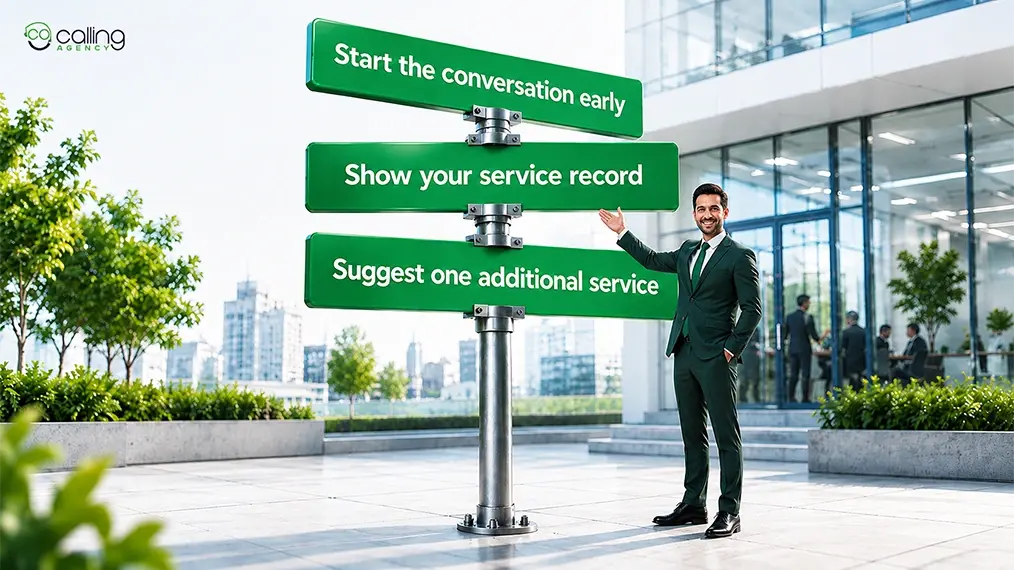
- Start the conversation early: Keep track of each contract’s end date and discuss renewal before the expiry date gets too close.
- Show your service record: Bring inspection reports, logged issues and response times. This gives the buyer a clear picture of the work you have completed during the contract.
- Suggest one additional service: Review any extra service the buyer mentioned during the year and include it as an optional upgrade.
Buyers often look for a new cleaning company because of repeated complaints rather than price alone. A clean service record can help protect the contract even when competitors offer a lower rate.
The inspection record should be updated from the first month. Waiting until renewal time may leave important work undocumented.
Finding new cleaning contracts also requires a high volume of outreach and consistent commercial cleaning lead follow-up. When an internal team cannot manage daily calling alongside cleaning operations, outsourcing this part is a practical option.
Frequently Asked Questions
Can you get a commercial cleaning contract with no commercial experience?
Yes, through smaller unposted buildings where availability matters more than references. Single-tenant offices and small retail sites rarely ask for a performance history. Posted bids and government solicitations expect past performance, so those come later.
What insurance do you need before you can bid on a cleaning contract?
Most commercial cleaning contracts require general liability insurance, workers’ compensation if you have employees and a janitorial bond. The client may also request specific coverage limits or endorsements, so review the bid documents and service agreement before submitting your proposal.
How do you get a government cleaning contract?
Register your business on SAM.gov for federal contracts and add NAICS 561720 for janitorial services. Then search for suitable opportunities, review the insurance, experience and bidding requirements and submit a complete proposal before the deadline. State and local cleaning contracts are usually listed on separate procurement portals.
What happens if the client cancels the contract early?
The termination clause determines what happens next. The client may need to provide written notice, pay the final invoice or cover an early termination fee if the contract requires it. A clear notice period helps protect your cleaning company from sudden revenue loss.
Should you lower your price to win a commercial cleaning contract?
No. Adjust scope instead. Reduce the frequency or drop a periodic task and hold your rate. A discounted contract underfunds staffing, which raises complaint volume, which loses you the account at renewal. You end up defending a low price for a year and then losing it anyway.
How many contracts can a small cleaning company realistically add in a year?
Use the ratio rather than a target. At 4.4 walkthroughs per signed contract, a team holding four walkthroughs a month adds roughly eleven contracts a year. Walkthrough volume is the constraint, not your close rate. The combined walkthrough-to-contract close rate across the campaign set was approximately 23%.
How long before an outbound campaign produces signed contracts?
Most outbound campaigns take several weeks to a few months to produce signed contracts. Timing depends on the buyer’s contract renewal date, sales cycle and follow-up process. In CallingAgency campaigns, some cleaning companies closed contracts within two months while maintaining 11 to 18 walkthroughs per month.
RFP bidding or direct outreach: which should you run?
Direct outreach is usually easier for newer cleaning companies because it requires fewer qualifications and can reach buildings before competitors. RFPs often require bonding, references and procurement experience but may lead to larger contracts. Established companies can use both. The CallingAgency dataset only measured direct outreach, not RFP performance.