

Most successful commercial cleaning services dominate a small geographic area before expanding. After a time, they appear in Google search results, Facebook groups, and local business events. When they become familiar, people trust them, which helps them to win contracts. This is exactly how to sell commercial cleaning services in your local market.
Local marketing focuses on becoming the obvious choice within a specific neighborhood, even a single ZIP code or business district. Buyers mostly hire those cleaning companies as they recognize them better.
If you are also trying to grow your commercial cleaning business in one city, this guide will tell you how to do it. Every step points at the same goal. You want steady commercial cleaning leads from businesses within driving distance. Afterwards, you can optimize your local presence, attract nearby prospects, and build trust among clients.
Quick Answer: The most effective way to sell commercial cleaning services in your local market is to combine an optimized Google Business Profile, neighborhood-focused SEO, hyperlocal advertising, strong customer reviews, and community networking. When you apply these strategies together, you create brand visibility and generate qualified leads.
Key Takeaways
- Local businesses usually hire commercial cleaning companies they recognize and trust.
- Optimizing your Google Business Profile is one of the highest-ROI local marketing strategies.
- Hyperlocal advertising targeted by ZIP code or neighborhood increases lead quality.
- In-person networking can outperform digital marketing for many commercial cleaning contracts.
- Customer reviews and referrals can create a compounding marketing effect over time.
- Tracking leads by marketing channel helps identify which local strategies generate the highest return.
How To Sell Commercial Cleaning Services In Your Local Market?
To sell cleaning services in the local market, you have to make a target, build a value proposition, optimize for local search, build trust, and so on. Let’s dig deeper into it.
Define Your Target Market And Service Area
First, you need to know exactly who you want to serve, as different commercial cleaning buyers have different priorities. When you understand those differences, you can easily tailor your marketing, pricing, and even sales conversations. Many companies make the mistake of advertising to “everyone.” Trust me, it will only result in generic messaging, not meaningful messaging.
Who Is Your Ideal Local Client?
To know your ideal local client, you have to divide the customer segments. Let’s have a look below:
| Client Type | Primary Need | Buying Decision Usually Made By |
| Office Buildings | Daily appearance and employee satisfaction | Office Manager or Facility Manager |
| Medical Clinics | Infection control and compliance | Practice Manager |
| Retail Stores | Customer-facing cleanliness | Store Manager or Owner |
| Warehouses | Dust control and safety | Operations Manager |
| Schools | Health standards and scheduled commercial cleaning | Facilities Director |
| Property Management Companies | Reliable vendors across multiple buildings | Property Manager |
Here, each segment requires different messaging. A medical clinic wants to hear about sanitation protocols. A warehouse manager cares more about floor maintenance and operational tasks. You can’t sell to both of them with the same marketing strategy.
Narrow Your Geographic Focus
Dominate one neighborhood before expanding because each neighborhood becomes its own marketing campaign. Let’s say you are advertising across all of Chicago’s Lincoln Park, River North, and West Loop. Don’t do that. Target each of them individually. As a result, you will face lower advertising costs, better visibility in Google Maps, and more referrals between nearby businesses. Once one neighborhood generates business, expand into the next.
Build Customer Personas
A customer persona is a profile of your ideal buyer. It includes details like the following:
- Business size
- Industry
- Number of employees
- Cleaning frequency
- Building size
- Decision-maker’s role
- Common objections
- Budget expectations
- Contract renewal timeline
For example, you are building a medical office persona. There, you might note 10 examination rooms, cleaning needed five evenings a week, concern about infection prevention, and a requirement for insured cleaners. All this information will help you get more office cleaning leads.
Build A Local Value Proposition
By building a local value proposition, you can tell others why businesses in your neighborhood should choose your company over other companies.
Highlight What Makes You Different
Your value proposition should state one or two meaningful advantages. Such as, 24/7 customer support or eco-friendly cleaning products.
Don’t say, “We provide quality commercial cleaning.” Instead, say, “We guarantee a supervisor will respond to every service request within two business hours.”
When you give specific promises, it creates confidence in both the buyer and seller.
Localize Every Marketing Message
When you localize your marketing message, people will naturally respond to it. Because they respond to businesses that feel part of their community. So, mention neighborhood names, local landmarks, and business districts.
Focus On Business Outcomes
Say something that clearly defines your business outcomes. Don’t say “We vacuum carpets.” Instead, say, “We help businesses create healthier workplaces, reduce employee sick days, improve customer impressions, and maintain professional facilities.”
Remember, business owners buy outcomes. Not cleaning supplies.
Support Your Claims With Proof
Show some pictures or proof of your services so that your value proposition becomes strong. Some examples of proof can be customer testimonials, Google review ratings and many more.
Optimize For Local Search
By optimizing for local search, you allow prospects to see your services first. It’s because Google judges commercial cleaning businesses that are optimized for local search. Google displays such businesses first with strong local SEO.
Local SEO isn’t just about ranking higher. It’s about helping businesses appear exactly when someone is looking for it. Remember, these are high-intent prospects. They are much more likely to request a quote than to trust a random advertisement.
Optimize Your Google Business Profile
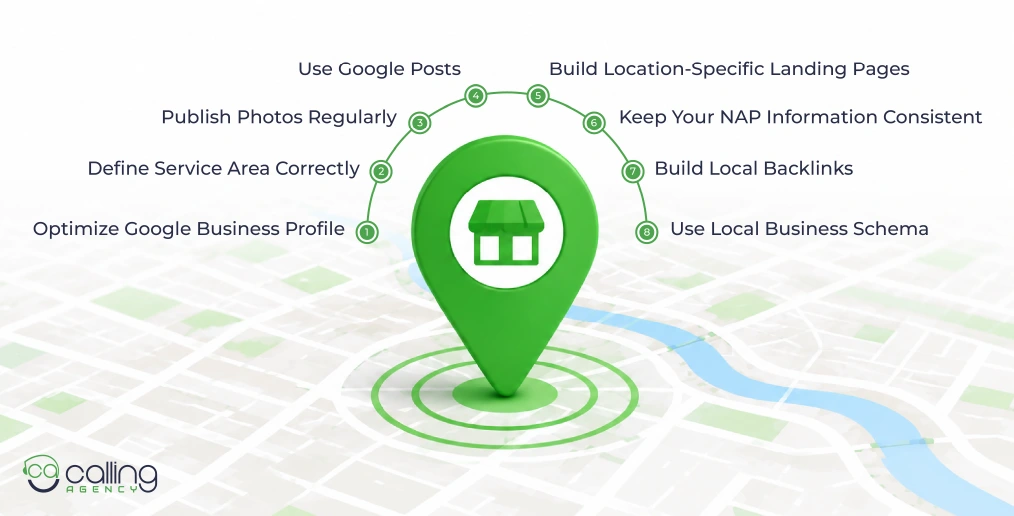
Optimizing your Google Business Profile (GBP) will give a positive impression among customers. It’s the first thing that a local prospect will see and decide whether to interact. Try to put a primary category there, like Janitorial Service. Then complete every field where information is required. This will make your profile complete.
Define Your Service Area Correctly
Tell about your service clearly because Google prefers accuracy. If you travel to clients to offer service, configure your profile as a service area business. Focus on areas you genuinely serve. It can be Downtown Dallas, Plano, or any address.
Publish Photos Regularly
By publishing photos regularly, you can generate more profile engagement. Better treat your profile like a social media page. Upload about your floor restoration projects, equipment, vehicles, before-and-after cleaning photos, etc.
Use Google Posts
Regular updates as Google Posts signal that your business is active. Here, you can publish updates directly inside your Business Profile.
You may upload your new service announcements, seasonal commercial cleaning offers, holiday schedules, and so on.
Build Location-Specific Landing Pages
Location-specific landing pages give clear ideas to prospects about your location. It’s better that you create individual pages for each city or neighborhood. For example, you can put office Commercial Cleaning in Downtown Houston or Medical Office Commercial Cleaning in Sugar Land. Each page should include local landmarks, nearby industries, an embedded Google Map, and local FAQs.
Keep Your NAP Information Consistent
Keep your NAP information consistent to improve local search rankings. If one website lists ABC Commercial Cleaning, don’t list another with ABC Commercial Cleaning LLC. Google will become less confident about your business identity then.
Build Local Backlinks
When you build backlinks, Google takes it as one of the strongest ranking signals, because backlinks help search engines evaluate a website’s authority. It’s better to earn links from organizations within your community. It can be:
- Chamber of Commerce
- Business associations
- Local newspapers
- Community blogs
- Nonprofit organizations
- Local sponsorship pages
- School partnerships
- Business networking groups
Use Local Business Schema
With Local Business Schema, your website will seem clear to search engines. They can easily understand your business’s
- Business name
- Address
- Service area
- Phone number
- Opening hours
- Reviews
- Services
- Website
Build Trust With Local Reviews
Always show local reviews as they build trust among customers. Even before contacting a commercial cleaning company, most commercial buyers compare reviews.
Instead of asking, “Can they do the job?” The prospect starts asking, “When can they start?”
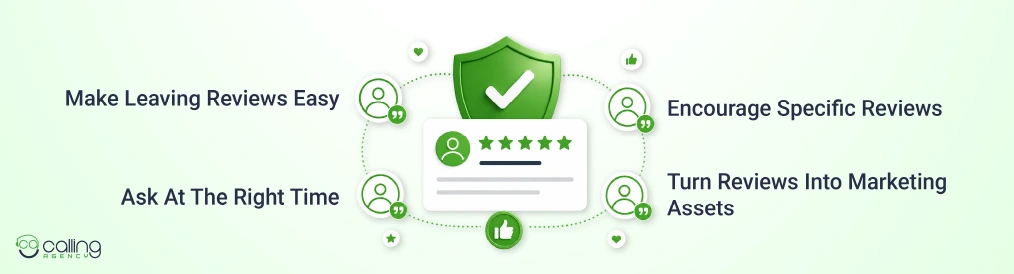
Ask At The Right Time
The right time to ask for reviews is within 24 to 48 hours after completing a project. At that time, the customer’s experience is fresh. So, they will leave honest reviews at that time.
Make Leaving Reviews Easy
Customers must find it easy to leave reviews. It’s better to remove as much friction as possible. Just provide:
- A direct Google review link
- QR code on invoices
- A follow-up email
- An SMS reminder (if needed)
- A thank-you card with a printed QR code
The fewer clicks there are, the higher your response rate will be.
Encourage Specific Reviews
Encourage customers to mention:
- Property type
- Service received
- Professionalism
- Response time
- Reliability
- Results achieved
This will increase your brand value.
Example:
“Our office has never looked cleaner. Their team arrives on time every evening and responds quickly whenever we need additional services.”
Turn Reviews Into Marketing Assets
To turn your reviews into marketing assets, don’t leave reviews hidden on Google. Repurpose them across your marketing.
Try to put in real customer words, like:
- Website homepage
- Service pages
- Proposal documents
- Sales presentations
- Social media graphics
- Email campaigns
Run Hyperlocal Advertising
Hyperlocal advertising involves paying for clicks from people inside a specific area. It narrows campaigns to neighborhoods where you actually want clients.
This will produce:
- Lower cost per click
- Higher click-through rate
- Better lead quality
- Shorter travel times
- Higher profit margins
Run Google Search Ads
With Google Search Ads, you can reach people who are already searching for commercial cleaning services in your local market. Here, you must focus on keywords combining service and location.
Examples:
- Commercial cleaning Dallas
- Office cleaning Downtown Dallas
- Janitorial service Plano
- Medical office cleaning Irving
Launch Facebook And Instagram Campaigns
Facebook and Instagram campaigns are valuable because business owners and office managers use them daily. There, you can create ads with short cleaning videos and before-and-after photos.
However, run a commercial cleaning Facebook and Instagram campaign based on the following:
- ZIP codes
- Interests
- Business ownership
- Job titles
- Company size
Advertise Where Your Community Already Looks
Advertisements will make your business more familiar. Don’t rely only on Google for this. You should also consider:
- Nextdoor
- Yelp
- Local newspapers
- Community newsletters
- Neighborhood Facebook groups
- Chamber of Commerce directories
- Business association websites
Sponsor Local Events
With sponsorship, you can build familiarity. So target certain organizations like the following:
- Charity runs
- School fundraisers
- Youth sports teams
- Chamber events
- Business expos
- Community clean-up projects
Measure Every Campaign
Measure revenue by tracking:
- Cost per click
- Cost per lead
- Phone calls
- Quote requests
- Meetings booked
- Closed contracts
If a campaign generates five contracts, that’s far more valuable than one generating 50 website visits.
Network Within The Community
Networking is one of the most cost-effective ways to sell commercial cleaning services in your local market because commercial cleaning is a relationship-driven business. Many property business owners prefer hiring companies they have met personally.
Join Local Business Organizations
Join a local business organization, as it can get you recognized as the local cleaning expert. Your ideal clients already spend time there.
Some of the examples of such organizations include:
- Chamber of Commerce
- Rotary Club
- Local Business Associations
- Property Management Associations
- Real Estate Investment Groups
- Apartment Associations
- ISSA Local Chapters
Build Relationships With Referral Partners
Build relationships with referral partners because most professionals regularly interact with them before a commercial cleaning company does.
You can go with:
- Commercial real estate agents
- Property management companies
- HVAC contractors
- Electricians
- Plumbers
- Flooring contractors
- Interior designers
- Restoration companies
- Pest control companies
- Security companies
You can also go through these janitorial industry networking tips.
Stay Visible Between Events
People remember businesses that remain visible.
Stay connected by:
- Commenting on LinkedIn posts.
- Congratulating contacts on company milestones.
- Sharing useful cleaning tips.
- Sending occasional check-in emails.
- Inviting contacts for coffee.
Pitch And Close In Person
Demonstrate your professionalism in person. It will build trust faster than calls.
For a personal interaction, here’s what you can do:
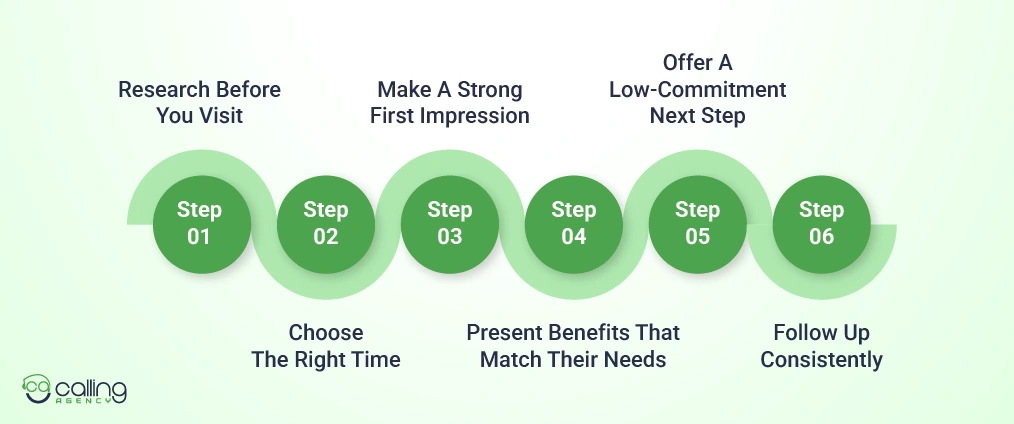
Step 1: Research Before You Visit
Before visiting, gather basic information about the company. Such as:
- Company size
- Building type
- Number of employees
- Business hours
- Current cleaning provider (if possible)
- Decision-maker’s name
- Recent company news
This will personalize your conversation.
You can say, “I noticed your company recently expanded into the second floor. Congratulations. We help growing offices maintain consistent cleaning without disrupting daily operations.”
Step 2: Choose The Right Time
Try to reach decision-makers at the right time. These can be:
- Early morning before peak business hours.
- Mid-morning after meetings.
- Mid-afternoon before employees begin leaving.
Step 3: Make A Strong First Impression
To make a strong first impression, be presentable. Wear clean business attire or a branded uniform.
Also, carry these things:
- Business cards
- Company brochure
- Capability statement
- Client testimonials
- QR code linking to your website
- Google review page
Step 4: Present Benefits That Match Their Needs
Once you understand their challenges, talk about your services that can solve those problems.
Let’s say they are facing inconsistent cleaning quality. At that time, you explain your quality inspection process. Or let’s say they are facing slow responses to urgent requests. At that time, you say your guaranteed response times.
Step 5: Offer A Low-Commitment Next Step
Many prospects don’t want to sign immediately. That’s why you should ask for a smaller commitment.
You may offer them:
- Free facility walkthrough
- No-obligation cleaning assessment
- Customized cleaning proposal
- Site inspection
- Trial cleaning session
Step 6: Follow Up Consistently
Most commercial cleaning contracts aren’t won during the first conversation. You have to create a structured follow-up sequence.
Example:
Day 1: Initial visit
Day 2: Thank-you email
Day 5: Phone call
Day 10: Share a relevant case study
Day 20: Check-in email
Day 30: Follow-up call
Run Targeted Local Promotions
Run targeted local promotions with offers, referrals, and so on. There’s more you can do like:
Create Neighborhood-Specific Offers
Neighborhood-specific offers can make people respond more positively. So, include:
- Free office cleaning consultation for businesses in Downtown Chicago.
- Complimentary restroom sanitation assessment for medical clinics in Plano.
- Carpet inspection for offices in Midtown Atlanta.
Use Seasonal Promotions
With seasonal campaigns, you can create urgency among customers.
Some of its examples include:
- Spring deep-cleaning packages.
- Back-to-school cleaning for educational facilities.
- Holiday office sanitization.
- Flu season disinfection services.
- Post-construction cleanup after renovation season.
Reward Customer Referrals
To enhance your expertise, you must reward your customer referrals.
You can encourage your referrals with incentives like the following:
- Service credits
- Additional cleaning hours
- Free floor maintenance
- Complimentary window cleaning
Partner With Local Businesses
Long-term cleaning partnerships can give you larger audiences.
However, you may partner with:
- Office furniture suppliers.
- Commercial movers.
- Property management firms.
- Interior designers.
- Coworking spaces.
Track Promotion Performance
By tracking promotion performance, you can know which offers are consistently producing profitable customers.
Your every promotion should answer three questions:
- How many leads did it generate?
- How many contracts resulted?
- What was the total return on investment?
Track Local Leads And Results
Track your local leads and results by recording every phone call, quote request, and referral. Only then can you know exactly where your best clients come from. You can even try out the account-based marketing approach. This will give you many answers like:
- Which neighborhood generates the most qualified leads?
- Are Google Ads producing better clients than referrals?
- Which networking events result in contracts?
Track Every Lead Source
Track every lead source categorized by its source, such as
- Google Business Profile
- Organic Google Search
- Google Ads
- Facebook Ads
- Cold Calling
- Cold Email
- Referral
- Networking Event
- Walk-in Canvassing
- Direct Mail
- Website Contact Form
Then you can identify which channels are delivering high-quality prospects.
Measure Performance By Neighborhood
To measure performance by neighborhood, you have to track results by:
- ZIP code
- Neighborhood
- Business district
- Industrial park
For example:
| Neighborhood | Leads | Meetings | Contracts | Close Rate |
| Downtown | 18 | 11 | 6 | 33% |
| West End | 14 | 7 | 2 | 14% |
| Business Park | 9 | 6 | 4 | 44% |
Monitor Key Performance Indicators (KPIs)
Monitor KPIs to be certain about trends and opportunities.
Here, you must track these things monthly:
- Website visitors
- Google Business Profile calls
- Quote requests
- Cost per lead
- Cost per appointment
- Appointment-to-proposal rate
- Proposal acceptance rate
- Customer acquisition cost
- Average contract value
- Customer lifetime value
- Monthly recurring revenue
- Client retention rate
- Referral rate
Use A CRM To Manage Follow-Ups
CRM will help you manage follow-ups. It will mainly help you to:
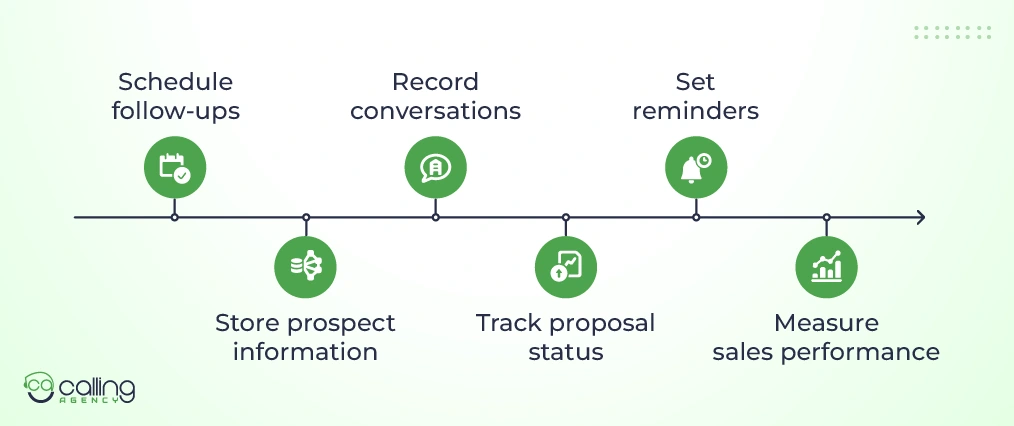
- Schedule follow-ups
- Store prospect information
- Record conversations
- Track proposal status
- Set reminders
- Measure sales performance
Deliver Service That Gets Talked About
A satisfied customer will talk about your service and become a potential advocate for your company. This can naturally generate repeat contracts, positive reviews, and referrals for you. Or you can check out complete guide to getting commercial cleaning leads.
Create A Consistent Customer Experience
Develop procedures so every client receives the same high-quality service. Just create checklists that cover:
- Arrival procedures
- Cleaning standards
- Equipment handling
- Safety protocols
- Final inspections
- Customer communication
Ask For Feedback Regularly
From feedback, you can learn about small issues.
To get feedback, you can ask:
- Were you satisfied with today’s service?
- Is there anything we could improve?
- Did our team meet your expectations?
Turn Happy Clients Into Brand Ambassadors
Turn your happy clients into brand ambassadors following these few things:
- Request a Google review.
- Ask for a testimonial.
- Create a case study.
- Request a referral.
- Ask permission to photograph completed work.
Invest In Your Team
Your cleaners represent your brand every day.
Provide them regular training on:
- Customer service
- Professional communication
- Cleaning techniques
- Safety procedures
- Equipment use
- Problem solving
Conclusion
Selling commercial cleaning services in your local market is not so complicated. You just need to combine a strong Google Business Profile, neighborhood-focused SEO, and outstanding service. More importantly, you have to be consistent. Only then will it help your business win more commercial cleaning contracts.
If you want to deliver exceptional cleaning, but also want experts to handle your prospecting, CallingAgency has got you. It can book qualified commercial cleaning appointments for you. That will go directly on your calendar by its proven C.A.L.L.S.™ framework.
Frequently Asked Questions
How many neighborhoods should I target when starting my commercial cleaning business?
While starting your commercial cleaning business, target one or two neighborhoods. These should be those neighborhoods where you can actually provide service. Once you start getting leads, expand gradually into your nearby neighborhoods.
Do I need a separate Google Business Profile for every city or neighborhood I serve?
No, you don’t need a separate Google Business Profile for every city or neighborhood. Keep one Google Business Profile for your business. Then configure it as a service-area business. List all the cities and ZIP codes where you serve. Lastly, create location-specific landing pages. Now, you can publish your content into the profile.
How long does it take for local SEO to generate commercial cleaning leads?
Local SEO takes two to three months of consistent optimization to generate commercial leads. However, results depend on your market competition, website quality, and Google Business Profile optimization.
What’s the most effective local marketing strategy for a commercial cleaning company with a limited budget?
If your budget is limited, just optimize your Google Business Profile, collect customer reviews, and network within your community. These tasks will take less money, but more time from you. But you can still expect the best results.