

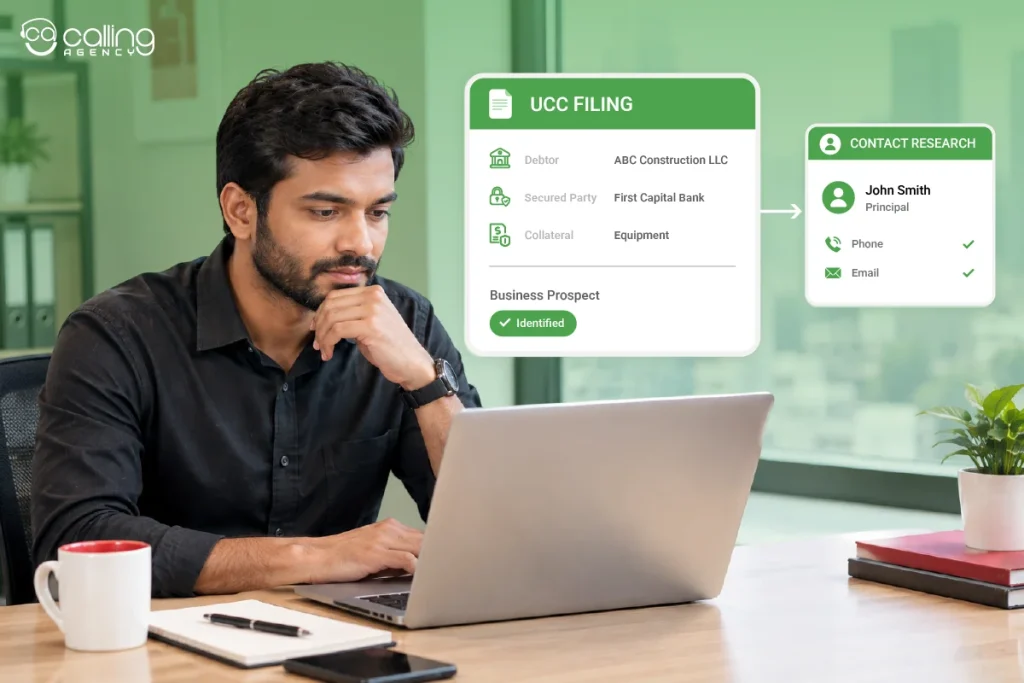
UCC (Uniform Commercial Code) filings are public records that can help brokers, ISOs, MCA funders and other financial institutions find businesses linked to secured financing. A UCC-1 financing statement shows the debtor, secured party and collateral, which can point to secured transactions such as equipment financing or financing backed by a blanket lien.
But UCC data alone is not enough to build a calling list. You still need prospect research, decision-maker names and firmographic information to build a verified prospect list.
This guide shows how to combine those sources and use UCC filings for lead generation and better business loan prospect targeting.
Does a UCC Filing Include a Phone Number?
No. A UCC-1 does not show the debtor’s phone number or email because its optional contact fields belong to the person filing the record. We checked Connecticut’s full UCC export of 846,767 records and found that none of its 32 fields contained a debtor phone number or email.
What Does a UCC-1 Contain?
A UCC form shows the debtor, secured party and collateral, along with optional filer details. Under Nebraska UCC 9-502(a), a filing needs these 3 items:
- Debtor’s name
- Secured party’s name or representative’s name
- Description of the collateral
| Filing item | What a call list needs | On the filing? |
| Debtor name | Business to call | Yes |
| Debtor mailing address | Business location | Yes |
| Secured party or representative | Funding source or agent | Yes |
| Collateral description | Asset financed | Yes |
| Debtor phone | Number to call | No |
| Debtor email | Email address | No |
| Loan amount | Deal size | No |
Sources are the Texas Secretary of State UCC-1 form (Rev. 07/01/23) and Nebraska UCC 9-502(a). The form does not show the loan amount, so UCC data cannot tell you the deal size.
Why Do Some UCC Lists Show Phone Numbers?
If a paid UCC database shows a phone number, that number came from another source because the UCC filing itself does not include one. Salesgenie’s UCC leads page shows debtor names, secured party names, addresses and filing numbers.
Which UCC Filings Are Worth a Call?
For prospect research, focus on original filings for business debtors and skip amendments, tax liens and filings for individuals.
In Connecticut’s UCC export, 97,865 filings from 1 year dropped to 19,925 original business filings after filtering. That is 20.4% of all filings.
Which Filings to Skip
For new business filings, skip amendments, tax liens, municipal liens and filings for individuals.
- A UCC-3 changes an existing filing, so it is not a new original filing.
- Other lien types. The export uses OFS for standard secured transactions, while municipal, federal tax, labor and other liens use different codes.
- Under Nebraska 9-503(a)(4), an individual’s filed name is linked to a driver’s license. A sole proprietor can appear under a personal name, and consumer auto loans can appear here too.
How Many Filings Survive Each Filter?
Connecticut had 97,865 UCC filings from September 23, 2025 to September 22, 2026, but only 19,925 remained after filtering for original business filings.
Use these steps to get the same count:
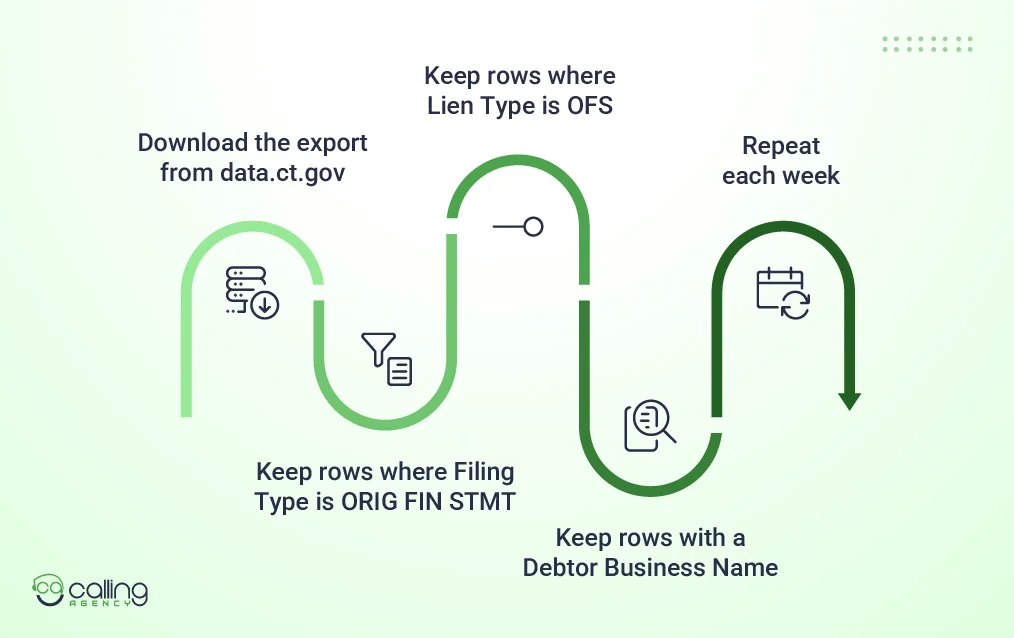
- Download the export from data.ct.gov.
- Keep rows where Filing Type is ORIG FIN STMT.
- Keep rows where Lien Type is OFS.
- Keep rows with a Debtor Business Name.
- Repeat each week using rows with a Filing Date after your last download.
| Step | Records left | Removed |
| All filings in the window | 97,865 | 0 |
| Original financing statements | 52,978 | 44,887 |
| Lien type OFS | 33,505 | 19,473 |
| Business debtor named | 19,925 | 13,580 |
This is CallingAgency’s own analysis of Connecticut’s UCC export, downloaded September 24, 2026. The filing dates run from September 23, 2025 to September 22, 2026. The last filter removes 13,580 rows, or 40.5% of OFS filings.
Of these 19,925 filings, 17,906 have a Connecticut debtor address. This data only covers Connecticut, while businesses formed in other states generally file in their state of organization.
Next, look at who filed against these debtors. CallingAgency grouped secured party names by keywords to create the following categories.
| Secured party group | Filings | Share |
| Other, unclassified | 6,977 | 35.0% |
| Banks and credit unions | 5,492 | 27.6% |
| Filing agent or representative | 3,516 | 17.6% |
| Equipment financing and vehicle finance | 2,583 | 13.0% |
| U.S. Small Business Administration | 1,285 | 6.4% |
| Named as loan agent | 72 | 0.4% |
The data does not separate merchant cash advance filers from the rest, so do not treat the Other group as MCA volume.
Choose a segment before starting the targeting process, then match those records with the funding products you offer and build a business loan prospect list.
Where to Search UCC Filings and What It Costs
Louisiana charges $30 for a certified debtor search. Texas charges $1.00 per web search, Minnesota offers a free file number search but charges for debtor-name searches and Florida uses a private vendor.
Which State Holds the Filing?
For most UCC filings, start with the registered organization’s state of formation because that is usually where its filing sits.
Nebraska UCC 9-307(e) says a registered organization is located in the state where it was organized. Section 9-301(1) says the law of the debtor’s location controls perfection, which makes a secured party’s claim effective against other creditors.
For example, a Delaware LLC with an office in Connecticut usually files in Delaware, so a Connecticut UCC export would not show that company.
What Do State Portals Charge?
UCC search fees depend on the state and the type of search you need.
| State | Service | Cost |
| Connecticut | Open dataset download | Free |
| Texas | Web inquiry | $1.00 per search |
| Texas | Debtor search certificate | $15.00 |
| Louisiana | Certified search | $30 per debtor name |
| Louisiana | Database subscription | $400 per year, unlimited use |
| Minnesota | File number search | Free, no account |
| Minnesota | Debtor-name look-up | Paid account and subscription |
| Florida | Private vendor search | Fee not listed on the state page |
These fees were listed on the state sites on September 24, 2026.
Minnesota says debtor-name search results cannot be used in court, so use them for prospecting only. In Texas, checking 100 debtor names by web inquiry costs $100, while Connecticut lets you download and filter the full dataset for free.
How to Read the Secured Party on a UCC Filing
The secured party usually identifies the funding source, although some filings show a representative instead. Section 9-502(a) allows either name.
In Connecticut’s export, 3,516 of 19,925 business filings, or 17.6%, name a representative. The three largest filing agents account for 3,224 of those, or 91.7%.
| Representative | Filings |
| C T Corporation System | 1,413 |
| Corporation Service Company | 1,382 |
| First Corporate Solutions | 429 |
| All other representatives | 292 |
Treat these as leads with an unknown funding source. Check the secured party, collateral and filing date, then use lead qualification to confirm the funding situation.
How to Get From a Filing to a Phone Number
Match the business name with public records to find the principal or agent, then use a verified source to locate the phone number.
For registered organizations, Section 9-503(a)(1) ties the filed name to the public organic record, so search the exact name.
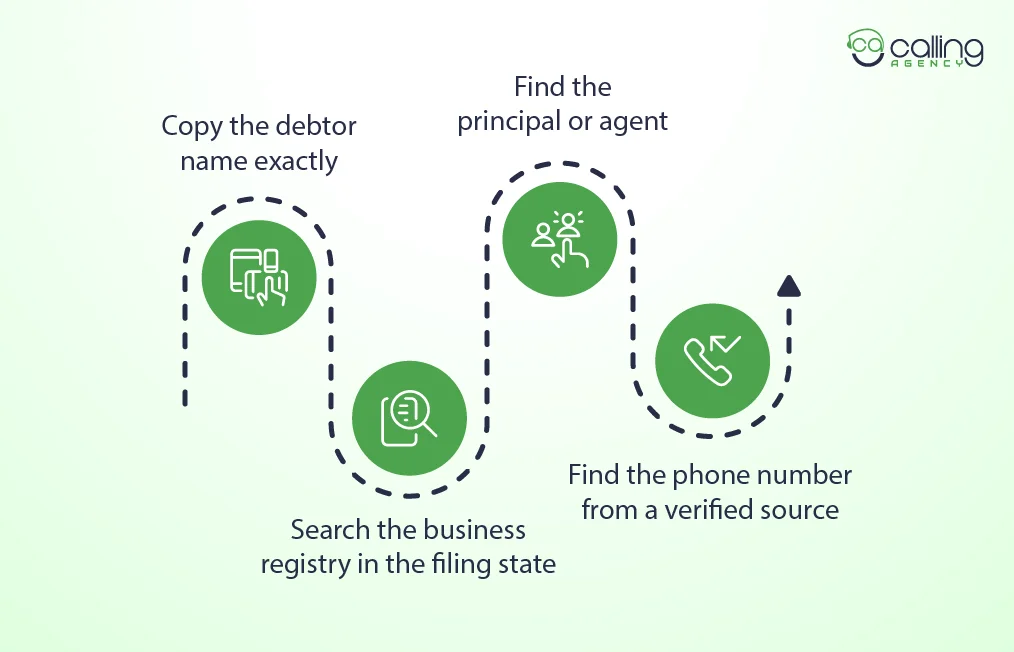
- Copy the debtor name exactly.
- Search the business registry in the filing state.
- Find the principal or agent.
- Find the phone number from a verified source.
The listed person may not be the right decision-maker for the loan, so check who to contact when selling business loans before reaching out. Use public databases to verify the phone number and check consent before calling.
Which Debtors Have a Public Phone Record?
Trucking businesses have a public federal phone source. The Federal Motor Carrier Safety Administration (FMCSA) Company Census File includes PHONE, FAX and CELL_PHONE fields. Other industries need a different phone source.
When Should You Call After a UCC Filing?
A UCC-1 usually lasts 5 years, and a lender can file a continuation only during the final 6 months, from month 54 to month 60.
This window gives you a clear reason to ask whether the business is thinking about renewal or refinance. Nebraska UCC 9-515 sets these rules.
As of September 28, 2026, Connecticut’s full live dataset, not just the 1-year window above, had 93,005 original business filings with a future lapse date.
| Month | Date for a March 24, 2022 filing | Event |
| 0 | March 24, 2022 | Filing date |
| 54 | September 24, 2026 | Continuation window opens |
| 60 | March 24, 2027 | Filing lapses without continuation |
Check the filing record for a continuation before calling because there is no evidence that filings in this window convert at a higher rate. The status field can also be misleading.
In Connecticut’s export, 17,000 original business filings marked Active already had a past lapse date, so check the Lapse Date instead. For larger lists, some lenders use agencies that provide business loan leads.
What Is the Continuation Window?
A lender can file a continuation between month 54 and month 60 to keep the financing statement effective. Filing earlier does not work, while a valid continuation under 9-515(e) extends the filing for 5 more years.
There are 2 exceptions:
- Public-finance and manufactured-home filings last 30 years.
- A transmitting utility filing stays active until a termination statement is filed.
Connecticut’s export shows the 30-year rule. The State of Connecticut Health and Educational Facilities Authority filed 3 records on February 12, 2026, and each has a lapse date of February 12, 2056.
Does Lapse Mean the Loan Is Paid?
No. A lapsed UCC filing does not mean the loan is paid because lapse only affects the financing statement’s legal effectiveness. Under Nebraska UCC 9-515(c), the financing statement stops being effective and a security interest perfected only by that filing becomes unperfected.
A lapsed filing does not confirm that the debt is repaid, so ask whether the financing is still active. You can use these business lending cold call scripts to structure that conversation.
Is It Legal to Cold Call Businesses From UCC Records?
Most B2B calls are exempt from much of the Telemarketing Sales Rule, although its rules against certain misrepresentations still apply. The Do Not Call registry mainly protects residential and covered wireless numbers.
Telemarketing calls using an ATDS or prerecorded voice to mobile numbers generally require prior express written consent under the Telephone Consumer Protection Act (TCPA), though a 2026 Fifth Circuit ruling narrowed that requirement within its jurisdiction.
Using a public UCC filing does not remove these rules, especially when the contact number belongs to a business owner’s mobile phone.
Keep a record of where each phone number came from and when you checked it. This guide is not legal advice, so review your calling process with legal counsel.
Frequently Asked Questions
Are UCC filings public record?
Yes. Nebraska UCC 9-523 requires the filing office to provide filing information when someone requests it. For most collateral, the Secretary of State handles these records under 9-501(a).
How long does a UCC filing last?
A UCC filing usually lasts 5 years. A lender can extend it for another 5 years by filing a continuation during the final 6 months. Public-finance and manufactured-home filings last 30 years, while a transmitting utility filing stays active until it is terminated.
Can I search UCC filings for free?
It depends on the state. Connecticut has a free open dataset, while Minnesota offers a free file number search but charges for debtor-name searches. Texas charges $1.00 per web search. Louisiana charges $30 per certified debtor search or $400 per year for unlimited database access.
Does a UCC filing show how much the business owes?
No. Section 9-502(a) requires the debtor name, secured party or representative name and collateral description. The Texas form also has no loan amount field, so a UCC filing does not show the debt amount.
What is the difference between a UCC-1 and a UCC-3?
A UCC-1 is the initial financing statement that creates the public filing. A UCC-3 changes an existing filing and can amend, continue, assign or terminate it.
How current is Connecticut’s UCC data?
In CallingAgency’s September 28, 2026 download, the newest filing was dated September 22, 2026. This shows a 6-day gap in that download, but it does not prove the dataset always updates with the same delay.
Does every business with a UCC filing need a loan?
No. A UCC filing shows a business linked to financing and collateral, but it does not show that the business needs new funding.