



Building a business loan prospect list is not about collecting as many business names as possible. The list has to match the type of deals you can actually fund. That starts with your credit box, then moves into finding the right businesses, checking funding signals, verifying the decision-maker and removing records that should never reach your sales team.
A useful list should tell you more than who the business is. It should show why the prospect may need funding, whether they fit your lending rules and how your team can reach the right person.
In this discussion, we will walk through the full process step by step, from UCC filings and SBA data to scoring, suppression and loan-product segmentation. This blog is written for loan brokers, ISOs, funders, lending sales teams or anyone who wants to learn about building a business loan prospect list.
Why Most Business Loan Prospect Lists Fail
Most business loan prospect lists fail because they focus on volume, use resold lists, target the wrong prospects, feature dead contacts, and ignore real-time financial or behavioral readiness instead of approval fit.
A broker may buy 20,000 records and still get poor results if those businesses do not match the funder’s loan approval criteria. Even business loan leads should be checked before outreach.
Good contact data is not enough. Each business also needs to fit the funder’s credit box. For example, check:
- Time in business
- Monthly deposits
- Open loan positions
- Industry and location
- Basic credit requirements
Small businesses may need funding for payroll, inventory, equipment, business expenses or expansion. Some may want to buy a business, while others may look for venture capital, which usually belongs outside a commercial lending prospect list.
The goal is to find business loan prospects that need funding and also meet the funder’s basic requirements.
How to Build a Business Loan Prospect List in 7 Steps
Building a useful business loan prospect list is not only collecting company names and phone numbers. You need to filter businesses by the funder’s rules, check real funding signals and verify the right contact before outreach starts. Here is the full process in seven steps.
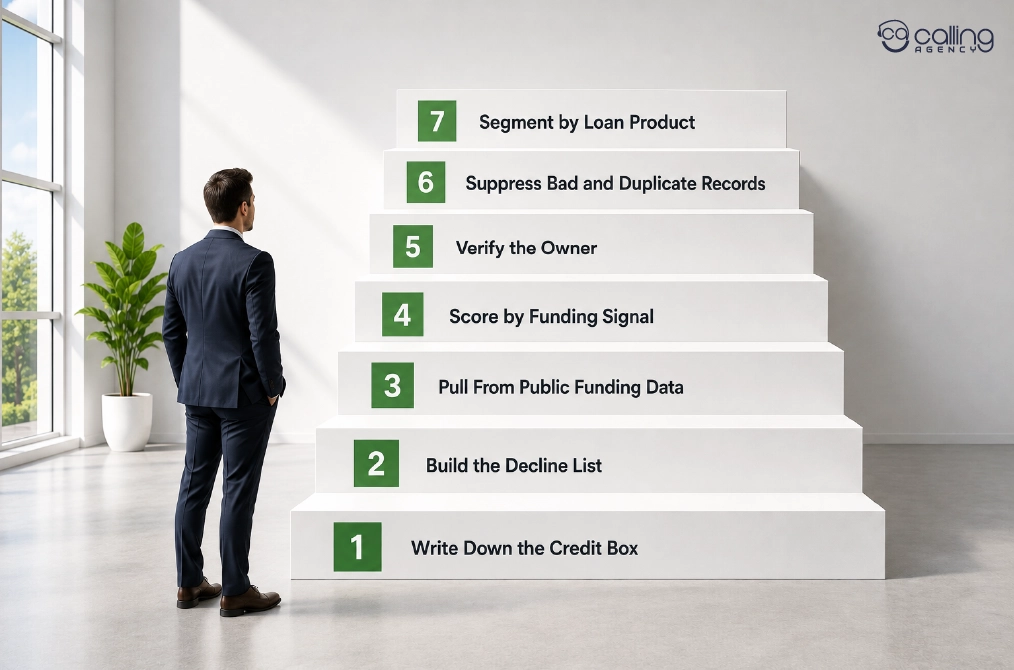
Step 1: Write Down the Credit Box Before You Pull a Record
Define the credit box before you collect any prospect data. Your credit box is the set of basic rules that decides whether a business is worth adding to the list. These rules should be clear enough for loan officers, relationship managers and your underwriting team to use the same way.
| Filter | What to Record | Why It Matters |
| Time in business | Minimum months | Removes businesses that are too new |
| Monthly deposits | Minimum and maximum | Helps match likely funding size |
| Average daily balance | Minimum amount | Shows cash flow strength |
| NSF and negative days | Maximum allowed | Flags weak bank activity |
| FICO band | Estimated range | Helps match products to the owner’s personal credit |
| Open positions | Maximum allowed | Helps control stacking risk |
| Geography | Approved states | Removes areas you cannot serve |
| Loan size | Minimum and maximum | Keeps deals inside your useful range |
Larger deals may also need financial statements and debt service coverage. Smaller sales-based products may depend more on bank activity. If two funders have different rules, build two lists. One mixed file usually gives both teams weaker results.
Step 2: Build the Decline List Before the Prospect List
Build your decline list before adding good prospects. Every lender, ISO and funder has businesses it will not finance. These may be blocked because of industry risk, state rules, product limits or internal policy.
Start with:
- Restricted industries
- States the funder does not serve
- Businesses below the minimum TIB
- Deposit levels below the minimum
- Too many open positions
- Recent declines that are still inside the waiting period
Use NAICS and SIC code filters where possible. You can also ignore businesses with licenses and permits that show an industry you do not fund. Keep the decline rules in your CRM or lending engine. This stops the same poor-fit records from returning when the list is refreshed.
Step 3: Pull From Public Funding Data, Not Only a Vendor File
Use public business and funding data to find stronger signals instead of relying only on a vendor file. A large file may contain thousands of businesses, but public records can help you see which ones have real financing history, active projects or a clear reason to need capital.
| Source | What It Shows | How to Use It |
| UCC Database | Secured financing history | Find possible renewal or paydown timing |
| SBA loan data | Approved borrower, amount and lender | Find businesses with past bank funding |
| Business registrations | Entity age and business name | Check TIB and legal identity |
| Trade boards | Active licenses and permits | Confirm that the business is operating |
| Building permits | Project timing and value | Find possible project funding needs |
| Business permits | Active operating location | Confirm the business is real |
UCC filings are especially useful because they can show the secured party, filing date and sometimes a pattern of past financing. The filing date can help identify a possible renewal window.
SBA data can also help. 7(a) loans and 504 loans show that a business has already gone through a formal lending process. SBA-guaranteed loans often involve more documents and longer approval cycles, but they can point to businesses with stronger lending history.
Lender Match may also connect businesses with SBA lenders, but product fit still matters. Public data can support lead generation by giving your team a better starting point than a random database.
A UCC filing, permit or SBA approval is only a signal. Every record still needs to pass your credit box, decline filters and contact checks.
Step 4: Score by Funding Signal, Not Firmographics Alone
Score each record by funding signal before it reaches the sales team. Firmographics tell you what the company looks like. Funding signals tell you why the company may need capital now.
| Signal | Score | What It May Mean |
| UCC filing 6 to 10 months old | +3 | Possible renewal window |
| Recent equipment or permit activity | +3 | New capital need |
| Hiring several people | +2 | Growth or payroll pressure |
| Busy season approaching | +2 | Inventory or staffing need |
| Older SBA approval | +2 | May need more working capital |
| No UCC filings | +1 | Clean file but weaker funding signal |
| Three or more open filings | -3 | Higher stacking risk |
| Very recent filing | -2 | May have just been funded |
Add simple business context too. Rising fixed costs, startup costs, new locations or expansion plans can show stronger fund intent.
Do not score every signal equally forever. Compare your scores with real submissions, declines and approvals. Keep the signals that lead to stronger deals.
Step 5: Verify the Owner, Not Just the Email
Verify the decision-maker before the record becomes a live prospect. A correct company with the wrong contact name is still a weak record. In many small businesses, the owner makes the funding decision. In larger companies, a controller, CFO or other member of the buying committee may also take part.
Verify:
- Business name
- Owner or contact name
- Job title or signing authority
- Direct phone or mobile
- Verified email
- Operating address
- State
- Data source
- Date verified
A DUNS number confirms the business entity, not the owner. A bank or financial institution record can support business identity. You still need direct contact checks to verify the decision-maker. This is why strong list building services focus on company fit and decision-maker accuracy at the same time.
Step 6: Suppress Bad and Duplicate Records
Suppress records that should not enter the active dial list. A clean suppression process protects sales time and keeps different reps from working the same prospect.
Remove or separate:
- Current customers
- Open submissions
- Recent declines
- Internal do-not-call records
- Records owned by another rep
- Duplicate businesses
- Businesses outside your approved states
Old inquiries should not always be deleted. They may need a different offer or a later callback. For example, aged MCA leads can still work when timing, cash flow or the merchant’s funding need has changed. Keep them in a separate reactivation queue instead of mixing them with fresh prospects.
Step 7: Segment by Loan Product Before Outreach Starts
Segment the list by loan product before you start calling or emailing. One message will not fit every borrower. A prospect looking at SBA financing has different needs from a merchant looking for fast working capital.
- SBA prospects: Look for longer TIB, stronger credit and a clear purchase, property or expansion need. SBA loan leads often need more documents and longer approval cycles.
- Merchant cash advance prospects: Look for steady card or bank deposits, an immediate cash need and businesses that may not fit normal bank rules. Merchant cash advance leads usually need fast contact and simple qualification.
- Equipment financing prospects: Look for equipment purchases, new contracts or project work. Surety bonds are not a loan product. But a contractor’s bonding or contract surety activity can signal the size and type of work they take on.
- Line of credit prospects: Look for seasonal gaps, inventory needs, payroll pressure or regular business expenses.
You can also segment by industry, loan size and state. A business plan, market research or competitive analysis may support some startup or expansion deals, but the credit box still comes first.
Once the segments are clear, use separate business lending cold call scripts and lending cold email templates for each funding situation.
Compliance Checks That Filter a List Before It Goes Live
Check compliance before any record goes live.
- For calling: apply the federal and state rules that fit your outreach. Pay attention to mobile numbers, consent records and internal do-not-call requests.
- For email: follow CAN-SPAM rules. Include a clear opt-out method and valid postal address. Your Privacy Policy should explain data handling when required.
State commercial financing rules can also affect funders, brokers and merchant cash providers. The exact rules vary by state, so confirm where your team can market or offer each product.
The Federal Trade Commission and other regulators publish rules that may affect outreach. Your compliance team should review the final process before launch.
Compliance works best as a list filter. If a record cannot be contacted or funded under your rules, remove it before a rep sees it.
What a Strong List Looks Like on a Live Desk
A strong list gives the sales team fewer weak conversations and more prospects that match the funding offer.
In the Elite 1 Finance campaign, our team ran 18,000+ outbound calls and 10,600+ emails over five months. The campaign generated 2,750+ conversations, 79 qualified funding consultations, 58+ opportunities and 24+ underwriting discussions.
The list was screened against the funder’s box before outreach started. That made the sales work more focused and gave underwriting more useful deals to review.
What Fields Should Be in a Business Loan Prospect List?
A useful business loan prospect list should contain enough data to check fit, contact the decision-maker and track why the record was selected.
At minimum, include:
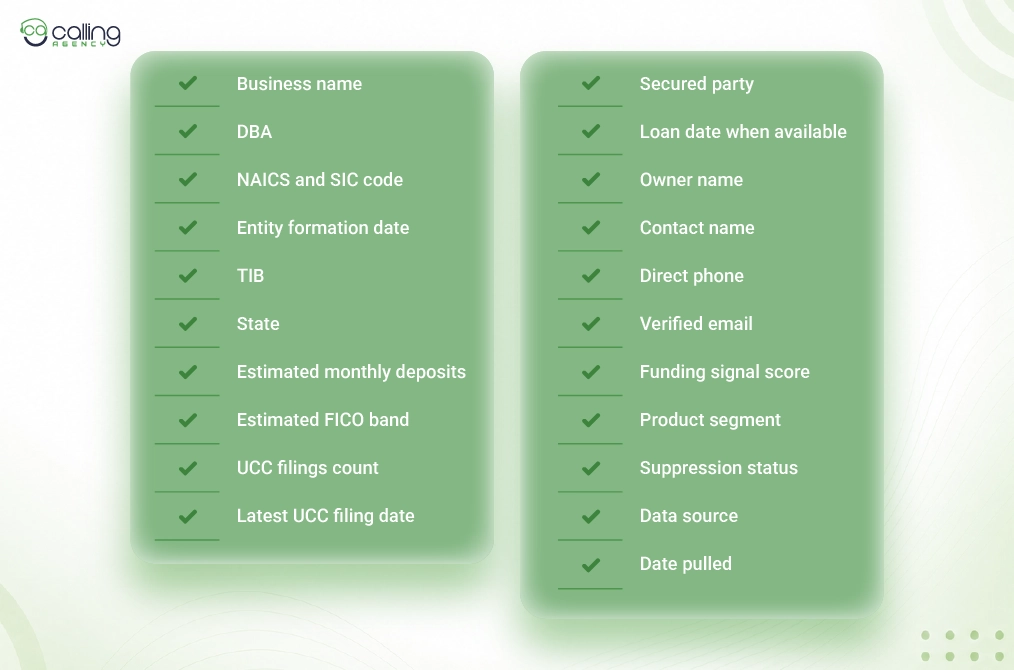
- Business name
- DBA
- NAICS and SIC code
- Entity formation date
- TIB
- State
- Estimated monthly deposits
- Estimated FICO band
- UCC filings count
- Latest UCC filing date
- Secured party
- Loan date when available
- Owner name
- Contact name
- Direct phone
- Verified email
- Funding signal score
- Product segment
- Suppression status
- Data source
- Date pulled
Refresh funding signals often. A business that looked strong a few months ago may already have received funding or moved outside your credit box.
Frequently Asked Questions
What is a business loan prospect list?
A business loan prospect list is a filtered list of businesses that match a lender or funder’s credit box. It combines company data, decision-maker details and funding signals so the sales team can focus on prospects with a better chance of qualifying.
Where do UCC leads come from?
UCC leads come from public UCC filings recorded through state systems. A UCC form can show financing history, filing date and the secured party. Brokers use this data to identify businesses that may be near a renewal or refinancing window.
How many business loan prospects should be on a list?
There is no perfect number. A smaller list with strong credit-box fit can perform better than a very large file with weak targeting. Build enough records to support your call volume, then keep adding and refreshing good prospects.
How often should the list be refreshed?
Refresh funding signals about every 30 days. UCC filings, open positions, business activity and contact data can change. High-priority prospects should be checked again before a new outreach sequence starts.
Is it better to buy or build a prospect list?
Buying gives you speed. Building gives you more control over fit and exclusivity. Many lending teams use both. Screen every record against your credit box before outreach begins.
If you want to improve how your team finds, filters and contacts business loan prospects, schedule a strategy call with CallingAgency. We can review your current list process and show where better targeting can help you reach more qualified businesses.