

There are primarily three types of dialers in B2B cold calling: Power Dialer, Parallel Dialer and Predictive Dialer. Each dialer has its own calling process. Which one is right for you will depend on dialer type because it decides how efficiently cold callers reach prospects. Additionally how many people you’re calling and what your team’s sales goals are. Sometimes you want to have more conversations and sometimes you want more control over each call.
A dialer helps your sales team to reach more prospects through cold calling. However, more calls do not equal more meetings. When setting standards, consider all the variables that impact meetings, such as conversation quality, reps available and time to prep.
TLDR;
Power dialer dials single prospects for any free rep. Parallel dialer dials multiple prospects, detects a live answer and connects a live call to a rep. Predictive dialer uses an algorithm to dial ahead of agent availability and routes answered calls to next free agent in a pool. Power dialers empower reps, parallel dialers boost agent efficiency and predictive dialers support large campaigns.
Power vs Parallel vs Predictive Dialer: Quick Peek at Differences
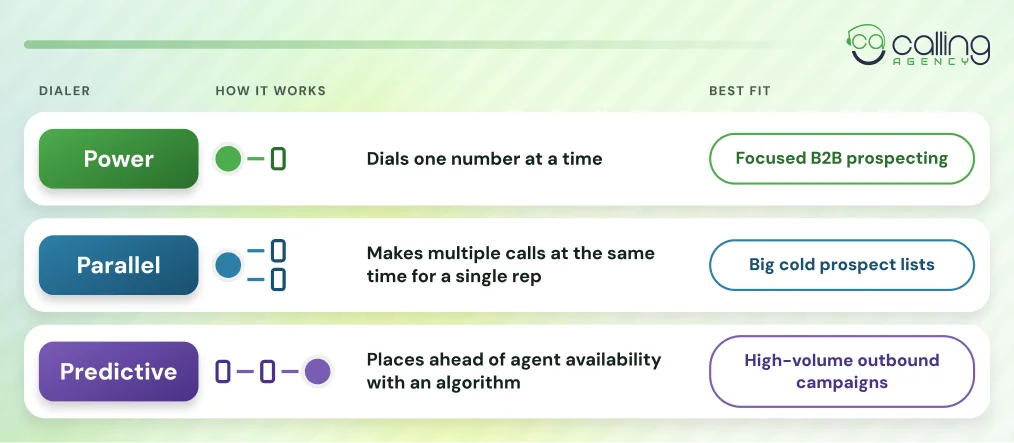
Power, parallel and predictive dialers all allow sales teams to make more calls, but they do so in different ways. Here’s a quick look:
| Dialer | How It Works | Main Advantage | Main Trade-Off | Best Fit |
| Power | Dials one number at a time and goes to the next contact | A better grip on every discussion | Fewer attempts per hour | Focused B2B prospecting |
| Parallel | Makes multiple calls at the same time for a single rep | More chances to reach a live person | Other inquiries may be ditched when one potential buyer picks up. | Big cold prospect lists |
| Predictive | Places ahead of agent availability with an algorithm | Keeps a larger agent pool active | Risk of abandoned calls or connection delays | High-volume outbound campaigns |
There are many different ways software providers refer to power and progressive dialers. Some may market them as one feature and in a bundle together, while you may find separate listings for them, each under a different product name. Confirm how it will work. For each provider, compare it with the cold calling system you will use.
What Is a Power Dialer and How Does It Work?
Power dialers are an automated outbound calling system. It sequentially dials numbers from a preloaded list of prospects. So reps don’t have to call manually or wait between calls. The next one starts after the previous call ends or the rep marks the call as a failure.
The process is simple. The rep accesses a prospect record or calling queue. The dialer calls the first number. The rep is on the phone with the prospect or is waiting for the call to end. The rep records the call disposition. The dialer moves to the next contact.
The rep participates in each live chat. They listen to prospect notes, can go through a cold calling script, document the follow-up needs and review account info and call objectives to prepare for cold calling sessions.
Power dialer programs are good for teams calling names and researched accounts, direct dial numbers or decision makers.
Advantages
- Reps have the ability to control when calls are made and view the prospect’s information prior to the call.
- More time for reps to prepare for senior decision makers and for post-call follow-up.
- Good for teams prospecting a target account list.
Limitations
- Reps continue to be held on hold waiting for their phone to ring.
- Typically, call volume is less than with parallel or predictive dialing.
- Incorrect contact information can waste calling time.
Power dialing can be an effective strategy for an individual SDR, BDR or AE. It may also be appropriate for a sales development team, which depends on the quality of each conversation more than the quantity of calls per hour.
What Is a Parallel Dialer? How Does It Work?
A parallel dialer is an outbound calling tool. Through it, reps dial multiple phone numbers (usually 2 to 10 lines) at the same time and connect sales representatives to one who answers first. AI answer detection and AMD (answering machine detection) are used by the software to identify a real answer and a voicemail.
Let’s say sales reps start dialing multiple direct dials. If a live answer is detected, the rep will be connected to that prospect. Therefore, other Live calls are typically terminated. Unanswered calls are either logged or re-dialed based on the software configuration.
Advantages
- Your reps can have one conversation with one prospect while dialing several numbers at the same time.
- Reps listen to fewer unanswered rings and voicemails.
- Great for teams that are working cold lists with lower pick-up numbers.
- Can boost live conversations and meetings per rep hour.
Limitations
- Reps are now left with fewer minutes to get ready for each live call.
- Detected answers sometimes identify voicemail as a person or vice versa.
- Connection delays can affect the prospect’s experience.
- Many Live Answers may result in either a call hanging up or indicating you can’t get through.
A parallel dialer could work well for outbound SDRs with lots of prospect lists. It could be less ideal for high-value accounts, where reps want to go over company info, past conversations or a longer sales cadence prior to making a call.
What Is a Predictive Dialer and How Does It Work?
It’s an automated outbound calling solution that makes multiple phone calls at the same time and uses statistical algorithms to predict when an agent will be available. When someone picks up the call, it is routed to a free agent. The predictive dialer must maintain abandoned calls under a limit (usually 3%).
The system takes various forms of calling data and computes the pace. They may be:
- Historical answer rates.
- Average call duration.
- Ring time.
- Agent availability.
- Recent abandoned-call results.
So, for example, a predictive dialer might determine the number of agents it expects will be free in the near future and call accordingly.
Predictive dialers are often used by high-volume outbound teams that have a steady stream of active reps. Agent utilization measures how much of each hour your reps spend on the phone. It might cut down on lost time between conversations, but overly aggressive dialing can cause issues.
If more prospects respond before agents are free, then some callers will be put on hold or have their calls dropped.
Advantages
- Calls are placed to a wider set of agents.
- Slashes the idle time agents have while transitioning from one call to the next.
- Can be used for outbound campaigns that are more or less standardized and use consistent staffing.
- Provides managers with centralized controls and calling reports.
Limitations
- Requires reliable calling and staffing data.
- A prospect might respond before an agent is prepared.
- Fast calling pace may lead to a higher abandonment rate.
- Less suitable for highly personalized B2B conversations.
In most cases, a predictive dialer works better for large outbound teams with a predictable team size. But the team size is not the only factor to decide if it is the right option. Number of answers, call time & campaign setup.
How Should B2B Sales Teams Choose a Dialer?
Pick a dialer that’s appropriate to the work your reps must do. Don’t select a system that simply makes a higher number of calls per hour.
When selecting your B2B sales dialer, ensure it integrates flawlessly with your sales process, sales automation software and your lead generation results. Your CRM and other tools should boost your cold calling effectiveness.
| B2B Calling Situation | A good entry position | Why |
| Solo SDR calling named accounts | Power | More time to review account notes and preparation |
| Small team calling a targeted list | Power | More granular control of each conversation |
| SDR team working a large cold list | Parallel | Increased number of calling attempts per rep as pickup rates decline |
| Outbound agency running large volume campaigns | Parallel or predictive | It depends on whether calls are answered by reps or a shared pool of agents |
| Large contact center with stable staffing | Predictive | Algorithmic pacing can keep more agents active |
| Executive follow-ups and warm callbacks | Power | Greater flexibility regarding the timing of calls and information about prospects |
High-value accounts and warm callbacks require more planning. A power dialer allows reps extra time to prepare by accessing previous chats with a prospect and reading about what the prospect needs.
Parallel dialing probably outperforms for bigger lists of prospects with lower pickup. Predictive dialing may be a good choice for mass campaigns if enough active agents are available.
Another option is also available:
A preview dialer allows reps to view CRM records before initiating a call. It can be beneficial when reps want to access information about the company or any previous conversations.
Typically makes one call for every agent that is available and makes the calls sequentially without any intervention. Some software providers combine power and progressive dialing.
Verify the vendor’s definition for these items before making comparisons between best dialers for cold calling.
Does Faster Dialing Get You More B2B Meetings?
When you dial more, the more opportunities you have to connect with prospects. Dials per hour also vary by dialer type, so compare them fairly. However, more dials don’t necessarily lead to better meetings. Make sure to follow through the entire process, starting from the initial call to the scheduled meeting.
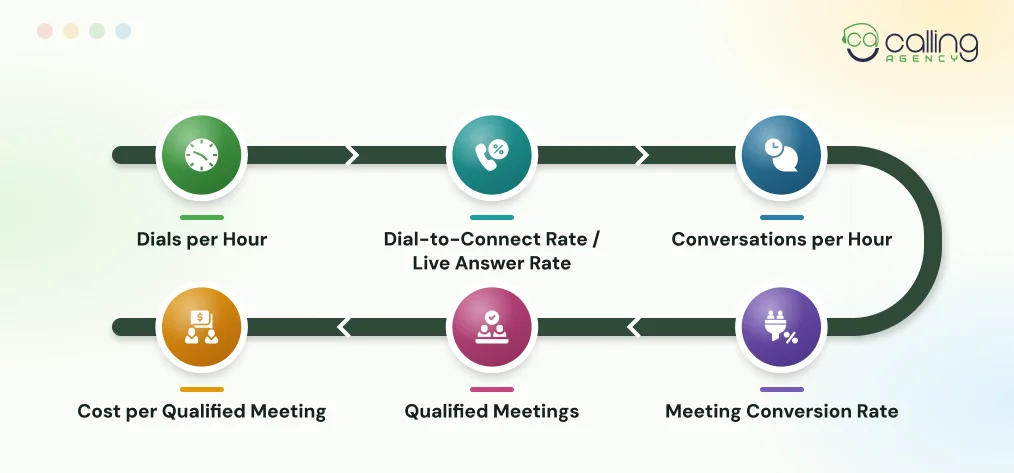
- Dials per Hour: Total outbound attempts divided by rep calling hours.
- Dial-to-Connect Rate / Live Answer Rate: Human Answered Calls / Total Dials
- Conversations per Hour: Live conversations per rep hour.
- Meeting Conversion Rate: Meetings booked / live conversations.
- Qualified Meetings: Meetings that fulfill your definite lead qualification criteria.
- Cost per Qualified Meeting: Total cost of the campaign ÷ qualified meetings.
Orum’s 2025 study on power and parallel dialers used its own calling data to compare the two.
The number of meetings per hour was greater with parallel dialing in the power dialing lead groups. Power dialing had more meetings per connection in its research data.
For individual contributors, the report showed:
| Metric | Parallel Dialing | Power Dialing |
| Meetings per hour | 0.88 | 0.62 |
| Meetings per connection | 3.8% | 6.4% |
Consider them vendor-reported findings. May vary by prospect quality, industry, time of day calling and experience level.
Other teams may adopt one method, for instance, they may employ parallel dialing to get more prospects and then flip interested callers into a power dialer for closure.
Assess meetings per rep hour alongside meeting quality, sales pipeline contribution and b2b appointment setting KPIs stack to see which dialer is performing the best.
What Should B2B Teams Check Before Launching a Dialing Campaign?
Before ramping up calls, examine compliance, who is calling and call quality.
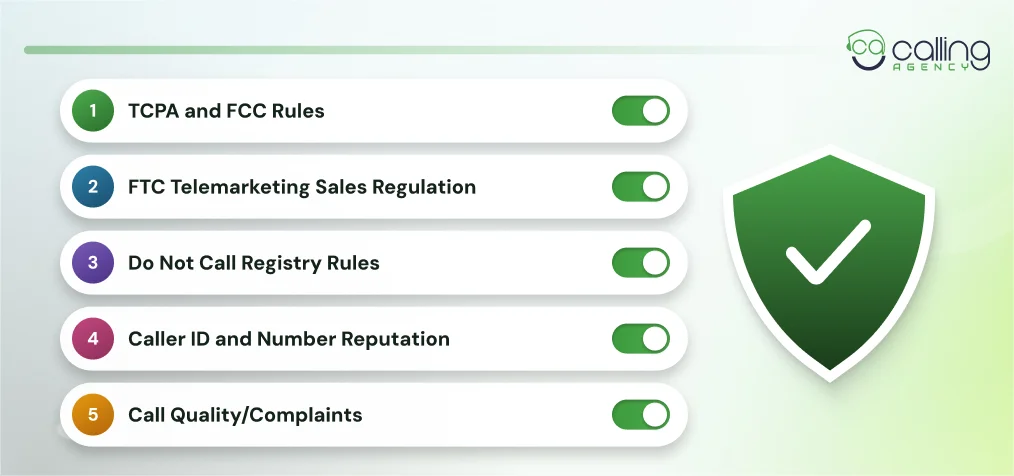
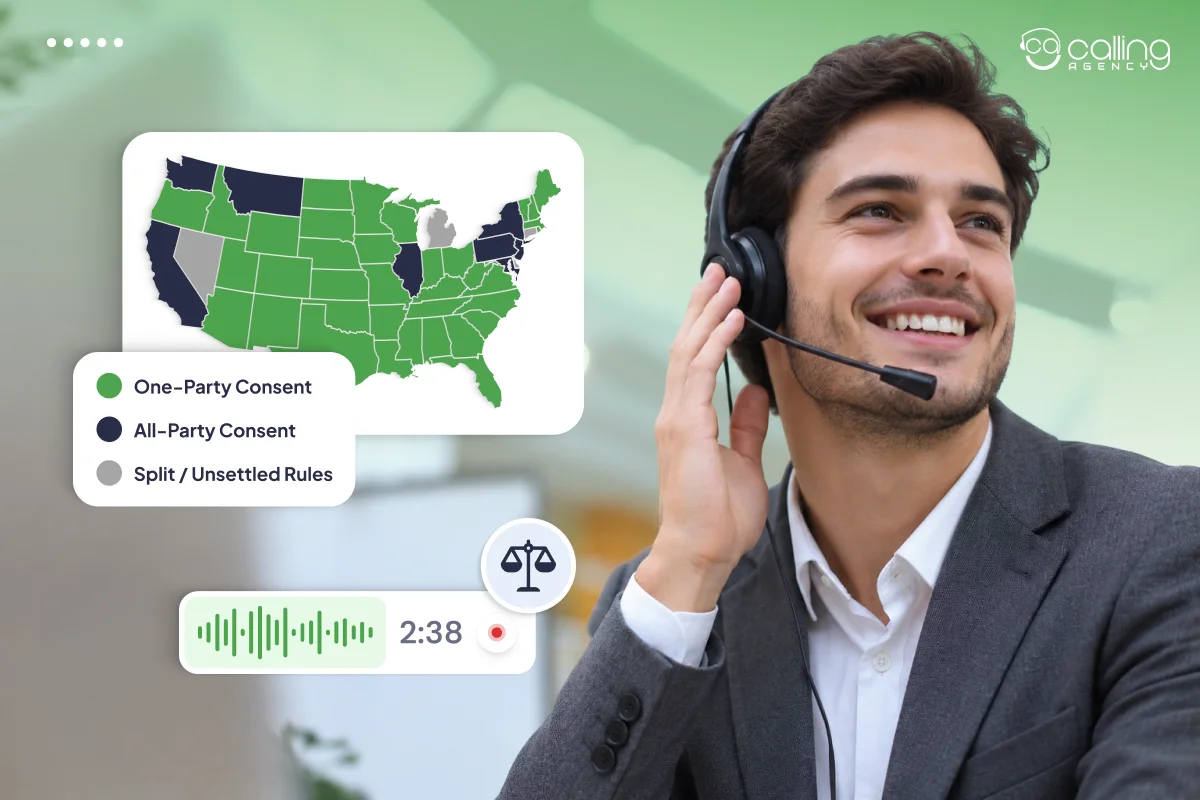
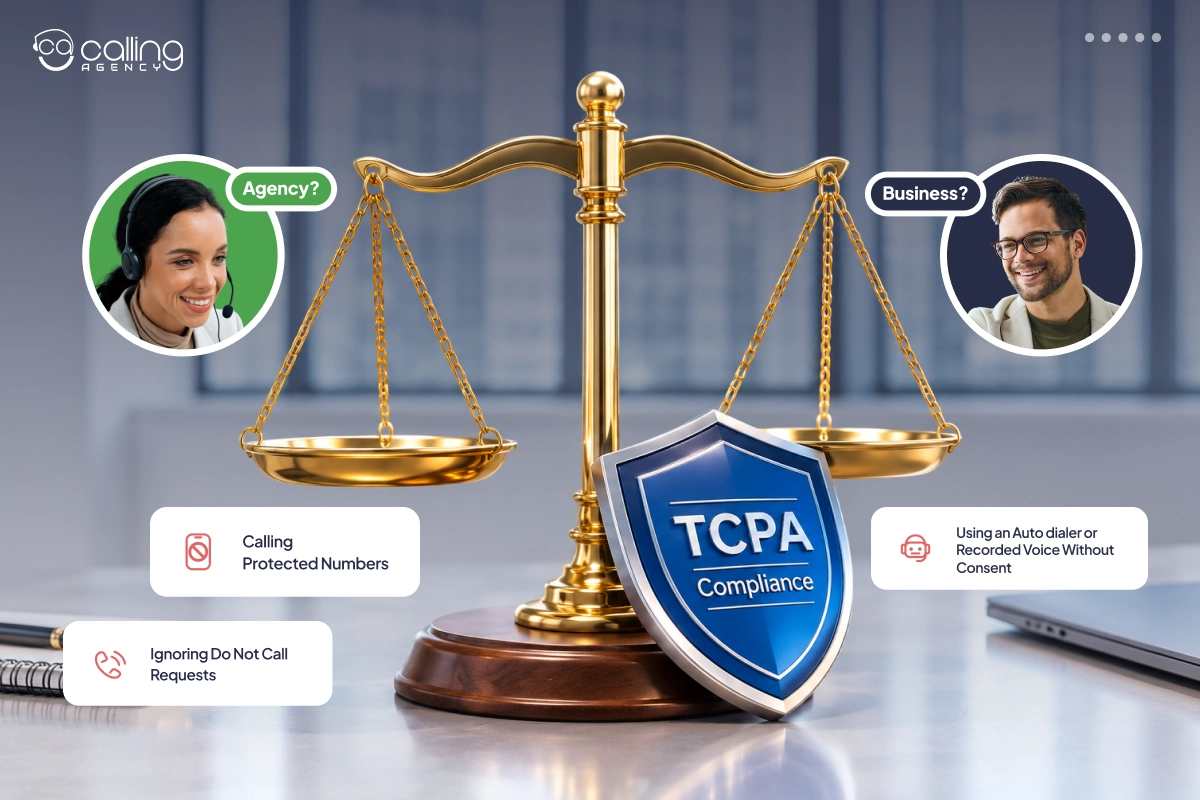
- TCPA and FCC Rules: The TCPA, FCC regulations and state laws can impact the following differently, depending on three things. The type of phone number you’re calling. The dialing technology used. Whether you have the consent to call.
Rules typically depend on the type of call you’re making. Facebook, Inc. V. Duguid, the US Supreme Court defined an automated dialing system or ATDS under the TCPA to include a random or sequential number generator stored or producing numbers.
The name of the product used by the dialer does not impact its legality. Make sure to understand how the dialer works and what laws may apply before you begin.
- FTC Telemarketing Sales Regulation: Most B2B calls don’t have to follow the bulk of the FTC’s Telemarketing Sales Rule (TSR). The FTC updated the rule in 2024, and now it’s a violation to lie or mislead anyone you speak to on the phone, whether you’re calling consumers or businesses. So be truthful in your sales pitch. So read up on FTC’s guidance to see which rules apply to your campaign and who you’re calling.
- Do Not Call Registry rules and internal suppression requests: Get consent as needed. Observe the proper hours for calling and follow relevant telemarketing rules.
- Caller ID and Number Reputation: Be sure caller ID information is correct and stay aware of any spam labels. STIR/SHAKEN authenticates caller ID information but does not provide protection against spam labels or call blocking.
- Call Quality/Complaints: Track call recordings, abandoned calls, prospect complaints and number reputation as dial volume builds. Review these results routinely as you scale up the campaign.
Frequently Asked Questions
Is a predictive dialer an autodialer under the TCPA?
Can be but depends on how it operates. TCPA defines an automatic telephone dialing system (ATDS) that has the capacity to store or produce phone numbers that are randomly or sequentially generated and the numbers can be dialed using that system. If it just retrieves numbers from a pre-dialed list, it may not be an ATDS under TCPA.
What counts as an abandoned call?
Let’s say a person answers and your rep doesn’t get on the line within 2 seconds of their greeting – that’s an abandoned call. According to 47 CFR 64.1200(a)(7), either a dialer hang-up or an unreasonably long silent interval will do it. The overall ABN rate should be under 3% of live answered calls in 30 days.
Can a parallel dialer call mobile numbers?
Yes. If the software and the campaign rules allow for calling mobile numbers, then you will be able to call them using a parallel dialer. However, teams should confirm consent obligations, calling rules, number reputation and contact list accuracy before making calls.
What happens if two prospects answer at once?
If you have two prospects at once, the system dials into the first caller and disconnects from the second. The second caller will hear silence before disconnecting, receive a missed call notification or go to automated voicemail.
How many lines should a parallel dialer use for B2B?
Lower than most vendors recommend. As a rule of thumb, 2-5 lines per parallel dialer are ideal for B2B outbound selling. But 3 lines are the best and safest. Some platforms support 10 lines, but power dialing in B2B can severely damage your caller ID reputation and prospects’ experience.
What do managers need to look at after a dialer pilot?
We recommend comparing live answer rates, conversations/hour, meetings booked, qualified meetings, abandonment rate, average handle time, and cost per qualified meeting. Use the same quality of prospect list and calling hours during the trial.