

The best merchant services sales start with a problem, not a rate. You have to find out what is costing the merchant money or causing payment problems. Then show a clear solution.
You can follow these seven steps:
- Qualify prospects by monthly volume and contract status.
- Generate leads through canvassing, referrals and targeted outbound.
- Reach the decision-maker.
- Run discovery and request recent processing statements.
- Build a savings analysis.
- Choose the right pricing model.
- Expand to more locations and ask for referrals.
This process covers how to qualify prospects, generate merchant services leads and reach decision-makers. Be it merchant services reps, ISO agents or payment consultants, all must know how to sell merchant services to retail and multi-lane merchants. You can go through this guide. It focuses on retail and multi-lane accounts. Not e-commerce or card-not-present sellers.
CallingAgency reported 178 qualified merchant meetings from one retail and restaurant campaign over eight months.
How Do You Qualify Retail and Multi-Lane Merchant Prospects?
Qualify retail and multi-lane merchant prospects using four things, monthly processing volume, average ticket size, card-present mix and lane or terminal count. These help you decide which merchants to contact and what to discuss.
Look for merchants with:
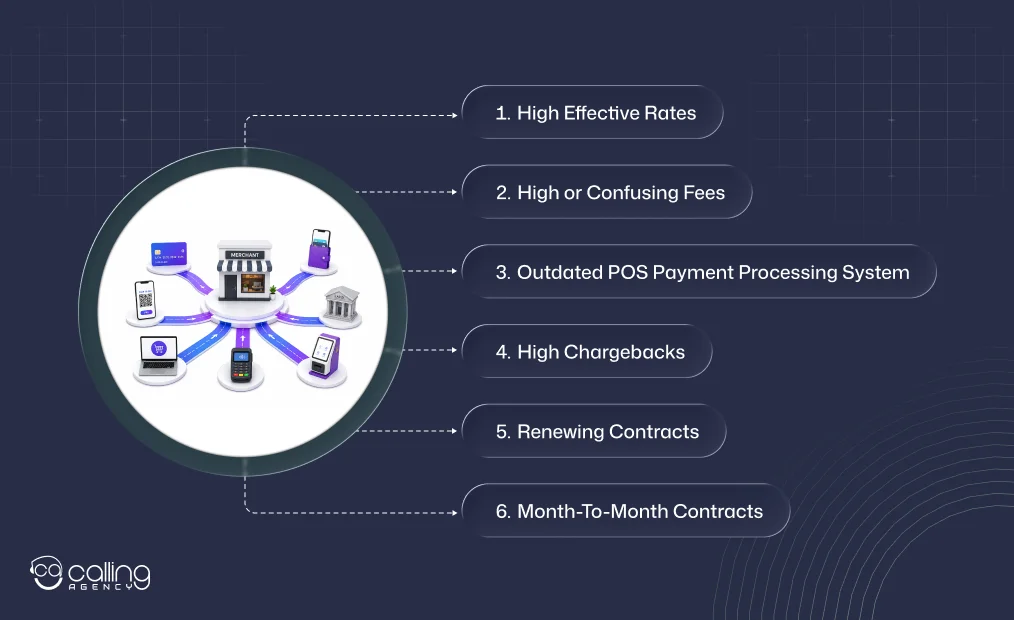
- High effective rates: They may pay too much in processing fees.
- High or confusing fees: These can reveal savings opportunities.
- Outdated terminals or POS payment processing systems: They may need better local payment methods.
- High chargebacks: They may need better dispute and payment support.
- Renewing contracts: They may be ready to compare processors.
- Month-to-month contracts: They can often switch more easily.
“Card-present mix” means sales where customers physically tap, insert or swipe a card.
Contract status is an important filter. Ask whether the current processor contract is still active. Then prioritize merchant acquiring banks that are close to renewal.
Finally, use lane count to choose your pitch. Single-store retailers usually care about savings and simple pricing. Multi-lane merchants care more about uptime, integration and a smooth rollout.
If you need a more detailed qualification process, see our guide on how to qualify merchant services leads.
How to Route Retail Versus Multi-Lane Pitches
Use terminal count and the decision-maker to choose the right pitch. Count the terminals first, then find out who approves the payment processor.
- Single-owner retail: The owner usually decides, so the sales cycle is shorter. So, lead with the savings number and show how much the merchant could save.
- Multi-lane merchants: Several people may be involved. Such as operations, finance and IT. Here, the sales cycle is usually longer. So, lead with integration and a smooth rollout.
For a multi-lane business, one payment lane going down during peak hours can be more costly. Maybe saving a few basis points on payment processing wouldn’t have cost that much.
Generate Retail Credit Card Processing Leads
The best way to generate retail credit card processing leads is using field canvassing, referral partners and targeted outbound.
Canvassing reaches large and small business owners directly. But POS resellers and bookkeepers can provide warm referral programs. And outbound lets you target market by processing volume, location and business type.
Look for buying signals. It can be new stores, renovations, nearby closures, new locations, outdated terminals and ownership changes. Before calling, remove merchants locked into long contracts. Then put them into a nurture list.
CallingAgency’s named campaigns show what this approach can produce:
| Campaign | Segment | Duration | Qualified Meetings | Monthly Average |
| TriStar Perks | Retail and restaurant | 8 months | 178 | 22 |
| US Card Solutions | Retail and hospitality | 5 months | 373 | 75+ |
| PayWithCause | Merchant services | 6 months | 149 | 24 |
These are client campaign results, not industry averages. US Card Solutions used four channels and averaged 75+ meetings per month. TriStar Perks and PayWithCause used calling and email and averaged 22–24 meetings per month.
Just focus on list quality. Then filter prospects by processing volume before calling. A small single-store retailer needs a different approach from a high-volume chain. So match the list to the accounts your sales team can close.
How to Prospect Multi-Lane and Chain Accounts
Prospect multi-lane and chain accounts by targeting regional operators, franchise groups and businesses with multiple locations.
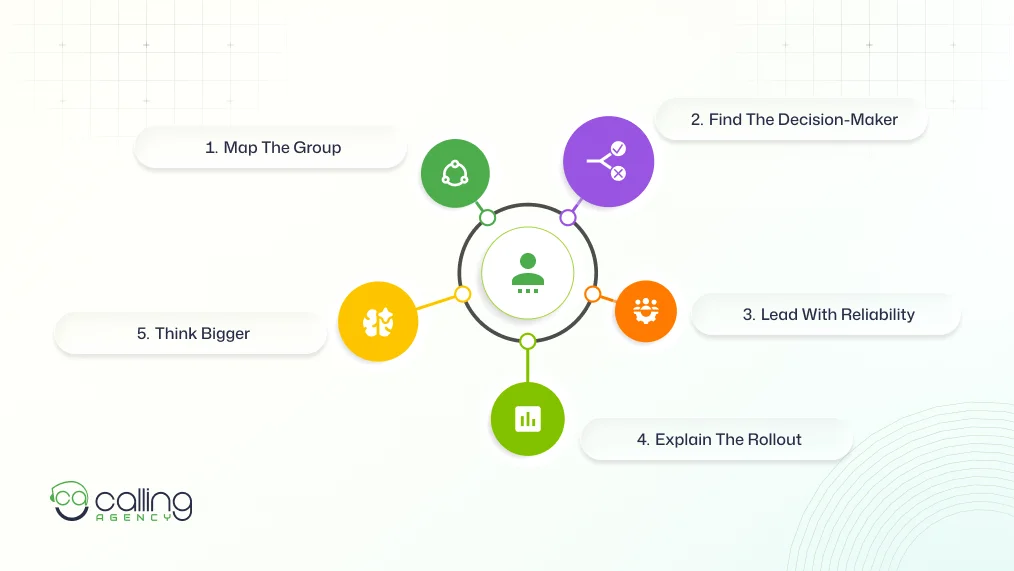
- Map the group: Find its locations and understand how it operates.
- Find the decision-maker: Target roles like the operations or finance owner.
- Lead with reliability: Show how you can keep payments running across connected terminals, POS software and gateways.
- Explain the rollout: Show how locations can switch with minimal disruption.
- Think bigger: One group agreement can bring many locations under one contract.
Because several checkout lanes depend on connected systems, downtime can affect multiple sales at once. So, show chains that your solution can keep payments running smoothly. Then discuss pricing.
How Do You Reach the Merchant Services Decision Maker?
The easiest way is to ask for the person who controls payment processing, not “who handles credit card terminals.”
Before calling, identify the decision-maker:
- Small retail: Usually small business owners or CFOs.
- Multi-lane accounts: Usually operations or finance.
- Retail/restaurant groups: It can be operations, retail or restaurant managers.
Ask for whoever reviews processing statements or approves vendor costs. CallingAgency campaigns have reached these roles. So identify the right role before calling.
How to Get Past the Gatekeeper
Get past the gatekeeper by talking about a problem, not your product.
Ask, “Who reviews your processing costs?” Then offer a free statement review as the reason for the call.
Don’t say “credit card processor” at the start. It can trigger screening. Instead, mention high interchange fees, outdated terminals or payment reliability. Also, keep the first request short and specific. For more practical wording, see these merchant services sales scripts.
Run the Discovery Conversation
Run the discovery conversation, finding the merchant’s cost, hardware and reliability problems. Then offer a solution.
For retail, ask about:
- Monthly processing volume and effective rate
- Processing and padded fees
- Terminal age
- Contract status
- Chargebacks
For multi-lane merchants, also ask about:
- Number of lanes and locations
- POS system and payment gateway
- Integration needs
- Downtime problems
Then request 2 to 3 recent processing statements. They give you the real numbers for your savings analysis.
Also check the card-present vs. card-not-present mix. Card-not-present payments usually have higher interchange, while retail is mostly card-present.
If the effective rate is high, examine the processor markup. Interchange is fixed; markup is where you can compete. For multi-lane merchants, also show how preventing peak-hour downtime can save more than a few basis points. Our discovery call guide for merchant services reps covers this conversation in more detail.
How Do You Build a Merchant Services Savings Analysis?
Build a merchant services savings analysis using the merchant’s statements to show exactly where they can save money.
Here is what you can do:
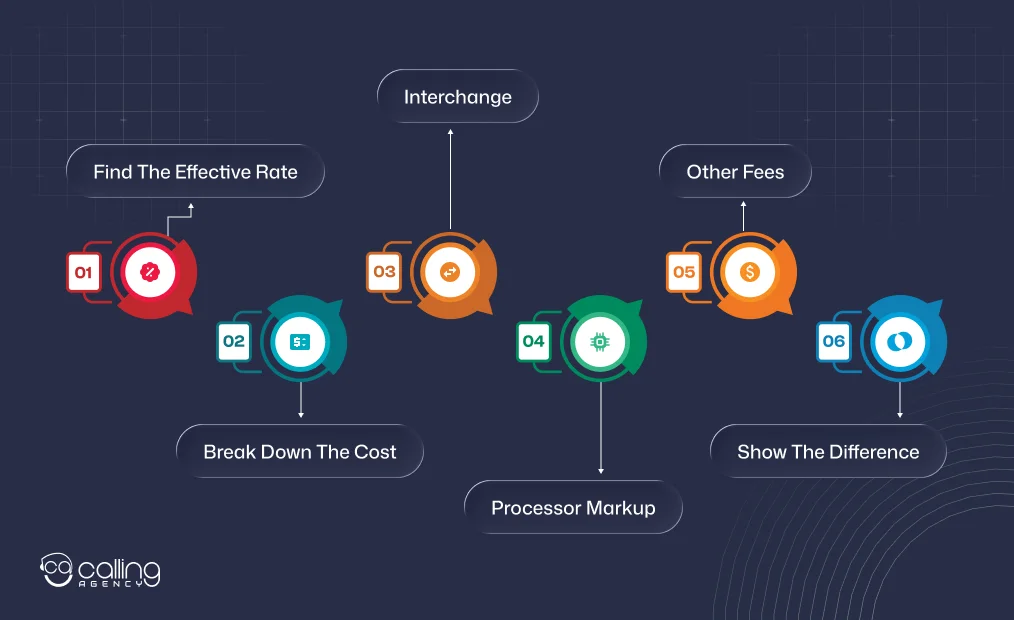
- Find the effective rate: Total monthly fees ÷ monthly processing volume.
- Break down the cost
- Interchange: fixed by card networks.
- Processor markup: the part you can compete on.
- Other fees: padded or unnecessary charges.
- Show the difference: Compare the merchant’s current cost with your proposed cost and show the savings in dollars.
For example:
| Line | Amount | Rate |
| Monthly volume | $50,000 | N/A |
| Total fees | $1,500 | 3.0% effective |
| Interchange | $900 | 1.8% |
| Processor markup | $600 | 1.2% |
Here, the merchant pays $600 in markup (1.2%). That is where you look for savings. Two merchants with the same volume can have different markups.
Do not promise lower interchange. Focus on reducing the processor markup and unnecessary fees. Then show the merchant the real dollar savings.
How to Read a Merchant Processing Statement
Read the statement from the total cost down, not just the advertised processing rate.
Start with the basic calculation:
Total monthly fees ÷ total processing volume = effective rate
Then separate the fees into interchange and processor markup. Interchange is set by the card networks and is generally fixed. The processor markup is where your offer can compete.
Next, look for extra charges like:
- Statement fees
- Batch fees
- PCI DSS non-compliance fees
- Equipment fees
- Monthly account fees
- Other processor charges
These fees can make the effective rate higher and may disappear after a switch. For example, a monthly PCI non-compliance fee may be a fixable cost. Not a permanent expense.
Finally, show the complete cost and explain which charges your proposal can reduce.
Structuring a Proposal That Converts
Structure your proposal starting with the number the merchant cares about, like monthly savings. Keep the proposal simple.
For retail, use a one-page savings summary showing:
- Current monthly cost
- Proposed monthly cost
- Estimated monthly savings
- Equipment changes
- Contract terms
For multi-lane merchants, add a clear rollout plan. Explain how each terminal will be changed, how the mobile POS and payment gateway will stay connected, etc.
Put the savings amount or uptime promise in the first line. Then use the remaining details to explain that benefit.
How Do You Price and Close a Merchant Account?
Price and close the merchant account by choosing the pricing model based on the merchant’s volume, needs and statement.
High-volume and multi-lane merchants usually benefit from interchange-plus because they can clearly see the processor’s markup. Low-volume retail often prefers flat rates because they are simple. Tiered pricing is mainly a legacy option and is harder to understand.
Interchange-plus vs Flat-Rate vs Tiered Pricing
| Model | Best Fit | Transparency | Main Trade-Off |
| Interchange-plus | High-volume, multi-lane | Highest | Statement is more complex |
| Flat-rate | Low-volume retail | Moderate | Can cost more as volume grows |
| Tiered | Legacy accounts | Lowest | Harder to understand and audit |
- Interchange-plus: It separates the fixed network cost from the processor markup, so the markup is clear.
- Flat-rate: It combines costs into one simple rate. However, it can hide the markup and cost more as volume grows.
- Tiered: Here, transactions are placed into pricing buckets.
Before closing, handle the main objections about dual pricing or switching risk. Don’t give the merchant a long menu. Use their statement to recommend the one model that fits their numbers.
How to Overcome Common Objections
The best way to overcome objections is to identify the concern and give the merchant a solution. Some of its examples are:
“I’m locked into a contract.”
In that case, check the contract and ETF. If it makes financial sense, reimburse the ETF so the switch has no upfront cost.
“I’m happy with my processor.”
Use their statement to show the exact savings gap. A real number is stronger than a general claim.
“Switching is too risky.”
Find the real concern, like PCI re-certification, frozen terminals, POS integration or downtime. Offer a managed cutover that replaces hardware.
“I’ll think about it.”
Summarize the savings and remaining concern, give a clear next step and set a deadline for the offer.
For more detailed objection handling, see how to overcome common merchant services objections.
Expand and Win Referrals
Turn one successful location into more locations, products and referrals.
Once the first location shows real savings, use those results to approach other locations. You can also sell POS hardware, gift programs, loyalty programs and working capital. Also, ask for referrals after the first successful batch and expand the cycle.
How to Land Additional Locations and Chains
Use the first location to win the merchant’s other locations. Show the actual savings and results to the operations or finance leader managing the group. Then offer:
- One point of contact
- One contract
- A clear switch schedule
- A plan to avoid downtime at each location
Chains worry about disruption. That’s why reducing that chargeback risk can make expansion easier.
Turning Accounts Into a Referral Engine
Turn happy clients into referrals by asking at the right time and making the request specific. The best moment is after the first successful batch and a clean statement.
Anyway, ask for one introduction to a similar business. Organize your referrals and residuals by industry.
Remember, a retail client can lead to another retail prospect. And each win helps you improve the next B2B sales conversation.
Conclusion
One good merchant account should not be the end of the sale. It should be the start of the relationship.
Always find the problem first. Then prove the savings and make the switch easy. Also, stay involved after the account goes live. A merchant who sees real value is more likely to keep you and introduce you to another business.
For retail, win on clear savings and simplicity. For multi-lane accounts, win on reliability and a smooth rollout. Do that consistently and you will see success on your own account.
Frequently Asked Questions
How do you sell merchant services to retail businesses?
Sell your merchant services to retail businesses by qualifying the merchant and showing clear savings. Then check processing volume and contract status and find the finance decision-maker. Lastly, calculate savings and recommend the right pricing model to them.
How do merchant services agents get retail leads?
Merchant services agents get retail leads by using canvassing, referral programs and targeted outbound. POS resellers and bookkeepers provide warm introductions. They filter outbound lists by volume, location and business type.
What is interchange-plus pricing?
Interchange-plus pricing separates the card network cost from the processor’s markup. This makes the markup easier to compare and is often best for multi-lane merchants.
How do you overcome objections in merchant services sales?
You can overcome objections in merchant services sales by using the merchant’s own numbers. Or just show savings for “happy with my processor.” Then you can review the lock-in contract and explain the transition and switching concerns.
For more help, see how to follow up with merchant services leads.