

The best way to get past the gatekeepers in a cold call is to stay confident, research the person you want to reach, provide proper value, and offer a clear reason to talk. The first few seconds of the call are very crucial as they often determine the call’s outcome. In simple words, the gatekeeper will connect you to the decision maker when you have something special to offer.
In this guide, we will discuss how to past gatekeepers, handle their screening questions, use scripts, and better calling windows to reach the right decision maker.
What Is a Gatekeeper in Cold Calling?
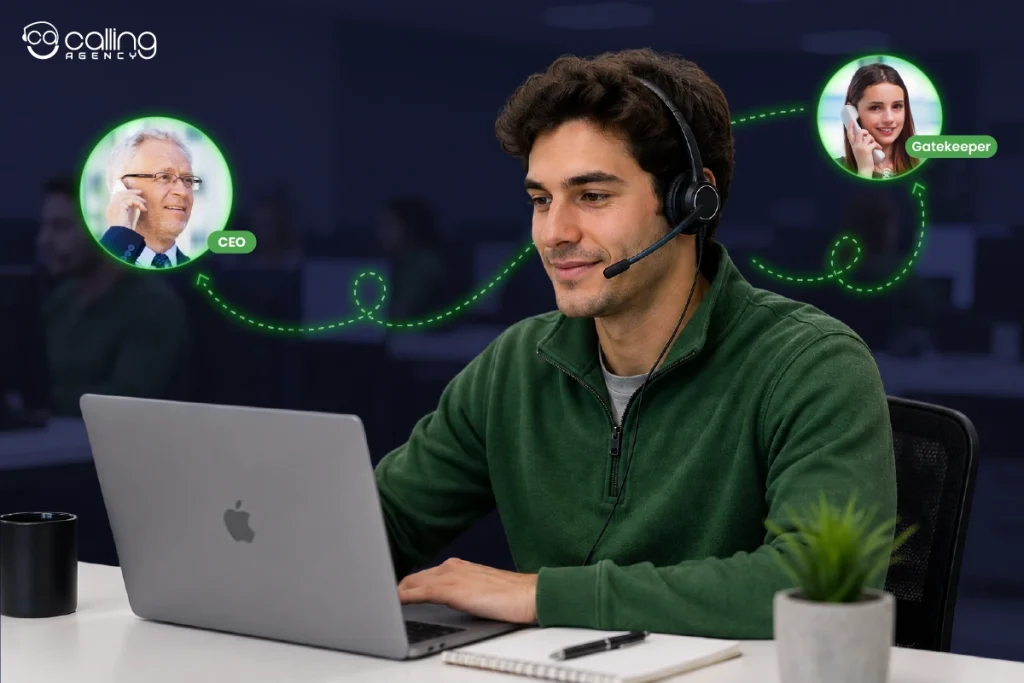
A gatekeeper in cold calling is the person who controls access to the decision maker. In gatekeeper cold calling, this person is often a receptionist, front desk rep, executive assistant, or office manager.
Their job is not to stop every sales call. Gatekeepers want to protect the decision maker’s time. That’s why they filter out calls that sound vague, random, or low-value. That is the core reason behind gatekeeper objections as well.
Once you understand that, you stop treating the gatekeeper like an enemy and start giving them a clear reason to connect you.
Why Gatekeepers Block Cold Calls and Why Most Reps Fail?
Gatekeepers block cold calls because most calls sound vague, scripted, or irrelevant. They hear the same weak openings every day, so they screen fast.
The problem usually starts in the first few seconds, before the rep even explains the reason for the call.
| What the agent does | What the gatekeeper hears |
| Asks for “the person in charge” | This caller did no research |
| Gives a vague reason | This is probably a sales pitch |
| Pitches too early | I need to stop this call |
| Sounds nervous or scripted | This is not worth transferring |
That is why the goal is not to win an argument with the gatekeeper. The goal is to sound clear enough to be worth passing through and reach key decision makers.
Most reps fail because they treat the gatekeeper like a wall. The better move is to respect their role, ask for the right decision maker, and give a clear business reason. That small shift makes it easier to get past the gatekeeper without forcing the call.
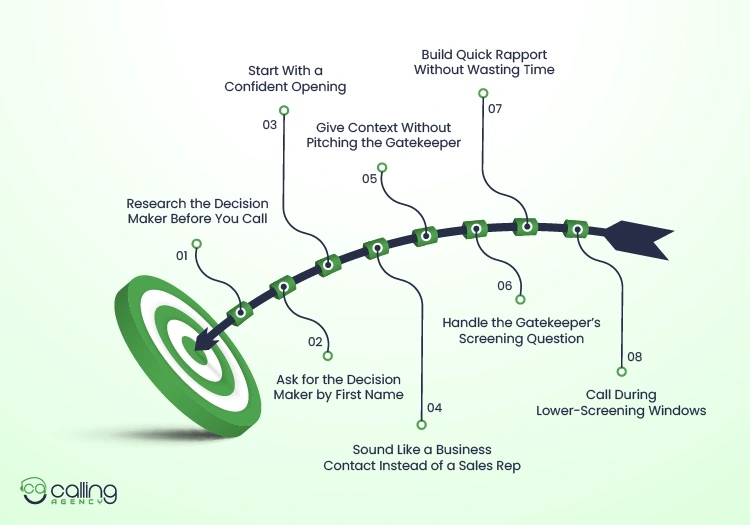
8 Proven Techniques That Help You Get Past the Gatekeeper in Cold Calling
To get past a gatekeeper in a cold outreach, you need to have confidence, context, clarity, and respect in your approach. When you are confident, it makes you sound clear, and when you have context, it makes you sound worthy to begin a conversation. Here are 8 proven techniques that will help you reach decision makers:
1. Research the Decision Maker Before You Call
Before dialing, find the exact decision maker, their role, and involvement with the buying committee. You can use resources like:
- The company website
- Job title
- Recent company updates
- Team pages
- Social media posts
Finding out the right decision maker is the key here, for example
| If You Sell To | Research This Decision Maker |
| SaaS companies | VP of Sales, CRO, or RevOps leader |
| Cybersecurity companies | CISO, IT Director, or Risk Officer |
| Manufacturing companies | Procurement Manager or Operations Director |
| Healthcare companies | Practice Manager or Administrative Director |
| Logistics companies | Supply Chain Director or Operations Manager |
After that, find out the name of the specific decision maker, which will make your outreach sharper.
2. Ask for the Decision Maker by First Name
Once you have the decision-maker’s name and designation, use the contact’s first name on the call.
When you use decision makers’ names, your outreach feels personalized, valued, and natural. But if you can find out the gatekeeper’s name too, then the chance of getting connected to the decision makers increases massively.
But in most cases, here is how you can approach a gatekeeper:
Can I speak with Sarah Johnson, the VP of Operations?
Or,
Hey Mia, can I speak with Sarah Johnson, the VP of Operations?
3. Start With a Confident Opening
Gatekeepers receive prospecting calls all the time, and their initial screening focuses on the approach of the caller. That’s why the psychology behind phone selling massively suggests that confidence and context in the call opening is the most required factor in cold outreach.
As gatekeepers receive and screen calls all the time, they can quickly tell when a caller sounds unsure, generic, or unprepared. If your opening sounds weak, they will treat the call like another vendor pitch and will block the transfer.
Your first job is to sound calm, direct, and relevant.
A strong gatekeeper opening should include:
- Your name and company: Say it clearly without rushing.
- The decision-maker’s name: Show that you are not randomly dialing.
- The reason for the call: Keep it short and business-related.
- A simple transfer request: Ask naturally, without pressure.
Instead of saying:
“Hi, I was just wondering if I could maybe speak with John?”
Say:
“Hi, this is Alex from CallingAgency. I’m calling for John Miller about outbound sales appointments. Is he available?”
This gets results because the caller sounds specific and the confident make him sound like there is a previous interaction.
You mention the contact, give business context, and avoid over-explaining. The gatekeeper does not need your full pitch. They only need enough context to understand why the decision-maker should take the call.
4. Sound Like a Business Contact Instead of a Sales Rep
Your confident opening makes you sound like a business contact rather than just a sales rep.
Gatekeepers react differently when agents sound like a business contact. A sales rep or an agent sounds like they need permission for the call. On the other hand, a business contact sounds like he already has a prior connection with the decision maker.
5. Give Context Without Pitching the Gatekeeper
Not all cold conversations go in the same way; that’s why top-performing cold calling agencies use different tactics in their call scripts. Often, the agents need to provide context of the call to gatekeepers to be able to get the decision makers.
In this type of situation, gatekeepers may block your call if you explain too much too early. Your job is not to pitch but to provide enough context that will transfer the call.
| Weak Context | Better Context |
| I wanted to talk about our appointment-setting service. | I’m calling about the sales pipeline. |
| We help companies generate qualified leads. | It’s about outbound sales appointments. |
| I wanted to introduce our company. | It’s related to new customer acquisition. |
| Can I explain what we do? | I’m calling about booked sales meetings. |
| We offer cold calling and lead generation support. | It’s about sales coverage for the revenue team. |
| I wanted to see if he would be interested. | It’s related to pipeline gaps this quarter. |
6. Handle the Gatekeeper’s Screening Question
Upon receiving the call, the gatekeeper immediately asks questions to see if your call has a real business reason or if you are just trying to sell something. This is where most of the cold calls get stuck, as prospects decide in just 3 seconds what to do with it.
Don’t make the pitch in this situation. Give just enough context so they understand why you’re calling and feel comfortable transferring the call.
Use this format:
It’s about [business area] for [decision-maker/team].
Examples:
- It’s about outbound sales appointments for John.
- It’s about pipeline coverage for the revenue team.
- It’s about vendor options for procurement.
- It’s about hiring support for the HR team.
- It’s about a security review for the IT team.
Any weak answer can lead to more screening questions. That’s why proper prospect research and strategy development are key.
7. Build Quick Rapport Without Wasting Time
Building a quick rapport with a gatekeeper means making the call easy for them to handle, not making them like you. The faster you reduce friction, the easier it becomes for the gatekeeper to route the call instead of resisting it.
Most reps think rapport means just behaving in a friendly way and getting work done. But as said earlier, they receive several calls every day and can easily tell the difference between a caller who is genuinely respectful and one who is performing warmth to get past them.
Here is what they think:
| What Callers Do | What the Gatekeeper Hears |
| Use their name three times | Trying too hard |
| Fake familiarity with the decision maker | A lie I have heard before |
| Over-explain the reason for the call | A pitch I need to stop |
| Say “I’ll keep it quick” and mean it | Someone worth transferring |
| Acknowledge their role briefly | A caller who respects my time |
Cold calling service providers utilize this as their objection-handling framework because of its proven results.
8. Call During Lower-Screening Windows
Lower-screening windows are the times of day when the gatekeeper is away from their desk, and the decision maker is more likely to pick up their own phone.
Gatekeepers work set hours, but decision makers usually do not. That gap is where cold callers get direct access. Early morning before the assistant arrives, the lunch hour when desk coverage is thin, and late afternoon after the assistant leaves are the three windows that consistently outperform standard business hours. That is why top-performing SDRs build their call blocks around these windows, not around their own convenience.
| Time Window | Why It Works |
| Before 8:30 a.m. | Assistants may not be at their desks yet. Decision makers often start earlier. |
| 12:00 p.m. to 1:00 p.m. | Lunch coverage is thinner, so calls may route directly more often. |
| After 5:00 p.m. | Gatekeepers may have left, while some executives still answer their own line. |
| 9:00 a.m. to 11:00 a.m. | Peak screening hours. Gatekeepers are active, alert, and ready to filter calls. |
| 2:00 p.m. to 4:00 p.m. | Busy work period. Screening is high, and transfer rates can drop. |
Timing can help you avoid the gatekeeper, but it cannot fix a weak opening. If the gatekeeper still answers, your research, tone, and business reason still decide whether the call gets transferred. Remember, decision makers will avoid your call, too, if they can’t find any value.
Cold Calling Gatekeeper Scripts That Actually Work
We have discussed the proven techniques that help you get past gatekeepers. Now let’s see what they look like when applied in real call scripts.
Situation 1: First Call, No Prior Contact
Hi, this is {{Your Name}} from {{Company Name}}. Is Sarah around?
Then wait and let the gatekeeper respond first. The shorter the opening question, the more natural it sounds. If they ask what it is about, that is when you move to the next script.
Situation 2: What Is This Regarding?
It’s about outbound sales appointments for her team. I’ll keep it brief.
The gatekeeper now has something specific to relay. A pitch triggers a block. A one-line business reason gets the transfer.
Situation 3: She’s Not Available Right Now
No problem. What time is she usually free to take a quick call?
You are not pushing for an immediate transfer. You are asking for a better time, which gives the gatekeeper something easy to help with and keeps the door open without any pressure.
Final Thoughts
To get past gatekeepers and reach decision makers, you have to sound prepared, clear, and respectful. Know who you are calling for, give the gatekeeper a real business reason, and keep the conversation short.
The reps who get through are not trying to trick the front desk. They make the transfer feel easy, relevant, and worth passing through.
Frequently Asked Questions
What do you say when a gatekeeper tells you to send an email?
When a gatekeeper says, “Send an email,” do not end the call immediately. Ask what subject line or context will help the decision maker recognize it. You can say: “Sure. What should I include so Sarah knows why I reached out?”
Should you leave a voicemail when a gatekeeper offers to take a message?
Yes, but keep the message short. Do not leave a full pitch with the gatekeeper. Say your name, company, and one clear reason for the call. For example: “Please let Sarah know Alex from CallingAgency called about outbound sales appointments.”
How many times should you call back after a gatekeeper blocks you?
Call back 2 to 3 more times, but do not repeat the same approach. Try a different time window, adjust your reason for calling, and follow up with an email or LinkedIn between calls. If the gatekeeper gives a firm no several times, stop pushing and find another route.
What is the biggest mistake reps make with gatekeepers?
The biggest mistake is treating the gatekeeper like a barrier instead of a person who controls access. Reps often hide the reason for the call, pitch too early, or ask for “the person in charge.” A better approach is to ask for the decision maker by name and give a short business reason.
Can you reach a decision maker without going through a gatekeeper at all?
Yes. You can sometimes reach a decision maker directly by using a direct dial, calling before full desk coverage, trying lunch hours, or calling later in the day. But this should not replace gatekeeper handling. If the gatekeeper answers, your name, reason, and tone still matter.