

You can cold call business cell phones without prior written consent under the TCPA. But you must check whether the number is on the Do Not Call (DNC) list. Also, see whether it is used for business or personal calls.
For automated calls, prerecorded messages, AI-generated voices and ringless voicemail, there are different rules. The TCPA and Federal Communications Commission (FCC) impose many restrictions on these calling methods.
For example, the FTC’s Telemarketing Sales Rule (TSR) exempts most B2B sales calls from certain telemarketing requirements. Like these, there are many more rules you need to follow in some cases of cold calling services.
Two Federal Rules, Two Different Tests
There are two different rules for calling cell phones in the USA, the TCPA robocall rule and the Do Not Call (DNC) rule. The TCPA rule applies to both business and personal cell phone numbers when using automated calls (IVR) or prerecorded messages. The Do Not Call (DNC) rule applies to people’s personal phone numbers to protect them.
TCPA Robocall Rule
As per the TCPA robocall rule, callers should obtain written consent before making a marketing call to a cell phone. It’s especially necessary when the person uses an automatic dialing system or AI-generated voice. For business cell phones also, this rule is applicable.
Remember, not every dialing tool counts as an automatic telephone dialing system (ATDS). In 2021, the Supreme Court said an ATDS must use a sequential number generator to select phone numbers and dial them. In that case, a regular CRM or click-to-call tool does not automatically count as ATDS.
Do Not Call (DNC) Rule
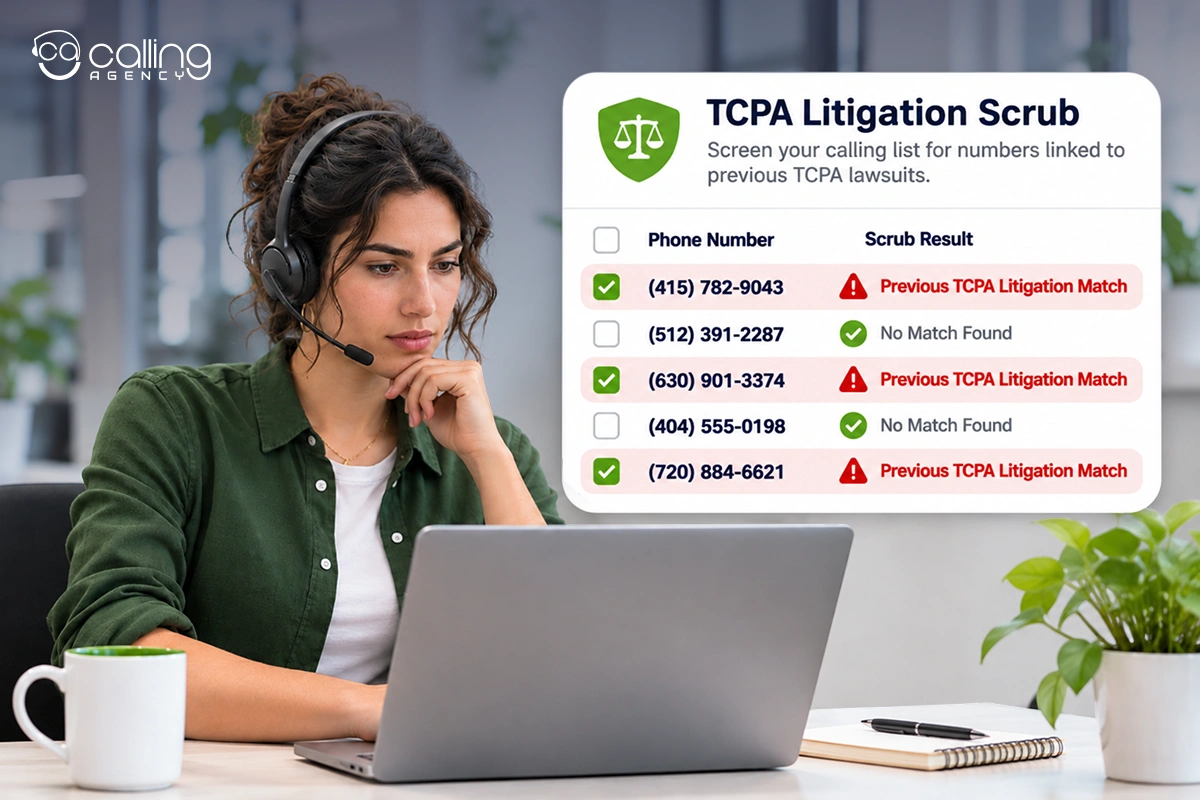
The National DNC Registry mainly covers personal and residential phone numbers. Here, genuine business numbers are not included. But if a cell phone is registered on the DNC list, it will be treated as a residential number.
There are three common types of cell phones you will find in the do not call list. They are company-issued phones, personal phones and mixed-use phones.
How the Rules Apply
| Calling method | Company-issued | Personal | Mixed-use |
| Manual call with a live person | Generally allowed | Check DNC status | Check DNC status |
| ATDS call | Written consent needed | Written consent needed | Written consent needed |
| Prerecorded or AI voice | Written consent needed | Written consent needed | Written consent needed |
| Ringless voicemail | Written consent needed | Written consent needed | Written consent needed |
Do DNC Rules Cover Business Cell Phones?
The National Do Not Call Registry does not protect genuine business cell phones, it protects registered personal cellular numbers only. Some people use mixed-use numbers for both business and personal calls.
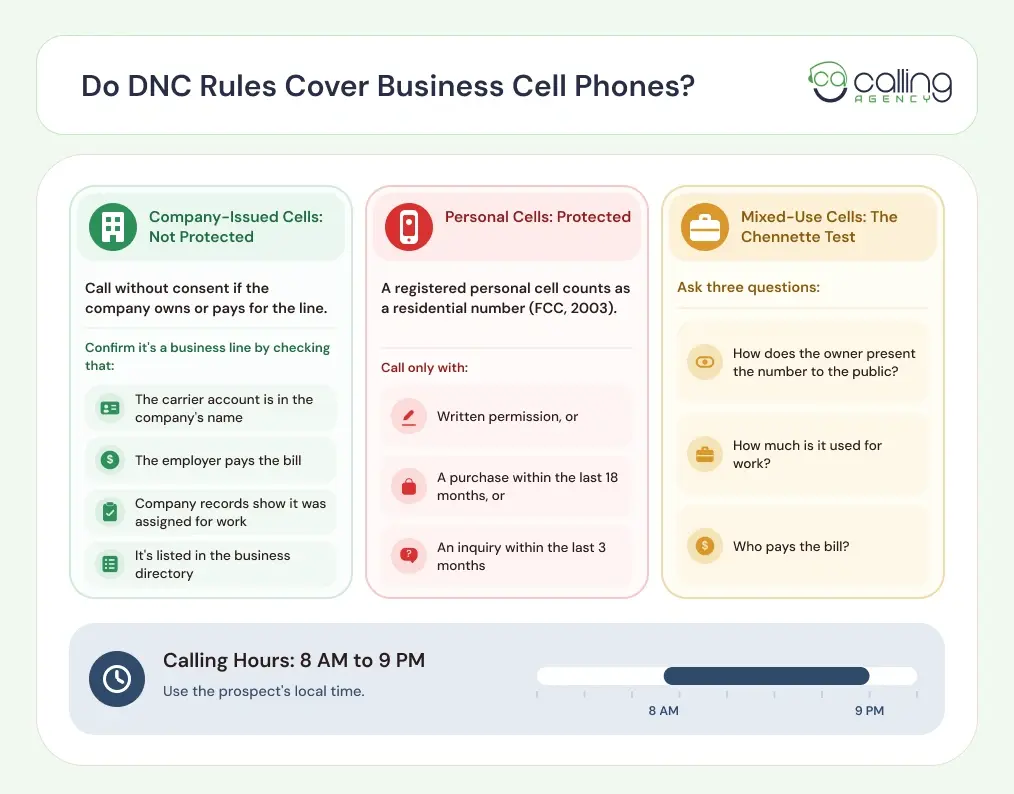
Company-Issued Cells
A company-issued cell that is used for work is not covered by residential protections of 47 CFR § 64.1200(c)(2). The FCC’s 2003 order explains that the national registry does not prohibit calls to businesses. So an SDR can manually call a genuine company business line without requiring any written consent. That’s because the number itself is a mobile number.
Your team still needs evidence that the number is genuinely a business line. That’s why they must check:
- If the carrier account is registered to the company.
- Whether the phone bill is paid by the employer.
- Whether the company records show that the number was assigned to an employee for work.
- If the numbers appear in the company’s business telephone directory.
A company website or employee’s work email signature can also show if the number is used for the business or not. But that won’t prove who owns or pays for the phone.
Personal Cells
A personal cell registered on the National Do Not Call Registry is protected from most sales calls, even when the SDR has a legitimate reason to contact the person. The FCC has treated registered personal mobile numbers as residential phone numbers since its 2003 TCPA order.
However, there are two main exceptions under 47 CFR § 64.1200(c)(2). You may call a registered personal number when the person has given written permission to receive calls from your business and when your company has an established business relationship (EBR) with the person.
The EBR exception has two time limits, e.g., 18 months and 3 months. Either the person should have a record of purchasing from your company within the previous 18 months or the person must submit an application about your products or services within the previous 3 months.
Mixed-Use Cells and the Chennette Test
A mixed-use cell is a phone number used for both personal and business calls. People generally don’t understand whether they should treat it as a personal number or business number.
In 2005, the FCC said that when you make calls to home-based businesses, you should judge it based on the specific facts. Later, on October 12, 2022, the Ninth Circuit provided a clearer approach in Chennette v. Porch.com.
As per the court’s decision, you must know how the owner presents the number to the public. Also, check how much the owner uses the phone for work and who pays the phone bill.
Calling Hours
As per the federal law, callers can give telemarketing services to personal phone numbers at a certain time. It says that you can make sales calls to residential numbers only between 8 a.m. and 9 p.m.
So, make sure that your SDRs check the prospect’s local time before calling. For example, if your SDR works in California but calls a personal mobile number in New York, they must call during New York’s calling hours.
What Can’t You Do on Any Cell Phone?
Some types of sales calls require written permission before calling. These rules apply to both personal and business mobile numbers, even if the number is not registered on the National Do Not Call Registry.
In November 2022, the FCC confirmed that ringless voicemail counts as a prerecorded call. In 2024, it also confirmed that AI-generated voices count as artificial voices. This means both marketing calls need written consent.
Remember, not every dialer counts as an ATDS. In 2021, the Supreme Court explained in Facebook v. Duguid that an ATDS must use a random or sequential number generator to select and dial phone numbers.
Some of the best dialers use prepared contact lists instead. These tools may not qualify as ATDSs. Not even a CRM click-to-call tool qualifies because the salesperson selects the number before making the call.
There are two other rules that also apply to B2B calls. They are abandoned calls and caller ID. Your company cannot abandon more than 3% of calls answered by people during a 30-day period.
If no salesperson is available to take the call, your company must play a message that explains how the person can stop receiving future calls. Also, you must show a working phone number that people can call back. They must also be able to use it to ask your company to stop calling.
How to Cold Call Mobile Numbers Safely
Before calling someone’s mobile number, first check whether it is a personal phone or a business phone. You must also follow TCPA rules to avoid legal problems.
Here are seven steps you can follow to cold call mobile numbers safely. Such as:
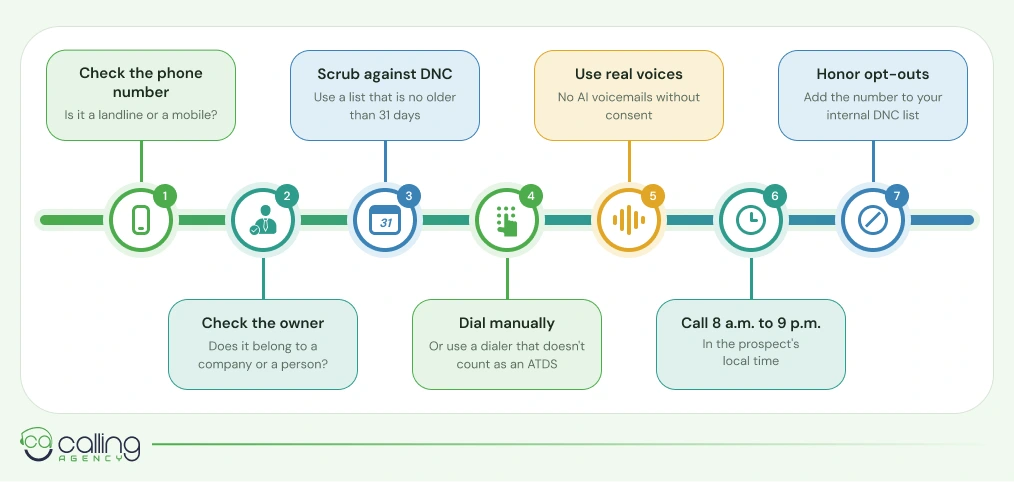
- Check the phone number: Use a lookup tool to check the phone number. From there, you can find out whether the number is a landline or mobile phone.
- Check who owns the phone: Find out whether the number is a company or an individual. You can check company records for this task or ask your data provider for this information.
- Check the Do Not Call list: Check the list of personal and unknown numbers against the National Do Not Call Registry. But make sure the list is not older than 31 days.
- Choose how to call: As a safer option, choose manual calls. You can also use a dialer, but that does not qualify as an automatic telephone dialing system (ATDS).
- Use your own voice: You can tell your SDRs to leave voicemails using their own voices. But make sure they do not use AI-generated voices without consent.
- Call at the right time: For both personal and unknown numbers, always call your prospects between 8 a.m. and 9 p.m. in their local time.
- Stop calling when asked: If someone already told you to stop calling, add their number to your company’s Do Not Call list.
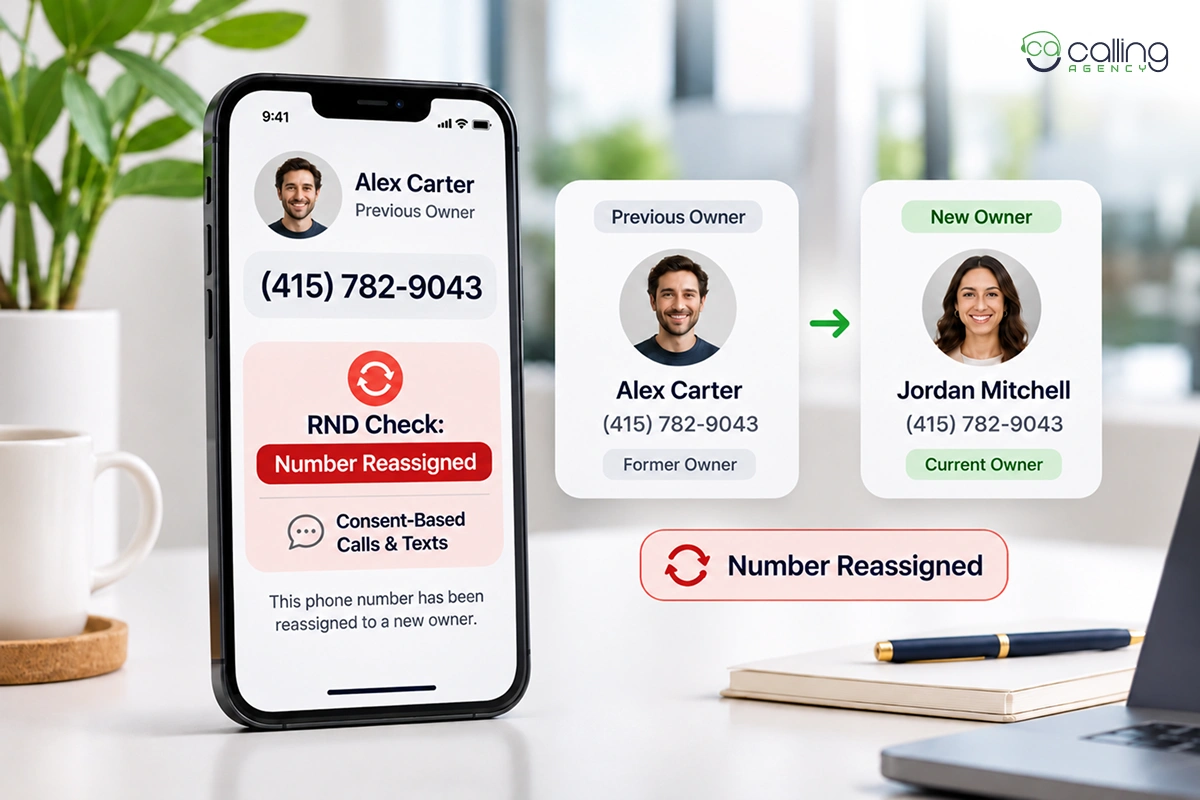
Sometimes, a person changes their mobile number and the phone company gives that old number to someone else. That’s why I don’t rely on old consent to call. Check the FCC’s Reassigned Numbers Database (RND) first.
The original owner may have changed numbers and someone else may now use it. And if someone says that their number is personal, mark it as personal in your records.
State Rules Can Go Further
Yes. Some US states have stricter cold calling rules than federal law. Florida and Maryland, for example, have additional rules for calling hours and Do Not Call lists.
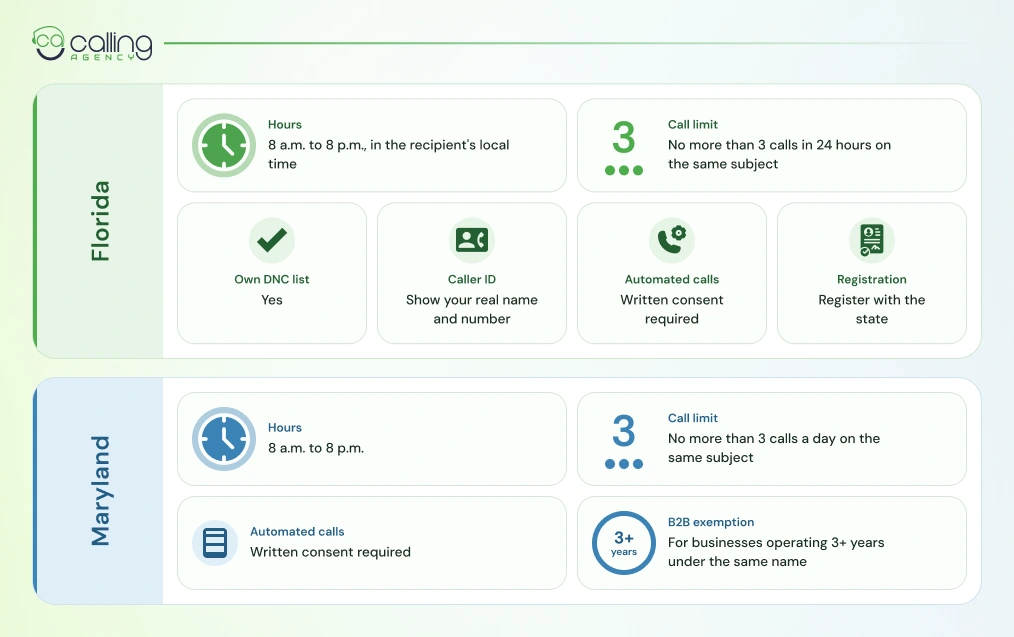
Florida
Florida has its own telemarketing laws. These laws mainly cover calls that promote products or services for personal use. However, this does not mean every B2B call is automatically exempt.
- Do Not Call list: Florida has its own Do Not Call Registry.
- Calling hours: Here, you have to make sales calls between 8 a.m. and 9 p.m. in the recipient’s local time.
- Caller ID: You must show your real name, business name and phone number when making sales calls.
- Automated calls: For automated sales calls and prerecorded messages, you will need written consent.
- Business registration: You must register with the state before making sales calls.
Maryland
Maryland gives some businesses an exemption from certain telemarketing rules. To qualify, a business must have operated legally under the same business name for at least three years. This rule is mentioned in Maryland Commercial Law § 14-4502.
Here are some of the important rules for making calls in Maryland:
- Calling hours: You have to make sales calls only between 8 a.m. and 8 p.m. in the recipient’s local time.
- Call frequency: You can’t call the same person more than three times in a day for the same reason.
- Caller ID: Show your real phone number and business name when available.
- Automated calls: Make sure you have written consent for making automated calls.
Other states have their own Do Not Call lists. These include Colorado, Florida, Indiana, Louisiana, Massachusetts, Missouri, Oklahoma, Pennsylvania, Tennessee and Texas. So, always check the state list too.
Also, check lead lists before buying. When you buy lead lists, ask the provider, “Does the list identify mobile and business numbers?” and “When was it last updated?”
Conclusion
Cold calling business cell phones is a better choice to reach decision-makers directly. But if you use the wrong calling method, all your toil goes in vain. In fact, companies can be alleged to have committed TCPA violations, which result in costly penalties.
Your only solution is to train your sales team properly. Teach them how to check phone numbers, review DNC restrictions and do everything without any mistakes.
Most importantly, your team should know the difference between manual calls and automated calls, as these two have different rules. So, you can’t apply the same cold calling techniques in them.
Frequently Asked Questions
Is there a B2B exemption in the TCPA?
No, there is no B2B exemption in the TCPA. Sometimes, we hear about certain exemptions, but that comes from the FTC’s Telemarketing Sales Rule (16 CFR § 310.6(b)(7)). In this rule, you will find everything related to sales calls made to businesses. But yes, there are some TCPA rules that you need to follow anyway.
Can I call a business cell that’s on the do not call list?
You can call a business that’s on the do not call list only if the number is used for business purposes. According to the FCC, cell phone numbers on the National Do Not Call Registry are personal numbers. You can call those numbers only if the owner of the number gives written permission to you.
Can I leave a voicemail drop on a business cell?
No, you can’t leave a voicemail drop on a business cell without the required consent. A voicemail drop is an automated message sent directly to someone’s voicemail without a normal conversation. As per the FCC, voicemail is like a call because it sends a recorded message to the person’s phone. To do that, you also need permission.
Can I text a business cell phone?
Yes, you can text a business cell phone, but you must follow TCPA rules for that. Let’s say you are using an autodialer to send marketing texts to cell phones. But to do that, you will need the cell phone owner’s written consent.