

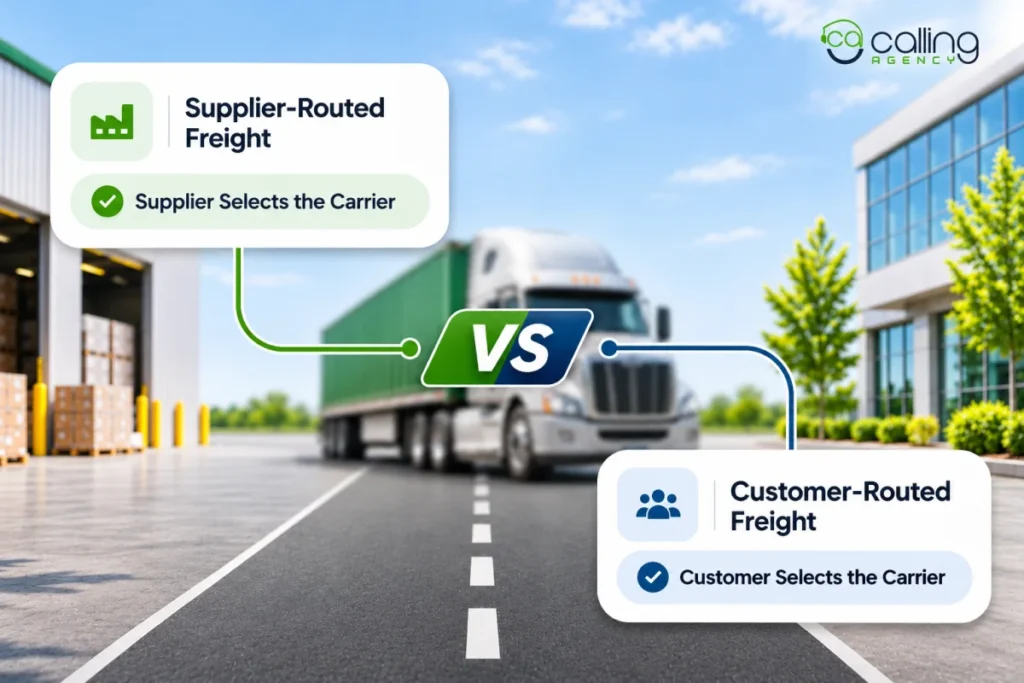
Whichever party selects the carrier will have control over the freight. In customer-routed freight, it is the buyer who does this, while in supplier-routed freight, it is the seller. This is easy, but the difficult part is knowing whether your company uses customer-routed or supplier-routed freight.
For instance, when the shipper says, “We are customer routed,” it could be true or it may not be. To find out, one needs to look at the freight terms on both the purchase order and bill of lading. These too could prove confusing, though.
Domestic FOB terms are defined by UCC 2-319, which takes into account delivery and risk only. To know whether it is prepaid or collect, you need to look further. International freight terms follow the Incoterms of the International Chamber of Commerce, where FOB is narrower: it applies only to sea and inland waterway shipments and refers to the port of shipment, not the destination. One can always refer to the U.S. International Trade Administration’s Know Your Incoterms document to refresh their memory.
After knowing the party controlling the routing, the next step is to find the carrier approval party. This is how you go about it.
Key Takeaways
- Whoever picks the carrier controls the freight.
- Trust the PO and BOL, not claims.
- FOB shows risk. Collect shows who pays.
- FOB origin plus collect: usually customer-routed.
- FOB origin plus prepay and add: usually supplier-routed.
- EXW, FCA, FOB: buyer arranges main carriage.
- Inbound and outbound control can differ.
- Find the carrier approver. Get two contacts.
Customer-Routed vs Supplier-Routed Freight: What Is the Difference?
Customer-routed freight only means that the customer selects the freight carrier and buys freight services for transporting the shipment. On the other hand, in supplier-routed freight, it is exactly the reverse. The supplier or manufacturer selects the freight carrier and pays the freight service charge.
For instance, let us suppose that you ordered your favorite fast food. If you arrange for a driver to get the fast food yourself, then it will be customer-routed.
| Feature | Customer-routed | Supplier-routed |
| Who picks the carrier | Buyer | Seller |
| Cost visibility | High | Often low |
| Typical Incoterms | EXW, FCA, FOB | CFR, CIF, CPT, DAP |
| Main benefit | Control and tracking | Less work for the buyer |
| Main risk | More work for the buyer | Hidden costs |
Many shippers use a rigid routing guide to handle their shipments. If a supplier neglects following those guidelines, they can incur penalties such as chargebacks, delayed receipts, or low vendor ratings.
The same applies when importing internationally:
- Customer controlled: If the importer handles booking and managing the shipment.
- Supplier controlled: If the foreign supplier handles shipping.
The sales terms FOB or CIF will tip you off immediately on which one controls the shipment.
How Freight Terms Show Who Controls the Shipment?
Freight terms provide answers to the following three questions:
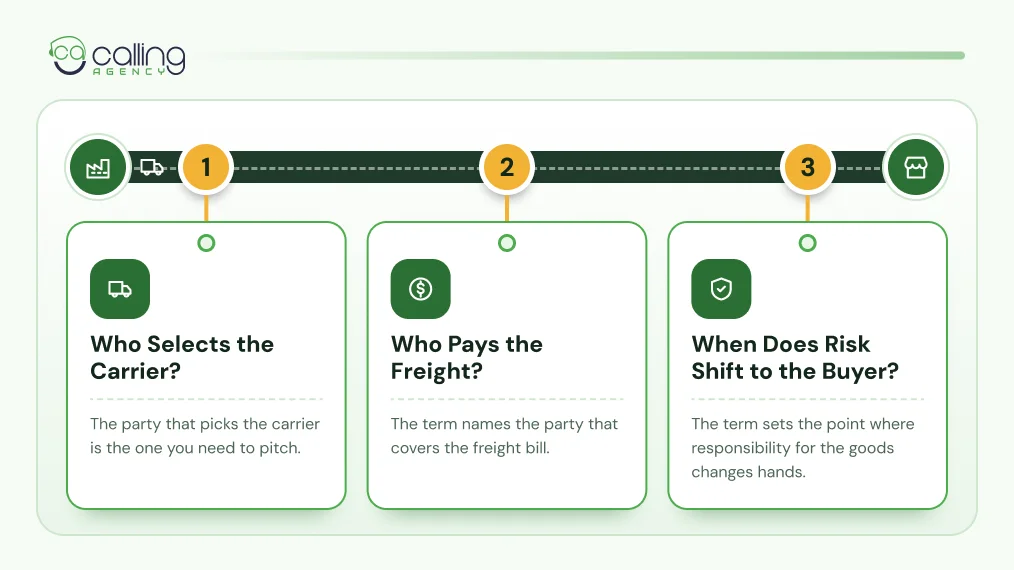
- Who selects the carrier?
- Who pays the freight?
- At what point does the risk shift to the buyer?
FOB Origin Versus FOB Destination
The two terms above are found in the U.S. Uniform Commercial Code (UCC 2-319), not in Incoterms. In other words, the terms just indicate when the liability for the goods changes from the seller to the buyer:
- FOB Origin: The seller bears the liability for costs and risks until they deliver the goods to the carrier. Once the carrier gets hold of the freight, the risk becomes that of the buyer.
- FOB Destination: The seller bears the liability for costs and risks until the goods get to the buyer’s destination.
Just remember that FOB terms are not concerned with who pays for the freight bill. The freight bill itself will specify whether it was paid before delivery or not.
Who Picks, Who Pays, and When Risk Moves
| Terms | Picks the carrier | Pays freight | Risk moves to buyer |
| FOB origin + collect | Buyer | Buyer | At carrier pickup |
| FOB origin + prepay and add | Seller | Seller, then bills the buyer | At carrier pickup |
| FOB destination + prepaid | Seller | Seller | At delivery |
| EXW (Incoterms) | Buyer | Buyer | At the seller’s door |
| CIF (Incoterms) | Seller | Seller, to the port | When loaded on the ship |
Incoterms Are a Separate System
Incoterms refer to the internationally recognized rules that indicate the responsibilities of the buyer and the seller in an export transaction, such as who pays for transportation and who is responsible for the cargo during transportation. For a clear understanding of Incoterms, one can refer to the Know Your Incoterms webpage on the website of the U.S. International Trade Administration.
Both international and domestic freight make use of the term “FOB,” although from different rulebooks:
- Incoterms FOB pertains only to ocean and inland waterways transportation, and it refers to the port of shipment.
- Domestic FOB pertains to the Uniform Commercial Code (UCC 2-319) and refers to a delivery term for U.S. sales. In FOB origin, the risk passes to the buyer when the goods are delivered to the carrier. In FOB destination, the seller transports the goods and the risk thereof.
Is “We’re Customer Routed” a Fact or a Brush-Off?
Sometimes, “we’re customer routed,” is just true. The buyer selects the carrier and bears the cost of transportation, so there’s nothing the shipper can do about the movement of the load. But other times, “we’re customer routed,” is a fast way to end a phone call, and on the phone, the two statements mean the same thing. Don’t try to argue; take it at its face value but find out who does the inbound shipping and who bears the freight bill.
Steps for Verification of the Assertion
- How many of your shipments are customer routed? Ask what share they route, 0 to 100%.
- What is the content of your current bill of lading? Who pays for it? Is it the shipper, consignee, or a third party?
- Routing can be found in purchase orders.
- Who chooses the carrier of the shipments that they pay for?
Who Really Makes the Call
| Freight type | Who routes it | Who to talk to |
| Prepaid | Shipper | Transportation manager or procurement |
| Collect | Consignee (receiver) | Customer’s buyer or logistics team |
| Third-party billed | 3PL | 3PL account manager |
Buyers often publish their rules, like Pennsylvania’s supplier shipping guidelines.
Handle the Objection
Don’t argue; use these freight broker objection-handling steps. Say, “Understood. Who is the client who chooses the carrier?” And then,
Broker: Understood. Are all your shipments buyer-routed, or do you control any lanes yourself?
Prospect: Most are customer-routed.
Broker: Understood. Which lanes do you still control, and who’s in charge of adding new carriers for those?
Find the Real Decision-Maker
- Look for the buyer’s transportation or routing team.
- Check procurement or carrier relations.
- Note any 3PL account manager in the middle.
- Get at least two contacts per account.
How to Identify Freight Control Before Cold Calling?
Wrong cold calls steal your time. Here’s the thing: not all shippers choose carriers for their loads. A structured freight broker lead generation process filters for shippers that actually control freight before your team spends time calling them.
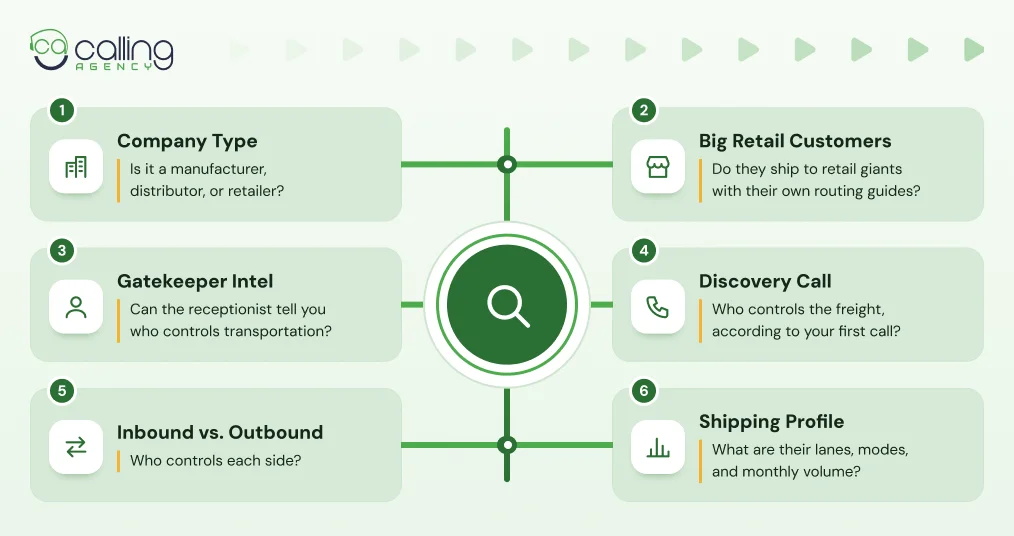
- What kind of company is it: Are they a manufacturer, distributor, or retailer?
- Does this company distribute products to retail behemoths that have their own routing guides?
- Can the receptionist give you any information about who controls their transportation?
- Who controls their freight on the first discovery call you make?
- Who controls their inbound vs. outbound freight?
- What are their lanes of shipment, mode of transport, and volume per month?
A strong logistics sales prospect list should also include lane, mode, freight profile, and the contacts responsible for carrier decisions.
Qualifying Questions on the First Call
- How many loads do you move each month?
- Do you or your customers control this freight?
- What’s your mix between inbound and outbound loads?
- Which lanes and modes do you run most?
- Who manages your routing guide and approved carrier list?
When Is Control Split Between Inbound and Outbound?
The inbound loads tend to be managed by the vendors, while the outbound is managed by you. When pitching outbound, let them know that they select the carrier.
| Direction | Who controls | Your move |
| Outbound, shipper-controlled | Shipper’s traffic team | Pitch them |
| Inbound, vendor-controlled | Supplier | Ask for the supplier’s contact |
| Customer-controlled | Buyer’s routing guide | Ask for the consignee contact |
Buyers often publish their rules, like Pennsylvania’s supplier shipping guidelines.
Who Is the Real Freight Decision-Maker?
No one particular person decides about the freight. Who buys logistics and freight services also changes by service line, company size, and who actually controls the routing. Three different jobs are usually involved, but the final decision depends on who performs the routing. Below are some of the job titles that are just examples.
Who books the truck, who picks the carrier, who signs
- Books: dispatcher, shipping clerk, or coordinator.
- Picks the carrier: transportation manager or routing group.
- Signs: director, VP of operations, or procurement.
Freight Decision-Makers When Supplier Routes the Freight
The list starts with the transportation, logistics or shipping manager of the supplier. Larger contracts should be signed by the supply chain director or VP of operations.
Freight Decision-Makers When Customer Routes the Freight
From the customer’s perspective, the transportation or routing department of the consignee, procurement or carrier relations, and even a 3PL account manager are the possible candidates.
Transportation Manager vs. Logistics Manager
| Aspect | Transportation Manager | Logistics Manager |
| BLS classification | Listed under Transportation, Storage, and Distribution Managers | Included in the same BLS occupation category |
| BLS-defined duties | Supervises employees of the transportation department, including drivers | Grouped with the above in the BLS description |
| Practical focus | Manages carriers and rates | Handles the whole process (end-to-end supply chain) |
| Scope | Narrower: transportation function | Broader: full logistics flow |
Influencers vs. Final Decision-Makers
| Role | Position in Decision | Why |
| Dock Supervisors | Influencer | Witness late pick-ups and no-shows firsthand |
| Dock Clerks | Influencer | Witness late pick-ups and no-shows firsthand |
| Transportation Manager | Final decision-maker | Makes the carrier decision |
| Procurement | Final decision-maker | Makes the carrier decision |
Decision-Makers by Company Size
| Company Size | Likely Decision-Maker | Title Keywords |
| Small | Owner or operations lead | Owner, Operations Manager, Shipping |
| Mid-size | Transportation or logistics manager | Transportation Manager, Logistics Manager, Traffic |
| Large | Director or VP, plus procurement | Director Transportation, VP Supply Chain, Carrier Relations |
Tip: Build at least two contacts per account.
What to Do When the Customer Controls the Freight?
Under FOB origin plus collect, when the buyer controls the freight, then the shipper whom you are dealing with cannot hire you for that. This decision is made by the buyer’s routing department. Know who manages logistics at the buyer and how to bid on their business.
Steps to Identify the Decision Maker
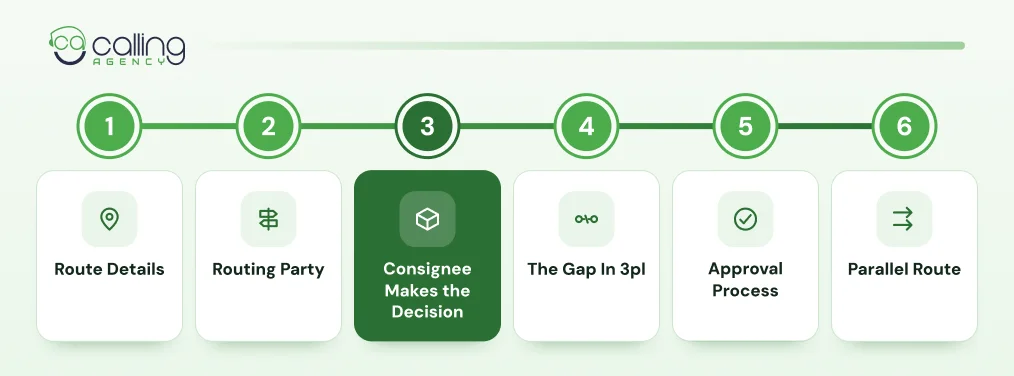
- Route Details: It is important to know about the origin, destination, type of transportation, and volume of load per week.
- Routing Party: From the supplier, you have to know who takes care of the load most of the time. Either there is a name or a team that handles the routing process.
- Consignee makes the decision: The receiver makes the decision regarding carrier selection.
- The Gap in 3PL: The third-party logistics company or TMS is present between the shipper and carrier.
- Approval Process: The people who approve the load and the paperwork required along with the timeline.
- Parallel Route: Check out the routes of inbound/prepaid loads from the first shipper.
How to Get on a Shipper’s Routing Guide
Send a clean setup packet.
| Item | Who needs it | Why |
| MC number | Carriers and brokers | A broker must hold FMCSA authority to arrange freight for pay. |
| W-9 | Everyone | Standard for vendor setup and payment |
| COI | Carriers | One shipper checklist asks for auto liability of at least $1M, with the shipper named as certificate holder. |
| BMC-84 bond | Brokers | A broker must have a $75,000 surety bond or trust fund. |
When Does the Bid Cycle Open?
Big shippers usually run one major bid a year, most often in the fourth quarter, so new contracts can start in January. It’s slow, averaging about 14 weeks, though some take four months. Mid-sized shippers are more flexible. They run smaller mini-bids whenever a lane needs fixing or they need backup carriers, and those take two to four weeks. Annual bids are still common, but mini-bids are becoming more popular.
Get registered, and then ask, “When is your next bid window?”
The next step: Integrate it into your shipper prospecting approach and LinkedIn messaging.
Frequently Asked Questions
Whose decision is it about the carrier in the shipping process?
Whoever controls the shipment usually chooses the carrier. That’s typically the shipper, though customer-routed freight puts the decision with the buyer. Prepaid, collect and third-party billing terms only settle who pays the freight bill, not who picked the carrier. Always confirm it on the PO or the buyer’s routing guide.
Is it possible to ship customer-routed freight and/or to sell to entities that are not controlling their freight?
Yes, it is possible to sell to the entity that controls the freight. The freight broker can ship customer-routed freight with permission from the routing department of the buyer. The only thing is that the supplier will not help you in any way. You have to get hold of the contact details of the transportation department of the consignee and ask them for the routing guide and bidding period.
Conclusion
At the end of the day, it all comes down to who controls the freight. Stop guessing and read what your purchase order, freight terms and bill of lading actually say.
Then, look into who signs off on carriers. It can be anyone like the Transportation Manager, Procurement Lead, or even 3PL Account Manager, but definitely not the answering person on the phone. Go after the people who truly decide the routing, and try to get at least two contacts at every account so you’re not stuck if one of them goes quiet.
Last but not least, get ready ahead of the bid process. Get your setup packet prepared and ask when their next bid cycle will open. Considering we are heading towards Q4, now is the perfect time to do that.