


Your IT company’s cold calling doesn’t work when targeting, timing, message content or qualification breaks down. Teams often call the wrong decision-maker, use weak data or pitch managed services too early.
Prospects may have an existing provider or can follow a break-fix model. Decision-makers often judge relevance within the opening seconds.
Some IT firms hire cold callers to improve targeting, qualification and appointment booking. This guide explains each problem and shows how to improve meeting quality.
Why Isn’t Your IT Company’s Cold Calling Booking Meetings?
IT cold calling fails to book meetings for four common reasons:
- Contacting the wrong decision maker or manager
- Offer is weak
- Not calling in the buying window
- Poor or backdated account data and missing pain points
Many MSP campaigns face several of these problems at the same time. This lowers connect rates, decreases conversations and reduces booked qualified appointments.
Cold calling still works for IT and MSP companies when execution matches the buyer and account. Generic outbound advice often misses the details behind IT purchasing decisions.
Four Signs Your IT Cold Calling Needs Attention
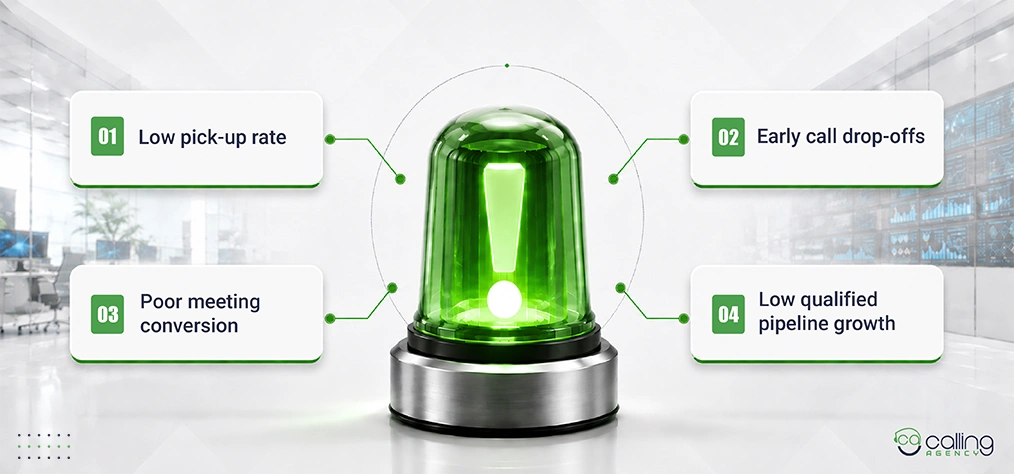
Four patterns show that your current cold calling process needs attention:
- Low pick-up rate
- Prospects ending calls within the first 15 seconds
- Conversations to booked meetings ration is too low
- Low qualified pipeline growth
Several of these signs together show where the calling process needs work. Review the list, buyer role, opening and qualification before increasing call volume.
Once the weak point is fixed, more calls can produce better results.
What Working Cold Calling Looks Like for an IT Company?
IT cold calling should be measured against realistic benchmarks. A strong IT lead generation service also tracks how outreach turns into qualified meetings.
MSP campaigns often need around 300 dials for one booked appointment. Decision-maker connect rates usually range from 15% to 20%.
The table below shows the main benchmarks for IT and MSP cold calling.
| Metric | Benchmark | How to Read Your Number |
| Dials per booked appointment | Around 300:1 | Fewer than 300 dials indicates stronger campaign efficiency |
| Decision-maker contact rate | Around 26% | A lower rate may indicate poor data, weak targeting or gatekeeper issues |
| Appointment rate per cold prospect called | Around 2% to 3% | A lower rate may point to the opening, offer or meeting request |
| Managed-services sales cycle | Around 382 days | Short campaign reviews may give a misleading result |
| Prospects actively looking to switch | Around 2% at any time | Most prospects are outside the active buying window |
| Calling Agency cybersecurity campaign | 87 meetings, 55+ opportunities and $1.5M+ pipeline | Consistent outreach can build a qualified pipeline across several months |
These numbers should guide campaign reviews. They should not become fixed promises for every MSP.
CallingAgency booked 87 qualified meetings for PDDG across nine months. The campaign also created 55+ opportunities and over $1.5 million in pipeline.
That result came from consistent outreach across several quarters. It also shows why teams should judge performance beyond weekly meeting totals.
Are You Calling the Right Person at the Target Company?
The right IT decision-maker depends on the company’s size and structure. Job titles alone do not always reflect who controls the budget or final approval.
The table below shows who usually controls IT decisions at different company sizes.
| Target Company Size | Who Actually Buys IT | Who to Call | Who Not to Lead With |
| Under 15 employees | Owner or founder | Owner by name | An IT manager who may not exist |
| 15 to 50 employees | Owner, operations manager or finance lead | Operations, finance or the owner | A front-desk employee |
| 50 to 250 employees | IT leadership with finance involvement | IT director and CFO | Junior helpdesk staff |
| 250+ employees | IT, security, finance and procurement | IT director, VP IT, CIO or CISO | One contact without mapping the committee |
Small companies often have no dedicated IT department. The owner usually approves technology-related spending and signs service agreements.
Mid-sized companies, however, may divide the decision between operations, finance and IT departments. Larger companies often require support from several stakeholders.
Co-managed IT needs a different approach. The internal IT leader should see your MSP as added capacity rather than a replacement.
Decision-makers also avoid calls that sound generic, irrelevant or from unfamiliar vendors.
They often judge the call within the opening seconds. Tone, pace and relevance can decide whether the conversation will continue.
The psychology behind phone selling explains how trust, curiosity and resistance shape this decision. Strong MSP lead generation starts by matching the message to the buyer’s role.
Why Managed-Services Pitches Fail With Break-Fix Buyers
Break-fix buyers pay for IT support only when they face a problem. They may see monthly managed services payments as an unnecessary cost.
These prospects may match your ICP but still lack current need or timing. They are your market-qualified leads and need nurturing before they are ready for a pitch.
Start with the problems they already face. Ask questions like:
- How often does downtime interrupt work?
- Who handles urgent IT problems?
- What did the last outage cost?
- When do you review IT support?
- Who approves technology spending?
Ask how these problems affect daily work and revenue. A real business impact gives the buyer a reason to consider ongoing support.
Good objection handling also helps when prospects question monthly fees. Explain how managed services improve cost control, response times and system reliability.
Discuss the service package after the buyer recognizes the risk. This keeps the conversation focused on business value rather than technical features.
Why Prospects With an Existing IT Provider Shut You Down?
Most prospects already have someone handling their IT-related work. Changing providers can create new risks, delays and internal work.
The current provider already knows their systems, users and support history. A new MSP must offer a clear reason to consider change.
Accurate data from custom list-building services helps reps reach people who understand the current provider’s performance. This may include the owner, IT leader, operations manager or finance lead.
“We already have someone” can mean several things:
- Their contract is still active
- Switching feels difficult
- No urgent problem exists
- Your offer sounds similar to other MSPs
- The wrong person answered the call
A strong cold call script should acknowledge the existing relationship. The rep can then explore specific service gaps:
- How quickly are urgent issues resolved?
- Do recurring problems return after each repair?
- Does leadership receive security and performance reports?
- Is support available outside normal business hours?
- When is the current agreement going to end?
These questions can help to find dissatisfaction without attacking the current provider. Record the gaps, decision-makers and renewal date in your CRM.
Follow up before the next contract review window. This gives the prospect time to compare options before renewing.
Why Renewal Timing Matters in IT Cold Calling?
An active IT contract can delay a sale even when the prospect likes your offer. Timing often matters more than another follow-up.
Ask and record:
- Current provider
- Contract review month
- Renewal date
- Known service gaps
- Main decision-makers
- Best follow-up date
A prospect may enter the sales funnel after the first call.
- TOFU: They remember your company
- MOFU: They compare providers and review current problems
- BOFU: They accept meetings, request pricing or review proposals
Focused IT appointment setting helps move earlier interest into a qualified sales meeting.
Start follow-up before the review period. This gives the buyer enough time to compare providers.
What’s Hurting Results: Your List, Offer or Reps?
Your call outcomes show where exactly the campaign needs work. For example, Low answer rates usually mean poor data or weak targeting.
Fast hang-ups often refer to a weak opening. Conversations without meetings may expose problems with the offer, qualification or agent’s execution.
Review these patterns:
- Low answer rates: Check phone numbers, job roles, account fit and caller ID reputation.
- Calls ending quickly: Review the opening, tone and reason for calling.
- Good conversations without meetings: Check the offer, questions and meeting requests.
- High meeting no-shows: Review qualification, urgency and confirmation.
- One rep performs poorly: Compare call recordings, outcomes and follow-up habits.
Fix poor data before training or instructing the reps because even the skilled callers can still struggle with old contacts, wrong roles or unsuitable accounts.
A lead can match your ICP and still need further qualification. An SQL has clear authority, need and timing.
Use BANT qualification to check budget, authority, need and timing. Keep each question natural and relevant. Tracking MQL-to-SQL conversion shows how many leads become qualified opportunities. Low conversion may reveal weak targeting, discovery or meeting criteria.
These checks help explain why cold calling fails before you increase call volume or budget.
Should You Fix Cold Calling In-House or Outsource It?
Keep cold calling in-house when you have dedicated management, reliable data and enough capacity for daily outreach.
Outsource it when your team lacks those resources or prospecting reduces time for qualified sales conversations.
The right choice depends on ownership, total cost, call volume and required speed to pipeline.
| Factor | Keep It In-House If | Outsource It If |
| Management | A manager reviews calls and outcomes daily | No one to review daily performance |
| Hiring | You can recruit and train dedicated callers | You need to avoid a long hiring cycle |
| Call quality | You can review recordings and coach reps | You lack a clear review process |
| Data | Your team can maintain accurate contact records | Data-related work reduces calling time |
| Capacity | Activity continues during absence or turnover | You need stable pipeline volume without more hirings |
| Cost | You can track salaries, tools and management overheads | Full internal cost remains unclear to you |
Salary alone does not always show the full cost of an internal SDR team. Recruitment, training, software, data and management also add expense.
Poor ownership is another reason why cold calling fails. Results decline when nobody reviews calls, updates records or corrects campaign issues.
CallingAgency generated 75 SQLs for Slick Cyber Systems across 13 months. The campaign averaged six meetings monthly and reached a 22% conversion rate.
Pipeline grew by 67% month over month. Regular call reviews and campaign updates helped maintain that progress. That’s why choose the model your company can manage consistently.
Fix the Weak Point Before Increasing Call Volume
Do not add more dials until you know where prospects are leaving the process. Track connect rate, conversation-to-meeting rate and show rate.
- Low connect rate: Fix contact data and caller ID issues.
- Low meeting rate: Improve the opening, questions and offer.
- Low show rate: Tighten qualification and meeting confirmation.
Test one change at a time and compare the results. Increase call volume after the weakest metric improves.
Need More Qualified IT Sales Meetings?
Your sales team should meet buyers with a clear need, authority and reason to act.
CallingAgency’s appointment setting services reach target accounts, qualify decision-makers and schedule meetings directly on your calendar.
Each meeting includes useful buyer context, including pain points, authority and timing. Your team can focus on moving the opportunity forward.
Book a strategy call and build a more consistent flow of qualified IT meetings.
Final Thoughts
IT cold calling improves when every part of the process supports the buyer’s situation. The right contact, message, timing and qualification all influence and shape results.
Track the numbers, fix the weakest stage and keep follow-up consistent. Better structure leads to stronger meetings and a healthier sales pipeline.
Frequently Asked Questions
Why are my IT cold calls not booking meetings?
The main reasons why your cold calling is not working are poor data, weak targeting, bad timing and an unclear offer. Meetings may also underperform when reps book prospects without confirming authority, need, timing and a clear reason for sales follow-up.
Does cold calling still work for IT companies and MSPs?
Yes. Cold calling works when the message fits the buyer’s needs, account and buying window. Consistent follow-up also improves results because this keeps you in front of the buyer.
How many calls does it take to book an IT appointment?
MSP campaigns may need around 300 dials for one booked appointment. Results vary by market, data quality, offer and caller performance. Track your own dial-to-meeting rate to set a realistic campaign benchmark.
How should reps handle “we already have an IT provider”?
Acknowledge the current provider without criticizing them. Ask about unresolved service gaps, response times and contract timing. Record the renewal date and follow up before the next review period begins.
Should IT cold calling stay in-house or be outsourced?
Keep it in-house when you can manage data, coaching and daily activity. Outsource when prospecting reduces closing time or your team lacks dedicated outbound resources and consistent management capacity internally.