

Healthcare lead generation is not a single campaign, it is an orchestra of many touchpoints that convert strangers into patients or clients. Cold call, cold email, LinkedIn InMail, SMS Marketing and also SEO to reach B2B decision-makers and B2C patients at the moment they ready to learn our offer is the most effective mix.
While SEO is to attract intent-driven users, outreach channels help churn conversations, SMS helps create a sense of urgency with quick follow ups and increases conversion. And this is the guide that will help you & clinic owners, health care marketers learn how to do it by creating that system with cold calling, cold emailing, LinkedIn InMail, SMS marketing and SEO so your growth will be powered with a continuous stream of high-quality leads.
You will learn what channels work best with which audiences, how to connect them using a CRM system, how fast you need to respond in order to take advantage of the conversions and how to keep things HIPAA- and TCPA-compliant.
Within each section, you will find a guided breakdown of operational workflows, tools recommendations and quantitative metrics for understanding success and improving ROI moving forward. These methods produce proven impacts of growth for health systems on digital and offline platforms, creating longer-sustaining pipelines and also acquiring patients with relatively high impact investment with limited costs.
Why is Multi-Channel Strategy the best option for Healthcare Leads?
Multi-channel strategy is effective as healthcare patients don’t use just one platform. They do their due diligence on Google, Social Media, websites and reviews before deciding on a provider. This is the behaviour and can be captured at each step with a multi-channel approach.
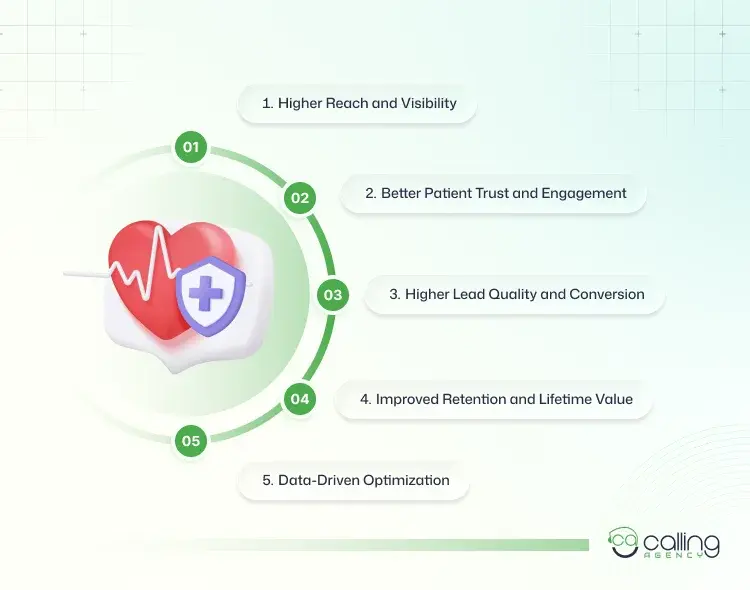
Higher Reach and Visibility
Patients use multiple platforms during their decision journey. Using 3+ channels can increase purchase or conversion rates by up to 287%.
- Connect with patients during search, social media, email and ads
- Collect data about the touchpoints at different points of the capture.
- Eliminate single channel solutions that limit the number of opportunities available.
Improved Patient Trust and Engagement
Trust is required in healthcare decisions. When you send the same message through multiple channels, it gains credence. Some 72% of users favor communication via several channels.
- Display reviews, testimonials and educational material.
- Be seen in the extended decision cycle.
- Develop familiarity prior to scheduling appointments
Better Lead Quality and Lead Conversion
Multi-channel campaigns will foster leads incrementally. Multi-channel businesses see increased leads for less money and increased close rates.
- Advertise to site visitors who have come and gone on your site.
- Send follow-up email or SMS
- Increase awareness to booking
Improved Retention and Lifetime Value
Healthcare is recurring. Multichannel engagement drives up to 89% retention and enhanced lifetime value.
- Stay connected post-visit
- Remind and tips on health
- Encourage repeat visits
Data-Driven Optimization
Data is provided to each channel to enhance performance.
- Keep a record of channels that bring appointments
- Use the ROI approach to optimise budget.
- Use personalized communication to achieve success.
Takeaway: Use SEO, Google Ads, Social media and email. Monitor all leads, retarget leads, and ensure consistent messaging across all platforms.
How Does Multi-Channel Lead Generation Work in Healthcare?
Multi-channel lead-generation in healthcare works by engaging patients on various platforms, collecting leads through forms or calls and taking it to one single platform to maintain all your data in one system. B2B Lead Nurturing Campaign through follow-ups, and campaign performance data review and optimization.
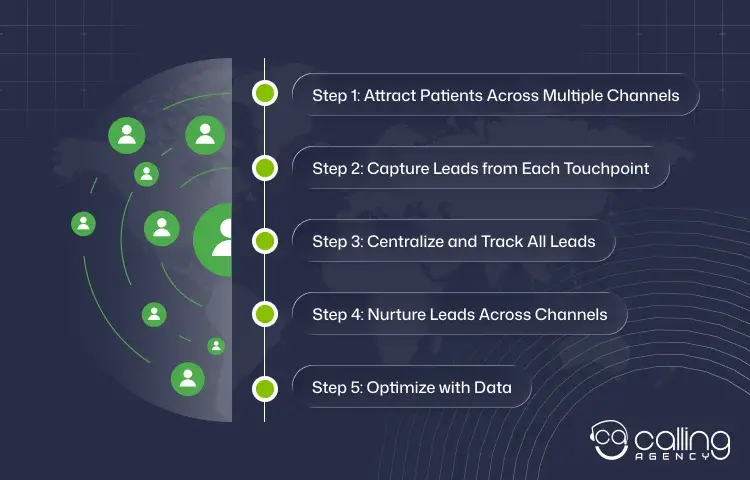
Step 1: Attract Patients Across Multiple Channels
Healthcare providers use different channels to create visibility.
- Google search (SEO, ads) for high-intent patients
- Social media for awareness and education
- Email and content for trust-building
Patients usually interact with 3–5 channels before converting, not just one
Step 2: Capture Leads from Each Touchpoint
Each channel has a lead capture system.
- Website forms and landing pages
- Call tracking and appointment booking
- Chatbots and social media messages
All inquiries are collected so no patient is lost
Step 3: Centralize and Track All Leads
A key part is storing all leads in one system (CRM/dashboard).
- Track source (Google, Facebook, call, etc.)
- Monitor patient behavior and interest
- Avoid data loss from scattered platforms
This gives full visibility of the patient journey
Step 4: Nurture Leads Across Channels
Not all patients book instantly. Multi-channel follow-up helps convert them.
- Retargeting ads
- Email or SMS reminders
- Educational content for trust
Multi-channel campaigns generate 3–5x higher response rates
Step 5: Optimize with Data
Every channel provides performance data.
- Track cost per lead and conversions
- Adjust budget to high-performing channels
- Continuously test and improve
Best Channels of Healthcare Lead Generation in B2B and B2C Marketing
Healthcare lead generation is the process of attracting the right leads into your funnel, whether they’re hospital admins, clinic managers or individual patients, and directing them toward your product or services. Regardless of whether your marketing is in a B2B (business-to-business) or B2C (business-to-consumer) environment, the marketing channels you select will have an impact on the quality and conversion of your leads. A B2B healthcare is for decision makers (doctors, hospitals, executives) and a B2C is for patients (individuals seeking healthcare).
Here are the best channels, the channel that works best for B2B or B2C, and detailed examples.
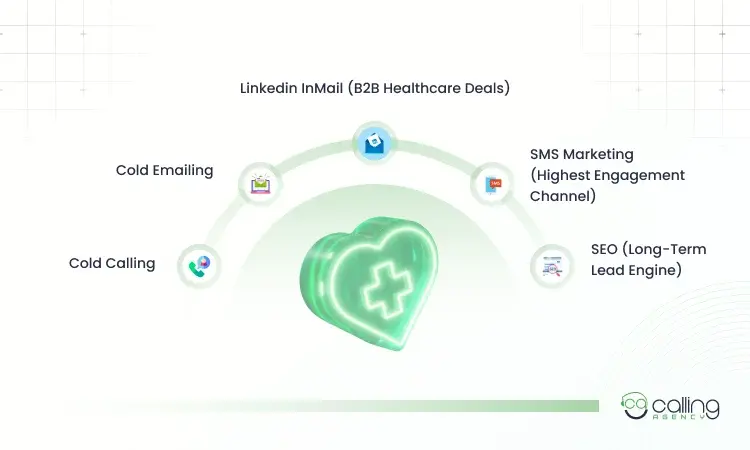
Cold Calling
Cold calling remains a traditional but effective method in healthcare B2B marketing.
Best for: B2B
Why: Decision-makers in hospitals, clinics and insurance companies often prefer personalised dialogue over blanket advertising.
Practical Approach:
- Create a targeted list of healthcare administrators/procurement officers.
- Use something like a CRM to log calls and responses, for example HubSpot or Salesforce Health Cloud.
- Write a script that shows you can deliver measurable benefits: (e.g., our diagnostic equipment lowers patient wait time by 30%)
Example:
Call 100 hospital procurement managers from a medical device company. From this group, 20 agree to a demo. The company receives 20% of the contracts it bids on, which means out of 20 contracts submitted, it wins half a dozen — for $50,000 each. You train them on how a cold call can hunt high-value B2B game when you know what parts of the forest to target.
Cold Emailing
Cold emailing is more scalable than calling and allows for detailed information sharing.
Best for: B2B
Why: Because emails can have brochures, case studies and compliance certifications that decision-makers require.
Practical Approach:
- Split your email list based on specialty (cardiology clinics vs general hospital).
- Take advantage of secure templates through a platform such as Mailchimp or ActiveCampaign that follows compliant and ethical best practices for email marketing in healthcare.
- Statistics: Open rates, Click-through Rates (CTR), Demo Bookings
Example:
Telehealth software provider sending 1,000 cold emails to clinic managers. The campaign gets 25% open rate, and 5% CTR. 50 demo requests -> 10 paying clients = $200K ARR
LinkedIn InMail
LinkedIn has become the most effective B2B healthcare lead generation multimodal channel today.
Best for: B2B
Why: LinkedIn is highly frequented by healthcare executives, doctors, and administrators – making it the perfect platform for outreach.
Practical Approach:
- Filter prospects in LinkedIn Sales Navigator (roles for hospitals with 500+ beds = Chief Medical Officer).
- Sending personalized InMails that tag into industry pain points (like this: “We help hospitals reduce readmission rates by 15%”
- Bookend them with case studies or whitepapers.
Example:
When a healthcare analytics company ran a LinkedIn InMail campaign targeting 500 hospital executives. 150 executives respond with a 30% contact. Complete 20 sign ups for pilots, yielding $1 million in contracts.
SMS Marketing
When you create marketing campaigns for B2C in healthcare, SMS is incredibly effective.
Best for: B2C
Why: Patients usually respond well to appointment reminders, health tips and promotional offers. SMS has a 98% open rate.
Practical Approach:
- Utilize text and SMS over HIPAA-compliant platforms like Twilio or Podium.
- Appointment reminders, vaccination alerts or promotions related to wellness programs.
- Make messages short and actionable (eg, Your flu shot is due. Book now: [link]”).
Example:
Sending SMS reminders for free annual checkups to 2000 people by a dental clinic 120000 in revenue as 600 patients make appointments. With a budget of just $500, this campaign had an astounding ROI.
SEO (Search Engine Optimization)
SEO is the cornerstone of lead generation for healthcare businesses, whether B2B or B2C.
Best for: Both B2B and B2C
Why: Decision-makers and patients research online before making healthcare decisions. Getting high ranking in google gives trust and exposure to visibility.
Practical Approach:
- For B2B: Target for words such as “hospital management software” or “suppliers of medical device”
- For B2C: Prioritize local SEO with phrases like “dentist near me” or “emergency care Miami .”
- You can measure keyword performance by using SEMRush or Ahrefs, for example.
- Write case studies, patient guides, and compliance articles to show expertise.
Example:
SEO target: “back pain treatment USA” Investment type: blogging Income source: a physiotherapy clinic Organic traffic grows 300% within 6 months. 5,000 visits get 200 appointments and $40k a month
Comparing Channels: B2B vs. B2C
| Channel | Best For | Strengths | Example Metric |
| Cold Calling | B2B | Direct, personal | 20% demo conversion |
| Cold Emailing | B2B | Scalable, detailed | 25% open rate |
| LinkedIn InMail | B2B | Professional targeting | 30% response rate |
| SMS Marketing | B2C | Immediate, high open rate | 98% open rate |
| SEO | Both | Long-term visibility | 300% traffic growth |
Step by Step Process to Generate healthcare Leads with Multi-Channel Marketing
For multi-channel marketing to create healthcare leads, you need to identify your target patients, develop a unified and effective CRM Workflow system, promote them via search engine optimization and ads, capture leads immediately, respond to them in minutes with automation, follow up with SMS and e-mail, recapture those that slip away and optimize for them with data. This all-in-one system will boost conversions with a single funnel that links all of the patient touch points together.
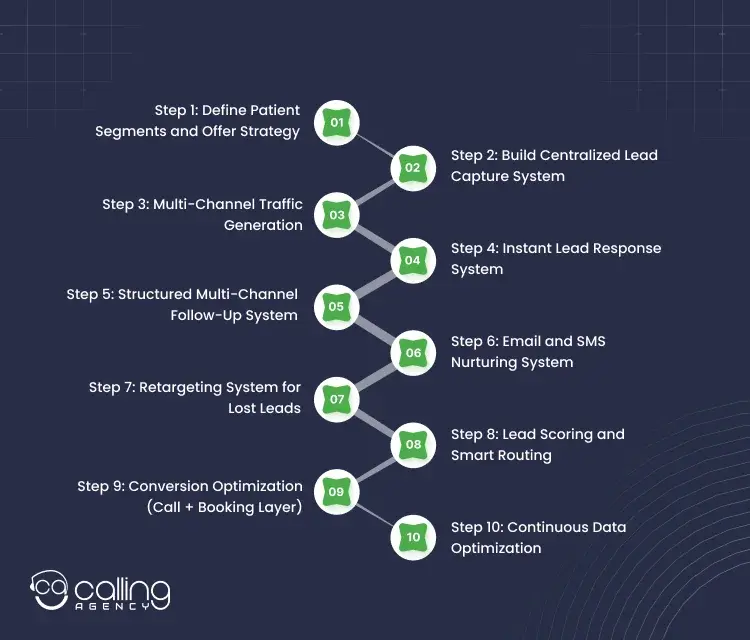
Step 1: Define Patient Segments and Offer Strategy
Start by identifying exactly who you want to attract. Healthcare works best with specific targeting.
Example:
- Cardiology clinic targets “patients aged 40–65 with hypertension risk”
- Dental clinic targets “working professionals needing implants or cosmetic dentistry”
Action steps:
- Create 2–3 patient personas
- Define pain points (cost, fear, urgency)
- Build service-specific offers (free consultation, discounted scan)
This improves conversion quality at the start.
Step 2: Build Centralized Lead Capture System
All marketing channels must feed into one system.
Core components:
- Website landing pages
- Call tracking numbers
- WhatsApp/chat widgets
- Appointment booking system
Tools used:
- HubSpot → Tracks leads, automates workflows, manages pipelines
- Zoho CRM → Cost-effective CRM for healthcare clinics
- Google Tag Manager → Tracks conversions from all sources
Example structure:
- 3 landing pages → 1 CRM system
- Each lead tagged by source (SEO, Ads, Referral)
Step 3: Multi-Channel Traffic Generation
Use multiple channels to bring patients into the system.
SEO (High-Intent Organic Channel)
- Patients search “best skin clinic near me”
- Conversion rate: 8–15%
Google Ads (Immediate Demand Capture)
- High-intent keywords like “dental implant cost”
- Cost per lead: $8–$20 depending on competition
Social Media Ads (Trust Building)
- Video testimonials, doctor explanations
- Builds awareness before booking
Example:
- SEO: 400 leads/month
- Google Ads: 500 leads/month
- Social Ads: 300 leads/month
- → Total: 1,200 leads/month
Step 4: Instant Lead Response System
Speed is the most important factor in healthcare conversion.
Workflow:
- Lead submits form
- Instant SMS sent
- Call triggered within 1–3 minutes
- Email confirmation sent
Tools used:
- Twilio → Sends SMS and automated calls
- Zapier → Connects CRM, ads, SMS, email
Telecom-style performance:
- Response time: under 3 minutes
- Contact rate: 70–80%
- Booking rate: 25–35% (when contacted fast)
Step 5: Structured Multi-Channel Follow-Up System
Most patients need multiple interactions before booking.
7-day follow-up flow:
- Day 0: Call + SMS
- Day 1: Educational email
- Day 2: Retargeting ads
- Day 3: WhatsApp follow-up
- Day 5: Reminder SMS
- Day 7: Final call
Example result:
- 1,000 leads/month
- 300 immediate bookings
- 200 additional bookings via follow-up
- → +65% total conversion improvement
Step 6: Email and SMS Nurturing System
Email builds trust. SMS creates urgency.
Tools used:
- Mailchimp → Email campaigns and segmentation
- Brevo → Combined SMS + email workflows
Email flow:
- Problem education
- Treatment explanation
- Patient success story
- Booking offer
Metrics:
- Email open rate: 25–30%
- SMS response rate: 30–50%
- Combined conversion uplift: +40%
Step 7: Retargeting System for Lost Leads
Many users visit but do not book immediately.
Channels:
- Google Display Ads
- Facebook/Instagram retargeting
- YouTube remarketing
Example funnel:
- 5,000 visitors/month
- 1,500 retargeted
- 300 return
- 90–120 bookings recovered
Step 8: Lead Scoring and Smart Routing
Not all leads are equal.
Scoring system:
- High intent: booking page visits
- Medium intent: form submissions
- Low intent: browsing only
Routing logic:
- Hot leads → call within 2 minutes
- Warm leads → email + SMS
- Cold leads → retargeting ads
Step 9: Conversion Optimization (Call + Booking Layer)
Even good leads fail without proper handling.
Best practices:
- Standard call scripts
- Urgency-based booking (“limited slots today”)
- One-click booking links
Example improvement:
- Before: 22% booking rate
- After: 38% booking rate
Step 10: Continuous Data Optimization
Every channel must be measured and improved.
KPIs:
- Cost per lead (CPL)
- Cost per acquisition (CPA)
- Channel conversion rate
- Appointment show-up rate
Example optimization:
- Google Ads CPL: $15 → $9
- Email conversion: 4% → 8%
- Retargeting ROI increased by 30%
How to Combine Channels (Real Multi-Channel System for Healthcare Leads)
A real multi-channel healthcare system combines SEO, cold calling, cold emailing, LinkedIn InMail, and SMS marketing into one connected workflow. SEO generates intent-based traffic, SMS and calls trigger fast action, emails nurture interest, and LinkedIn builds partnerships. All leads are tracked in a CRM, scored, and followed through automated sequences to increase appointment bookings and reduce drop-offs.
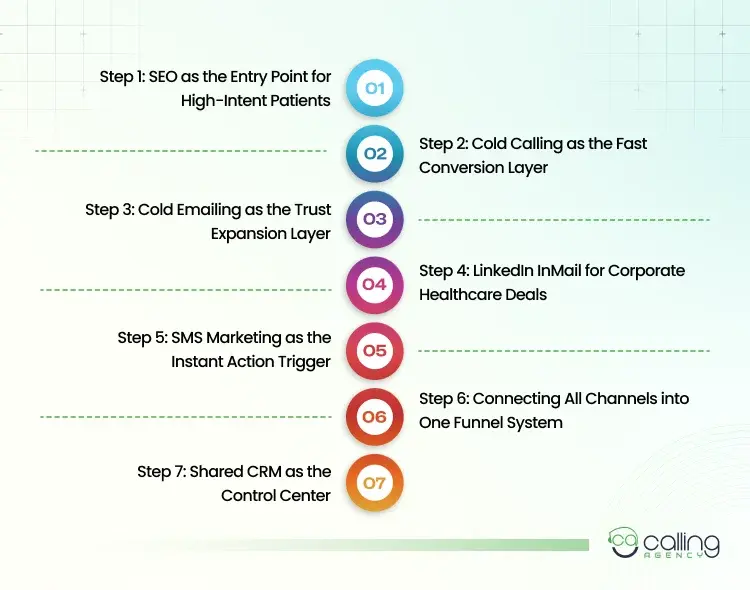
Step 1: SEO as the Entry Point for High-Intent Patients
SEO is the starting layer because it captures patients already searching for solutions.
How it fits into the system:
- Patient searches “MRI scan cost near me”
- Visits clinic website
- Enters CRM through form or call
Example structure:
- 3,000 monthly organic visitors
- 10% conversion = 300 leads
Tools used:
- Google Tag Manager → tracks SEO actions
- HubSpot → stores SEO leads and assigns follow-ups
SEO becomes the entry layer that feeds all other channels, not a standalone channel.
Step 2: Cold Calling as the Fast Conversion Layer
Cold calling is used only after SEO or ads generate leads. It is not random calling.
System integration:
- SEO lead enters CRM
- Lead is labeled “high intent”
- Call triggered within 2–5 minutes
Example scenario:
- 200 SEO leads/month
- Call team reaches 70%
- 35% book appointments
Practical structure:
- Script focuses on urgency and booking
- CRM shows patient search history before calling
Cold calling becomes a conversion accelerator, not a separate outreach method.
Step 3: Cold Emailing as the Trust Expansion Layer
Cold emailing works after initial interest is captured but before booking happens.
How it connects:
- SEO or call leads that did not book
- Enter automated email sequence
Example flow:
- Day 1: symptom explanation
- Day 3: treatment benefits
- Day 5: patient success story
- Day 7: booking reminder
Tools used:
- Mailchimp → manages sequences and segmentation
- Brevo → combines email with follow-up messages
Example metrics:
- 1,000 emails sent
- 28% open rate
- 6% conversion into bookings
Email acts as the trust-building layer between awareness and action.
Step 4: LinkedIn InMail for Corporate Healthcare Deals
LinkedIn InMail is not for patients. It is for B2B healthcare partnerships.
Use case in system:
- Corporate health checkups
- Insurance partnerships
- Employee wellness programs
Integration flow:
- SEO identifies healthcare brand
- CRM flags corporate leads
- LinkedIn outreach begins
Example:
- 120 InMails sent to HR managers
- 10% response rate
- 5 corporate contracts closed
Tools used:
- LinkedIn → outreach to decision makers
- HubSpot CRM → tracks corporate pipeline
LinkedIn becomes the enterprise acquisition channel inside the same system.
Step 5: SMS Marketing as the Instant Action Trigger
SMS is the fastest response channel and connects all other channels.
System role:
- Triggered immediately after SEO form fill or missed call
- Sends reminders and confirmations
Example flow:
- Patient fills SEO form
- SMS sent in 10 seconds
- Call scheduled automatically
Tools used:
- Twilio → instant messaging and call triggers
- Zapier → links CRM + SMS + email
Example metrics:
- 95% SMS open rate
- 40% response rate when sent within 5 minutes
SMS acts as the instant conversion layer across all channels.
Step 6: Connecting All Channels into One Funnel System
Now all channels are combined into one structure.
Unified workflow:
- SEO brings traffic
- CRM captures lead
- SMS triggers instant response
- Cold call converts warm leads
- Email nurtures undecided patients
- LinkedIn builds corporate deals
Real healthcare funnel example:
- 10,000 monthly visitors (SEO)
- 900 leads captured
- 80% contacted via SMS/calls
- 300 converted through follow-ups
- 100 additional conversions from email
- → Total: 400+ appointments/month
Step 7: Shared CRM as the Control Center
All channels must report into one system.
CRM functions:
- Lead scoring (hot, warm, cold)
- Channel performance tracking
- Automated task assignment
Tools:
- HubSpot CRM → full funnel automation
- Zoho CRM → cost-efficient tracking for clinics
Without CRM integration, channels work separately and lose efficiency.
Compliance in Healthcare Lead Generation in the USA
Healthcare lead generation services in the USA must follow HIPAA and TCPA rules. HIPAA requires protection of patient health data and written authorization before using it for marketing. TCPA requires prior express written consent before sending calls or SMS. Businesses must store proof of consent, secure all patient data, and ensure every communication is legally approved before contacting leads.
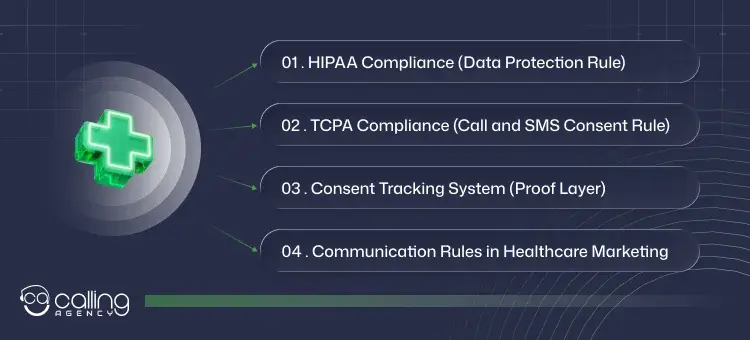
HIPAA Compliance (Data Protection Rule)
HIPAA controls how healthcare companies collect and use patient-related information.
What counts as regulated data:
- Name + medical concern (e.g., “back pain inquiry”)
- Appointment requests
- Treatment questions
Even a simple “contact us for consultation” form can become sensitive if health intent is included.
Core requirements:
- Patient data must be encrypted and access-controlled
- Marketing use requires written authorization
- Every vendor handling data must sign a Business Associate Agreement (BAA)
Practical example:
If a clinic collects “knee pain consultation” leads from SEO ads, that data must be stored securely in a HIPAA-compliant CRM. Sharing it with a marketing agency without a BAA becomes a violation.
HIPAA clearly requires written authorization before using health-related data for marketing purposes in most cases.
TCPA Compliance (Call and SMS Consent Rule)
TCPA regulates how healthcare leads can be contacted through phone and SMS.
Core rule:
You must get prior express written consent before sending marketing calls or text messages.
What valid consent includes:
- Clear opt-in checkbox (not pre-checked)
- Statement that the user agrees to receive calls/SMS
- Identification of the healthcare provider
- Timestamp and proof of submission
Real-world impact:
- No consent → no cold SMS or automated call allowed
- Even third-party leads require proof of consent
Violations can lead to heavy penalties per message or call.
TCPA applies directly to SMS marketing and requires strict consent before sending messages.
Consent Tracking System (Proof Layer)
Compliance is not just asking permission—it is proving it.
What must be stored:
- Original form submission
- Exact consent text shown to user
- IP address and timestamp
- Source channel (SEO, Ads, referral)
Practical healthcare setup:
- SEO lead enters form
- CRM stores consent log automatically
- SMS/call only triggered after verification
TCPA compliance requires businesses to maintain proof of consent for every communication channel used.
Communication Rules in Healthcare Marketing
Not all communication is treated the same.
Allowed (with proper setup):
- Appointment reminders
- Care follow-ups
- Non-promotional updates
Restricted:
- Automated promotional SMS without consent
- Robocalls to unverified leads
- Sharing lead data with third parties without agreement
Important operational rule:
Every outreach must match the original consent scope. If a patient agreed only to consultation calls, you cannot send promotional offers.
7 Common Mistakes to Avoid
Not all healthcare lead generation campaigns are unsuccessful due to ineffective marketing, but due to mere mistakes in implementation. These can be avoided to enhance results within a short time.
Major pitfalls to be avoided:
- Delayed reaction to leads: There should be no waiting hours or days, which minimizes conversion. The majority of leads cool off in a few minutes.
- Working on a single channel: Using either SEO or ads alone limits the reach to patients and decreases uniformity.
- No follow-up system: Booking requires more than a single call and the contacts that many leads require are 3-7.
- Missing CRM tracking: Without a system, the leads are lost and performance cannot be measured.
- Disregard of consent regulations (HIPAA/TCPA): Making contact with patients without necessary permission may pose legal threats.
- Weak landing pages: Having a bad design or ambiguous messages lowers form submissions.
- No performance tracking: You have no data to optimize cost per lead or conversion.
These errors are avoided to make your healthcare marketing system quicker, secure, and more lucrative.
Final Words
Multi-channel marketing is the most reliable way to generate consistent healthcare leads in both B2B and B2C. By combining SEO for inbound demand with cold calling, cold emailing, LinkedIn InMail, and SMS marketing for direct outreach, you create a system that captures, nurtures, and converts leads faster.
Success depends on clear channel roles, strong CRM integration, fast response times, and strict compliance with HIPAA and TCPA. When executed correctly, this approach delivers predictable growth, higher conversion rates, and better patient or client acquisition.
To expand your healthcare practice, make sure to develop an interconnected multi-channel system rather than use a single approach. Enhance follow-ups, speed and tracking to maximize conversions.
FAQs
How Do You Allocate Budget Across Multiple Marketing Channels?
The budget must be based on performance data. Focus more on more converting channels such as SEO and Google Ads and follow-up using SMS and email. Get a small amount of budgets tested, monitor CPL, and redirect expenditure into the most effective channels.
How Long Does It Take To Generate Healthcare Leads?
Starting within 24-72 hours of ads can be achieved by healthcare leads. SEO can achieve good results in 3-6 months. Cold outreach is fast acting and requires follow-up. Multi-channel systems that are fully stable typically require 30-90 days of optimization.
How Important Is Mobile Optimization In Healthcare Lead Generation?
Optimization via mobile is imperative since the majority of patients are searching via phones. Slow or improperly designed mobile site lowers conversions. Quick loading pages, click-to-call buttons and easy forms can help to generate leads and book appointments quite often.
How Do You Integrate CRM With Multi-Channel Campaigns?
CRM integration is the integration of all channels. Ads, SEO, calls, and SMS leads are automatically saved. HubSpot or Zoho tools can be used to track behavior and assign follow-ups and send automated messages to convert more quickly.
How Do You Manage Multi-Location Healthcare Marketing?
There should be different landing pages, local optimization and tracking numbers in each location. Monitor all branches with a central CRM. The budget and campaigns are to be changed according to the performance of the locations and the patient demand.
How Do You Handle Seasonal Demand In Healthcare Marketing?
Predict peak seasons using historical data. Run more ads and reminders in months of high demand. Decrease budget in slow seasons but keep SEO and email. Provide seasonal sales to maintain year-round traffic.