

A sales representative must know how to make a sale to their potential customers by addressing their doubts or concerns for buying a product or service. So if you want to be successful in your sales career, then you must know how to overcome their common objections.
As a sales person, if you receive an objection, then it doesn’t mean that the prospect will never convert. It just means you need to find a way to convince them by clearing all the confusion they may have.
Why Merchant Service Prospects Object?
It is natural for someone to have some fear or worry about changing their existing payment processing solutions. And, when you reach out to a merchant service lead or credit card processing leads you need to identify the reason behind those concerns.
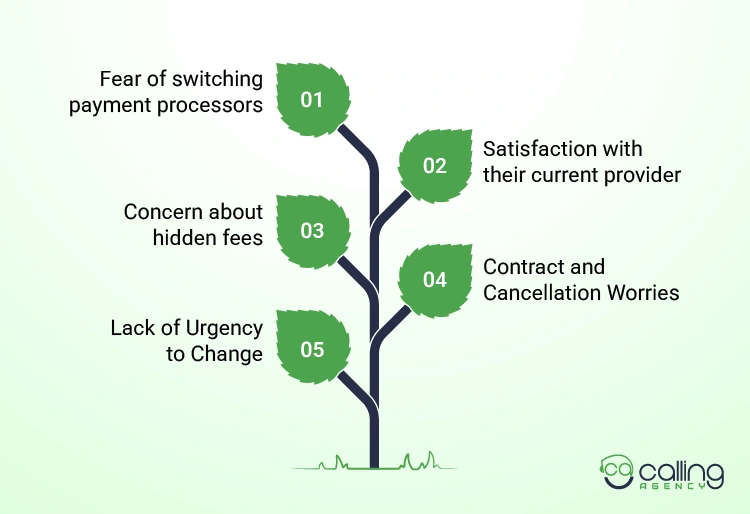
Fear of switching payment processors
Merchants often don’t want to switch their payment processing service because they think of some possible complexities such as operational disruption, losing customer data, losing sales due to payment processing failure, etc.
Satisfaction with their current provider
A potential customer may be happy with their existing provider if they are not having any issues with it. Some prospects may not be bothered and compare other services because they are too busy with their business.
Concern about hidden fees
Payment or credit card processing services may charge additional fees or surcharges, which they don’t disclose directly. Merchants often don’t want to switch to a new payment processing service because of these fees.
Contract and Cancellation Worries
Businesses often have concerns about contracts and cancellations with their existing payment providers. Some payment processors may charge early termination fees, include unfair termination clauses, or hold a merchant liable for chargebacks that occur several months later. These types of complexities make merchants hesitant to switch.
Lack of Urgency to Change
Some merchants may choose to stick with their existing provider even when they know there are other service providers who can offer better benefits. They just resist the change unless they experience an urgent issue.
The Most Common Merchant Services Objections
While working in sales, handling sales objections can be a regular part of your job. Here are some common objections you can most frequently receive from merchant service prospects. So you must be well-prepared to handle them:
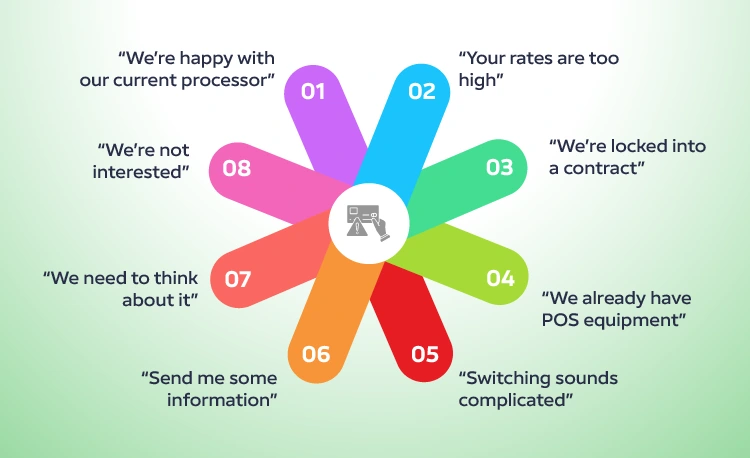
We’re happy with our current processor
After reaching out to a potential customer, when they respond: “We’re happy with our current processor. It means they don’t feel any need or are not even considering changing their current provider.
In this case, you shouldn’t try to change their mind or disapprove of their satisfaction.
Instead ask a follow up question so that you get the chance to review the overall cost and services of their current provider.
“What areas do you feel your current provider could improve?”
Then identify whether they are actually getting the value at the price say or is there anyway you can reframe their position.
Your rates are too high
When a prospect says, “Your rates are too high,” then it means you need to highlight how your credit card processing fees stand lower than their existing ones. Now, it doesn’t mean that you have to show them that your processing fees are lower.
Instead, you need to analyze their existing credit card processing service fees, including the surcharges, junk fees, and all other hidden fees. So that you can make a strong argument for why their headline prices don’t show the full scenario and how your service is the best for cost reduction.
Here is how you can response:
“I understand many of our clients have felt the same way. The reality is that many providers advertise low headline rates, but once you factor in surcharges, hidden fees, and other costs, the actual expense becomes clear. Would you be open to reviewing your last statement together so I can show you where the savings come in ?”
We don’t want to switch right now
Sometimes a lead might say, “We don’t want to switch right now.” In sales you will receive this type of objection very frequently and it is basically a timing objection where your prospect doesn’t feel the urgency to switch.
As a salesperson, you need to identify what is stopping them from making the change.
Here are common reasons why some leads delay switching providers:
- Waiting for contract renewal or fiscal year updates
- Avoiding the hassle of sudden disruption
- Lacking time to retrain staff and partners
To convert this type of lead, you need to first acknowledge their concern. Then, educate themselves about the cost of delay. What is the amount of money they are losing per transaction every month ? How much they can save if they decide early and how it can impact their ROI. So they can compare the cost of switching vs. the cost of non-switching.
We’re locked into a contract
When doing an outreach and getting a reply: “We’re locked into a contract,” it suggests they are positive about the change, but they feel trapped by certain conditions such as an unfair cancellation policy or early termination fees.
In this scenario, you can say that you have an expert legal team who can review their contract policy and help them to get out early. Then, try to prepare a special discount or offer that can offset the cost of early termination of their existing service. A prospect may get encouraged to switch early if they see a greater value out of it.
We already have POS equipment
In the merchant service market, there are several types of businesses who heavily rely on POS systems for accepting payment. Some of the prospects in these markets may hesitate to change their payment service provider, fearing that their POS equipment might fail.
This type of concern should be handled by sharing how you are going to support them with the integration and replacing of their equipment. It will reassure them that there will be no disruption to their payment accepting process.
Switching sounds complicated
Some leads can be too comfortable with their existing payment processing solution, and changing it can seem like a hassle to them. They can worry about operational downtime and disruption of their service.
To convert these leads, you need to reassure them that your customer service and technical support teams will guide them through the process. Explain how the migration will take place and how smooth it will be. Sharing an onboarding story or case study from another customer can also be very effective for converting them.
Send me some information
As a sales representative, you will often hear a prospect say, “Send me some information” or “just send me an email” especially when you are reaching out through cold calls. This response can come from a general curiosity, but in many cases a potential customer also uses it to avoid saying a direct “no.”
So you need to be very strategic in handling this response. First, you need to verify whether your prospect is really interested or just politely rejecting your offer.
Instead of sending a generic PDF that includes your company information and service packages, you can ask a clarifying question such as the following:
“Thank you for showing your interest. Could you tell me what type of information can be more useful for you? Like, should I give you more information about our fees, packages, or how we support clients during onboarding?”
It will signal your prospects that you are seeking genuine engagement. So if they don’t have any real interest, they will keep the conversation short. But if they show genuine interest. Then, try to identify their specific pain points, motivation, or reason for requesting information.
Customize your response based on their needs and pain points. Like, if you see that they are looking to reduce their transaction cost. Send them a customer testimonial or case study that shows how your solution helped reduce transaction costs and save money. You can also invite your lead to a quick call or demo to move the conversation forward.
We need to think about it
Another common objection you can often get from the prospects is “We need to think about it” or “let me think about it”. This objection can be frustrating when you are doing a lead follow-up. But this doesn’t mean you have to give up on your prospects because there can be the following reason behind this objection:
- They are not interested and are just stalling your offer instead of rejecting it directly
- They need someone else’s approval or something holding them back.
- They actually need more time and information to review your offer.
In this situation, you can ask some follow-up questions to know whether you should invest your time and energy on that prospect and for how long. Here are some example responses that can be useful for you:
Response 1:
“I completely understand. Do you want me to follow up again?”
This response will help you determine if your lead is serious or just simply stalling your offer because they have no interest.
Response 2:
“Of course, take your time. May I check up on you again by [specific date] if I don’t hear from you?”
This response is setting a clear deadline instead of leaving a conversation to uncertainty.
Response 3:
“I totally understand that you need time. Most of our clients take time to review our offer. But is there any way I can help, or do you need any specific information that can be useful for you to decide?”
This response makes you look like you are a polite salesperson who gives priority to their lead’s interest instead of trying to be pushy for making a sale.
We are not interested
Sales professionals often get the ‘not interested’ response when they follow up on a prospect for sales conversion. A potential customer of a credit card processing lead may say they are not interested. They can have this objection because of previous bad experience or they just simply don’t trust random follow-up calls.
However, if you get this response, it doesn’t mean you have to stop that conversation immediately. There is a way to handle this objection with a follow-up question like the following:
“I understand, but may I ask why you are not interested to hear about our service?”
But you must move on and take no further attempts to contact them if they respond in the following ways:
- They ask you to remove them from the list.
- They are completely satisfied with their current provider.
- They don’t want to switch at all.
As a salesperson, you may try to reframe the lead if they respond by saying
- It’s not a good time, or we don’t want to switch right now.
- Can you send me more information?
- We will get back to you if we feel interested in the future.
In this case, you can try to reframe or redirect their objection based on their concern. Like, if they ask now is not a good time, ask them what time they might be available for a follow-up again.
How To Overcome Merchant Services Objections Effectively?
Receiving an objection is very common in merchant services sales conversations. It is an essential skill of a sales representative to handle the objection of their prospects. Here are the effective techniques they must use to convert their potential customers:
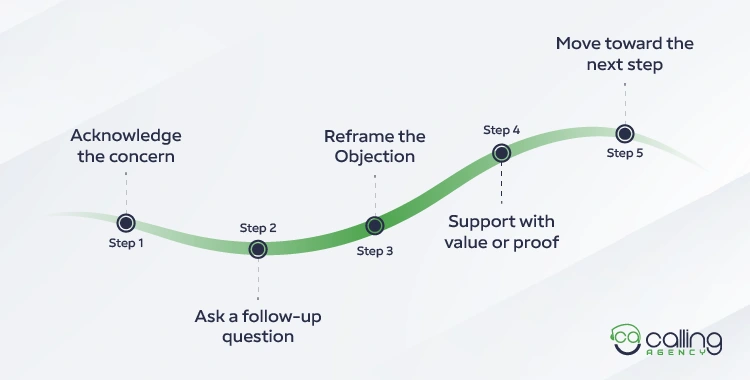
Step 1: Acknowledge the concern
As a sales person, you need to listen to the concern of your prospects and respond to them with empathy. Remember, building a rapport with your prospect is very first step of converting them and here is how you should do it:
Listen fully before responding: When having a conversation with a potential customer in direct conversation such as in cold call you must always let them finish first and then respond to them. It is not only a way of showing respect to them but also to prove that you are serious about listening to their problems.
Clarify the real concern: There can be a root cause behind the concerns of a prospect. It is your job to explore that cause and so that you can help them get rid of their fear.
Here is how you can respond to clarify their concerns:
“I understand that switching can feel complicated. But it sounds like your main concern is changing your existing equipment……….?”
Step 2: Ask a follow-up question
Behind the objection of a lead there is always a root cause or big issues which you need to identify for converting them. Asking an open ended question can help you with that.
For example, when a prospect says that they don’t want to switch because it sounds complicated.
You can say:
“Could you please tell me some other reasons that makes you worried about the migration process”
Or,
“I understand that you are concerned about a POS failure, but what makes you think so ?”
This technique is very useful for keeping the conversation alive and studying the mindset of your prospects.
Step 3: Reframe the Objection
Once you have clarified the concern of prospects, the next thing you need to do is to shift their perspective and provide a meaningful answer.
For example, if a prospect say:
“Your rates are much higher than my current provider…..”
As a response you can say:
“I understand. Many of our clients felt the same way until they reviewed the total costs with their previous provider.May I take a look at your monthly fees and per‑transaction processing costs so we can compare the full picture?”
When reframing objections, also remember to personalize your answers to their specific concern. It will increase your chance of conversation. In b2b sales conversation, personalized offers can increase the close rate by 20%.
Step 4: Support with value or proof
Let’s say you have personalized your answer to a potential customer. They are interested in taking your service but some of them might be still hesitant because they need proof.
So you need to clear that hesitation with a case study, success story or data that shows how you made a significant positive impact to another customer’s business when they switched to your service.
A study showed that 72% of customers say that positive reviews and customer testimonials increase their trust in a business.
Step 5: Move toward the next step
When giving proof of examples to your client, you should also highlight some clear benefits that your prospect will gain by migrating to your payment processing service.
A lead is more likely to convert if you can show them how your payment processing service is going to give them a greater value than what they are receiving from their current provider.
Here is an example of how you can summarize the major outcomes:
“Send instant notification to your customer while handling transactions without any third-part tools and reduce credit card processing cost by [X%]”
When an Objection Is Actually a Buying Signal?
In merchant services sales, objection doesn’t always mean that a prospect is not interested in the offer. Sometimes, an objection can also be buying a signal and as a sales professional you need to understand such signals.
Here are some common objections which often turn out to be a buying signal:
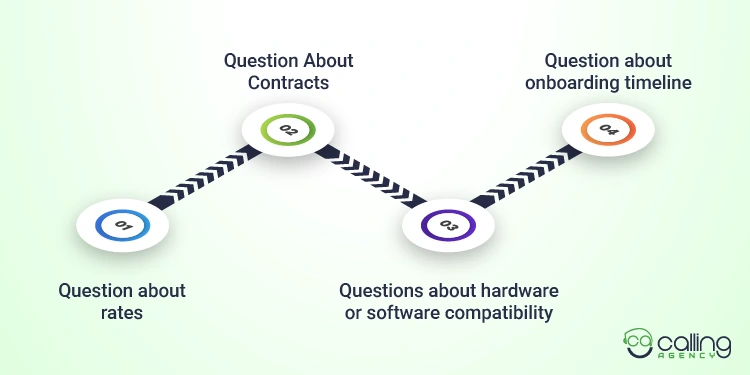
Question about rates
When a prospect questions the price or rates, it can suggest that they are reviewing the offer but concerned about the price. In this situation, you can respond like this way:
“I understand that you are concerned about the rates. But have you considered the overall cost you are paying with your current provider including hidden fees or surcharges?”
Question About Contracts
When a prospect asks a question about contracts such as “What is contract length?” or “Is there an early termination fee?” It can suggest that they are seriously reviewing the contract agreements.
In this case, provide clear and transparent information to them so that they can build trust in you and your company.
Questions about hardware or software compatibility
Merchant sales prospects often have a major concern about the hardware or software compatibility when they want to switch their payment service provider. They can ask questions like, “Do I need to change my POS?” or “Is your system PCI-DSS compliant?”
Now in this case, it shows that they are considering you as an option, but their biggest concern is that they don’t want any technical trouble. So you need to reassure them that your service will integrate with their existing equipment, accounting software, apps, or websites.
Question about onboarding timeline
Merchant service leads often hold back from switching their existing provider because of a lengthy merchant onboarding process. So if you receive a question about the onboarding timeline then it may be a sign that your prospect is getting close to deciding whether or not they should migrate to your solution.
Leads can usually ask the following question about onboarding timeline:
- “How long does the process take?”
- “How soon can I start accepting payments?”
- “What’s the average timeline for final approval?”
So if you receive questions like that try to be very specific with the timeline. Try to avoid any type of information gap in your answer because it can create a distrust between you and the prospect.
Objection Handling Framework for Merchant Services Sales
Before buying a service or product buyers always hesitate because they have some concerns. Sales professionals often use a structured or step-by-step process known as objection handling framework to address and overcome the common objection of their prospects.
Here are 3 common objection handling frameworks which can be effective for converting your leads:
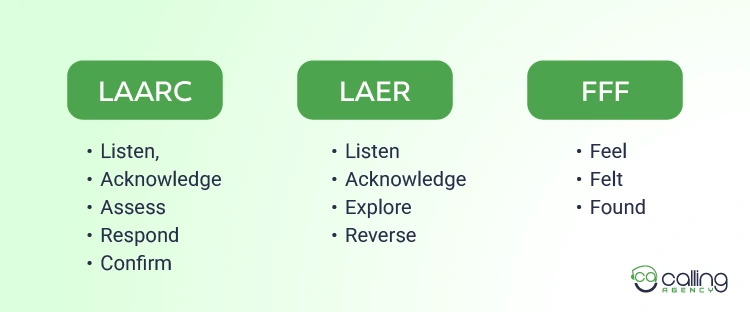
LAARC
The full form of this framework is Listen, Acknowledge, Assess, Respond and Confirm. In these techniques a sales representative actively listens to a prospect’s concern, then assesses the reason behind the concern and gives a meaningful answer to convert them.
Here is how it works:
Listen
Before responding to a prospect, listen about their problems with complete attention. Don’t try to interrupt their speech or change their mind. Identify their specific needs so that you can prepare a meaningful solution for them.
Acknowledge
After listening to your merchant lead concern, you need to acknowledge them. It means that you need to show them that you can understand their pain. Do this by showing empathy in the conversation or repeating what they have said.
For example, example you can respond saying:
“I know, you are looking for lower rates for card processing because pricing is the major concern for you now……..”
Assess
Once you have shown empathy for your potential customer’s concern, you need to assess it. A prospect may have a fear or concern that you can easily address. Like, if a lead is worried that they need to change their POS equipment, then you can say that there is no need for that.
Respond
You need to prepare a meaningful response after listening to your lead’s concern carefully. Remember, it is important to support your response with proof or data so that your potential customer can trust you.
For example, if a prospect says that:
“your rates are too high”
Then, you need to show them in calculation how your rates save their money compared to the hidden fees and monthly fees of their existing provider.
Confirm
After responding to the client’s concern with a meaningful answer you need to confirm if that satisfies them or is there any other concern they want you to address. This stage is important for sales professionals because it helps them to determine whether they can move forward with the prospect.
However, it is also important to understand that confirming doesn’t mean you have become successful in converting that lead. There are still some ongoing efforts you need to make such as scheduling a demo or sending any additional information to the prospect which they need to make a final decision.
LAER
This framework stands for Listen, Acknowledge, Explore and Respond. It is very similar to the LAARC framework but instead of assessing a solution here you need to explore the root cause of a prospect’s concern. The exploration steps in this framework include asking some open ended questions to potential customers. The goal of asking those questions is to explore your prospect’s concern as much as possible before you respond.
FFF (Feel, Felt, Found)
The ‘FFF’ or the ‘Feel, Felt, Found’ is a method where a sales representative tries to build an emotional connection with their prospect by showing empathy to their concern.
Here is how you can use this framework to convert your leads:
Feel
In this stage a sales professional acknowledges their lead’s concern with emotion. So that they know someone can understand their problems and connect to the way they feel about it.
Felt
It is a step where a sales person uses social proof to say that it is totally normal for the prospect to feel the way they are feeling about the problems. This is an effective way of building trust with a potential customer since they are more likely to listen to someone who can totally understand their situation.
In this step you can respond to the prospect that many of your other clients had similar feeling in the exact situation:
“I totally understand that you are satisfied with your existing payment processing system. Many of our clients felt the same when we outreached them.”
Found
In this step, you reframe their objection with a discovery or solution. The main goal of this step is to change the mindset of your prospect by sharing the other experience of yourself or other clients.
For example you can respond:
“When we showed them the hidden fees they were paying on credit card transactions, they realized the total amount they were actually giving to their provider beyond the standard charges.”
Final Thoughts
While working in sales, you will often receive many objections from your prospect. It is important to remember that you are not supposed to give up on a lead just because they have raised some concern.
It is an essential part of your role to identify the reason for their concern and handle them with effective techniques so that you can successfully close a deal.
However, it is also necessary to maintain a professional attitude while chasing a potential customer and know when you should move forward.
At the same time, you must also learn how to identify the objections which can be converted into sales opportunities and use the common sales objections handling frameworks to become successful in your sales attempt.
FAQ Section
What are the most common merchant service objections?
The most common merchant service objections are usually related to the time, price and need. The prospect can respond to their concern by saying: that the price is too high, they don’t have time, they have to think or they need more information etc.
How do you respond to merchant processing price objections?
In order to respond to price objections, you can request more information about the pricing, charges or fees of a merchant’s current provider. Then, you need to highlight the overall cost they are paying to their payment service and how the total cost of your service offers them the greater value.
How can I overcome “happy with current provider” objections?
Acknowledge the feeling of your prospect then try to gather more information about their current provider by asking a follow up question. Compare the price and overall cost of using their service and use what you have found with other clients to reframe their objection.
Why do businesses hesitate to switch payment processors?
Businesses hesitate to switch payment processors because they worry about possible payment handling disruption,equipment failure, cost of switching such as early cancellation cost,onboarding timeline and sometimes for the lack of urgency or need to switch payment processors.
What is the best way to handle merchant services contract objections?
The best way to handle a merchant’s objection is to listen to their concern completely before responding, asking follow-up questions to clarify their concern, showing empathy to establish emotional connection and using social proof to support your answer or solution to their concerns.