

Cold calling is highly efficient for a B2B sales team to connect with the right person or decision makers and ensure qualified leads.
But the main thing is strategically using it on time. When done properly, cold calling can provide a reliable number of meetings, pipeline growth, and new revenue.
We’re going to give you a good overview of actionable cold calling techniques that allow sales professionals to get better response rates and make more effective calls.
You will learn:
- How to research and target prospects correctly
- Best ways to start a cold call
- First 30 seconds: what to say
- Questions that keep conversations moving
- Proven methods for handling objections to cold calling
- Follow-up strategies and sales tools
What Are Cold Calling Techniques?
Well, the best cold calling technique is a structured sales process used to initiate conversations with prospects who have not previously engaged with your company.
In B2B criteria, the techniques are used to go from an absolute stranger in minutes to a qualified sales conversation.
Cold-calling now is not random dialing. It is a well-thought-out process that includes:
- Researching the type, size, and pain points of the company
- Crafting a strong 10-second opener
- Short outcome-based value proposition statement
- Customizing your qualification questions with business objectives
- Handling objections professionally
- Getting a crisp next step (a meeting, a demo, or follow-up)
In sectors such as SaaS, financial services, manufacturing, logistics, and commercial services, cold calling allows sales teams to contact decision-makers directly.
These techniques, when used in conjunction with CRM data and performance tracking, transform outbound calls into measurable pipeline generation activities versus guesswork.
Does Cold Calling Still Work?
Cold calling is still effective, especially in B2B sectors where high-commitment choices need dialogue.
Email open rates vary, and LinkedIn messages are frequently ignored, but phone calls produce instant two-way engagement.
That live give and take lets sales reps modify messaging dynamically.
Cold calling performs well when:
- Target accounts are clearly segmented
- Impressions is messaging, which highlights specific problems unique to the industry
- Consultative selling is taught to sales reps.
- Thus, they are determined to call blocks and track performance.
- Follow-up sequences support initial conversations.
In sectors like enterprise SaaS, commercial cleaning staffing, IT services, and financial advisory, outbound calling remains a fundamental pipeline driver.
A large percentage of booked meetings come from sales calls, not just digital avenues. In fact, many outbound teams indicate that most of their booked meetings come from cold calling rather than online only.
However, cold calling requires discipline. Buyers today expect relevance. They ignore generic pitches about saving time and money. It’s all about personalisation, confidence, and timing.
Cold calling still delivers qualified meetings, shorter sales cycles, and enables predictable revenue when combined with a multi-channel outbound strategy.
Current Research on Connect Rates and Pipeline Contribution
- Industry averages tell us that you can connect with your target customer 2%-5% of the time, and again, this will depend on data quality and targeting within the garage door industry.
- In enterprise-level sales, it can take 30-60 dials to find a direct decision-maker.
- 30%-50% of qualified meetings come via outbound calls.
- The average prospect monologue length in successful cold calls is only 3.5 seconds.
- 57% of C-level executives prefer to be contacted via phone rather than through other methods.
- 82% of buyers say they’ve accepted sales meetings after a connection that began with a cold call.
Imitate Industries Where Cold Calling Is Still a Major Channel
Cold calling is still one of the main sales channels in industries where trust, complexity, and deal size call for a conversation.
Key examples include:
- SaaS – Sales development reps cold call targeted accounts to schedule product demos and qualify enterprise buyers.
- Financial Services – Advisors offer personalized outreach for wealth management, lending, and insurance solutions.
- Real Estate – Agents make calls to property owners, investors, and expired listings for new opportunities.
- Commercial services – Cleaning, security, and facility management firms sell directly to businesses.
In these industries, purchase decisions are often made by a group of individuals with financial liability.
A live phone conversation enables you to qualify faster, handle objections, and build a relationship more quickly than simply digital outreach.
State When Cold Calling Underperforms
So cold calling is not successful without strategy and execution. Without any kind of structure, it can be inefficient and frustrating. So try to avoid these underperforming common mistakes and issues.
Common performance issues include:
- Poor-quality or outdated contact data
- Not industry or company size segmented
- Generic, benefit-heavy scripts without relevance
- Calling outside optimal business hours
- Lack of follow-up cadence
- Training for and review of calls is insufficient
Cold calling is also ineffective in low complexity, low-cost product markets where self-service purchasing models abound. Conversion rates and success rates drop if the value proposition is vague or the target market is too wide.
Without a discipline of targeting and consistent performance analysis, simply doesn’t work predictably.
4 Result Focused Core Cold Calling Techniques
To execute the cold calling campaign more efficiently, you have to follow some essential techniques.
This will help you in the long run to make the right decisions or generate and close more leads for your business.
There is structure behind the most effective cold calls, rather than luck. The best sales teams use repeatable techniques that improve connection rates and turn the meeting into an absolute must-have rather than a late-breaking or never-arriving second base.
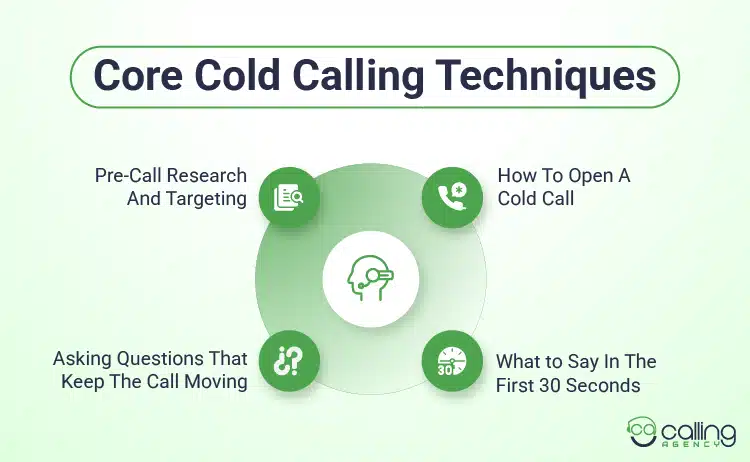
Core techniques include:
- Strategically targeting accounts based on industry and company size.
- Researching the decision-maker before dialing.
- Making a bold, succinct opening.
- Articulating a business-oriented value proposition.
- Asking relevant qualification questions.
- Listening actively and adapting.
- Securing a defined next step.
1. Pre-Call Research And Targeting
It is what separates a simple caller from the best of the best. Decision-makers in all B2B industries want it to be relevant. If you come off as unprepared, the call ends fast.
Before dialing, sales reps should:
- Research the company and recent news
- Understand the prospect’s responsibilities and role
- Understand industry-specific challenges
- Check LinkedIn for a professional background
- This time, look through your CRM notes for past interactions
Targeting is equally important. Target accounts that are part of your ideal customer profile (ICP).
SaaS companies, for instance, might focus on mid-market tech clients, and commercial cleaning providers might specialize in multi-location facilities. Precision improves connect-to-meeting ratios.
Knowing your research gives you a personalized opener, which lets you ask smarter questions. Even two minutes’ preparation can highly improve credibility.
What not to do:
- Never supreme call without knowing the prospect’s title
- Avoid the cliche phrases like, “I help companies grow.”
- Avoid lists of purchased email addresses without verification
- Segmentation by industry should not be skipped
- Never forget previous CRM activity
Preparedness makes cold calls business conversations rather than intrusions.
2. How to Open a Cold Call?
The first 10 seconds of the call will decide its fate. Your opener should be concise, confident, and respectful of time. The goal here is not to sound too robotic or excitable.
The best cold call openers are:
- Please state your name and the company you are with clearly
- Acknowledge that it is a cold call
- Seek short-term permission to proceed
- State a legitimate reason for why you are calling
Example (under 10 seconds):
“Hello Sarah, it is Alex from XYZ Solutions. “This is a cold call, 30 seconds to tell you why I’m calling?”
This path alleviates stress and cultivates confidence. It shows transparency and professionalism.
What not to do:
- Don’t say “How are you today? as your first line
- Avoid a cold call pitch for your products right away
- Do not speak too fast
- Do not apologize excessively
- Do not say unsure or sound nervous
A strong opener earns attention. Weak openers create resistance.
3. What to Say In The First 30 Seconds?
Once permission is granted, the following thirty seconds should focus on relevance and value. This is where a lot of sales reps go off the rails with overexplanation.
In the first 30 seconds:
- State why you are calling
- Mention who you typically help
- Reference a specific business outcome
- Ask a light qualification question
Example structure:
“We partner with mid-sized logistics companies in mitigating delivery delays through better transparency of routes. I see your company is growing regionally, and how are you managing route optimization today?”
It keeps the message about results, not features.
Your voice should be measured and consultative. The idea is to create prospect interest, but not give a full sales pitch.
What not to do:
- Do not list product features.
- Do NOT just speak for a FULL 30 seconds uninterrupted.
- Do not overwhelm with statistics.
- Do not sound scripted.
- Avoid asking for a meeting too soon.
- Clarity and brevity increase engagement.
4. Asking Questions That Keep The Call Moving
Strong cold callers are inquisitive and ask questions that move the conversation forward. They should train on pain points, decision processes, and urgency. And they need to feel organic or relatable to the industry.
Effective question types include:
- Problem-based: “What issues are you having with your current provider?”
- Process-oriented: “How would you go about this?”
- Impact-centric: “What is the effect of that on your operations or costs?”
- Decision-focused: “Who else is involved in evaluating solutions?”
Open-ended questions reveal budget authority and buying timelines, especially in SaaS and financial services.
Listen carefully. Take notes. Instead of sticking to a script, respond to what the prospect says. The more the prospect talks, the more qualified their opportunity is.
What not to do:
- Don’t only go for yes/no answers
- Do not interrogate rapidly
- Do not interrupt
- Do not ignore objections
- Never rush to pricing right away
Strategic questioning converts cold calls into real business conversations and raises your meeting conversion rates.
How to Use a Cold Calling Script Without Sounding Scripted?
In industries like SaaS, financial services, commercial cleaning, logistics, and IT services with B2B sales models, cold calling scripts provide you with consistency, think compliance, and messaging adjustment-oriented aspects.
But artificial sounds are a total turnoff to senior decision makers. You want your script to be more of a strategic guideline than a strict speech. It should clearly outline:
- Your opener and positioning.
- The industry-specific problem you solve.
- A quantifiable business outcome (reduction in Cost, efficiency gain, revenue growth).
- Qualification questions.
- Objection responses.
- A defined next step.
To avoid sounding robotic:
- Memorize the lines so that they are not memorized.
- Personalize examples by vertical or company size.
- Adjust tone based on the prospect’s energy level.
- Include any out-of-the-ordinary observations/insights.
For instance, within SaaS, you might mention operational efficiency, whereas with commercial services, you could talk about compliance or cost control.
The best sales teams create, practice, and refine their scripts through role-play on a regular basis, analyzing recorded calls for delivery.
The aim is to come across as an industry-informed advisor, not a telemarketer reading from a template.
Best Time to Make Cold Calls
Timing has a direct impact on connect rates and the quality of conversations. In B2B sales environments, getting to decision-makers depends on understanding their daily workflow.
Research across outbound sales teams has shown connect rates to be higher during:
- Before meetings start: 8:00 AM – 10:00 AM
- 4 PM – 6 PM (outside peak operational hours)
- The best days to cold call prospects are Wednesday and Thursday.
Pickup rates tend to be even lower around midday when there are internal meetings and workload peaks.
Industry context matters:
- Financial services professionals are often available at the crack of dawn before market activity kicks into high gear.
- High-level managers are usually available at the start of the day before meetings begin, while mid-level managers are more likely to be available post-lunch and during the latter part of the day.
- Operations and facility managers can pick up the phone calls before site duties begin for the day.
- Real estate agents tend to be more responsive later in the afternoon, it effective time to reach out to them.
- Testing different blocks of time by zones may be needed for SaaS executives.
Top inbound teams that manage outbound sales campaigns measure connect rates (hour, day, and industry segment).
Beyond randomized calling, data-driven dialing schedules consistently yield much better performance. Structured call blocks improve rep focus and productivity, as well.
How to Handle Objections on a Cold Call?
Objections are a part of the qualification process in Industry-focused B2B sales. They usually signal one of three potential problems – bad timing, unclear value, or weak urgency.
Handling objections in a professional manner is an exercise of organization:
- Acknowledge the concern respectfully
- Clarify the real issue
- Reposition the value proposition
- Confirm next steps
If a logistics company says, “We already have a provider,” the objective is not to debate. Instead, explore gaps:
“That makes sense. Realizing that, what areas are you currently trying to optimize cost, speed, or visibility?”
Budget objections in financial services may reflect risk concerns, not a lack of budget availability. In SaaS, “Not interested” often means not differentiated enough.
Sales teams need to keep track of common objections by industry and build frameworks for responding. Scheduled sessions for role-playing and auditing calls build confidence with regard to objections.
Handling objections effectively positively impacts meeting conversation rates and saves your brand’s reputation.
8 Most Common Cold Call Objections
Across B2B verticals, some objections rear their ugly heads repeatedly. By knowing their root cause, sales teams can respond strategically.
Common cold calling objections include:
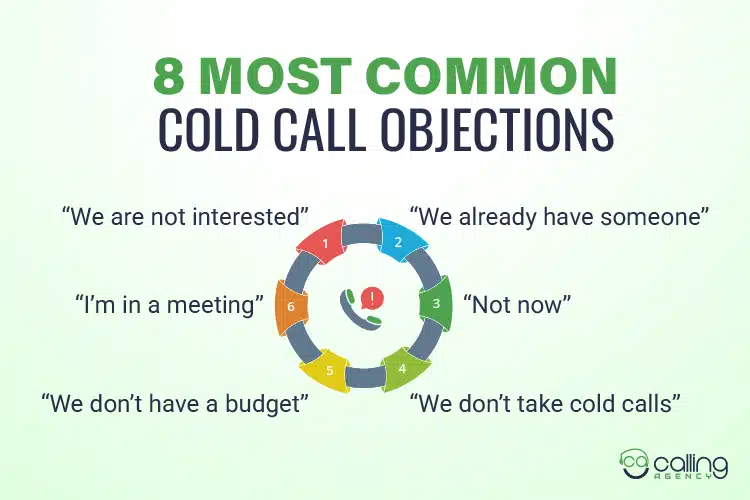
“We are not interested.”
This objection typically comes up early in a call, before you even have the prospect’s attention to explain why you’re calling. Our extensive guide on responding to the “We are not interested” cold call objection covers tried and tested response techniques.
“We already have someone.”
Prospects commonly say this when they already have a relationship with another provider. However, that does not always imply their complete satisfaction. Read more in our article on how to overcome the “we already have someone” cold call objection.
“Not now.”
This is a common response that indicates a timing issue, not an outright rejection. Most prospects just have other things on their plate right now. One of the things we talk about at great length when it comes to cold calls is working through the “not now” timing objection.
“We don’t take cold calls.”
Some companies do not even permit unsolicited sales outreach to preserve decision-makers’ time. There are still professional ways to respond, though, to the “we don’t take cold calls” objection.
“We don’t have a budget.”
This is commonly found at the stage in your process where they may exhibit a budget objection. More on this one here, handling the “No Budget” cold call objection.
“I’m in a meeting.”
This is more a sign that the prospect is busy at that moment than anything else. And the correct follow-up tactic, explained in this article, is to respond to the “I’m in a meeting” cold call objection.
In SaaS and IT services, “Send me information” is often a low engagement signal. Instead of just terminating the call, reps can ask a quick qualifying question to bring relevance back into the mix.
Regime bias is prevalent in commercial services such as cleaning or facility management. Unless performance problems are evident, companies are reluctant to change vendors.
Most budget objections in financial services are actually comments about uncertainty around ROI and not money to spend.
Handling objections effectively requires acknowledging the prospect’s concerns and providing thoughtful responses.
Personalizing your approach based on research about the prospect can significantly improve rapport and engagement.
The best sales teams first sort objections by type, such as timing, trust, value, or authority, and craft responses to reflect that. Preparation turns objections into exploration moments.
The Feel-Felt-Found Technique
The feel-felt-found method is common in B2B sales because it minimizes defensiveness while improving credibility.
It works best in industries where there is some risk associated with switching vendors.
It functions in three steps:
- Feel – Empathize with the prospect’s pain
- Felt – Demonstrate that others shared the same reluctance
- Found – the good thing you found out when you switched
Example in SaaS:
“I get your hesitation to stick with your current system. Many of our clients thought so as well before examining alternatives. What they discovered was a 20% decrease in processing time post-implementation.”
This works because it uses both empathy and social proof. Rather than debating, you validate the concern and offer evidence-based reassurance.
Feel-felt-found can build trust because it has an excellent impact when supported with actual case studies or metrics, and it serves to maintain the conversation.
Cold Call Follow-Up Techniques
In most B2B industries, you are not going to close a deal on the first call. Follow up call in a structured manner. That is what transforms initial interest into pipeline opportunities.
Effective follow-up includes:
- Sending a customized follow-up email within 24 hours
- Referencing specific challenges discussed
- Including one obvious call to action
- Before ending the call, schedule the next interaction
- Phone, cold email, and LinkedIn touchpoints combined
A follow-up email after a call with, say, a facility manager or sales manager could summarize cost concerns and suggest a 15-minute walkthrough discussion.
And SaaS, it might be a short case study relevant to the prospect’s industry.
Elite outbound teams often advantage 6-10 touchpoints via multiple channels before closing the loop.
Cold calls that include collaborative language are generally more likely to result in follow-up. It will help you to close more deals for your sales cycle.
It is important to ensure consistency, personalization, and relevance. So if you do, you’re held in higher value and can build a deeper relationship with them, ensuring that the opportunity isn’t lost over timing.
How to Structure a Post-Call Email
An email after the call may renew what you talked about and help maintain momentum in the sales process. A straightforward follow-up email keeps your message present and professional.
What should a good post-call e-mail include?
- A brief message expressing gratitude for the conversation
- A short recap of the prospect’s issues or objectives
- A refresh of the value your solution offers
- Any agreed next steps
- A clear call to action
For instance, if a facilities manager expressed that rising maintenance costs were a concern, the email should address this pain point and explain how your service reduces operational expenditure.
This demonstrates that you paid attention and absorbed what mattered most to them.
Make the email short and scannable. Decision-makers get bombarded with hundreds of messages every day, so clarity is key.
Skip long product features and descriptions and concentrate on every result, upgraded efficiency, reduced costs, and improved performance.
Including a short case study or a relevant resource added on can also go a long way to strengthen credibility.
When done correctly, a post-call email strengthens trust and increases your chances of closing the next meeting.
Cold Call Cadence: How Many Touchpoints to Make Before Giving Up
The cold call that works usually comes with an initial contact. So businesses cannot expect to trust them at the first touchpoint, just like your prospects will most likely require multiple different contact points before you can even get them to reply or book a meeting.
Having a process for outreach provides consistency in follow-up without bombarding the prospect.
Most outbound sales teams have a cadence. This usually includes:
- 6 to 10 total touchpoints
- A combination of phone calls, cold emails, and LinkedIn messages
- An extended outreach of two to three weeks
A typical class might go something like this:
- Day 1: Cold call + message
- Day 2: Call follow-up email
- Day 4: Second call attempt
- Day 7: LinkedIn connection request
- Day10: Another call and value-packed email
- Day 14: Final follow-up message
The trick is being present without overstaying your welcome with the prospect. Due to tight schedules, many of the decision-makers only respond to the third or fourth request.
By tracking response rates at every touchpoint, the cadence can be adjusted as it goes. It is often the discipline of consistent, professional persistence that makes the difference between successful outbound teams and those that quit too soon.
Tools That Support Cold Calling Execution
This is the reason modern cold calling is done with the help of technology to improve productivity and data accuracy.
Sales teams use dedicated tools to organize contacts, monitor performance, and facilitate outreach.
- CRM systems – Salesforce or other platforms track leads, calls, and follow-ups.
- Sales dialers – Power Dialers and auto-dialers for maximizing call efficiency.
- Sales intelligence platforms – Providers like ZoomInfo or Apollo that offer verified contact data and company insights.
- Call analytics software – record calls, analyze performance metrics.
- Tools for email automation – Have them manage follow-up sequences and track engagement.
These tools keep sales teams organized and allow them to track their results. For instance, call analytics can discover which opening lines drive more engagement.
Also, AI-powered tools can analyze data gathered during the cold-calling process to provide insights on the next steps, such as when to follow up with prospects.
Managing connect rates, meeting rates, and pipeline contribution is also made easier with CRM dashboards.
Using tools like LinkedIn Sales Navigator can help find target prospects and send personalized messages to engage with them.
Technology doesn’t replace strong communication, but helps with the execution.
These tools increase outreach sales processes, adaptability, and efficiency when combined with good training and strategy.
Final Words
Cold calling is still one of the most direct methods of having conversations with prospective customers.
In many B2B industries, it still produces qualified meetings and sets up predictable pipelines.
The key to success is preparation, clear and precise messaging, and strategic follow-up.
Sales professionals who research prospects or potential customers, open calls with confidence, ask relevant questions, and close objections well simply do better.
Technology and deliberate outreach cold calling strategies also contribute significantly. CRM systems, sales intelligence stations, and dialing tools help people manage outreach at scale while tracking progress.