


Wrong contact means a wasted call. Knowing who to contact when selling commercial insurance matters more than the pitch itself because each policy line has its own buyer inside a company. A CFO signs off on workers’ comp and large liability policies. An office or operations manager handles property and general liability.
An IT director now controls cyber insurance budgets. HR leads often own group benefits decisions. Call the wrong title and even a strong offer gets buried or forwarded into a black hole.
This guide breaks down exactly which decision-maker owns each commercial policy line so you can skip the gatekeepers and reach the person who actually approves the purchase.
Key Takeaways:
- Each commercial policy line has a distinct decision-maker, not one universal buyer
- CFOs and controllers typically approve workers’ comp and major liability policies
- Operations or office managers usually own property and general liability
- IT and security leaders now drive cyber insurance purchases
- HR often controls group benefits and employee-related coverage
- Matching outreach to the right title shortens sales cycles significantly
The Short Answer: Owns It, Signs It, Blocks It
There are three roles in every commercial insurance deal. There is one person who owns the policy daily, another signs off on budget, and a third quietly blocks approval in silence without even a title. Be certain of all three before you rely on a close.
- Owns It: responsible for managing the policy, tracking renewal date, and making day-to-day decisions about risk.
- Signs It: Has budgetary control and final authority over coverage binding.
- Blocks It: legal, compliance or finance staff who can delay approval without ever being on a call. A real decision maker controls the budget and does not have to get anybody else involved with approving a purchase.
You can verify this by inquiring who signs the renewal, or approves that budget line and reviews contracts before closing. The biggest reason that a deal that seemed closed can potentially fall apart is when they skip over any one role.
Company Size Sets the Structure Before Policy Line Does
A business’s size decides who you should approach, since a small company’s owner usually buys the policy directly while a midsize firm brings in a controller or CFO and a large company routes everything through a dedicated risk manager.
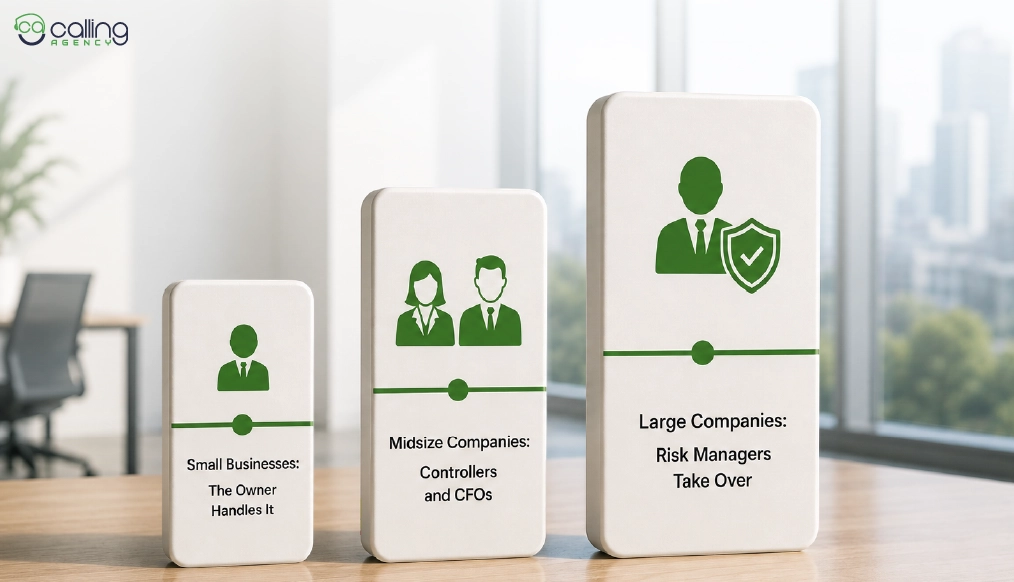
Small Businesses: The Owner Handles It
For companies under 10 million dollars in revenue, the owner acts as the risk manager and picks the policy directly, according to the Insurance Information Institute. The Small Business Administration also advises new owners to find a licensed agent who understands their specific risks, since no risk function exists to route through.
Midsize Companies: Controllers and CFOs
Once revenue crosses 10 million dollars, a controller, CFO or HR director usually owns the renewal file, but the CFO or president signs the broker of record letter. Controllers hold the paperwork but rarely make the final call.
Large Companies: Risk Managers Take Over
Companies above 100 million dollars in revenue employ staff dedicated to analyzing loss causes, recommending preventive steps and purchasing insurance, a role known as risk management, according to the Insurance Information Institute. The treasurer or CFO signs off, but only on the risk manager’s recommendation. Going over the risk manager’s head ends the account.
| Company Size | Owns the Renewal | Signs the BOR | Where to Start |
| Under $10M revenue | Owner, office manager, or bookkeeper | Owner or president | Call the owner. No risk function exists to route through. |
| $10M to $100M | Controller, CFO, or HR director | CFO or president | Call the CFO. Controllers hold the file but rarely the pen. |
| $100M and above | Dedicated risk manager | Treasurer or CFO, on the risk manager’s recommendation | Call the risk manager. Going over their head ends the account. |
The Decision-Maker Map by Policy Line
For most policy lines, the buyer is a functional owner (HR, safety, operations, IT) who manages the day-to-day risk, while the final signature comes from the CFO, owner, or CEO who controls the budget. Ask early who else needs to approve the renewal.
Who Owns Each Policy Line
The CFO sits in the middle of most renewals. They set the premium budget, weigh retention against transfer and sign once the numbers clear.
Workers’ comp looks operational, so HR or safety usually owns it. Program structure is a finance call. Guaranteed cost, large deductible and captive each tie up very different amounts of capital.
| Policy Line | Owns It | Signs It | Opening Question That Works |
| General Liability and BOP | Owner or office manager | Owner | Who handles your certificates of insurance when a client asks for one? |
| Workers’ Compensation | Safety director, HR director, or payroll manager | CFO or owner | Where does your experience mod sit right now? |
| Commercial Auto and Fleet | Fleet manager, dispatcher, or operations manager | CFO or owner | How many power units are on the policy today? |
| Commercial Property | Facilities manager or controller | CFO or owner | When were the building values last updated? |
| Cyber Liability | IT director, CISO, or compliance lead | CFO or general counsel | Does the current policy cover ransomware payments? |
| Group Health and Benefits | HR director or benefits manager | CFO or owner | What is the renewal date on the medical plan? |
| D&O and EPLI | General counsel or CFO | Board, CFO, or president | Has the board reviewed the D&O limits since the last raise? |
| Professional Liability and E&O | Practice lead or managing partner | Managing partner or owner | Do any client contracts require limits you do not carry? |
Key Stakeholders by Function

- Safety teams: focus on injury prevention and daily hazard control
- HR teams: manage employee relations, benefits enrollment and leave policies
- Risk managers: oversee claims handling and insurance renewals
- CFOs: control cash flow, capital allocation and final sign-off on premium spend
- Brokers: bring market knowledge of available structures and carrier options
Opening Question That Works
Ask this on the first call: “Who currently manages your [policy line] renewal, and who signs off once terms are set?” This question surfaces the real buying committee fast.
Why Titles Vary by Company Size
- Small Businesses: the owner often manages and signs every policy line
- Mid-Size Firms: a risk manager or HR director owns the relationship, finance signs the check
- Large Firms: separate owners exist per line (IT for cyber, legal for D&O), with CFO or board approval required
Confirm both the functional owner and the final signer before quoting any line.
The Person Who Blocks the Deal Is Rarely on Your List
The person who blocks a commercial insurance deal rarely sits in the meetings you attend. Legal, compliance, or a quiet finance stakeholder can stop approval even after the main buyer says yes. Map the full buying group early instead of trusting one contact alone.
Who Actually Blocks Approval
Hidden buyers are stakeholders who never engage with sales content directly, usually in finance, legal or procurement, yet their approval decides whether a deal closes.
Forrester’s State of Business Buying, 2026 puts the typical buying decision at 13 internal stakeholders plus 9 external influencers. The same research found procurement acting as a decision maker in 53% of business buying cycles.
The Role of the Gatekeeper
A B2B gatekeeper often controls access to the true decision maker and can quietly block renewals if trust is not built early. Once six or more stakeholders join a deal, close rates drop fast.
How to Avoid the Block
- Ask the champion who else reviews contracts
- Request a call with legal or compliance before finalizing terms
- Send short proof points that internal staff can forward without a pitch
Why the X-Date Outranks the Title
The X-date is the expiration date of a business’s current commercial policy, the point at which coverage comes up for renewal. It matters more than a contact’s job title because even the right decision-maker cannot act until that date arrives. Timing decides access, not authority.
What an X-Date Actually Is?
State law controls the notice window around that date. New York Insurance Law 3426 requires a nonrenewal or conditional renewal notice between 60 and 120 days before expiration. If that notice runs late, coverage stays in force until 60 days after it is mailed (New York Department of Financial Services).
Rhode Island sets the same 60-day floor for nonrenewal and for any premium increase above 10% under R.I. Gen. Laws 27-29-17.2 and 27-29-17.3.
Why Timing Beats Title
- A CFO with full signing power will rarely rewrite coverage mid-term
- An office manager near the X-date can start the renewal conversation
- In Massachusetts, workers’ comp nonrenewal notice is fixed by law at 10 days
- Working the account 45 to 60 days out reaches the buyer while quotes are still open
Where X-Date Data Comes From
| Source | What It Provides |
| Workers comp rating bureau filings | Public record renewal timing in many states |
| State insurance department rules | Legal notice periods before nonrenewal |
| NAIC model regulations | Baseline renewal notice standards states adopt |
How to Find an X-Date
Tracking that date across a few hundred accounts is the hard part. Three sources cover most of it: a certificate of insurance the prospect already sent one of their customers, state workers’ comp bureau records and a direct ask on the first call.
Building the date into your call cadence is what commercial insurance lead generation is actually for, especially when it is paired with custom list building to pull accurate renewal data by industry and region.
Three Questions That Confirm You Have the Right Person
Ask these before you put a producer’s hour on the calendar. Each one surfaces authority without challenging the person you are speaking to.
- When your policy was renewed last year, who signed off on it? This names the signer without asking for a title.
- Who pulls the loss runs when the broker asks for them? This names the owner.
- If you decided to look at another market, is that your call or does it go up the chain? This confirms authority and gives the person an easy way to say no without ending the call.
If the answers point somewhere else, ask for a warm introduction rather than starting over. A referral inside the account beats a fresh cold call to the same building.
Our own campaign data backs this: on the GAMS Group campaign, we booked 93 qualified commercial insurance appointments in 5 months at a 92% show rate.
Frequently Asked Questions
Who Is The Decision Maker For Commercial Insurance At A Small Business?
The owner is usually the decision maker at a small business. They manage the budget, sign contracts, and approve coverage changes without checking with anyone else, since most small businesses lack a dedicated risk manager or finance department.
Does The CFO Or The Risk Manager Buy Commercial Insurance?
Usually, the risk manager owns the policy and makes daily decisions on its implementation, while the CFO signs off on the budget as well as gives final approval. At smaller firms where there is no risk manager, the CFO or owner has responsibility for both roles directly.
Who Signs A Broker Of Record Letter?
The person with legal authority to bind the company signs a broker of record letter. This is usually the business owner, CEO, or CFO, since the letter formally changes who represents the company with insurance carriers.
Should I contact HR or the CFO for group benefits?
Contact HR first, since they manage plan design, enrollment, and vendor relationships daily. Loop in the CFO for budget approval and final sign-off, since group benefits usually need both functional and financial approval before changes happen.
How far before renewal should I contact a commercial insurance prospect?
Reach out to a prospect 45-60 days ahead of their X-date. This window captures buyers in the heart of their search process as they’re still comparing quotes, before an existing agent secures renewal terms or a business confirms its desire to remain.
Put the Map to Work
Knowing who to contact when selling commercial insurance saves time and closes more deals. Map the owner, the signer, and the potential blocker before pitching any policy line, and always track the X-date closely.
Once you know exactly who to reach, the right message matters just as much as the right contact. Use our commercial insurance cold calling scripts, cold email templates, and LinkedIn message templates to open conversations with the right stakeholder every time.
If you would rather have the meetings booked for you, our insurance appointment setting service handles outreach and qualification, so your team only shows up for calls with confirmed decision-makers.