



A sales pipeline for an IT services business is a step-by-step process that tracks every sales opportunity from the first contact to a signed contract. Unlike a standard B2B pipeline, it includes technical stages such as discovery, solution design, proof of concept (POC), architecture review, security checks and procurement because IT buyers evaluate technical expertise before making a purchase decision.
We have organized this article for IT services founders, sales leaders and technical co-founders who want to build a predictable sales process instead of relying on referrals. It explains pipeline stages for managed IT services, IT consulting, software development and enterprise projects, including exit criteria, key stakeholders, sales cycle benchmarks and pipeline metrics.
What Is a Sales Pipeline for an IT Services Business?
A sales pipeline for an IT services business is a stage-gated system that tracks every deal from first contact to signed contract. It maps the buyer’s evaluation process, not the seller’s activity list. For IT services, that means 11 to 12 stages, because IT buyers evaluate vendors technically before they commit commercially.
In IT services, a pipeline that mirrors the seller’s activity list instead of the buyer’s evaluation process produces accurate-looking data and misses deals at every stage.
A well-designed IT services sales pipeline does more than organize opportunities. It helps sales managers measure pipeline velocity, apply consistent qualification criteria and improve closing deals by ensuring every opportunity moves through clearly defined stages. It also gives leadership a more accurate way to forecast revenue and identify where deals are slowing down.
Most IT services companies manage their pipeline using CRM software, where sales managers can track lead nurturing activities, monitor buyer engagement and assign next steps. When the pipeline is built around well-defined buyer personas, every stage aligns with how different stakeholders evaluate technology vendors, making the sales process more predictable and easier to scale.
Throughout this article, deal and opportunity are used interchangeably to mean a qualified account in an active pipeline stage.
| Generic B2B pipeline | IT services pipeline | |
| Stage count | 5–7 | 11–12 |
| Buyer type | Single decision-maker | 4–7 stakeholders |
| Typical cycle | 15–45 days | 60–180+ days |
| Technical evaluation | None | Required |
| Procurement gate | Rare | Standard above mid-market |
| Stakeholder count | 1–2 | 4–7 |
Why Most IT Services Pipelines Break Down Before They Work
Most IT services pipelines are based on traditional B2B sales processes rather than the unique way that IT buyers evaluate and purchase services. Unlike transactional sales, IT services deals are highly technical or involve multiple stakeholders, procurement reviews and longer buying cycles, needing a specialized sales pipeline.
Why Generic B2B Pipelines Fail
A generic B2B pipeline is for a deal that closes in 30 days with one decision maker. IT services sales take 90 to 180 days, require four to seven stakeholders and include discovery, solution validation, procurement, and contract reviews. Consequently, a five-stage pipeline aimed at SaaS trial conversion would fail to accommodate managed services, consulting, or enterprise implementation business.
Pipeline breakdowns are mostly:
- No stage exit criteria – Opportunities go cold too quietly without any hard criteria that need to be met for the opportunity to advance.
- Single points of contact – The tech buyer is trying to engage with the economic buyer or others in the decision-making team, but they never end up getting involved.
- Discovery focused strictly on technical – Sellers answer technical questions without qualifying budget, authority, need, or timeframe.
- Unstructured POC (proof of concept) – Free, unscoped POCs draw additional delivery resources out in the field without a corresponding increase in purchase commitment.
- No pipeline math – Sales teams can not guess how much qualified pipeline is needed for revenue objectives.
- Poor lead source attribution – Referral, inbound, outbound and partner opportunities are all lumped in together without the ability to measure pipeline performance.
These pipeline issues make it difficult for sales management to forecast accurately and plan around revenue goals. Without structured qualification, lead tracking and stage progression, opportunities often remain inactive, qualified prospects become cold leads and sales teams struggle to move deals toward a successful deal close. Over time, this reduces forecasting accuracy and creates an inconsistent sales process.
A structured IT services pipeline also improves the overall customer experience by ensuring every opportunity receives consistent follow-up from lead capture through contract signing. Instead of allowing cold leads to accumulate or relying on guesswork, each stage has a defined purpose that helps identify stalled opportunities, re-engage cold leads and keep the pipeline aligned with long-term revenue goals.
Bottom Line: The pipeline for most IT services is a representation of seller activity rather than the buyer’s processes to arrive at a decision.
The IT Services Pipeline Stage Map
An IT services pipeline runs 12 stages from targeting and prospecting through implementation kickoff and handover. Not every deal hits every stage. MSPs managed service providers delivering IT infrastructure, security, or support under a recurring monthly contract typically skip RFP response, architecture review and full procurement onboarding. The table below shows all 12 stages with buyer action, seller action, exit criteria and typical duration.
What stages should an IT services pipeline have? The full architecture below is the reference map. Remove stages that don’t apply to your deal type. Don’t improvise new ones when a deal unexpectedly needs them; map them in advance.
| Stage | Buyer action | Seller action | Exit criteria | Typical duration |
| 1. Targeting and Prospecting | None yet | Define ICP and build a prospect list to enter the outreach sequence | Named contact at a qualified company in an active outreach sequence | Ongoing |
| 2. Initial Outreach and First Response | Responds to outreach; agrees to a conversation | Execute outreach sequence; handle first response | Discovery call booked and confirmed | 1–3 weeks outbound; 24–72 hrs inbound |
| 3. Discovery and Qualification | Describes current state, pain and timeline | Validate commercial fit using BANT | BANT (budget, authority, need, timeline) validated; technical discovery call booked | 1–2 calls over 1–2 weeks |
| 4. Technical Discovery | Discloses current environment, compliance constraints, integration requirements; signs NDA (non-disclosure agreement) if required | Demonstrate domain knowledge; confirm architectural fit; identify compliance requirements early | Current environment documented; NDA signed where required; key technical requirements confirmed; no architectural disqualifier identified | 1–3 calls over 1–3 weeks |
| 5. Solution Design and Scoping | Confirms scope reflects requirements | Produce proposed solution architecture and commercial scope | Scope document reviewed and acknowledged by technical buyer; pricing framework discussed | 1–3 weeks |
| 6. Proof of Concept or Pilot | Agrees to defined success criteria in writing | Structure POC as a bounded, time-boxed sales motion | Success criteria agreed in writing before POC starts; timeline and scope bounded | 2–6 weeks |
| 7. Formal Proposal or RFP Response | Issues RFP (request for proposal) or receives formal proposal | Run a bid/no-bid assessment before committing to an RFP response; respond with scoped commercial proposal tailored to the buyer’s pain | Proposal submitted; stakeholder review meeting scheduled | 1–3 weeks |
| 8. Architecture and Security Review | The security or IT architecture team evaluates vendor compliance | Return completed SIG/CAIQ (security questionnaire); surface no blocking gap | Security questionnaire returned; no blocking compliance gap identified | 1–4 weeks |
| 9. Procurement and Vendor Onboarding | Procurement initiates vendor registration | Complete vendor onboarding form; obtain supplier portal access | Onboarding form complete; supplier portal access granted | 1–3 weeks |
| 10. Legal and Contract Review | Legal team reviews contract documents and responds with redlines | Respond to redlines; confirm final contract version | Contract redlines resolved; both parties confirm final version for signature | 1–4 weeks |
| 11. Verbal Commitment | Economic buyer confirms intent to proceed | Initiate signature process | Verbal or written commitment from economic buyer on record; signature process initiated | 1–5 days |
| 12. Closed Won and Implementation Kickoff | Signs contract | Brief delivery team; book kickoff call | Signed contract on file; kickoff call booked; delivery team briefed |
For MSPs, Stage 10 typically involves a managed services agreement rather than a generic master service agreement (MSA) – the scope structure, SLA terms and termination conditions differ materially.
Deal shape – MSP recurring contract (anonymized): A 22-person managed services firm targeting SMB manufacturing clients. $88K ARR managed security and infrastructure contract.
Stakeholders: IT Manager (technical buyer), CFO (economic buyer), Operations Director (end user).
Cycle: 71 days.
The deal stalled at Stage 8 when the buyer’s security team requested a SOC 2 Type II report that the vendor had not completed. Front-loading the compliance question at Stage 4 would have surfaced the requirement 40 days earlier and prevented the Stage 8 delay.
Stage skipping by deal type:
- MSP recurring contracts: typically skip Stages 6, 8, and 9
- Small consulting engagements below threshold ACV (annual contract value): compress Stages 5–10 into a single proposal-and-sign motion
- Enterprise implementations and public-sector deals: include every stage
In practice, Stage 6 shows the largest variance between deal types. MSP deals rarely need a POC. Enterprise implementations almost always do.
Bottom line: Configure your CRM (customer relationship management tool) around the stages your deals actually hit; not all 12 apply to every deal type.
How to Set Exit Criteria for Every Stage
Exit criteria are the specific, verifiable conditions that must be met before a deal moves to the next stage of the sales pipeline. Without clear exit criteria, deals rarely appear stalled. They simply go cold without any visible warning. Every pipeline stage should include three exit conditions: what the buyer has done, what the seller knows and what the seller has confirmed.
Exit Criteria Examples by Pipeline Stage
| Stage | Exit Condition Type | Example |
| Discovery and Qualification | Buyer Action | Buyer has confirmed a named decision-maker and a timeline. |
| Discovery and Qualification | Information Gate | Seller has documented budget signal, authority level and urgency trigger. |
| Discovery and Qualification | Seller Action | Technical discovery call is booked. |
| Technical Discovery | Buyer Action | Buyer has shared current environment documentation. |
| Technical Discovery | Information Gate | Seller has confirmed no architectural disqualifier exists. |
| Technical Discovery | Seller Action | Solution scoping call is scheduled. |
| Formal Proposal | Buyer Action | Buyer has confirmed the proposal was reviewed by at least one decision-maker. |
| Formal Proposal | Information Gate | Seller knows who will attend the stakeholder review meeting. |
| Formal Proposal | Seller Action | Stakeholder review meeting is booked with a confirmed agenda. |
The Three Types of Exit Criteria
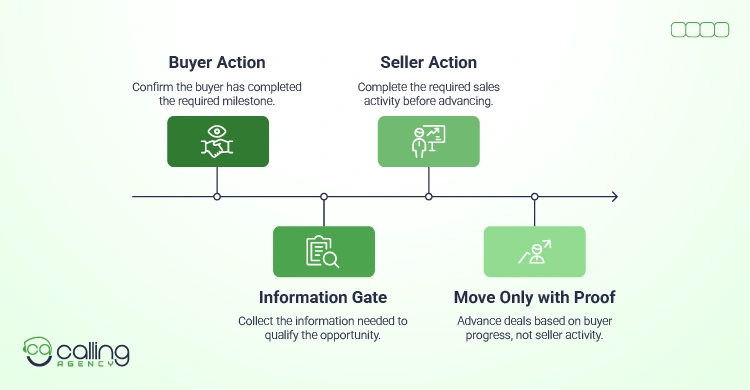
Every pipeline stage should include these three exit condition types:
- Buyer Action: What the buyer must complete before the opportunity advances.
- Information Gate: What the seller must know to be true about the opportunity.
- Seller Action: What the seller must complete or confirm before moving the deal forward.
The most common mistake is confusing seller activity with buyer progress. Sending a proposal is not an exit criterion. A valid exit criterion is when the buyer has reviewed the proposal and confirmed the next steps.
Bottom Line: A deal should advance only after the buyer has demonstrated measurable progress, not simply because the seller completed an activity.
Who Controls Each Stage? Understanding the IT Services Buying Committee
IT services deals are rarely controlled by a single decision-maker. Most opportunities above a defined contract value involve four to seven stakeholders, each influencing different stages of the buying process. While the technical buyer often leads discovery, the economic buyer typically approves the investment and procurement, legal and security teams influence the final purchasing decision.
Why Multi-Stakeholder Selling Matters
IT services buying is a committee-driven process rather than a single-person decision. Each stakeholder evaluates the solution from a different perspective, including technical fit, financial return, security, legal compliance and operational impact.
For this reason, multi-threading, maintaining active relationships with two or more stakeholders simultaneously, is the primary risk mitigation strategy for IT services deals above a defined ACV threshold. Never advance a deal beyond Stage 5 while relying on a single contact. If your only contact changes jobs, goes on leave, or lacks purchasing authority, the opportunity can quickly collapse and meetings with unclear stakeholder ownership are exactly where no-shows happen most often.
Stakeholder Roles in the IT Services Buying Committee
| Stakeholder | Stage Influence | Primary Concern | Common Objection | Recommended Engagement |
| IT Director / CTO | Stages 3–6 | Technical fit, integration complexity | “We could build this ourselves.” | Demonstrate technical fit through discovery and POC. |
| CFO / COO (Economic Buyer) | Stages 7, 11 | ROI, budget risk, payback period | “The timing isn’t right.” | Present a business case tied to the quantified cost of the current state. |
| Internal Champion | All Stages | Career risk of recommending the vendor | “I need more internal support before I can push this.” | Provide presentations, data and resources they can use internally. |
| Procurement | Stages 9–10 | Vendor compliance, contract terms | “You’re not on our approved vendor list.” | Begin vendor onboarding requirements early. |
| Legal | Stage 10 | Liability, IP ownership, data processing terms | “Our standard contract has 47 redlines.” | Start with your own agreement and prepare a redline-ready version. |
| Security / Compliance Lead | Stage 8 | SOC 2 (security compliance standard), data handling and access controls | “We need to complete a security review first.” | Return SIG/CAIQ promptly and have your SOC 2 Type II report available. |
| End Users | Stages 4–5 | Workflow disruption, ease of transition | “This will change how we work.” | Include them in technical discovery and address workflow concerns early. |
The most common reason IT services deals are lost is not that the technical buyer rejects the solution. Instead, opportunities fail because the economic buyer was never meaningfully engaged before the proposal stage.
Bottom Line: Winning complex IT services deals requires engaging the entire buying committee, not just the technical buyer.
How to Run a Technical Discovery Call for IT Services
An IT services technical discovery call should qualify both the commercial opportunity and the technical solution. While a commercial qualification confirms budget, authority, decision process and timeline, a technical qualification evaluates the buyer’s environment, integration requirements, compliance constraints, and architectural fit. Focusing on only one track creates an incomplete picture of the opportunity.
How Do You Qualify IT Services Leads?
Qualification happens during the discovery call, not before it. Every discovery meeting should run two qualification tracks simultaneously:
- Commercial qualification: Budget, authority, decision process, and timeline.
- Technical qualification: Current environment, integration requirements, compliance constraints, and architectural fit.
Many founders focus only on technical discussions and leave the meeting without understanding whether the opportunity is a genuine SQL or still just an MQL.
Technical Discovery Call Structure
Follow this framework during every discovery call:
- Pre-call research: Document the buyer’s current environment, known pain points, recent business news, and compliance requirements.
- Hypothesis-led opening: Share what you believe is true about the buyer’s challenges and invite them to correct or expand on it.
- Current environment mapping: Document the technology stack, integrations, team structure and technical constraints.
- Pain validation: Quantify the business impact of the current problem in revenue, time, or risk.
- Commercial qualification: Confirm BANT budget signal, authority level, decision process and timeline.
- Next-step commitment: End the meeting with a specific buyer commitment instead of a vague “we’ll be in touch.”
Example: Enterprise IT Services Discovery
A cloud infrastructure consultancy pursued a $375K Statement of Work (SOW) for cloud migration and managed operations with a mid-market financial services company. The buying committee included an IT Director, CISO, CFO, procurement lead, legal counsel and project sponsor. The opportunity progressed through a 141-day sales cycle and the proof of concept (POC) met its written success criteria while securing support from an internal champion.
The deal almost failed during Stage 9 because procurement requested vendor onboarding documentation that had not been prepared. This requirement should have been identified during Stage 4 and started alongside Stage 5 solution scoping instead of waiting for procurement to introduce it later.
Applying MEDDPIC to IT Services Discovery
| MEDDPIC Component | IT Services Definition | Example Discovery Question |
| Metrics | Quantify the business impact of the current state in revenue, time, or risk. TCO (total cost of ownership) can also compare the cost of maintaining the current approach with the cost of switching. | “What does this problem cost your business each month if it isn’t solved?” |
| Economic Buyer | CFO, COO, or CEO not the IT Director. | “Who approves a contract at this value?” |
| Decision Criteria | Technical and commercial requirements the solution must satisfy. | “What capabilities must the ideal solution provide that your current approach doesn’t?” |
| Decision Process | Internal approval process from verbal agreement to signed contract. | “What needs to happen internally before you can move forward?” |
| Identify Pain | The business impact of the problem rather than the technical symptom. | “What happens if this issue isn’t resolved within the next 90 days?” |
| Champion | Internal advocate who promotes your solution to decision-makers. | “Who else should be involved in evaluating this solution?” |
| Paper Process | Procurement, legal and compliance activities between approval and signature. | “How did your last IT services purchase move through procurement?” |
| Competition | Alternative vendors or the build-versus-buy option. | “Are you evaluating other vendors or considering building this internally?” |
Bottom Line: Within the first ten minutes of a technical discovery call, you should know whether the opportunity is worth pursuing. If the buyer cannot quantify the cost of their current problem, they have not created enough internal urgency. Do not advance the opportunity to solution scoping until they can.
When to Offer a Proof of Concept (POC) – and Whether to Charge for It
Offer a Proof of Concept (POC) when the annual contract value (ACV) justifies the delivery investment, the economic buyer is actively involved, and written success criteria can be agreed upon before the POC begins. A POC without defined success criteria is not a sales qualification step; it is unpaid consulting.
When Should You Offer a Free Proof of Concept?
Four conditions determine whether a POC makes sense. Getting any one of them wrong can turn a sales opportunity into a cost centre.
When a POC Makes Sense
| Condition | Offer POC | Skip POC |
| ACV above threshold | Yes | ACV too low, move directly to a proposal. |
| Economic buyer present and engaged | Yes | An economic buyer not engaged qualifies first. |
| Success criteria can be defined in writing | Yes | Cannot define success criteria. POC is premature. |
| Procurement timeline allows | Yes | The timeline is too short to move toward a buying decision without a POC. |
| Competitive pressure | Yes, with clearly bounded terms | The buyer is using the POC to delay the decision close instead. |
Free POC vs. Paid POC
| Free POC | Paid POC | |
| When appropriate | Below the ACV threshold when competitive pressure requires it | Above the ACV threshold when the POC requires a significant delivery effort |
| Risk to the seller | High resources are consumed without a committed purchase | Lower cost is partially recovered, and the buyer has committed to the budget |
| Qualification signal | Weak – the buyer has little investment in the evaluation | Strong – the buyer has committed resources to the process |
| Scope requirement | Must be clearly defined in writing | Must be clearly defined in writing and used as the basis for pricing |
| Success criteria | Mandatory – no criteria, no POC | Mandatory – success criteria become the evaluation standard |
A free POC without written success criteria is one of the most expensive sales activities an IT services company can run. It consumes delivery resources, delays other qualified opportunities, and gives buyers a no-cost way to postpone a purchasing decision indefinitely.
How to Structure a POC as a Sales Motion
Treat every POC as a qualification stage rather than a delivery project:
- Define success criteria jointly and document them before the POC begins.
- Scope the POC as a time-boxed engagement with a fixed duration and a clearly defined deliverable.
- Schedule a milestone review meeting during the POC, not after it – to evaluate progress and determine the next buying step.
- Track buying signals and stalling signals throughout the engagement to qualify the opportunity continuously.
Bottom Line: A POC without written success criteria agreed before it starts is not a sales motion. It is unpaid consulting with an optional outcome.
Sales Cycle Benchmarks by IT Services Type
IT services sales cycles vary sharply by deal type, deal size, and number of stakeholders involved. Complex B2B technology purchases now involve considerably larger buying groups than they did a decade ago. Forrester’s 2026 buyer survey puts the average buying decision at 13 internal stakeholders plus 9 external influencers, rising further for complex or strategic purchases. Deal complexity compounds this: Forrester also reports that 86% of B2B purchases stall at some point in the buying process.
| Service type | Typical cycle | Typical ACV | Stakeholders | Stage where most deals won or lost | Primary deal killer |
| MSP recurring revenue | 30–90 days | $60K–$180K ARR (annual recurring revenue) | 2–4 | Technical discovery (Stage 4) | Architectural disqualifier identified too late |
| IT consulting project | 45–120 days | $40K–$250K | 3–5 | Solution design and proposal (Stages 5–7) | Scope not locked before pricing; margin lost at proposal |
| Enterprise implementation | 90–180+ days | $200K–$1M+ | 5–9 | Security and procurement (Stages 8–9) | Vendor onboarding or compliance review blocks or kills the deal |
| IT staffing and resource augmentation | 14–45 days | $80K–$200K ARR | 2–3 | Discovery and qualification (Stage 3) | Rate mismatch or no existing headcount approval |
MSP Recurring Revenue Contracts
MSP deals close fast, but the security qualification gap kills late-stage deals. Front-loading Stage 8 compliance requirements into Stage 4 is the structural change that most regularly improves MSP close rates. The SOC 2 Type II review should be surfaced at technical discovery, not triggered by procurement at Stage 9.
IT Consulting Project Deals
Scope lock is the margin protection mechanism for IT consulting deals. Sellers who allow verbal scope expansion in Stage 5 routinely find those expansions reappear as contractual obligations at Stage 10. Lock scope before pricing. Confirm it in writing before the proposal leaves.
Enterprise Implementation Deals
Enterprise IT implementations are not slow because of seller inefficiency. They are slow because procurement, legal and security operate on independent review cycles. Plan Stages 8 through 10 as parallel tracks, not a sequential queue. Engaging procurement at Stage 7 instead of Stage 9 typically removes two to three weeks from the cycle.
IT Staffing and Resource Augmentation
Headcount approval is a binary qualifier for IT staffing deals. A hiring manager without budget authority cannot advance a deal past Stage 3 regardless of expressed urgency. Confirm the approved headcount exists before the first discovery call. If it doesn’t, park the deal until it does.
Bottom line: Your b2b sales cycle benchmark is only useful if segmented by deal type. A blended average hides the variance that drives pipeline decisions.
Pipeline Coverage Ratios for IT Services Win Rates
Pipeline coverage is the total qualified pipeline value divided by the revenue target. Generic sales advice says maintain three times coverage, a rule of thumb that assumes a generalized close rate of about 33% and applies a top-down weighting of 33% to the pipeline by construction. For IT services, the right multiplier depends on your win rate, which ranges from 15% for competitive RFP responses to 40% for direct engagement managed services deals. Use your actual win rate, not an industry default.
How much pipeline do I need to hit my revenue target? The formula is simple. The inputs have to be specific to your deal type.
Pipeline coverage formula:
- Definition: total qualified pipeline value ÷ revenue target = coverage ratio
- Formula: revenue target ÷ win rate = pipeline required
- Worked example: $1M revenue target ÷ 25% win rate = $4M qualified pipeline required
Win rate to pipeline coverage (against a $1M revenue target):
| Win rate | Pipeline required | Coverage ratio |
| 15% | $6.7M | 6.7x |
| 20% | $5.0M | 5.0x |
| 25% | $4.0M | 4.0x |
| 30% | $3.3M | 3.3x |
| 40% | $2.5M | 2.5x |
If your IT services’ win rate is 25%, you need four dollars of qualified pipeline for every one dollar of revenue target. The three-times-coverage rule assumes a 33% win rate. If your win rate is lower, common for competitive RFP deals, the coverage requirement is higher, not the same.
Stage-weighted pipeline applies a probability adjustment to each deal based on its current stage. The result is a probability-adjusted figure that reflects true forecast coverage more accurately than raw pipeline value alone.
| Pipeline stage | Stage name | Probability weight |
| Stage 3 | Discovery and Qualification | 15% |
| Stage 5 | Solution Design and Scoping | 30% |
| Stage 7 | Formal Proposal | 50% |
| Stage 10 | Legal and Contract Review | 85% |
A $500K deal at Stage 5 contributes $150K to your probability-adjusted pipeline, not $500K. Coverage ratios calculated on unweighted pipeline values regularly overstate forecast accuracy and produce missed quarters.
Bottom line: The three-times-coverage rule assumes a 33% win rate. If your IT services’ win rate is 20%, you need five times pipeline coverage, not three.
CRM and Tooling Setup for Your IT Services Pipeline
The best CRM for an IT services business is the one that supports your sales process, not the one with the most features. Build your pipeline architecture first, then configure your CRM to enforce it. Setting up a CRM before defining your pipeline stages and exit criteria causes the software to reinforce the wrong workflow from day one.
What CRM Should an IT Services Company Use?
The CRM platform matters less than its configuration. A correctly configured mid-market CRM outperforms a poorly configured enterprise platform on pipeline visibility every time.
Before selecting or configuring a CRM, establish your sales process in the following order:
- Define your ideal customer profile (ICP): Identify company size, industry, geography, technology stack, and minimum annual contract value (ACV).
- Build your pipeline stage map: Determine which of the 12 sales pipeline stages apply to your managed services, consulting, or implementation deals.
- Define exit criteria: Create the required fields and stage-gate conditions that every opportunity must satisfy before moving to the next stage.
- Configure the CRM: Use the CRM to enforce your stage map and exit criteria instead of relying on the vendor’s default pipeline template.
CRM Features Every IT Services Business Should Prioritize
| CRM Capability | Why It Matters for IT Services |
| Multi-contact deal management | IT services deals typically involve four to seven stakeholders. Single-contact records reduce visibility when contacts change roles. |
| Configurable stage gating with required fields | Prevents opportunities from advancing before buyer actions and exit criteria are confirmed. |
| Deal aging alerts | Identifies opportunities that remain in one stage beyond an acceptable timeframe, helping detect stalled deals early. |
| Document tracking (Proposal, SOW, Contract) | Tracks whether key documents have been sent, opened and reviewed not simply delivered. |
| Pipeline reporting by stage | Reveals stage-by-stage conversion rates and identifies where opportunities regularly stall. |
| Mobile access | Enables sales teams to update opportunities between meetings, improving CRM adoption and data quality. |
| PSA integration (ConnectWise, Autotask, HaloPSA) | Synchronizes CRM and service delivery data, ensuring visibility from opportunity management through implementation handover. |
Bottom Line: Process first. CRM second. A CRM should support your pipeline, not define it. Build your stage map and exit criteria before configuring the system so your CRM reinforces the right sales workflow from the start.
How to Move from Referral-Dependent to Pipeline-Driven Revenue
The best way to reduce dependence on referrals is not to replace them but to turn them into a measurable sales process. IT services companies make this transition in three phases: document what makes referrals happen, systematize the referral process and build an outbound pipeline alongside it.
How Do You Stop Relying on Referrals for IT Sales?
Referral revenue should remain part of your growth strategy, but it should not be your only source of opportunities. Instead of treating referrals as unpredictable wins, treat them as a tracked pipeline stage with measurable activities, conversion rates and follow-up processes.
Why Referral Revenue Is a Risk
Referral-driven growth creates three business risks:
- Timing risk: Referrals arrive on the referral source’s schedule, not yours.
- Ceiling risk: Referral volume is limited by the size of your existing network.
- Relationship concentration risk: Losing one referral partner can remove an important revenue source without warning.
The Three-Phase Transition Model
- Phase 1 – Document the referral engine: Identify who refers business to you, what types of opportunities they send and why clients recommend your company. Use these insights to refine your Ideal Customer Profile (ICP).
- Phase 2 – Systematize the referral ask: Make referral requests a repeatable sales activity with a defined cadence, measurable conversion rate and dedicated pipeline stage instead of relying on occasional client conversations.
- Phase 3 – Build your first outbound channel: Run outbound prospecting alongside referrals. For many IT services companies, warm LinkedIn outreach to former colleagues, existing customers and industry contacts produces the first non-referral pipeline opportunities. Warm outbound typically performs better than list-based cold email while requiring little additional tooling.
The referral ask is one of the most underused sales motions in IT services. Most founders ask for referrals only when they remember. Standardize the process first, then expand outbound prospecting in parallel.
Referral revenue alone was never designed to scale. Companies that regularly grow beyond their referral network treat referrals as a measurable pipeline stage rather than a fortunate outcome.
What a Healthy Pipeline Looks Like
| Milestone | Month 6 | Month 18 |
| Pipeline Source | First qualified non-referral opportunities enter the pipeline. | Outbound channels generate 30–50% of total pipeline. |
| Tracking | Referral opportunities are managed as a formal pipeline stage. | Referral-to-pipeline conversion rates are measurable. |
| CRM Status | CRM contains at least 60 days of pipeline history. | Stage conversion rates provide actionable sales insights. |
| Forecasting | First pipeline-generated deals are progressing. | Forecast accuracy improves quarter over quarter. |
Bottom Line: The referral ask is the most underused sales motion in IT services. Turn it into a tracked pipeline stage with a defined cadence and measurable close rate, then build outbound channels alongside it to create predictable, scalable revenue.
Pipeline Metrics That Matter for IT Services Companies
Six metrics tell you whether your IT services pipeline is healthy: lead velocity rate, stage conversion rate, average sales cycle length, win rate segmented by source and deal type, deal aging and forecast accuracy. Lead velocity rate is the only leading indicator. Every other metric tells you what already happened.
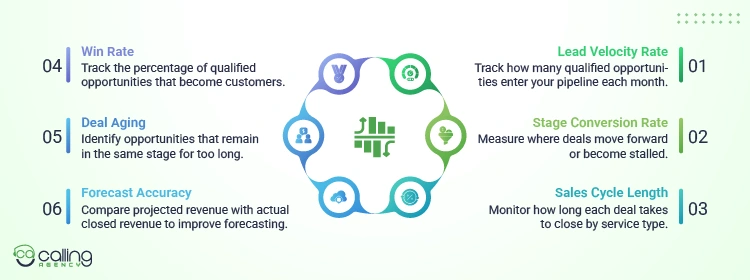
Pipeline hygiene, consistent data entry, dead deal removal, and stage exit enforcement are a prerequisite for all six metrics below. Deal aging and stage conversion rates are meaningless if reps advance pipeline stages without completing exit criteria or leave dead deals open in the CRM.
| Metric | What it measures | Leading or lagging | Review cadence |
| Lead velocity rate (LVR) | Month-over-month growth in qualified opportunities entering the pipeline | Leading | Weekly |
| Stage conversion rate | Percentage of deals exiting each stage vs. stalling identifies bottleneck stages | Lagging | Monthly |
| Average sales cycle length | Days from Stage 2 to Stage 12 segmented by deal type | Lagging | Monthly |
| Win rate (segmented) | Percentage of qualified opportunities closed won by source, deal type and deal size | Lagging | Quarterly |
| Deal aging | Days a deal has sat in a stage without a confirmed next step | Lagging (with leading signal at deal level) | Weekly |
| Forecast accuracy | Variance between the pipeline-weighted forecast and the actual closed revenue | Lagging | Monthly |
Sales velocity formula:
Sales velocity = (Number of deals × Average deal size × Win rate) ÷ Sales cycle length
Sales velocity tells you whether your pipeline is getting faster or slower at producing revenue. Track it monthly. Segment by deal type.
Bottom line: Lead velocity rate is the only leading indicator in the set. Every other metric tells you what already happened.
Frequently Asked Questions
What are the stages of an IT services sales pipeline?
An IT services pipeline runs 12 stages from Targeting and Prospecting through Closed Won and Implementation Kickoff Handover. Not every deal hits every stage. MSP recurring contracts typically skip RFP response, architecture review and procurement onboarding. Each stage should have defined exit criteria before it is added to a CRM.
How long is the sales cycle for IT services?
MSP recurring revenue deals typically close in 30 to 90 days. IT consulting project deals run 45 to 120 days. Enterprise implementation deals run 90 to 180 days or more. The POC or pilot stage adds two to six weeks regardless of deal type. Sales cycle length varies significantly by ACV and stakeholder count.
What CRM should an IT services company use?
Select on four criteria: multi-contact deal management, configurable stage gating with exit criteria enforcement, deal aging alerts and document tracking for proposals, SOWs and contracts. MSPs should verify PSA (professional services automation) integration compatibility. ConnectWise, Autotask and HaloPSA are the most common. CRM configuration matters more than CRM choice. A correctly configured mid-market tool produces better pipeline visibility than a misconfigured enterprise platform.
When should you offer a proof of concept in IT services sales?
Offer a POC when the deal ACV justifies the delivery investment, the economic buyer is present and engaged and success criteria can be defined in writing before the POC starts. Structure every POC or pilot as a time-boxed engagement with a bounded scope and a defined deliverable. Charge for POCs above a defined scope threshold.
What is MEDDPIC and how does it apply to IT services?
MEDDPIC (Metrics, Economic Buyer, Decision Criteria, Decision Process, Identify Pain, Champion, Paper Process, Competition) is a deal qualification framework. In IT services, metrics are the quantified cost of the current state. TCO (total cost of ownership) framing works well here. Economic Buyer is the CFO or COO, not the IT Director. Paper Process maps directly to Stages 9 and 10: procurement onboarding and contract review.
How do you qualify leads for an IT services business?
Use BANT (Budget, Authority, Need, Timeline) as a first-pass filter in discovery, then MEDDPIC for deal-level qualification. IT services-specific disqualifiers include no economic buyer access, unrealistic implementation timeline, compliance requirements the vendor cannot meet, or a scope need below the vendor’s minimum engagement threshold.
How do you build a sales pipeline when you have no sales team?
Start with the founder or technical lead running pipeline activities directly. Build the stage map and exit criteria before hiring so the first sales hire inherits a functioning system, not a blank CRM. Most IT services firms that hire sales before building the process end up rebuilding both. Pipeline architecture takes three to four weeks. Hiring takes three to four months.
What pipeline metrics should an IT services company track first?
Start with three: lead velocity rate (qualified opportunities entering the pipeline month over month), stage conversion rate (where deals stall or exit) and average sales cycle length by deal type. These three metrics reveal pipeline health, stage bottlenecks and forecast accuracy simultaneously. Add the win rate segmented by source once the pipeline has 90 days of history.