



Healthcare staffing agencies secure facility contracts by finding out the right contract. Then they approach the facility with the staff needed for them and fulfil contract requirements. The exact process depends on the state rules, the facility type and the overall purchasing system.
Each area has its own unique set of rules. Confirm them thoroughly before you sign any contract. Healthcare staffing agencies looking to establish a consistent workflow can also use B2B healthcare lead generation services to find facilities, reach decision-makers and create qualified sales opportunities.
Through this guide, you’ll get an idea of how healthcare staffing agencies can find the right facilities, reach contract signers, understand state licensing rules, prepare required documents and turn staffing opportunities into contracts. It is perfectly suitable for owners of new and growing healthcare staffing agencies and stakeholders.
Which Facility Type Should a New Agency Target First?
Carefully select the facility type where you think you can fill shifts in the shortest amount of time. Nursing homes, hospitals and Department of Veterans Affairs (VA) medical centers have their own rules and regulations for connecting with healthcare staffing agencies. Also, their needs or requirements are different.
For example:
- Nursing homes may need Certified Nursing Assistants (CNA), Licensed Practical Nurses (LPN), etc. for open shifts.
- A hospital’s requirements might be several clinical roles across different departments.
- In home health agencies, they may need staff based on their patient visits and schedules.
Begin with the one facility type that matches your right now available healthcare professionals. Additionally, choose the facility type keeping in mind where your agency can fill shifts reliably.
State rules have an impact on billing and contract terms. To have a clear idea of this, we can take Minnesota, for example. Minnesota has restrictions on what staffing agencies can charge for nursing homes to hire temporary staff. The limit is based on the average wage plus payroll taxes. This rule applies to nursing homes, including skilled nursing facilities, but not hospitals.
If we think about another state, Massachusetts also sets certain limitations on maximum hourly rates for agency nurses. The rates change by area and shift time. Some shifts, such as holidays and travel assignments, may have higher limits.
| Facility type | How it may buy staff | Common opportunity source |
| Nursing home or Skilled Nursing Facility (SNF) | Direct staffing requests | Facility outreach |
| Hospital | Direct buying or Managed Service Provider (MSP) | MSP or supplier network |
| Home health agency | Staff by visit or schedule | Direct outreach |
| VA medical center | Federal purchasing | SAM.gov and Veterans Affairs (VA) programs |
After you finalize the right facility type, the next step would be to prepare the required documents buyers might request.
What You Need Before a Facility Can Sign
You need to have your necessary compliance documents, such as your state license or registration, a full bill rate schedule and clinician credentials ready before any serious sales outreach. If the conversation runs toward a positive outcome, then the healthcare organization will ask for these basic documents first. So, if you can’t provide these documents on time, then it would create a difficult impression to continue with the contract discussion.
The facility of the organization may also ask for background checks, Office of Inspector General (OIG) screening and training certificates. But this required information depends on the facility, role and contract type.
Example:
“Before we talk about staffing, would you mind sharing what credentialing requirements you currently have?”
This question can help you understand what the buyer expects before you submit a proposal.
Before you pitch any facility, here’s a pre-pitch document checklist you should consider:
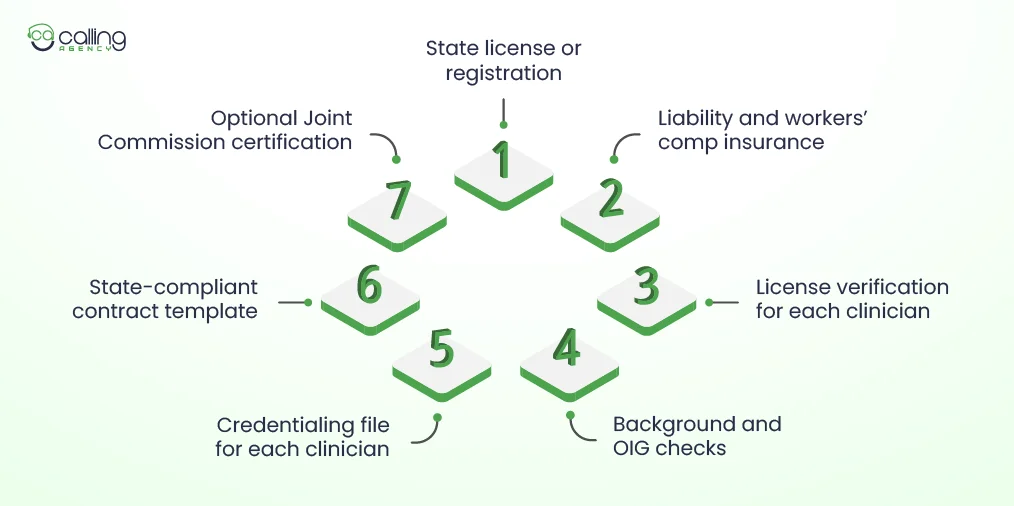
- State license or registration
- Liability and workers’ compensation insurance
- License verification for every clinician, such as through Nursys
- Background checks and Office of Inspector General (OIG) exclusion list checks
- A credentialing file for each clinician
- A contract template that meets your state’s rules
- Optional Joint Commission Health Care Staffing Services certification
How Do State Rules Affect Staffing Contracts?
State rules have a significant impact on your license, rates and contract terms. They also have influence on how you charge facilities for some specific services.
- Illinois has a requirement for a nurse agency license. The nurse must get at least 100% of the hourly rate in the contract. For this, the contract needs to list hourly bill rates and every administrative charge. You have to file quarterly reports on average charges and the contract with the Department of Labor within 5 business days.
- Iowa charges each agency location $500 a year for registration. You also need to file quarterly reports for every Medicare or Medicaid facility you will serve. Each report must have average charges and average worker pay by category.
- According to the fiscal 2025 report, Massachusetts collects an annual cost report from temporary nursing agencies.
| State | License or registration | Rate cap | Conversion fee ban | Reporting to the state |
| Illinois | Nurse agency license from the Department of Labor | Not in this review | Yes | Quarterly labor cost reports for each facility. Contracts filed within 5 business days |
| Iowa | Annual registration, $500 per location | Not in this review | Yes | Quarterly reports for each Medicare or Medicaid facility you serve |
| Minnesota | Annual registration with the Department of Health, per location | 150% of the weighted average wage plus payroll taxes, nursing homes only | Yes | Keep records for 5 years and make them available to the department |
| Massachusetts | Registration with the Department of Public Health | Hourly maximums for nursing facilities and hospitals | Not in this review | Annual cost report |
What Should Agencies Know About Conversion Fees?
In the healthcare staffing context, a conversion fee is the fee a staffing agency may charge when a facility wants to hire the agency’s temporary worker as a permanent employee in the institution. So the fee is charged to compensate the agency for losing that worker after recruiting and placing them.
Some states have restrictions on fees for when a facility hires an agency worker permanently. Illinois and Iowa both banned agencies from charging conversion fees.
Illinois does not allow agencies to charge conversion, buy-out or placement fees when a facility hires a temporary worker permanently. Iowa also restricts employment fees and liquidated damages in these cases. Both states also prohibit agencies from using non-compete clauses with their workers.
If your margin plan counts on conversion fees, those two states remove that income. Program contracts in other states may still allow them, so read each contract before you price. Do not include a conversion fee without ch00+ecking the applicable state rules and contract.
Other states may treat these fees differently. Facility agreements can also include their own terms.
Who Signs Staffing Contracts at Each Facility Type?
Don’t misunderstand that the person you are getting the order from might be the one who will sign the contract or finalize the deal. A scheduler can seek a clinician while an administrator or procurement team approves the agreement. In the scenario of a hospital, they can sometimes add another layer through an MSP. That’s why it’s important to be sure about the signing authority of contracts.
An administrator, director of nursing or procurement officer generally approves the contract and finalizes the deal upon discussion. The specific roles depend on the facility, so you need to confirm them on your first call. Do not assume the person answering the phone has signing authority.
Example:
“May I ask who usually handles your staffing agreements once a new vendor is approved?”
Once you know the buyer, you can make your staffing offer more specifically customized for them.
| Facility type | Who books shifts | Who approves the contract |
| Nursing home | Staffing coordinator or director of nursing | Administrator |
| Hospital | Unit manager or staffing office | Nursing leadership, procurement or the MSP |
| Home health agency | Scheduler | Agency administrator |
| VA medical center | Nursing service | Contracting officer |
Keep that first pitch call short and specific to the point. Healthcare cold calling scripts can guide you on how to name the role, shift and fix meetings quickly. Ask who signs agency agreements before ending the call. Then reach that person with proof you already filled a shift.
Where Public Facilities Post Staffing Contracts
Public healthcare organizations use formal procurement processes to connect with agencies. Some publish RFPs on their procurement websites or any other related official platform. Federal facilities can use SAM.gov and other federal purchasing systems.
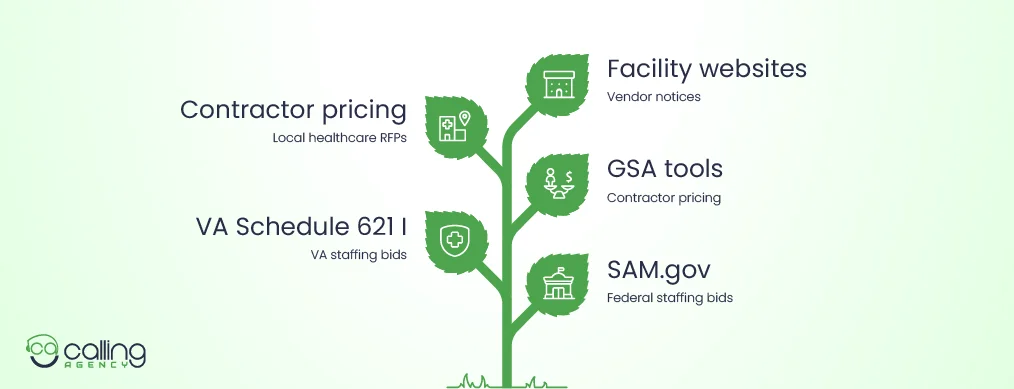
VA Schedule 621-I basically covers mostly professional and allied healthcare staffing services. It includes different types of nursing and healthcare staffing categories. VA medical centers also post individual staffing notices. These notices include requirements for licenses, certifications and business status.
The table below presents some public sources for posting staffing contracts:
| Source | What agencies may find |
| SAM.gov | Federal staffing solicitations |
| VA Schedule 621 I | VA healthcare staffing opportunities |
| GSA ordering tools | Contractor information and pricing |
| County portals | Local healthcare RFPs |
| Facility websites | Vendor and procurement notices |
Before submitting any proposal, review every solicitation thoroughly. Eligibility, insurance and credential requirements can be different between contracts.
What to Do When a Hospital Says It Uses an MSP
If a hospital uses an MSP, then ask for the MSP name. Contact the MSP’s supplier or program manager for further details. An MSP usually controls supplier approval, vendor onboarding and staffing orders. That’s why your agency may need to join its supplier network before receiving orders. MSP programs add another layer of approval. Try to keep a plan for more than one approver.
You can ask these questions to clarify:
- Which MSP manages your staffing program?
- Who handles new supplier approval?
- Is your supplier network accepting agencies?
- Which roles need more coverage?
- How does vendor onboarding work?
- What credentials do you require?
- Which shifts are hardest to fill?
Example: “I understand you work with an MSP. Would you mind sharing who I should contact about adding new staffing suppliers?”
Turn your conversation with the MSP regarding the staffing gaps you can contribute. Don’t start with a long company pitch.
Example: “We have credentialed LPNs available for weekend coverage. May I ask if those shifts are sometimes difficult for your current staffing suppliers to cover?”
MSP contracts may have specific rates and supplier terms. Make sure to review the agreement before going forward with any pricing commitments.
How Do You Turn a First Shift Order Into a Contract?
Utilize the first shift to prove that your agency can produce professional-quality work. Confirm credentials, communicate with the authority properly and make sure the clinician arrives as committed. Then ask for a standing staffing agreement once the facility has seen your workflow and quality of the work. Think of the first orders as a test. It’s a part of your pitch to secure a longer contract.
You can follow these steps to turn a first shift order into a contract:
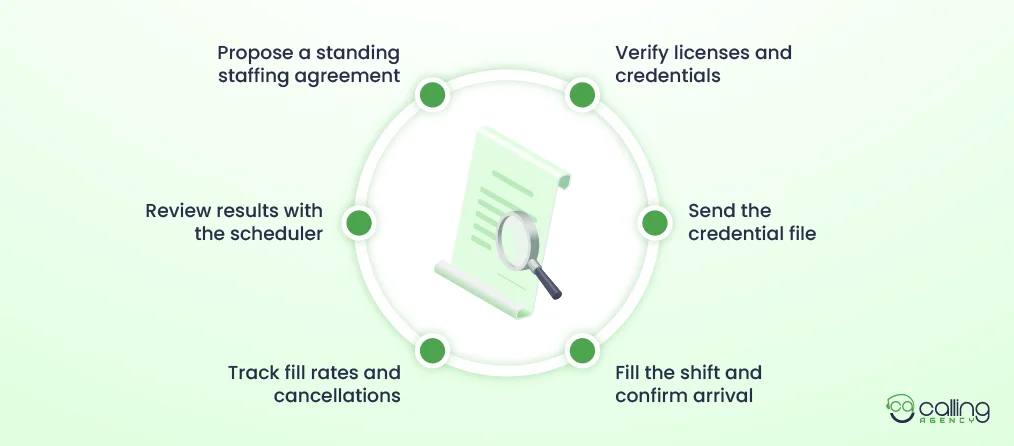
- Confirm the clinician’s license and credentials before the shift.
- Send the facility the credential file before the start time.
- Fill the shift and confirm the clinician arrived.
- Track your fill rate and any cancellations.
- Review those numbers with the scheduler after a few weeks.
- Propose a standing staffing agreement with your full rate schedule.
Upon successful completion of the first shift, continue following up instead of relying on a single conversation. Multi-channel healthcare lead generation provides support to agencies to stay connected with facility buyers through calls, email and other outreach when they are not ready to discuss a longer-term agreement immediately.
In a medical staffing lead generation case study conducted by Calling Agency, a four-month campaign generated 73 qualified facility meetings and more than 50 qualified staffing opportunities by combining cold calling with targeted email outreach.
The facility may consider a standing agreement after a cordial approach. Your proposal should be customized solely for the facility you are pitching to. That would make the discussion more interactive and valuable.
Frequently Asked Questions
Do I need a license to run a nurse staffing agency?
It varies by your state and staffing model. For example, Illinois requires a nurse agency license. Iowa demands each agency location to register every year for $500. Minnesota’s requirement is registration with its Department of Health. So whether you need a license to run a nurse staffing agency depends entirely on the state or region where you operate. Check with your own state agency before you place anyone.
Can a facility hire my nurse without paying a fee?
It depends on the contractual agreement between the nurse or their staffing agency/employer and the facility. Also, state law and the contract have influence on this decision. Illinois and Iowa have put certain restrictions on conversion and employment fees. Laws in some other states manage these fees differently. So, format your contract properly after reviewing the state’s rules.
Can my staffing agency get VA contracts?
Yes. You can apply to get VA contracts with the Department of Veterans Affairs (VA) by registering as a federal vendor and bidding on open solicitations or joining federal supply schedules. You can apply at any time, since it runs as an open solicitation. VA medical centers also post their own notices on SAM.gov. Some, like VA Palo Alto’s 2024 nursing assistant notice, are open only to veteran-owned small businesses.
Can a state cap what my agency charges?
Yes, some states have some ground rules that set a maximum amount an agency can charge a facility for temporary staffing. Before an agency sets its staffing rates, it should check the rules in the state where it operates. This helps the agency avoid charging more than the law allows.
How do I get a contract with a hospital?
Firstly, identify whether the hospital books agencies directly or they deal through an MSP. If they deal through an MSP, then contact the supplier manager. For direct booking, start with the unit manager or staffing office. Then ask who approves agency agreements. Proceed to the next step of completing credentialing or vendor registration and negotiate terms that comply with healthcare regulations.