


Most commercial insurance agents build a prospect list the wrong way. They pull a generic industry list, dial through it, and wonder why appointment rates stay flat. The problem is not effort. It is targeting.
A real commercial insurance prospect list is not built around industries or company size. It is built around three specific signals: class codes, X-dates, and exposure. Class codes tell you exactly what a business does and how risky that work is. X-dates tell you exactly when a business can shop its coverage. Exposure tells you how large that account could actually be.
When you combine these three filters, you stop guessing and start prospecting with precision. You call businesses that match your appetite, when they are open to switching, and with a premium size worth your time.
This guide walks through the exact steps to pull, filter, and route a commercial insurance prospect list using public data, rating logic, and timing signals, so every record you dial is one worth dialing.
Key Takeaways
- A commercial insurance prospect list should be built around class codes, X-dates, and exposure, not industry labels or company size.
- Class codes reveal actual work exposure, giving a more accurate underwriting picture than NAICS or SIC industry titles.
- X-dates show the exact window when a business can shop its coverage, making timing the difference between a warm call and a cold one.
- Exposure data such as payroll, sales, or square footage predicts premium size before you ever make contact.
- Public registries like FMCSA SAFER, OSHA, Census County Business Patterns, and state rating bureaus offer free, verifiable data to build this list.
- A well-filtered, smaller list outperforms a large generic one, since accuracy raises contact and conversion rates at every stage.
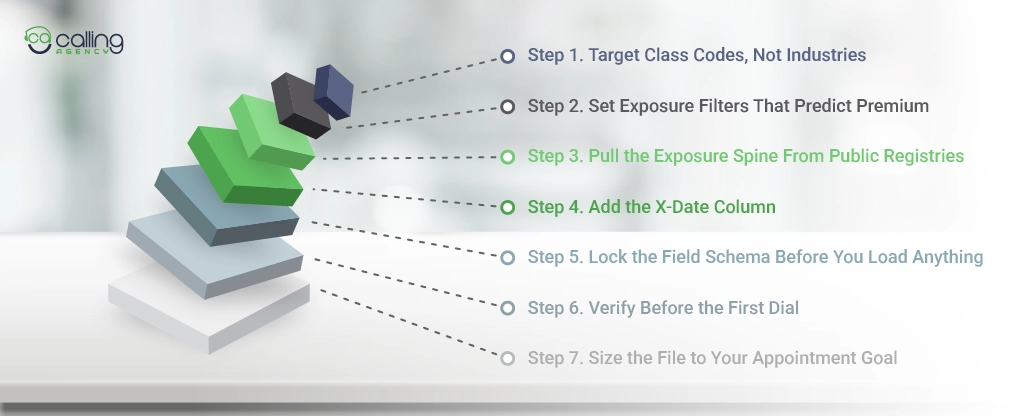
Step 1. Target Class Codes, Not Industries
A class code is the 4-digit number an insurer assigns to a business based on its actual work exposure, not its industry label. Two companies in the same “industry” bucket can carry completely different class codes and premiums, because underwriting cares about what employees actually do, not what the company calls itself.
The Texas Department of Insurance confirms this logic directly: employers with similar operations are grouped into a classification so that loss costs and rates reflect actual employee exposure to injury. That’s the opposite of NAICS, which the U.S. Census Bureau and BLS use only for economic statistics, not underwriting. NAICS classifies establishments by the services they provide, at a much broader statistical level, as explained in this BLS overview.
For prospecting, this means:
- Pull leads by class code, not SIC or NAICS industry title.
- Cross-reference NCCI or state rating bureau class code lists.
- Segment by exposure severity, not company size alone.
- Use these code groupings as the foundation to build a high-intent ideal customer profile so your appointment setters target businesses that actually match your best-performing risk profile, not just a broad industry label.
| System | Used For | Granularity |
| Class Code | Underwriting and rating | 4-digit, task-based |
| NAICS | Government stats | 6-digit, industry-based |
Step 2. Set Exposure Filters That Predict Premium
Exposure is the number that gets multiplied by a rate to produce premium. If you filter prospects by exposure size, you filter directly for premium size, before you ever talk to them.
The California Department of Insurance confirms the formula plainly: rate multiplied by exposure equals premium, and the exposure basis changes by coverage line, including square footage, payroll, or gross sales.
The Texas Department of Insurance shows this in practice for workers’ compensation: total payroll in a class code is multiplied by the rate per $100 of payroll to produce that classification’s premium.
Filter your list by the exposure that matches the line you sell, not generic company size.
- Workers’ compensation: total payroll by class code.
- General liability: gross sales, payroll, or square footage.
- Commercial property: building square footage and construction type.
- Commercial auto: vehicle count and radius of operation.
| Coverage Line | Exposure Basis |
| Workers’ Compensation | Payroll per $100 |
| General Liability | Sales, payroll, or square footage |
| Property | Square footage, construction type |
Step 3. Pull the Exposure Spine From Public Registries
Public registries turn a raw list of business names into a data-backed prospect list with real exposure signals. This step pulls fleet size, safety history, employee count, and license status from free government sources; no paid data vendor needed.
What to pull and where:
| Source | What You Get | Best For |
| FMCSA SAFER Company Snapshot | Fleet size, USDOT number, safety rating, inspection and crash history for any motor carrier | Trucking and transportation class codes |
| OSHA Establishment Search | Inspection and citation history by establishment name, searchable across over 3 million inspections since 1972 | Manufacturing, construction, and warehousing exposure checks |
| Census County Business Patterns | Employee count and payroll size by NAICS code and county, used to size the exposure base | Sizing the total prospect pool in a territory |
| State Contractor License Boards | License status, bond amount, and class scope for construction and trade class codes | Contractor and trade class prospecting |
| Secretary of State Business Registry | Legal entity name, formation date, registered agent, and standing status | Confirming a prospect is still active |
| State Workers Comp Rating Bureau | Experience mod, payroll class breakdown, and NCCI class code alignment | Ranking prospects by loss history |
How to build the spine:
- Start with the FMCSA SAFER snapshot for any prospect that runs trucks. It confirms fleet size and flags carriers with poor safety scores, which changes how you price the risk.
- Run the same company name through OSHA Establishment Search. A pattern of repeat citations under one NAICS code signals higher exposure than the class code alone suggests.
- Use Census County Business Patterns to check if the employee count on file matches what the prospect claims. This step catches underreporting before it reaches underwriting.
- Confirm active license status on the state contractor board, since a lapsed license changes eligibility for many carriers.
- Cross-check entity standing on the Secretary of State registry, since inactive entities are dead prospects.
- Pull the experience mod from the state rating bureau to rank prospects by loss history, not just size.
Each match becomes one row in your spine: legal name, class code, fleet or employee count, and safety flag. Teams that lack the bandwidth to run this process at scale can turn to custom list-building services to handle the registry pulls and matching. This spine feeds directly into Step 4, where you overlay X-dates.
Step 4. Add the X-Date Column
The X-Date column is the renewal or expiration date of a prospect’s current commercial policy. It is the single most important field in your prospect list because it tells you the exact day a business owner becomes legally free to switch carriers or agents. Without this column, your list is just a name and address file, not a working prospecting tool.
In commercial lines, the X-Date usually comes from the workers’ compensation policy, since that data is tied to state rating bureau and payroll filings and is easier to trace than general liability or property dates. Add the X-Date as its own column next to Class Code and Exposure so you can sort the whole list by renewal month and build call and mail cycles around it.
Where to find X-Date data:
- State Department of Insurance filings, many of which are public record and searchable on state .gov sites. Example directory: NAIC State Insurance Department Directory.
- Workers’ comp rating bureau records such as NCCI, WCIRB for California and NYCIRB for New York.
- OSHA injury and illness records at gov, which list active employer establishments by industry.
- DOT and FMCSA safety records at dot.gov for trucking and transport risks.
- SBA business data at gov for verifying active business status.
- Paid data aggregators and agency management systems, which compile bureau data into ready-made X-Date lists, such as Applied Epic, Vertafore AMS360 and HawkSoft.
Suggested column layout:
| Column | Example Entry |
| Business Name | ABC Roofing LLC |
| Class Code | 5551 |
| Exposure (Payroll/Sales) | $850,000 |
| X-Date | 03/15/2027 |
| Current Carrier | Unknown/Verify |
| Outreach Start Date | 01/15/2027 |
Set the Outreach Start Date 45 to 60 days before the X-Date, since that is the window when incumbent agents have not yet locked in the renewal and business owners are most open to quotes.
Step 5. Lock the Field Schema Before You Load Anything
A field schema is the fixed list of columns your prospect list must follow before you load any data. Lock it first, because fixing broken columns after rows are already loaded wastes hours and creates duplicate records in your CRM. The NIST Research Data Framework confirms that naming and format standards must be set before collection begins, not after.
Locked field schema table:
| Field | Format Rule |
| Legal name and DBA | Text, no abbreviations |
| NAICS and NCCI class | Numeric text, verify with SBA NAICS lookup |
| Exposure figure | Number only, no symbols |
| Employee count | Whole number |
| Years in business | Whole number |
| Decision-maker name and title | Text, confirm who to contact when selling commercial insurance; breaks that down line by line |
| Direct phone and mobile | Ten-digit format |
| Email address | Validated format |
| X-date | MM/DD/YYYY |
| Incumbent agent and carrier | Text, use Unknown if unverified |
| Mod factor | Two decimal places |
| Trigger event | Short tag, example New Hire |
| Last touch date and outcome | Date plus fixed outcome |
| Channel routing | Fixed values, example Call, Email |
Standard values stop free-text errors and keep reporting accurate. This same locked structure mirrors how Data.gov’s schema standard keeps public datasets consistent across many contributors.
Step 6. Verify Before the First Dial
Before you call any lead, confirm the business is real, active and matches your target profile. Skipping this step wastes calls on dead leads.
Checklist to verify:
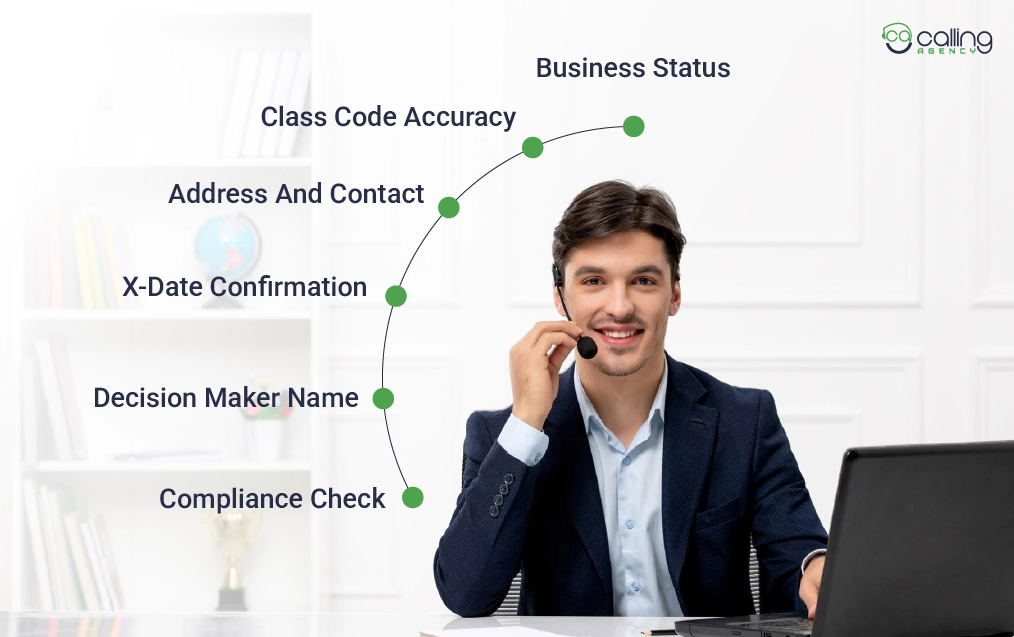
- Business status: Check the state Secretary of State business search to confirm the company is active, not dissolved or suspended.
- Class code accuracy: Cross-check the NAICS or SIC code against the S. Census Bureau NAICS lookup tool to make sure the class code still fits the business activity.
- Address and contact: Confirm the physical address and phone number using the SBA business directory or a recent Google Business listing.
- X-date confirmation: Call the office once to confirm the renewal date if it is not from a reliable source.
- Decision maker name: Verify the owner or risk manager name through LinkedIn or the IRS EIN lookup guidance or company website before dialing.
- Compliance check: Before dialing, review the B2B outbound compliance rules so your calling window, do-not-call list checks and disclosure requirements are all in order.
This step protects your time and raises your connect rate.
Step 7. Size the File to Your Appointment Goal
List size should come from a formula, not a guess. Multiply your appointment goal by your average contact-to-appointment rate, then multiply again by your average dial-to-contact rate, to get the number of records you actually need.
The SBA’s Marketing 101 course recommends building a marketing plan around a defined target market before setting activity goals, since a vague target inflates the list size needed for the same result.
Use this simple math:
- Set your appointment goal for the week or month.
- Apply your known contact rate, for example, 20 percent.
- Apply your known dial-to-contact rate, for example, 25 percent.
- Multiply backward to get total records needed.
- Add a 20 to 30 percent buffer for bad numbers and disconnects.
A tighter, well-filtered list beats a bigger, generic one, because clean class code and exposure data raise every rate in the chain above. If building and dialing this file in-house stretches your team too thin, outsourced commercial insurance lead generation can size and run the list against your exact appointment goal. One agency using this approach produced 93 qualified appointments for a commercial insurance agency, showing how the right list size, matched to the right conversion math, turns into a predictable calendar of appointments.
Route Each Record to the Right Channel
Match each prospect to the channel their record actually supports. A verified direct phone number goes to a call. A verified work email goes to email. A LinkedIn profile with no phone or email goes to LinkedIn.
The FTC’s Telemarketing Sales Rule reminds sellers that outbound calls must follow do-not-call and disclosure requirements, so clean, verified numbers matter before you route a record to calling.
- Direct dial confirmed: use commercial insurance cold calling scripts.
- Verified email only: use cold email templates for commercial insurance.
- No phone or email, active profile: use LinkedIn message templates.
Never force one channel across the whole file. Routing by data quality raises contact rates and keeps you compliant.
Frequently Asked Questions
How often should the list be refreshed?
Refresh monthly. X-dates shift, licenses renew, and new business registrations appear constantly, so a list older than 30 days already contains outdated exposure and renewal data.
Which policy line should a new list target first?
Start with workers’ compensation. It has the clearest class code data, predictable X-dates, and the most public exposure records, making it the easiest line to prospect accurately first.
How many records should a commercial insurance prospect list have?
No fixed number. Calculate backward from your appointment goal using your contact rate and dial rate, then add a 20 to 30 percent buffer for bad data.
What is an x-date in commercial insurance?
An X-date is a policy’s expiration date. It tells you exactly when a business can shop coverage, making it the single most important timing signal for outreach.
Should I buy a commercial insurance prospect list or build one?
Building costs more time but gives cleaner, targeted data. Buying is faster but often generic. Check insurance lead-generation costs before deciding what best fits your budget and timeline.
Build the File Once, Then Work It
A strong commercial insurance prospect list is not about volume. It comes from targeting class codes, tracking X-dates, and filtering by real exposure data. This approach turns cold outreach into timed, relevant conversations with businesses that actually match your risk appetite. Build the list this way, and every call, email, or message becomes worth the effort, not just another dial.