

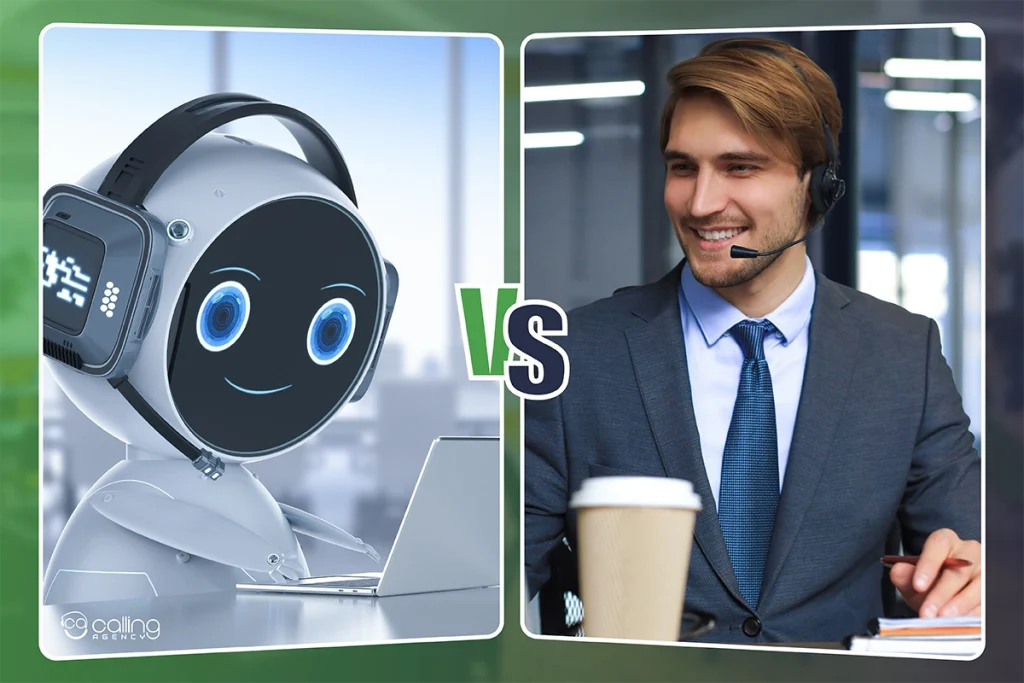
When it comes to cost, volume, speed, and consistency, AI SDRs win. Human SDRs excel at meeting quality, complex deals, and relationships. For most teams, the ideal outcome is not one or the other; it’s both, with AI handling repetitive top-of-funnel work and humans engaging in conversations that actually convert.
There is also a third option many comparisons overlook: outsourced SDRs, which give you the human element without the hiring and management overhead of other approaches. We cover each claim with real numbers below.
Key takeaways
- A well-rounded human SDR costs $80,000–$150,000 a year; an AI SDR about $6K–$36K per year depending on the tool and scale (often 5–40% of a human’s fully loaded cost).
- AI SDR provides 10–50x more outreach volume compared to a human SDR and follows incoming leads within seconds, not hours.
- However, AI-booked meetings have lower quality, with 40–60% show rates compared with 70–85% for human-booked meetings, affecting sales appointment
- Hybrid teams often generate more pipeline per seat than either pure model, while reducing cost per meeting by 30–60%.
- Traditionally, teams choose between inbound and outbound motions, so the simple decision often comes down to the size and complexity of each SDR function. Inbound and outbound comparisons rarely stay fixed, and a third path, outsourced or managed SDRs, is often overlooked.
| TL;DR:
AI SDRs deliver high-volume outreach (10-50x a human) at lower cost and instant speed, but with lower meeting quality for complex deals. Hybrid (AI for grunt work in top-of-funnel + humans for high-value conversations) is the path to take in 2026. Outsourced SDR teams offer a solid third choice. |
What is an AI SDR?
An AI SDR is an advanced software or automated outreach machine that imitates and scales many of the manual prospecting tasks carried out by Human Sales Development Representatives. Core functions include:
- AI SDR leads research & enrichment using a number of data sources
- Identifying decision-makers and contact information with AI SDR
- AI SDRs easily create personalized email outreach, LinkedIn messages, and sequences
- Multi-channel outreach (email, social, calls if supported) is also done by AI SDR
- Reply handling: Email automation rule-based or generative first replies
- Meeting scheduling directly into calendars can be done with AI SDR
- Logging activities in your CRM systems
- Handle monotonous and repetitive tasks with AI SDR
In 2026, there are two primary categories:
Fully Automated AI SDR Agents : Tools like Artisan’s Ava, 11x’s Alice, or similar tools that run autonomously 24/7 after you provide an Ideal Customer Profile (ICP), plug your own tools (CRM data, email, LinkedIn), and set guardrails. These need only the smallest ongoing human touch.
AI-Assisted Platforms: These allow for research summaries, suggested messaging, prioritization, and automation while keeping a person in the loop for quality control.
The rest of this guide is written with an emphasis on comparing autonomous AI SDRs to full-time human SDRs, as it is the key strategic trade-off for most teams outgrowing their outbound efforts or ramping up inbound qualification.
What Does a Human SDR Actually Do?
Human SDRs (sales development representatives) represent much more than an outreach machine. Their role on the sales team involves strategic, social, and adaptive tasks that are still harder for AI to fully imitate:
- Deep account research and prioritization.
- Creative, contextual personalization that takes into account cultural differences or recent company events and buying signals.
- Dealing with gatekeepers, tone of voice, discovery calls and real-time objections on sales calls.
- Multi-threaded relationship building across stakeholders.
- Use BANT or a similar framework to qualify prospects, along with emotional intelligence.
- Change how conversations go based on small cues (for example, a recent competition win can open the door to differentiation).
- Leveraging LinkedIn or social media to build your personal brand or network, warm intros, and get referrals
In other words, humans excel in complex, consultative, or regulated sales situations where trust, judgment, and adaptability drive success. The performance gap shown in later metrics is created by this judgment layer: understanding hesitation, politics, and unarticulated needs.
AI SDR vs. Human SDR: Side by Side
| Factor | AI SDR | Human SDR |
| Annual cost | $6K–$36K+ (entry to mid-range tools) | ~$80K–$150K fully loaded |
| Volume / capacity | 10–50x a human; no ceiling | ~40 calls/day; finite |
| Speed-to-lead | Seconds, 24/7 | Hours (often far longer) |
| Consistency | Identical every time, no off days | Varies with fatigue and workload |
| Personalization depth | Good at scale; shallow on nuance | Deep, context-aware |
| Meeting quality | Lower show and conversion rates | Higher show and conversion rates |
| Complex / multi-stakeholder deals | Weak | Strong |
| Ramp time | Days | 3 – 6 months |
| Brand risk | Can send off-brand messages at scale | Lower, but not zero |
Many of these rows show AI winning on efficiency. Hence the quality picture further down reads more credibly than defensively.
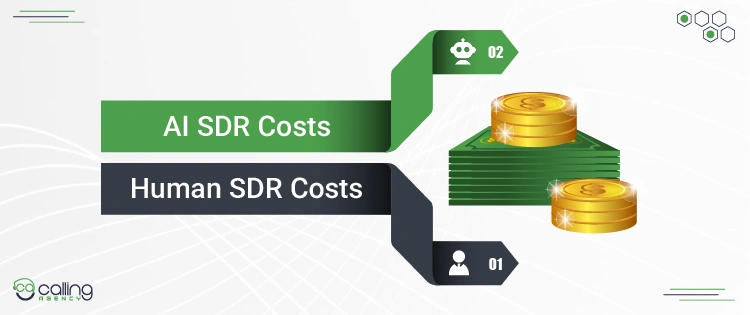
Cost Comparison: What Each Really Costs
On the surface, AI wins on cost alone. However, a deeper dive tells an important, nuanced story.
Human SDR Costs
- Most US markets $55K–$80K base salary
- Total cost (after costs): $80K–$150K+ per year
- Ramp time: Up to 3–6 months to be productive (3.2–5.7 months average of recent benchmarks)
- Turnover: Most organizations see average tenures of 1.4 to 1.9 years, which creates ongoing recruiting, training, and productivity gaps caused by churn. Replacing reps can add $35K–$150K in lost pipeline and team disruption
AI SDR Costs
AI SDR pricing in 2026 varies significantly by tool and usage volume:
- Entry-level or lighter tools: Often $500–$1,500 per month ($6K–$18K annually)
- Mid-range autonomous platforms (e.g., typical Artisan Ava or similar setups): Around $2,000–$3,000 per month ($24K–$36K annually)
- Enterprise solutions (e.g., 11x Alice): $5,000+/month ($60K+ annually)
Additional expenses include data enrichment, email infrastructure, warming, and compliance tools. Setup takes days, not months
The focus has shifted from cost per lead to cost per qualified meeting and cost per opportunity. Low-quality meetings booked by cheap AI SDR tools are not free. High-volume AI can win on unit economics despite quality differences.
Performance: The Quality Gap Nobody Likes to Mention
It’s the part vendor comparisons skim over so it is worth pausing here
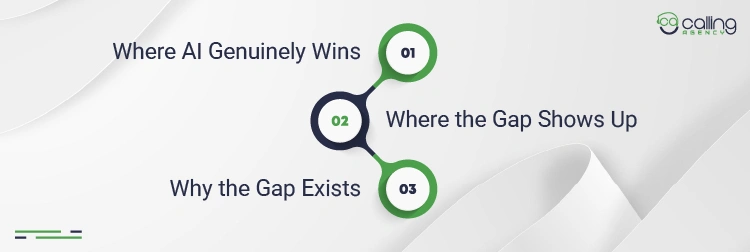
Where AI Genuinely Wins?
- In all of this, it is volume and consistency that allow teams to test these new segments quickly and continue follow-up at a relentless pace
- Responding to leads within 5 minutes can yield dramatically higher qualification rates
- Classic studies show that the threshold can be up to 21x higher than for slower responses, and this still largely applies
- Most Suitable for the highest volume, transactional, or wider ICP motions
Where the Gap Shows Up?
Data from 2025–2026 analyses (including aggregates from Bridge Group, Outreach, and vendor benchmarks) consistently show:
- Show rates: AI 40–60% vs. Human 70–85%.
- Meeting-to-opportunity: 15% AI vs. 25% Human.
- Downstream win rates: AI-generated opportunities are often a staggering 9–12 points lower.
- The revenue impact: Humans produced 6x the amount of revenue per win in head to heads.
Why the Gap Exists?
AI books the meetings, but the expectations were set in an automated interaction rather than by a human touch. As a result, the data shows prospects are more likely to no-show or to turn out misqualified, or not the actual decision maker. The relationship context that helps a prospect show up and engage is where autonomous agents struggle most.
That does not make AI “worse.” It simply separates volume and quality as two different metrics. It means anyone comparing them on meeting count alone is reading only half the scoreboard. Moreover cold calling prospecting can be done by humans alone. They can research, prepare and then call.
When AI SDRs Win vs When Human SDRs Win?
Determining the right answer relies almost wholly on who you sell to and what you are selling.
AI SDRs Are the Right Call When
- Deal sizes are smaller, typically sub-$25K, and the sales cycle is short or transactional
- Your ideal customer profile is broad, and higher volume genuinely adds capacity to the top of your funnel
- The role is top-of-funnel qualification at high volume and repeatable, not nuanced discovery
- You want to quickly assess a new segment or vertical. It takes six weeks to learn, while hiring alone would take six more months to tell you
- You are early-stage, have no SDR infrastructure, and need territory coverage immediately
Human SDRs Win When
- The deals themselves are bigger ($50K+ ACV) and typically consist of multi-stakeholder buying committees
- The sales cycles are lengthy, consultative and relationship-focused
- Phone calls need to contend with gatekeepers, sense the mood in real time, and adjust accordingly
- You work in a regulated or brand-sensitive area, where an out-of-tune automated response poses a serious risk
The cleanest way to put it is AI scales activity and humans scale quality. Pick the motion that is genuinely lacking. Cold calling vs. lead generation shows how these two motions serve different parts of the funnel, and why treating them as interchangeable is one of the most common SDR strategy mistakes. For enterprise-level, relationship-based sales where the human element is non-negotiable, B2B appointment setting services staffed by trained reps directly address the scenarios where AI consistently falls short.
Why Hybrid Beats Either Alone?
Benchmark data on hybrid pods (one human + AI support) shows strong results:
- Pipeline per seat/month: ~278K (hybrid) vs. 187K (human) vs. 94K (AI)
- 30–60% lower cost-per-meeting
- Scaling more with high show and conversion rates
That’s the whole point of splitting up labor. Let AI-powered SDR do what it does best: build lead lists, research accounts, respond to inbound messages in seconds, run follow-up sequences, and log everything. It also allows human touch to handle the conversations that require judgment, persuasiveness, and trust.
How to Run the Hybrid Model in Practice?
The teams that truly yield the benefits of pipeline and cost-per-meeting gains see the power when they intentionally run the model, not simply slap an AI tool onto a team. Here are some rules that distinguish the versions that work from those that die silently.
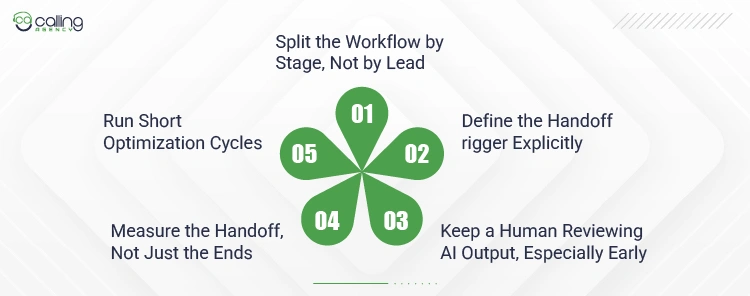
Split the Workflow by Stage, Not by Lead
The first split is between the different stages of a sales cycle. AI owns research, list-building, initial outreach, speed-to-lead, and early follow-ups. Magic happens at meaningful engagement, and humans step in.
Define the Handoff Trigger Explicitly
The weakest point is usually the handoff. Know ahead of time what leads to a human and how quickly. A realistic guideline that many groups practice:
- Any response referring to pricing
- Security
- Integrations or a competitor
- Queries exceeding one or two sentences
- Or direct asks for an individual
The usual handoff rules are pretty vague, and warm leads go cold.
Keep a Human Reviewing AI Output, Especially Early
The quickest way to destroy your brand is letting an autonomous agent blast off-brand or tone-deaf replies at scale. Compare AI outputs to human-produced content for 30–60 days, A-B testing voice and tone, then ease it up as you build confidence in it.
Measure the Handoff, Not Just the Ends
Measure conversion at each stage individually. Reply rate, meeting booked, meeting showed, and show the tightest seam between artificial intelligence and humans. If you have a leaky handoff, a healthy AI top-of-funnel still outputs a bad pipeline. The numbers tell you which half to work on.
Run Short Optimization Cycles
The teams that are seeing the largest improvements in process (the ones you want to follow) re-evaluate handoff triggers, messaging, and qualifications regularly. It is not as simple as configuring the hybrid model and forgetting.
The Third Option Most Comparisons Skip: Outsourced SDRs
Don’t build an internal AI System or hire to manage your sales team. Partner with a professional managed SDR service. These sales teams employ trained human reps supported by best-in-class AI tools. Benefits include:
- No ramp time and no turnover risk
- Access to experienced callers and multi-channel experts in no time
- Built-in compliance, scrubbing, and optimization
- Capacity to scale specific to your ICP and objectives
If you’d prefer to have trained human SDRs powered by the right technology to engage your conversation that converts, tell a professional outbound call center and lead generation SDR team what that would look like for your pipeline.
Frequently asked questions
Can AI SDR Replace Human SDRs?
No, especially in the case of work that requires judgment and relationships. But if your top-of-funnel process includes a lot of low-value repetitive work, research, dialing, follow-up, basic qualification, etc. AI can remove that and do it at scale. Yet for most multi-stakeholder, complex, extensive negotiation and relationship-based deals, it augments the human rather than substitutes them. In truth, the teams get the best results by combining both.
Are AI SDRs Cheaper Than Human SDRs?
Yes on sticker price. The only number to focus on is cost per qualified meeting as AI’s volume advantage can be offset by lower conversion quality in complex scenarios.
Do AI SDRs Book Lower-quality Meetings?
Generally, yes. 2025–2026 data shows AI SDR show rates of 40–60% vs. 70–85% for humans, with meeting-to-opportunity around 15% vs. 25%. The gap reflects the relationship context that prospects respond to. AI can book the slot, but humans set the expectation that gets the prospect to show up.
AI SDR vs. Agency Which is Better?
It depends on deal size and ICP complexity. An AI SDR is the better fit for high-volume, lower-ACV, transactional motions where speed and reach matter more than conversation quality. An agency or managed SDR team is the better fit when you need trained human reps for relationship-driven sales but don’t want to hire and manage them internally. Compare the two on cost per qualified meeting and show rate, not raw outreach activity.
What is a Hybrid SDR Model?
A hybrid model assigns AI SDR to repetitive tasks, high-volume top-of-funnel work research, list-building, speed-to-lead, follow-up while leaving humans to the persuasive conversations that convert. Teams using this model gain higher pipeline per seat and lower cost-per-meeting than both AI-only or human-only implementations.
How Much Does an AI SDR Cost?
AI SDR costs typically range from $500–$3,000+ per month ($6K–$36K annually for entry to mid ranger tools),enterprise tools scaling higher based on volume and features. Don’t expect sticker prices to include setup, data, email infrastructure, and the human review of AI output that most teams need.