

Your cold calling team’s high activity feels productive, but when meetings don’t follow, something is broken. As a decision maker your first job is to find out the pain point not to be rude on agents.
Once you find out the issues, half of the job is done here, now you need to fix those broken issues that make your team look busy but not driving outputs. So let’s explain why calls fail and how to correct them in the discussion below.
The Real Financial and Other Cost of Calling Without Results
Whether you take cold calling service or run in-house, no matter what you are going to face some penalties if your agents look busy but not driving conversion. So, before starting the problem finding and solving them you should know how much this issue can impact on your business.
- Lost revenue
- Lower customer lifetime value
- Inefficient sales spend
- Low conversion rate
- Waste agents productivity
- High agent burnout
- Brand damage
- Broken referrals
Those are direct impacts that cause you loss on loss. So when you notice your agents are looking so busy but it brings nothing then it’s time to take things seriously and clean those bugs up.
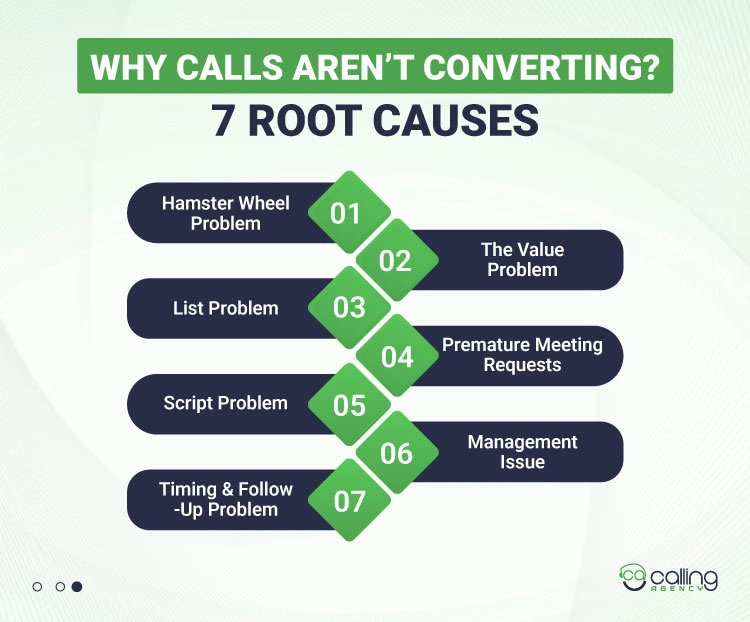
Why Are Calls Not Converting? 7 Root Causes
Don’t worry, the culprit behind the no result can be defined with below 7 fact checking. Mostly the lack of high converting cold calling script, quality leads, proper follow up, objection handling and few more reasons are the main problems that block your results.
1. The Hamster Wheel Problem: Activity Without Progress
The viral Hamster Wheel problem is known for number one reason if your agents are making a lot of calls looking busy, appreciated by team leaders but no results are coming. This problem is called Hamster Wheel because on wheels, hamsters run fast, work a lot but do not change their position and stay in the same place. Your problems are the same so it’s very relatable.
How to identify the hamster Wheel problem:
- High activity, low conversion
- No pipeline growth
- High disconnect or no answer rate
- Short call duration
When you will see those problems are happening with your company then it’s eyeing the hamster wheel problems.
2. The List Problem: Calling the Wrong People
If you are in the B2B lead generation industry and calling a government employee then it’s nothing but wasting time.
How to identify it:
- High rejection rates in the first 15 seconds
- Prospects say “this is not relevant”
- No ICP, intent data, or role-based targeting
High quality leads are always the key for cold calling success.
3. The Script Problem: Sounding Generic or Robotic
A good script is like a weapon to a warrior. You don’t need to memorize it exactly or read it like a robot. Understand the concept of the script and present it like a human being and the magic happens. Apart from this, if it’s sound robotics and the prospect feels someone is just reading a script then you are in danger.
How to identify it:
- Prospects interrupt or disengage early
- Reps rely on rigid intros
- Same pitch used across industries and roles
“Make a customer, not a sale.”- said by Katherine Barchetti. So your tone of voice with empathy is the key to making a customer not just robotic recitation.
4. The Timing & Follow-Up Problem
“It’s not about having the right opportunities. It’s about handling the opportunities right.”- Mark Hunter. So if you call a prospect on holiday or midnight then you are probably going to handle an objection on your cold call. Timing is crucial and keeps them follow up as well.
How to identify it:
- Calls happen at random times
- No structured follow-up cadence
- Prospects say “call me later” and disappear
Once you hit the prospect at the right time, take note for further follow ups, otherwise it results in nothing.
5. The Value Proposition: Features Before Relevance
Making calls and delivering scripts is not everything. You need to focus on the value proposition. If your pageants just make calls and start explaining features you offer then it will not be effective most of the time.
How to identify it:
- Long explanations with little engagement
- Prospects ask, “Why are you calling me?”
- Reps talk more than they listen
Above reasons are the key indicator for your problem of no result but the agent looks busy.
6. The Ask Problem: Weak or Premature Meeting Requests
If your agent is asking vague or ambiguous questions for an appointment then it’s going to happen. Even if for some cases they say yes but it’s possibly going to end up with no show.
How to identify it:
- Reps never clearly ask for a meeting
- Meeting is pitched before value is established
- Objections spike at the close
Let’s show you a sample of weak asking. Are you available for a meeting to show what we can do for you?
7. The Management Problem: Measuring the Wrong Things
Management or key decision makers are also the reason for your no result problems. Without finding real problems if they focus on other things then it’s normal to happen with your company.
How to identify it:
- KPIs focus on dials, not conversations or bookings
- Call reviews are rare or surface-level
- Coaching is reactive, not systematic
How to Fix It? 6 Strategies That Turns Calls Into Meetings
Now it’s your job to fix the issues according to the above explanation, we hope you got the problem that caused your agent to be busy but with no result. Now with below 6 solutions you can drive cold calling success if followed properly.
- Audit Before You Dial:
- Review the last 50 to 100 failed calls
- Identify list, script, and timing patterns
- Narrow focus to high-fit, high-intent accounts
- Win the First 10 Seconds:
- Lead with a relevant insight or trigger
- Drop small talk and permission-based openers
- Earn the right to continue the conversation
- Shift From Features to Outcomes:
- Talk about business impact, not product specs
- Tie the message to the prospect’s role
- Make the value obvious early
- Reframe the Meeting as Low-Risk:
- Position it as an exploration, not a pitch
- Reduce commitment and pressure
- Focus on mutual fit
- Improve Timing and Follow-Up Discipline:
- Call in proven time windows
- Use structured multi-touch sequences
- Treat “not now” as a timing signal, not rejection
- Manage Conversations, Not Dials:
- Review calls weekly
- Coach objection handling and openings
- Align incentives with booked meetings
Conclusion: Audit, Adjust, and Book Smarter
After your resolution period don’t relax because you need to audit your agents calls and need to find out adjustments if needed. When you will maintain a regular session on feedback or audit results with training, your cold calling results will automatically start rising up giving you better return on investment.