



Call canceled carriers within the 30-day BMC-35 window. Call fleet changes within days. Call renewals 60–90 days before the estimated date. CallingAgency checked 10,697 liability filings that ended Sep. 5 to Oct. 5, 2026. Of those, 82% were replaced and 18% canceled. So most carriers on a cancellation list already have a new policy.
Old cancellation lists and X-date lists waste dials. Many carriers on them already switched insurers. Some renewal dates are just guesses. Each dead dial costs a setter time that could go to a live carrier. This is for commercial trucking insurance agents. It also fits the outbound appointment setters who call established carriers for them. Below, you’ll see when to call for each trigger.
When Should You Call Trucking Companies for Insurance?
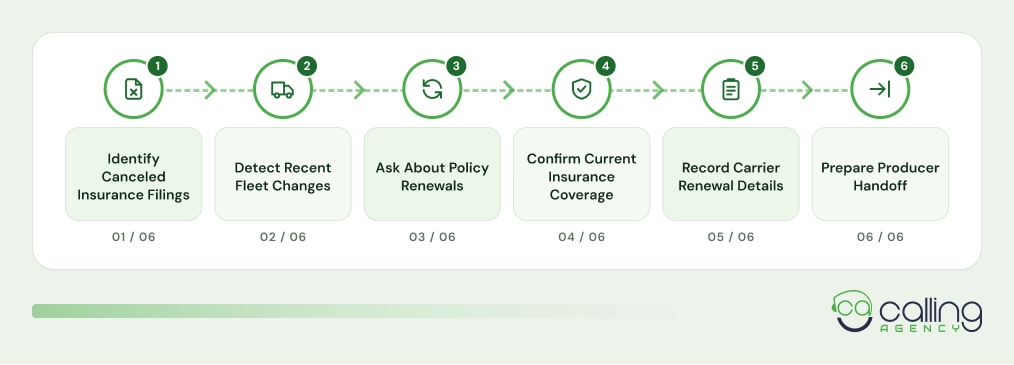
Go in order of the shortest clock. Canceled carriers come first, and you have 30 days from the BMC-35 notice. Fleet changes are next, so reach out within days. Renewals come last, at 60–90 days before the estimated date. That date is a guess, so ask the carrier for the real one.
| Buying Trigger | Exact FMCSA Motus File | Form/Field Signal | Optimal Call Window | Setter Opener Script |
| Canceled filing | History file | Canceled liability filing from a BMC-35 notice | Within 30 days of the notice | “FMCSA shows your liability filing ending. Do you have a new policy yet?” |
| Fleet change | Census file | New authority type or more power units on the MCS-150 | Within days of the change | “I saw your new authority on FMCSA. Does your policy cover it?” |
| Renewal | Active insurance file | Effective-date month on the filing | 60–90 days before the estimated date | “When does your current policy renew?” |
One carrier can show more than one trigger. Start with the canceled filing, since its clock runs out first. Work the fleet change next. Renewal comes last. If a carrier says to call back at renewal, write down the month they give. Then book the callback before that date.
The setter books the meeting. Setters who handle truck insurance lead generation should check four things before the handoff. The licensed producer then talks coverage and price.
- Renewal date
- Power units
- Current insurer
- Whether loss runs are ready
With those answers, the producer can quote in the first meeting.
How Do Trucking Insurance X-Dates Work (and Why Are 42% Over a Year Old)?
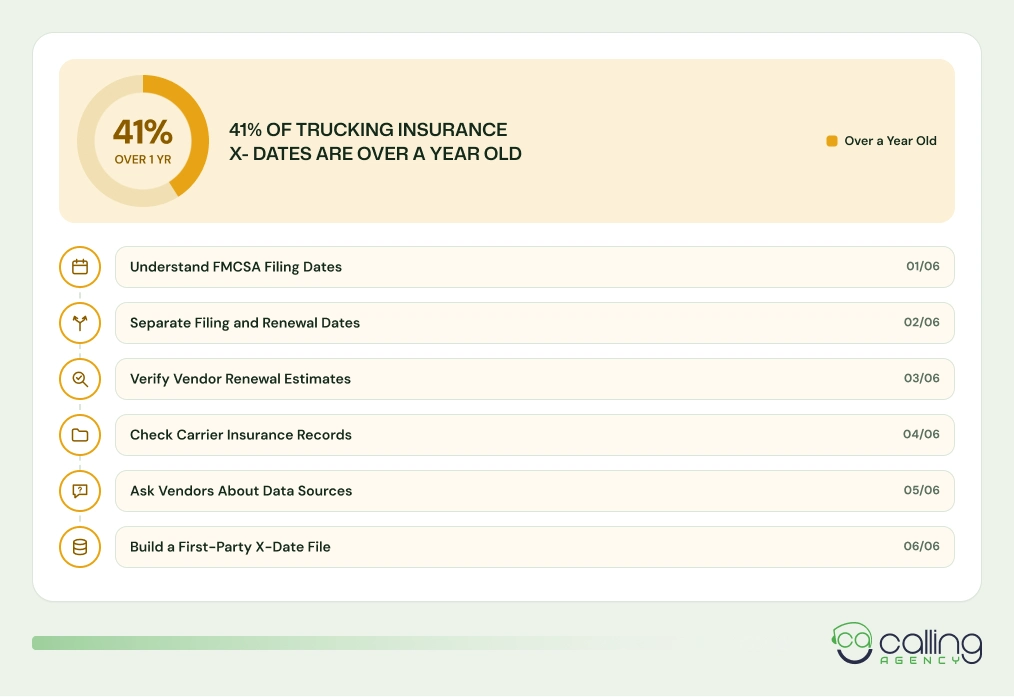
Vendors guess X-dates. An X-date is the day a commercial insurance policy ends. FMCSA’s active insurance file doesn’t list it. It only shows when each filing started. On October 5, 2026, CallingAgency counted 47,731 of 114,374 active filings that started over a year ago. That’s 42%.
Why FMCSA Effective Dates Don’t Equal Renewal Dates
FMCSA’s file lists the insurer, the policy number and the date each filing took effect. It doesn’t list when the policy ends. The effective date only tells you when the filing started. It doesn’t tell you when this year’s policy began. Vendors build renewal dates from those dates or from their own models.
Many filings run for years, so they keep their old dates. Some go back to 2001. A date that old tells you nothing about next month.
FMCSA shares this file for free. The data comes from FMCSA’s Motus registration system. Intrastate-only carriers aren’t in it. They don’t need federal authority, so they don’t file insurance with FMCSA.
The anniversary month still helps. Use it to ask a question on the first call. Don’t treat it as a real renewal date.
How to Test a Lead Vendor’s X-Date List in 4 Steps
Few vendors say how they set renewal dates. Carrier Software has a policy filing month filter, which points back to FMCSA’s filing dates. Carrier Network says it reads expected renewals from past insurance timing. Neither one explains how it works.
Test the list before you buy it.
- Pick a sample of carriers from the vendor’s list.
- Look up each docket number in FMCSA’s active insurance file.
- Compare the vendor’s renewal month with the filing’s effective-date month.
- Ask the vendor how it sets renewal dates. Get the answer in writing.
If the months match every time, the vendor is using the anniversary guess. That’s not wrong, but it’s not a real date. If the months differ, ask what data the vendor used.
A good answer names a source. That could be FMCSA filings, dates from carriers or past calls. A fuzzy answer about their own models means you should test more carriers. Until a vendor proves its dates, price the list as guesses and compare your trucking insurance leads cost to the appointments it books. Run the test again each time the vendor refreshes the list.
The Two-Call Cadence: Building a First-Party X-Date File
Every renewal month a carrier gives you becomes your own X-date. After a year, you’ll have a renewal file no vendor can sell you. It comes straight from the carriers.
On call 1, open with the anniversary month. Ask when the policy renews. Then log the renewal month, the current insurer and the date you asked.
Call 2 comes 60–90 days before that renewal month. Book it during call 1 so it doesn’t slip. Confirm the power units and the insurer. Ask if loss runs are ready. Then pass it all to the producer, who can quote in the first meeting.
How Does a BMC-35 Cancellation Open a 30-Day Call Window?
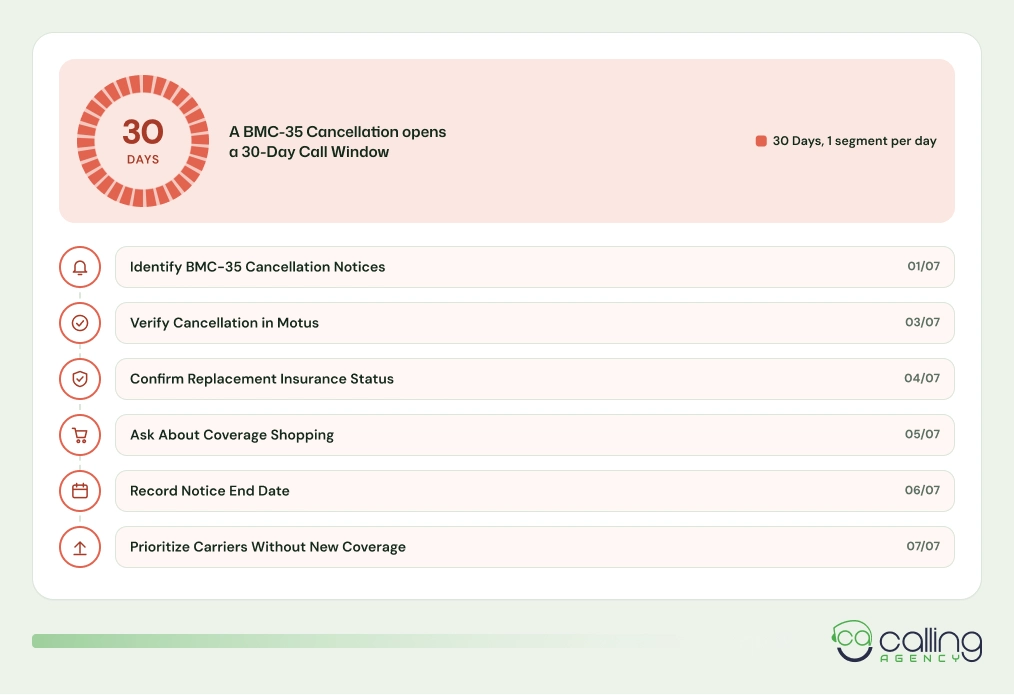
A BMC-35 is FMCSA’s Notice of Cancellation form for motor carrier insurance. A cancellation can’t take effect until 30 days after the insurer files it, under 49 CFR 387.313(d). So you have a month to reach the carrier. If coverage lapses, FMCSA can start revocation proceedings against its authority.
Why the 30-Day Window is Hard to Catch in Public FMCSA Files
FMCSA’s public files show few cancellations before they take effect. Agents often find them late. On October 5, 2026, the history file showed only 10 cancellations dated after that day. That count covers every filing type.
Check the history file every day for new canceled records. Then look up each one on the carrier’s public Motus record before you call.
A cancellation you find late can still be worth a call. The carrier may be shopping right now. Ask if a new policy is in place before you pitch anything.
BMC-35 vs. BMC-36 and the 3 Facts Setters Need on the Call
The BMC-35 is for motor carrier insurance. The BMC-36 cancels surety bonds, which brokers or carriers file. Bonds follow the same 30-day rule, but on the BMC-36 form. So a BMC-36 points to a bond, not a policy.
The carrier needs a new filing before the 30 days end. That gives it a real reason to talk. Ask these three questions on the call.
- Does the carrier know about the cancellation?
- Has it started shopping yet?
- When does the notice period end?
Carriers that haven’t started shopping have the most room for your quote. Count 30 days from the notice date and call early. The same rule applies to any mid-term cancellation, no matter who starts it.
How Do You Tell If a Canceled Carrier Already Switched Insurers?
Look at the status reason on each ended filing in FMCSA’s history file. A carrier marked replaced already has a new filing. One marked canceled may still need coverage. CallingAgency counted 10,697 liability filings that ended Sep. 5 to Oct. 5, 2026. Of those, 82% were replaced and 18% canceled.
| Status reason in FMCSA’s file | Filings ended | Share | What to do |
| Replaced | 8,765 | 82% | A new filing took over. Drop the carrier. |
| Canceled | 1,930 | 18% | Coverage ended and no new filing is on record. Call. |
| No reason listed | 2 | Under 1% | Check the carrier’s record first. |
| Total | 10,697 |
CallingAgency counted these records in FMCSA’s Motus history file on October 5, 2026.
4 Steps to Turn FMCSA’s History File Into a Clean Call List
Sort the file down to liability filings first. Insurers file these on Form BMC-91 or BMC-91X. Cargo and bond filings sit in the same file. But the liability filing is the one this list targets.
- Pull ended filings for the last 30 days.
- Keep liability filings only.
- Keep records marked canceled and drop records marked replaced.
- Check that each carrier has no new liability filing in the active file.
Look twice at layered coverage. FMCSA marks each filing as primary or excess. So one replaced layer may sit next to a live one. Check both layers before you drop a carrier.
Replaced filings also show who is winning. The active file names the current insurer. If the name changed, you can see which insurer got the account. Over time, those names show which insurers win the most accounts in your area.
Which FMCSA Fleet Changes Signal an Immediate Insurance Need?
Two FMCSA records show a fleet change. One is a new authority type on the record. The other is a higher power unit count. Either one can mean the carrier needs a policy change before its renewal date.
New Authority Types Added to the Motus Record
Motus records each authority type a carrier holds. So added authority shows up as a new entry. A new entry means a new kind of authority. A property carrier might add household goods authority, for example.
Household goods carriers also need a cargo filing. So ask about cargo coverage on the call.
Weekly MCS-150 Power Unit Jumps on Small Fleets
A higher power unit count means more trucks on the carrier’s MCS-150. That’s the registration update form every carrier files. FMCSA’s census file has both the power unit count and the MCS-150 date. Carriers update that form every 24 months, so the count can fall behind the real fleet.
Most of these calls go to owner-operators and small fleets, where one added truck changes the policy. Check power units against your last pull each week. The jump is what matters, not the count. Say a carrier goes from 2 power units to 4. Its policy may not list the 2 new trucks yet. Ask if the new units are on the policy.
Frequently Asked Questions
How far before renewal should you call a trucking company?
Start 60–90 days before the estimated renewal date. FMCSA’s records don’t hold expiration dates, so that date is a guess. Ask for the real renewal month on the first call. Then set your follow-up from the carrier’s answer.
What happens to a carrier’s authority when insurance is canceled?
FMCSA requires carriers with operating authority to keep proof of insurance on file. A canceled filing needs a new one before the 30-day notice ends. If it doesn’t get one, FMCSA can start revocation proceedings. The carrier could lose its right to haul for hire.
What is the difference between form BMC-35 and form BMC-36?
The BMC-35 cancels motor carrier insurance. The BMC-36 cancels surety bonds, which brokers or carriers file. Both follow the same rule. The cancellation can’t take effect until 30 days after the notice is filed with FMCSA. That gives the carrier or broker time to replace it.
Why do so many ended FMCSA filings show as replaced?
Most carriers get a new filing before coverage lapses. It can come from a new insurer or the same one. In CallingAgency’s count of filings that ended Sep. 5 to Oct. 5, 2026, replaced filings beat canceled ones by more than 4 to 1.