
You dial. They pick up. You get ten seconds before they say: “We already use someone for that.” This is something I have faced plenty of times as an SDR. For a lot of you out there, it’s the end of the call.
But, when you get a competition objection, it’s not a door slamming shut. It actually tells you they’re aware of the problem. It tells you they’ve already spent money or time on it.
To handle competition or alternative objections, you first need to acknowledge and validate the prospect’s current choice. Then, shift the focus to your unique, high-value differentiators.
It gives you a foothold to start a real conversation. That’s why I will be sharing the strategies I have learned from experience for handling these objections. Let’s get onto it.
Why Prospects Raise Competition And Alternative Objections
What I have learned over the years in handling cold calling objections is that those objections are more emotional than rational. There are two psychological reasons here –
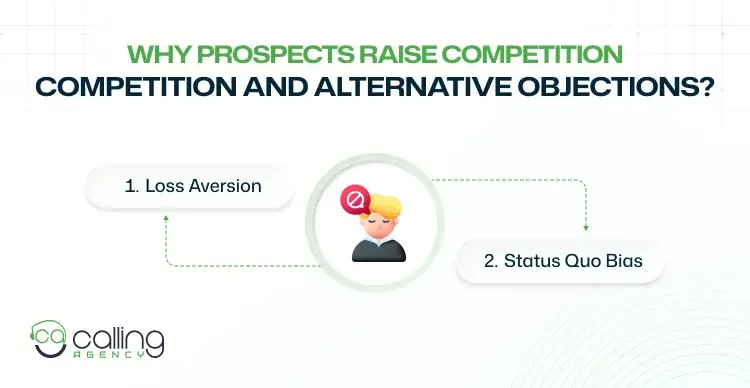
Loss Aversion
In most cases, the prospect you have approached isn’t comparing your tool to their current one. Rather, they are thinking about the risk, effort, and political exposure of switching.
They are more worried about the “cost of changing” their solution. To avoid this additional cost, they simply stick to what they have.
Status Quo Bias
This is a cognitive bias of humans, where they want to stay put with whatever works. They have a tendency to keep things as they are, even when better alternatives are coming in.
Your prospect may say, “we’re happy with our current setup”. While in reality they may not truly be satisfied, but rather they just feel comfortable with what they have.
Common Competition and Alternative Objections
Now, let’s get through some of the most common cold calling competitor objections I have heard over the years while providing cold calling services. Don’t worry, I will tell you how to navigate through these objections as well with the right script like:
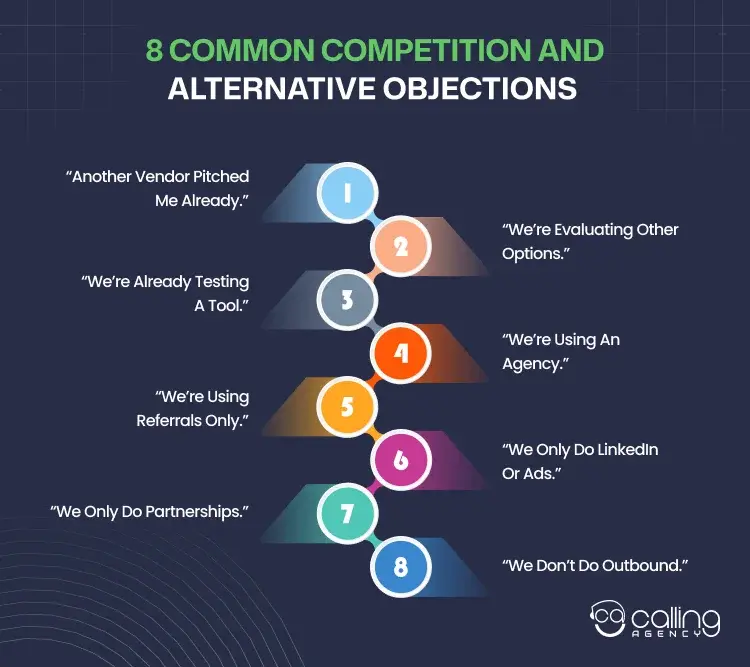
Objection 1: “Another Vendor Pitched Me Already.”
When the prospect says something like this, they are, in reality, trying to say that they have already spent energy on this. It’s not that they prefer the competition over you. But they are just tired.
Where most SDRs fail here is that they follow their script and launch a pitch. To the prospect, you become a noise rather than a solution. Here’s what you should do instead to handle the shut down:
“It’s completely understandable. If I were in your shoes, I wouldn’t want to go through another demo either. If they did a good job, then you probably have a clear picture of the whole thing.”
Doing this will validate their decision not to go through the whole thing again. They don’t feel pressured anymore. You instantly stand out from the other vendors who pitched. It feels like you are not competing, but you are curious.
That’s when you ask a question like –
“I’m just curious as to what they showed you to make you think this is something you need?”
With this question, you will bypass the gatekeeping. Then they will tell you their pain points themselves. If they are truthful, then you have learned what’s triggering their buying intent and what you have to build on.
Objection 2: “We’re Evaluating Other Options.”
When you hear something like this, you should definitely take it as a positive. Why? Because here they say they want to buy but don’t want to make the wrong call.
It means they are looking for an option, and you can be that. However, don’t just directly present your services and values. Use the Feel-Felt-Found framework here.
First, help them acknowledge that something needs to change within that conversation. You can say something like –
“I’m actually glad to hear that. Since you are evaluating, you are probably looking for a solution to your problems. You wouldn’t be spending time on this if something wasn’t already broken.”
Once you have gotten to this point. You can start with this question –
“While looking at the options, what’s the “must-have” criteria that you are using to filter out noises?”
This question allows you to get inside their evaluation framework. You will get to learn what matters to them. It ends up becoming your sales roadmap.
Objection 3: “We’re Already Testing A Tool.”
In this objection, what they are really saying is that they are committed to the trial and hoping it works for them, so they don’t have to look elsewhere. Now this is a harder wall to crack than the previous objections.
Here, they seem to be trying something out. So, challenging their current choice will only make it worse, as they will go defensive.
Don’t attack their tools. Instead, position yourself as a backup option. That way, you can be the next best option. You do this through Gap Selling by saying –
“That’s great, testing is the best way to see the cracks. Most of our best clients actually came to us after a pilot with [Competitor], specifically because of [a pain point common to that tool]. Doesn’t always happen, but it’s worth being aware of.”
With this, you plant a seed without attacking. You aren’t directly saying that their tool is bad. Instead, you are making them aware of a pattern. Then follow up with this question –
“Since you are already trying out, have you come across any red flags in the trial?”
Most prospects face issues during the trial period. So, they will tell you about something they found issues with. That’s where you find your opening.
Objection 4: “We’re Using An Agency.”
The “We are using an agency” or “We already have someone” response often refers to “I pay someone else to handle this so I don’t have to think about it”.
Now, this is a bit tricky because you are not directly talking to the decision maker in this scenario. The person you are talking to doesn’t even know if the problem they face is genuinely solved or not. In this scenario, you are not competing with a vendor. You are dealing with a belief that someone else has it covered.
The best approach to navigate through this is –
“Agencies are great for doing the heavy lifting, no doubt about it. Usually, we often get in when an agency hits a ceiling on [specific result].”
At this stage, you are not attacking the agency, but you are making them question whether they are getting what they are paying for. Or if the agency is solving the problem. Then you hit them with this question –
“How do you measure whether the agency is bringing fresh ideas versus just running the same playbook they’ve used for the last three years?”
Now, this is not a comfortable question for the prospect. But it gets them thinking about the situation and whether something needs to change or not. It can be your opportunity.
Objection 5: “We’re Using Referrals Only.”
Usually, a response like this tells you that they trust their network more than a sales representative. It shows their fear of a bad hire or purchase from someone they don’t know.
The perfect approach in this scenario would be leaning into the challenger sale tactic. You have to point out that referrals are safe and all, but they are being limited to several extents. Using a good cold calling script can phrase this objection like below –
“Referrals are the highest compliment a business can get. But the challenge I hear from other sales managers is that referrals are a bit static. You can’t just increase the numbers whenever you want or need.”
Essentially, you are agreeing with them here to lower their guard. Then you introduce a fundamental problem that they can’t even argue with. After that, you ask this –
“Does your referral network realistically support the volume if you ever need to double your pipeline in a short time?”
Most of the time, I received a “no” to this question. That’s where I got the opening, not by making them feel bad about their strategy, but simply pointing out the limitation.
Objection 6: “We Only Do LinkedIn Or Ads.”
These kinds of statements signal that they have found a comfort zone in one channel. What they are trying to say is that they are scared to try a new channel because they just don’t know the ROI.
In this case, they often miss out on the fact that they aren’t reaching the right audience. They fail to reach the senior buyers who never click on ads, who don’t respond to LinkedIn DMs. But in reality, they are the people with the money.
Try using this approach –
“Ads are a strong way to capture demand that already exists. We also stand by that. But along with that, we are also going after the ‘big fish’ who are a perfect fit but never engage with digital content.”
It will not replace their current channel, but complement it even more. What makes it even better is that you also point out what the current tactic is missing and how you can make it better. Combine this with the following question –
“What percentage of your LinkedIn leads actually turn into enterprise accounts, are they worth the sales cycle?”
I found a lot of success with this question because it brings up whether they have quality leads or not. If they say not much, then you have got a way forward.
Objection 7: “We Only Do Partnerships.”
It’s a straightforward way to say that they are in a partner ecosystem. Partners are great options for reliability and legitimacy. But what they lack is freedom.
In a partnership, they have to be dependent on the partner whose priorities can shift, attention can drift, and who has their own thing going on as well. At some point, the prospect will feel like they don’t have full control over this.
You present the situation like this –
“Partnerships are a gold mine. But relying on them means your growth is essentially in someone else’s hands. I work with companies to build an ‘owned’ channel so they have a predictable way to reach decision-makers regardless of what their partners do.”
It’s something the prospect already knows but doesn’t want to admit directly. Here, you are not saying partnerships are wrong, but you are bringing up that drawback they are already aware of. To take advantage of this, you can ask this question –
“What percentage of your new revenue is tied to your top two partners?”
The “revenue is tied” statement brings up a crucial point that might feel like a risk for the prospect. It eventually leads to them evaluating the partnership and how fragile the whole thing is.
Objection 8: “We Don’t Do Outbound.”
Something as direct as this often indicates they have had a bad experience before, or they simply don’t believe in the outbound culture.
Typically, it’s not about a competitor or a specific strategy. It’s more about not believing in your approach. They simply don’t see the value of your offerings yet.
This is where you get in with the value proposition play. You can break in with this statement –
“I completely get it, most cold outreach is actually just noise. But we don’t do that here. Our approach is highly targeted and data-driven, so we know who actually needs our help.”
It makes them feel you agree with their critique about the outbound approach while making you stand out from the “typical cold-calls”. Pair it up with this question to increase your chances –
“When you lose a deal to a competitor, how often is it because they got in the door six months before you did?”
This question hits them hard and reminds them of the times when they lost to their competitor, who uses an outbound approach.
Above common competition and alternative cold calling objections handling scripts and processes are not only objections they can also be used as data for further approaches once master handling those situations.
Conclusion
As you can tell by now, knowing how to handle competition and alternative objections is not about winning an argument. It’s more about opening a crack and finding the pain point of the prospect. Avoid trying to push your service directly.
Always approach by acknowledging their current situation, reframing the conversation to point out the blind spot, and then asking a question. You will surely find an opening, as I have.