



For commercial cleaning companies, property management firms have the potential to become valuable long-term clients. But winning these contracts takes more than sending a quote. You need to reach the right decision-maker, meet their vendor requirements and earn the opportunity to bid.
A consistent commercial cleaning lead generation process can help create those opportunities. From there, these eight steps can take you from prospecting to a signed contract.
How to Get Cleaning Contracts With Property Management Companies: 8 Steps
Getting a property management cleaning contract becomes easier when you follow a clear process instead of pitching every company the same way.
The goal is to become vendor-ready, target the right firms, reach the right person and prove your value on one property first.
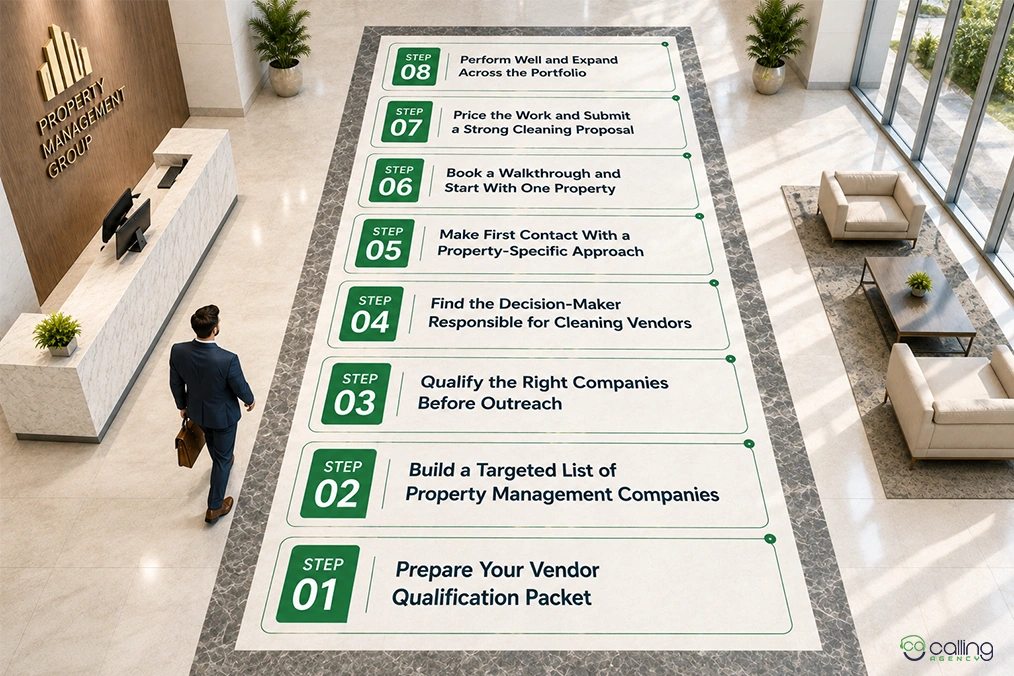
Here are the eight steps to follow:
- Prepare your vendor qualification packet
- Build a targeted list of property management companies
- Qualify the right companies before outreach
- Find the decision-maker responsible for cleaning vendors
- Make first contact with a property-specific approach
- Book a walkthrough and start with one property
- Price the work and submit a strong cleaning proposal
- Perform well and expand across the portfolio
Step 1: Prepare Your Vendor Qualification Packet
Most property management companies will not move forward with a walkthrough or bid until you meet their vendor onboarding requirements. Larger firms may use a compliance portal, while smaller companies usually send a checklist, and missing documents can delay your approval.
Your vendor packet should include:
- Business license
- Employer identification number
- General liability insurance
- Workers compensation coverage
- Janitorial or fidelity bond
- Signed W-9
- Certificate of insurance (COI)
- Additional insured endorsement
- Managed-property references
- Background check and hiring policy
- Safety data sheets for cleaning chemicals
- Sample scope of work and invoice
Keep these documents updated and ready to send in one folder. An expired certificate of insurance can remove you from an approved vendor list, while a sample janitorial service proposal and invoice can show that you have experience managing contract work.
What Insurance Do Cleaning Companies Need?
Cleaning vendors working with property management companies commonly carry four types of coverage:
| Coverage | What it covers | When managers require it |
| General liability | Property damage and injury to third parties | Usually required for every contract |
| Workers compensation | Injuries to your cleaning crew | Required once you employ staff |
| Commercial auto | Vehicles used between properties | Needed when crews drive for work |
| Janitorial bond | Employee theft inside occupied properties | Common for residential portfolios |
Insurance requirements vary by property management company. Some also require the management company and ownership entity to be named as additional insureds.
A missing or expired COI, no workers compensation coverage, no working business phone or no managed-property references can stop the process before a walkthrough is booked.
Step 2: Build a Targeted List of Property Management Companies
Focus on property management companies within a practical service range. The right list should show which firms manage properties you can actually serve and which buildings they currently control.
You can find target companies through:
| Source | What it gives you | Limitation |
| State real estate licensing rosters | Legal company names and addresses | May not show current properties |
| NAA, NARPM or IREM directories | Established firms and larger portfolios | Membership is voluntary |
| County rental registration lists | Rental properties and responsible parties | Availability varies by county |
| Commercial listing platforms | Buildings and firms handling them | Often focused on vacant properties |
| Signage on managed buildings | Proof of who manages the property now | Requires local research |
| Tenant review pages | Complaints and possible service issues | Reviews may be dated or unverified |
Use directories and public records to build the list, then verify current management through building signage, listings or other property-level signals.
Once you have a verified list, the next step is to reach those companies directly. B2B cold calling services can help you connect with property managers and find out who handles cleaning vendor decisions.
Step 3: Qualify the Right Companies Before Outreach
Qualify each property management company before you engage. Otherwise, you may waste time on poor-fit firms.
Qualify each firm before outreach based on:
- Portfolio type: Residential, commercial or mixed-use properties require different cleaning services.
- Portfolio size: Larger portfolios often have more formal vendor approval processes.
- Buying structure: Some firms choose vendors centrally while others leave the decision to on-site managers.
- Geographic density: Properties close together help protect travel time and labor margins.
- Vendor signals: Management changes, ownership transitions or recurring tenant complaints may signal an upcoming vendor review.
These signals can also help you focus on prospects that are more likely to turn into successfully closed janitorial appointments.
Remove companies with properties outside your workable service radius before spending time on outreach.
Step 4: Find the Decision-Maker Responsible for Cleaning Vendors
Identify the key decision-makers in B2B companies who control cleaning vendor decisions before outreach. The right contact usually depends on the company size and buying structure.
| Role | What they know | Can they sign? |
| On-site property manager | Building issues and current vendor performance | Sometimes |
| Regional or portfolio manager | Vendor performance across several properties | Usually |
| Director of operations | Vendor standards and approval process | Yes |
| Owner or managing broker | Overall operations at smaller firms | Yes |
| Maintenance supervisor | Problems the current vendor misses | No |
| Leasing agent or front desk | Who handles vendor decisions | No |
Maintenance supervisors cannot usually sign, but they can tell you where the current vendor is falling short. That information can help you approach the actual decision-maker with a stronger reason to talk.
Step 5: Make First Contact With a Property-Specific Approach
Start with the property office instead of the corporate line. Ask who manages cleaning vendors, use the call to make first contact and use email to send documents or follow up.
Keep the first contact simple:
- Introduce yourself and your company
- Name the specific property
- Mention one relevant observation
- Ask about the current cleaning arrangement
A property-specific opening gives the manager a reason to listen. If your goal is to turn these conversations into booked meetings, janitorial appointment setting can help you reach and qualify the right decision-makers.
Ask when the current contract comes up for review. If there is no response, call again after a few days, send useful information by email and check in every three to four weeks.
Step 6: Book a Walkthrough and Start With One Property
Ask for a walkthrough instead of pitching the entire portfolio for the job directly. It gives the manager a chance to show the property, explain current cleaning problems and discuss the scope before you price the work.
Start with one building or a small batch of unit turnovers rather than asking for every property at once. For residential portfolios, turnover cleaning can be a strong entry point. For commercial properties, common-area cleaning often works better.
If you agree to a trial, keep it at your normal rate, set a 30- to 60-day period and confirm the review date in writing.
Step 7: Price the Work and Submit a Strong Cleaning Proposal
Build your bid around the actual cleaning scope and the labor hours required. Start with the cleanable area and work out how long each part of the job will take. Then factor in wages, supplies, equipment, overhead and your margin.
| Step | Example input | Output |
| Measure cleaning service area | 20,000 sq ft carpet + 5,355 sq ft hard floor | 25,355 sq ft |
| Calculate task time | 2 hours vacuuming + 1 hour mopping | 3 hours per visit |
| Multiply by annual visits | 3 hours × 260 visits | 780 hours |
| Apply wage | 780 × $17.71 | $13,813.80 |
| Load labor cost | $13,813.80 × 1.30 | About $17,960 |
| Add final costs | Supplies, equipment, overhead and margin | Final bid |
This example covers vacuuming and mopping type of jobs only. A real bid should also account for restrooms, trash, dusting, travel between properties and access restrictions.
Your proposal should clearly show the areas cleaned, service frequency, staffing plan, complaint response time, monthly and annual pricing and insurance coverage. Keep scope and pricing separate when possible.
Also list exclusions such as carpet extraction, exterior window cleaning, post-construction cleanup, biohazard work and unit trash-outs. Require written approval before extra work begins.
For apartment turnovers, price per unit by bedroom count and condition rather than hourly. Charge more for heavy-condition units or urgent same-day work.
Avoid underbidding just to win the contract. A very low price can make managers question whether you fully understand the scope.
Step 8: Perform Well and Expand Across the Portfolio
Once you win the first property, focus on consistent service, fast complaint resolution and clear reporting. A short monthly update can show completed work, issues found and how they were handled.
Use quarterly reviews to ask for the next property by name instead of pitching the entire portfolio. You can also expand through services such as day porter coverage for lobbies and restrooms.
Track how many walkthroughs turn into signed contracts and how many contracts expand into additional properties. Reviewing these sales funnel conversions can show where opportunities are moving forward or dropping off.
Rate increases are easier to justify at renewal, after documented wage increases or when the scope has grown. Keep change orders and payroll records so you can show exactly why the price needs to change.
Want a More Detailed Guide?
If you want to understand the process in more detail, this video gives you a practical walkthrough of how to approach and win property management cleaning contracts:
Final Thoughts
Property management contracts can become a strong source of recurring revenue for commercial cleaning companies. But winning them requires the right preparation and outreach. Get your vendor documents ready, focus on firms you can realistically serve and approach the right decision-maker with a clear reason to consider your company.
Start with one property, deliver consistent results and use that performance to earn the next opportunity. Over time, one successful contract can open the door to more buildings and a much larger share of the same portfolio.
Frequently Asked Questions
Do you need a license to clean for property management companies?
You generally need a business license for the jurisdictions you serve. Some cities may also require janitorial registration. Property managers usually verify your license, insurance and tax information during vendor onboarding.
How long do property management cleaning contracts last?
Contract length changes by property management company. Many agreements run annually and may renew automatically. Larger portfolios may use a master service agreement with separate schedules for each property, while termination terms usually allow either side to exit with written notice.
Can a solo cleaner get property management contracts?
Yes. Solo cleaners can win small buildings and apartment turnover work. Larger portfolio contracts usually require enough staff to cover absences and multiple properties, along with the insurance and bonding required during vendor approval.
Why do property managers change cleaning companies?
Property managers often switch vendors after repeated service problems, missed visits, staffing issues or poor communication. Ownership changes and management transitions can also trigger a formal rebid or RFP for cleaning services.