



A cold call script A/B test involves testing two sales scripts with similar prospects and selecting the winning script based on the calling results. It works when there are single variables to test, the test gets equal attention and the calling team measures the same thing from beginning to end.
TL;DR
To A/B test a cold call script: form a testable hypothesis, use one parameter in the script, generate two variations and randomly distribute equal prospects. Measure the same main KPI from the call recordings and wait for the required sample size. Compare the quality of meeting and conversion metrics and choose the best one.
Key Takeaways:
- Test your scripts one by one.
- Use similar prospect groups for both versions.
- Let every SDR test both variants when practical.
- Track meetings booked per conversation or another predefined primary metric.
- Calculate sample size and start the experiment.
- Review call recordings alongside conversion data.
- Check meeting attendance and qualified opportunities.
- Document every result and start another experiment.
How to A/B Test a Cold Call Script Step by Step
Try A/B testing your cold call script with these 10 steps and your existing sales team, CRM and dialer.
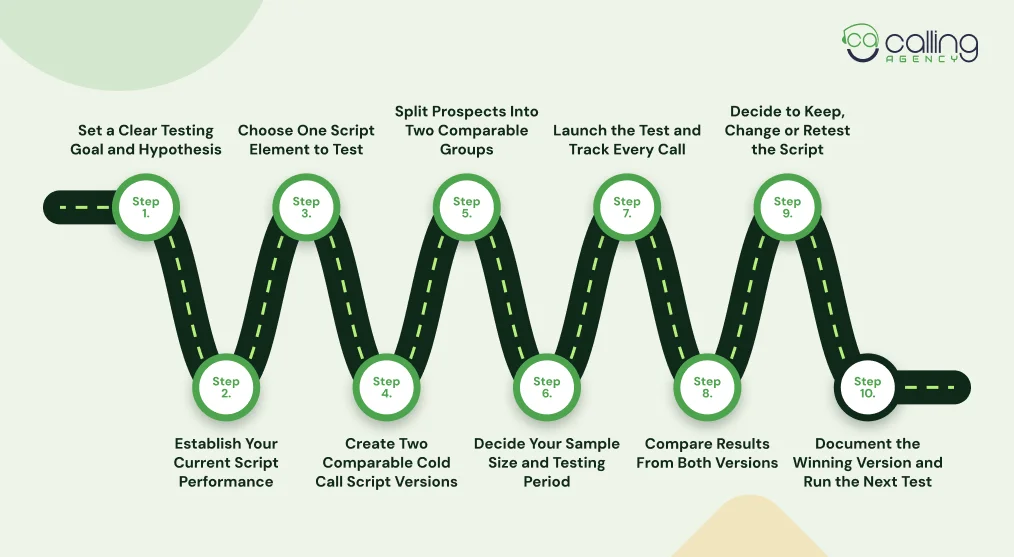
Step 1. Set a Clear Testing Goal and Hypothesis
Decide what you want to improve. Now, A/B testing your script can affect many aspects of a sales conversation, so you need to set a specific goal.
Your objective might be to:
- Increase qualified conversations.
- Get more prospects past the opening line.
- Improve meeting booking rates.
- Reduce early hang-ups.
- Get more qualified leads into the sales pipeline.
- Improve appointment setting results.
Select a single key metric for the experiment.
Then, draft a hypothesis regarding the change that you would like to test and the outcome that you expect. Remember that the goal, user base and key metric should all stay the same during the experiment.
Step 2. Establish Your Current Script Performance
Before creating another version, measure how the existing script performs.
Your current script becomes Variant A, the control. Use recent CRM data from a representative period to establish its baseline conversion rate.
Review the last four weeks of calls if the team has enough consistent data. Compare similar prospect segments and calling conditions.
Record:
- Total calls made.
- Live connects with target prospects.
- Meaningful conversations.
- Meetings booked.
- Meetings held.
- Qualified opportunities created.
- Common objections.
- Average call duration.
Check the prospect list too. You should test out your ideal customer profile (ICP). Make sure the company size, location, industry and the buyer’s role is really what you’re looking for.
Step 3. Choose One Script Element to Test
Choose one part of the call based on your existing performance data.
Do not rewrite the entire cold call script. If you change so many factors at once, it’ll be tougher to determine what really made a difference.
Start with the section causing the most friction.
For example:
- If prospects hang up early, test the opener.
- If they’re listening but not engaged, test the value prop.
- And if your conversations end with no decision or next step, test the CTA.
- If common objections stop conversations, test the objection-handling response using an objection-handling framework for cold calling.
Here are some common elements for cold call script testing:
| Script Element | Testing Opportunity | Primary Outcome |
| Call opener | Company-focused vs. problem-focused | Meetings per live connect |
| Reason for calling | General introduction vs. specific business problem | Positive response rate |
| Value proposition | Feature-focused vs. outcome-focused | Qualified conversation rate |
| Discovery question | Broad vs. specific question | Conversation progression |
| Objection handling | Direct response vs. acknowledge and redirect | Objection pass-through rate |
| Call to action | Soft meeting request vs. direct meeting request | Meeting booking rate |
We recommend starting with either the opener or value proposition. Because they both occur right at the beginning of a cold call and can determine whether a prospect remains engaged, test deeper sections after establishing a reliable opening.
Step 4. Create Two Comparable Cold Call Script Versions
Make Variant A & B with that basic cold call script structure. Change up the element you chose in Step 3. Keep everything the same.
The discovery questions, value proposition, objection responses and meeting request also remain unchanged. This isolates the opening statement as the main variable.
Before launching the test, check both versions for:
- Similar length and speaking time.
- Clear wording and a natural tone.
- Matching product claims and offers.
- Consistent follow-up instructions.
- The same CTA and meeting length.
Save both versions under clear names. Keep a copy of the original control script for future reference.
Step 5. Split Prospects Into Two Comparable Groups
Assign prospects to Variant A or Variant B. Random assignment gives both versions a fair chance with similar prospects. It also reduces the chance of reps choosing easier prospects for their preferred script.
Use a single Clear Segment. For instance, your prospect list could include operations managers at logistics firms with between 50 and 500 employees.
Use a CRM or a spreadsheet to randomly divide your list:
| Prospect | Company Size | Assigned Variant |
| Prospect 001 | 120 employees | A |
| Prospect 002 | 280 employees | B |
| Prospect 003 | 95 employees | B |
| Prospect 004 | 410 employees | A |
| Prospect 005 | 175 employees | A |
| Prospect 006 | 320 employees | B |
Follow these rules during assignment:
- Use the same prospect source for both groups.
- Keep company size and buyer roles comparable.
- Avoid assigning one industry to A and another to B.
- Keep calling windows balanced.
- Prevent the same contact from receiving both versions.
Step 6. Decide Your Sample Size and Testing Period
Figure out the number of calls per version you need. The required sample size ultimately boils down to two things.
- Your base conversion rate
- The smallest improvement you want to detect.
For this example, assume the sales team has a baseline meeting booking rate of 5%. It wants to test whether a new script can increase the rate to 10%.
A standard two-proportion sample size calculation with a 5% significance level and 80% statistical power gives a requirement of roughly 425 to 435 live conversations per variant, depending on the calculation method.
This means the team needs approximately:
- 435 live conversations using Variant A.
- 435 live conversations using Variant B.
The timeline depends on how many prospects your team or cold calling service can reach each week.
Therefore, pick a start date and calculate an approximate end date based on your call capacity. Cover normal working days and calling windows.
Step 7. Launch the Test and Track Every Call
Once both versions are ready, distribute the scripts and start calling.
Give every SDR clear instructions about the assigned variant and the exact wording under test.
Create a required CRM field called Script Variant with two values:
- Variant A
- Variant B
Record the assigned version against each prospect. Keep the same assignment during call follow-ups.
Track these details:
- Prospect and company.
- Assigned script version.
- SDR name.
- Call date and time.
- Number of attempts.
- Live connect status.
- Call disposition.
- Meeting booked.
- Meeting held.
- Qualification status.
- Call outcome.
Use call recordings to check script follow-up. Review a selection of recordings from both groups during the experiment.
Also keep normal compliance procedures in place. Maintain Do Not Call (DNC) suppression, caller ID checks and approved sales claims across both variants.
Step 8. Compare Results From Both Versions
After reaching the planned sample size, compare both versions using the same primary metric and denominator.
For our example, the primary metric is meetings booked per live connection.
Suppose the sales team completes the following hypothetical experiment:
| Result | Variant A | Variant B |
| Live connects | 440 | 440 |
| Meetings booked | 22 | 44 |
| Meeting booking rate | 5% | 10% |
| Meetings held | 18 | 35 |
| Qualified opportunities | 9 | 18 |
Variant B generated 2x the number of meetings from the same number of live connections.
The team can pay more attention to the quality of meetings and qualified opportunities, especially when A/B testing across B2B funnel. Even if there are more bookings, it doesn’t mean the opportunities are higher quality.
When diving into statistical comparisons, you have the option to choose from two proportion tests.
Step 9. Decide to Keep, Change or Retest the Script
You’ve looked at the results and now have to make one of three decisions:
Keep Variant B
If the new version is outperforming the original, meeting your metrics and holding your quality expectations, then go ahead and implement it. Be sure to update the cold call script and inform sales about it.
Keep Variant A
If the new call script isn’t outperforming or isn’t much of an improvement over the old one, then keep the same call script. There’s no need to replace a good script just because the other one looks better.
Run another test
Retest if the result remains inconclusive. You may need more data, a clearer script difference or a better-defined prospect segment.
For example, both versions may produce similar meeting booking rates. Call recordings might reveal a common objection after the value proposition. The next experiment could compare two objection responses.
Step 10. Document the Winning Version and Run the Next Test
Once the team selects a winner, update the official script and save the experiment results.
Record:
- The original hypothesis.
- The tested script versions.
- The variable changed.
- Prospect segment.
- Sample size.
- Test duration.
- Primary metric.
- Final conversion rates.
- Statistical findings.
- Call review observations.
- Final decision.
Keep a version history so that each team can keep track of what changed from one version to the next. The winning version gets used as the new control in the next round.
Say you optimize an opener and discover a new value proposition. You could then test this new value prop with the winning opener and thus have a new test.
This creates a repeatable cold call script testing process. Each experiment builds on the previous result instead of restarting from personal preferences.
What Should You Test in a Cold Call Script First?
Start with the part of the conversation causing the most measurable friction. For many outbound teams, the call opener lines and value proposition are sensible starting points.
Use the following testing order as a guide.
| Priority | Script Element | Variant A | Variant B | What to Measure |
| 1 | Opener | Company focused | Problem focused | Conversation progression |
| 2 | Reason for calling | General reason | Prospect-specific reason | Positive response rate |
| 3 | Value proposition | Feature focused | Outcome focused | Qualified conversations |
| 4 | Discovery question | Broad question | Specific pain point question | Conversation progression |
| 5 | Objection handling | Direct product response | Acknowledge and redirect | Objection pass-through |
| 6 | CTA | Soft meeting request | Direct meeting request | Meeting booking rate |
Which Metrics Should You Track During a Cold Call Script Test?
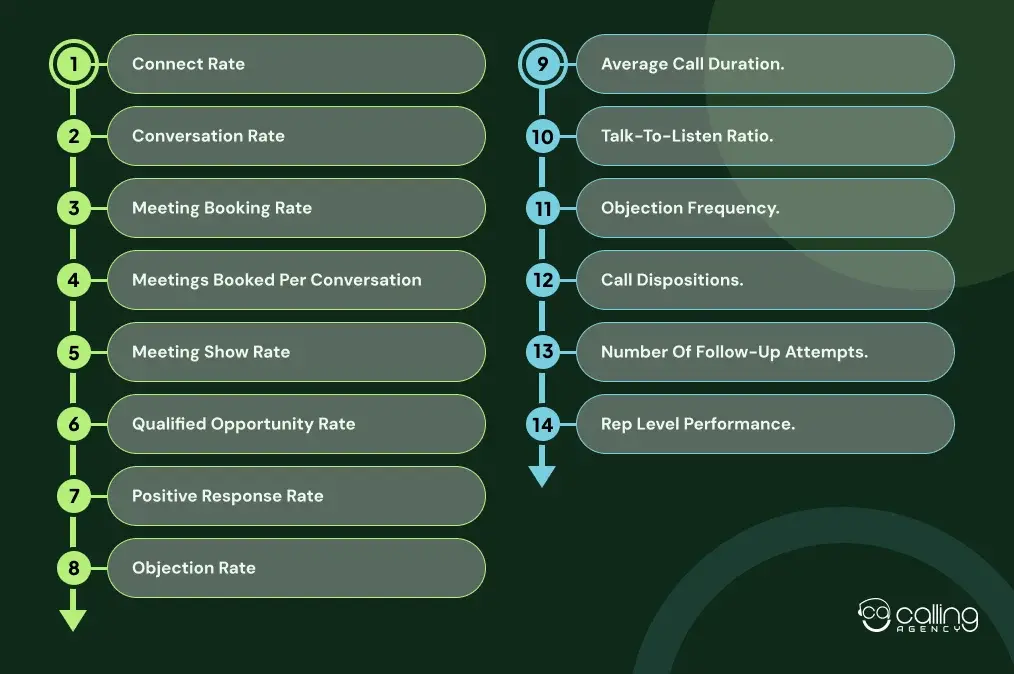
If you’re testing a cold call script, there are metrics you should be monitoring to make sure you’re assessing the effectiveness of your call script. But you shouldn’t be looking at the connect rate alone.
Use one primary metric and several supporting metrics.
| Metric | Formula | What It Measures |
| Connect rate | Live connects ÷ total dials × 100 | How often calls reach a person |
| Conversation rate | Meaningful conversations ÷ live connects × 100 | How often prospects engage beyond the opener |
| Meeting booking rate | Meetings booked ÷ live connects × 100 | Meetings generated from answered calls |
| Meetings booked per conversation | Meetings booked ÷ meaningful conversations × 100 | Meeting conversion after engagement |
| Meeting show rate | Meetings held ÷ meetings booked × 100 | Attendance after booking |
| Qualified opportunity rate | Qualified opportunities ÷ meetings held × 100 | Downstream opportunity quality |
| Positive response rate | Positive responses ÷ meaningful conversations × 100 | Prospect interest |
| Objection rate | Conversations with a selected objection ÷ meaningful conversations × 100 | Frequency of a specific objection |
Also monitor:
- Average call duration.
- Talk-to-listen ratio.
- Objection frequency.
- Call dispositions.
- Number of follow-up attempts.
- Rep level performance.
How Many Calls Do You Need to A/B Test a Cold Call Script?
At a 3% meeting booking rate, a test needs 749 live connections per version to detect an increase to 6%. That’s far more than Apollo’s suggested 50 to 100 connections per version.
Smaller improvements need even larger samples. So decide the improvement worth detecting. This is your minimum detectable effect (MDE).
We calculated the table below using the pooled normal approximation formula without continuity correction. It assumes equal groups, a two-sided 5% significance level and 80% statistical power. All sample sizes are rounded up.
Use your recent CRM data to estimate the starting rate. Keep the same prospect segment, script conditions and conversion definition for both groups. Meeting rate here means booked meetings divided by live connections.
| Metric | Starting rate | Rate to detect | Connects per version |
| Meetings per connect | 3% | 4.5% | 2,518 |
| Meetings per connect | 3% | 6% | 749 |
| Opener continuation rate | 20% | 30% | 294 |
| Opener continuation rate | 30% | 40% | 356 |
| Opener continuation rate | 40% | 50% | 388 |
At 50 connections per version and a 3% meeting rate, each version produces an expected 1.5 meetings on average. At 100 connections, the expected number is only three.
Another booking bumps the net rate by 2 percentage points at fifty connections and 1 percentage point at one hundred.
How Do You A/B Test Cold Call Scripts With a Small Team?
You can easily run cold call script tests with a small team using only a simple prospect list, 2 scripts, and a spreadsheet.
Follow this process:
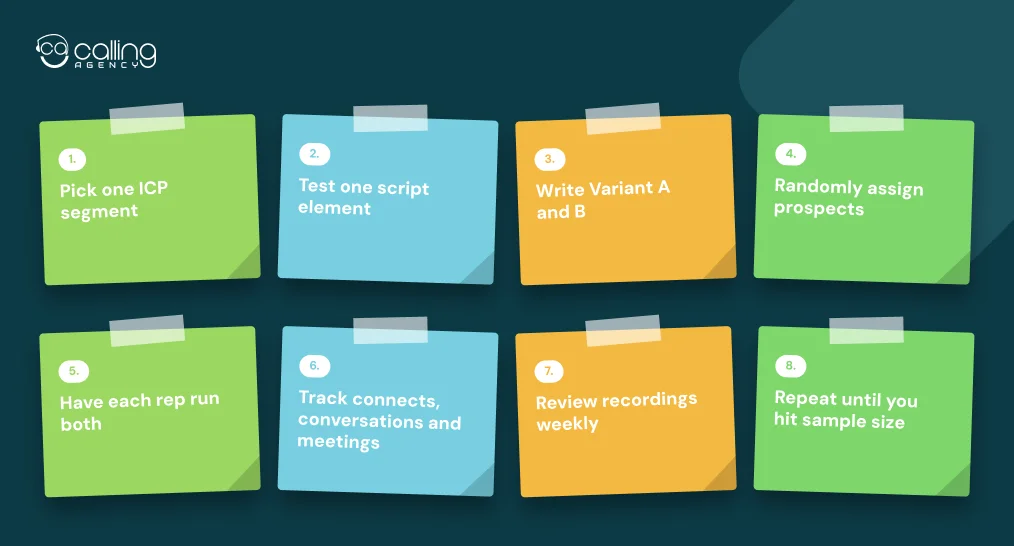
- Pick one ICP segment.
- Choose one script element to test.
- Create Variant A and Variant B.
- Randomly assign prospects in the shared spreadsheet.
- Have each rep use both versions where possible.
- Track the number of connections, conversations and meetings booked.
- Listen to call recordings weekly.
- Repeat until sample size target is achieved.
Timing on this experiment will take longer if you only have a couple of SDRs in your team. Also, avoid running several tests at once. Start with the opener, complete that experiment, record the results, then move on to the value prop.
Use Google Sheets or Excel to record each prospect’s assigned version and outcome. A simple CRM with consistent call dispositions can also support the process.
If the team cannot reach the required sample size, treat early findings as directional. Look for repeated patterns in call recordings, test a larger wording difference and repeat the experiment when more data becomes available.
Do not present a small sample as proof of a universal winner. In the NIST handbook, Fisher’s exact test can help compare booking rates between two script versions with small samples. Yet statistical significance does not guarantee the same results across all prospect segments.
Common Mistakes to Avoid When A/B Testing Cold Call Scripts
Small errors in experiment design can make the results misleading. Avoid these mistakes during cold calling script tests.
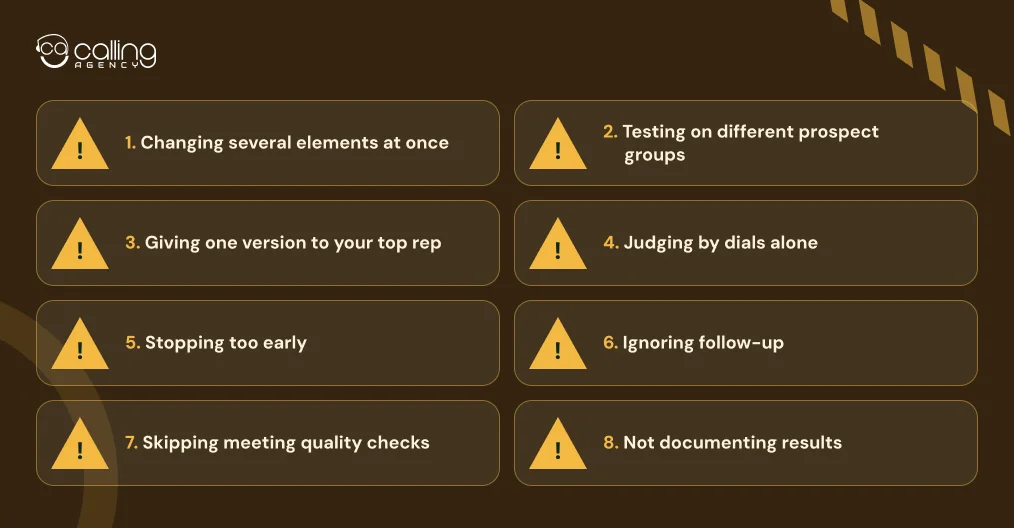
- Changing multiple script elements at once. A new opener, value proposition and CTA in Variant B make the results difficult to interpret.
- Comparing different prospect groups. Testing A on enterprise buyers and B on small businesses creates an unfair comparison.
- Assigning one version to your best rep. A strong SDR can outperform other reps with either script.
- Using total dials as the only success metric. Call volume measures activity instead of script performance.
- Ending the test too early. A few additional meetings do not prove a script is better.
- Ignoring script follow-up. Reps may combine both versions or improvise the tested line.
- Measuring meetings without checking quality. A higher booking rate can come with more “no-shows” or unqualified prospects.
- Failing to document results. Without a test record, the team may repeat old experiments or lose track of the approved version.
Frequently Asked Questions
What is a confidence interval?
A confidence interval gives a range of plausible values for the actual difference in meeting booking rates between two cold call scripts.
Should every SDR test both versions of a cold call script?
Ideally, yes. Let each SDR use both versions with randomly assigned prospects. This reduces the effect of individual rep performance on the comparison. If separate groups must use separate scripts, balance experience levels and include rep performance in the analysis.
How often should sales teams update their cold call scripts?
Review performance regularly, but update wording after a completed experiment or a clear change in product, audience or buyer concerns. Quarterly reviews can help teams catch declining conversion rates and repeated objections.
Should reps read a cold call script word for word?
They can just use it to learn its structure. But live calls require natural conversation. They should adapt to the prospect’s responses. Also, keep the tested message consistent.
What should reps do when a prospect takes the call off script?
When a prospect takes a call off-script, sales reps should treat it as an opportunity to diagnose real pain points. Do not panic or force the conversation back onto rigid rails.