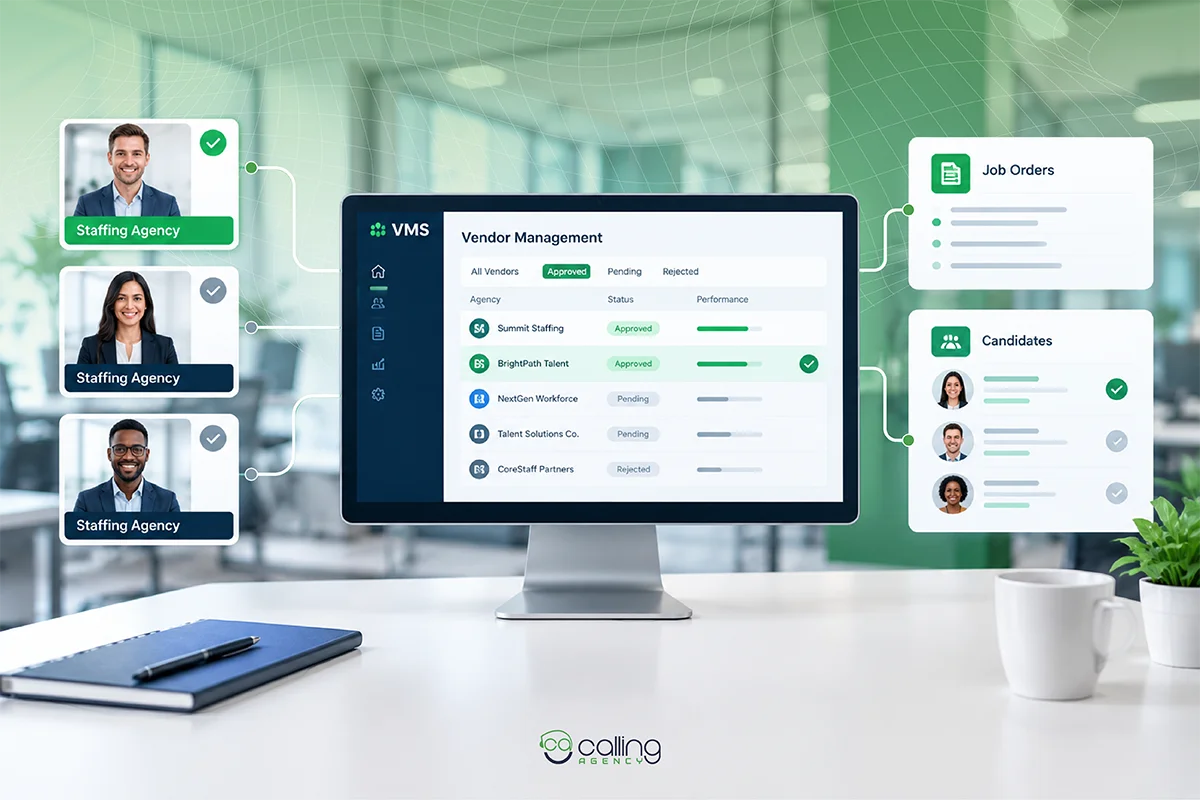


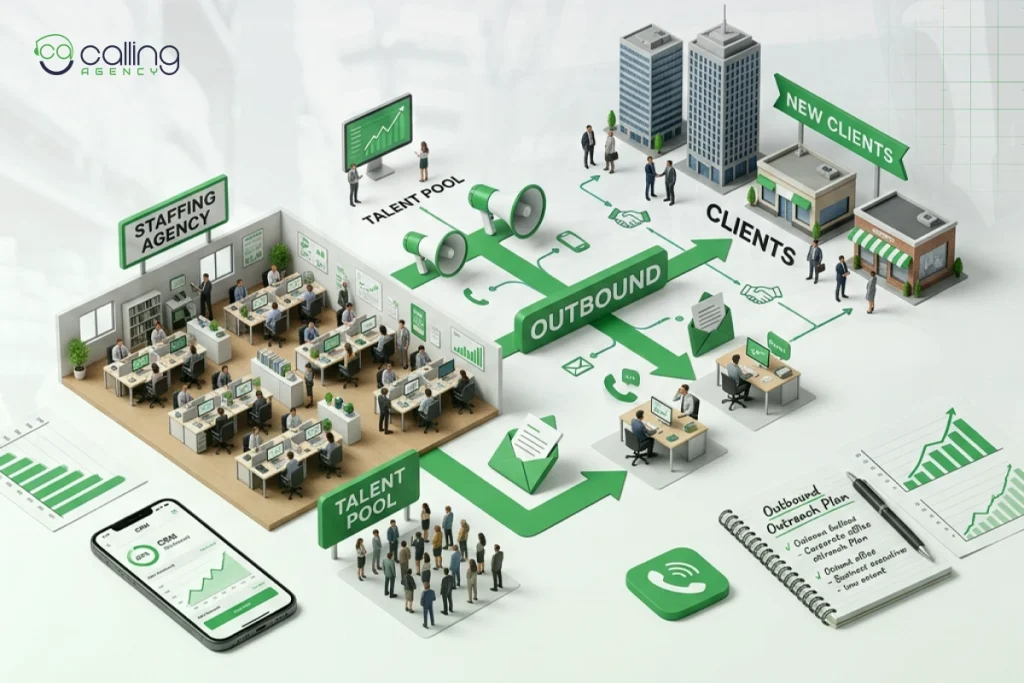
Staffing agencies typically have various methods of contacting potential new clients, including approaching companies that are currently looking to recruit new employees and getting in touch with key personnel in the company. They follow up through email and LinkedIn. Referral services can help, although they mostly do not provide much control over the process.
As a staffing agency owner, it is important to use outbound methods, which can specifically help your agency reach the lead sooner than the competition. You can also use services for staffing agency leads to have an automated appointment-setting cycle while the agency’s recruiters are actively placing candidates.
What Results Should You Expect From Outbound?
You can expect to see interested prospects and appointments set up within a couple of weeks of starting the outreach process. But signing staffing agreements and receiving job orders may take more time. Your overall results depend on the types of businesses you target, the positions you can offer and how well your team can handle the follow-up process.
In an outbound campaign for a U.S. based staffing company, CallingAgency has a record of scheduling 223 qualified meetings in 7 months. The team also shared that more than 150 target companies and moved over 40 opportunities into serious sales conversations. These statistics present the reported results of the agency. Don’t take them as guaranteed outcome numbers for every agency.
Track meetings and contracts both separately. A hiring manager might agree to a meeting but not have an immediate job order. Another employer might need three approvals before adding a new staffing vendor.
Market conditions matter too. When companies don’t have much to spend on staffing, then your pitch needs to be more specific to solve a certain hiring problem. It would be more beneficial than just offering the usual generic recruitment support.
Industries With More Job Openings Than Hires
Beginning with the industries where companies apparently report more job openings than hires would be a smart move. After that, narrow down your list to companies that need the roles your agency can contribute to.
The U.S. Bureau of Labor Statistics (BLS) has reported the below-mentioned preliminary figures for August 2026. The openings-per-hire ratios below are calculated from the reported opening and hiring counts.
| Industry | Job openings | Hires | Openings per hire |
| Finance and insurance | 353,000 | 110,000 | 3.2 |
| Information | 123,000 | 44,000 | 2.8 |
| Health care and social assistance | 1,359,000 | 703,000 | 1.9 |
| Manufacturing | 522,000 | 332,000 | 1.6 |
| Total private sector | 6,348,000 | 4,846,000 | 1.3 |
| Business services | 1,186,000 | 935,000 | 1.3 |
| Trade and transportation | 1,287,000 | 1,085,000 | 1.2 |
| Accommodation | 713,000 | 750,000 | 1.0 |
| Construction | 251,000 | 308,000 | 0.8 |
These numbers help you decide where to start prospecting for outbound reach. They don’t mean that every employer in an industry struggles to hire.
As an example of a light industrial staffing agency, they may target clients that are manufacturers who often require workers such as forklift operators and warehouse workers or production workers daily. On the other hand, a finance and accounting recruiter would want to work with business-related firms that are in need of accountants or financial analysts.
It would be a smart move to always keep yourself updated with the current BLS statistics on a monthly basis. Then confirm actual hiring needs during your pitch calls. Industry-level figures cannot tell you which specific positions an employer needs to fill but can give you an idea of the statistics.
Who Do You Call First in Each Staffing Segment?
Start by contacting the person who has the highest level of authority to deal with the hiring issue. Then find out who has the authority to approve the staffing agreement. The person who finally signs the agreement may not be the same decision-maker. Depending on the organization, the agreement has to go through the HR department, the procurement office or the administration, among other options. In any case, having the information about the right person to contact in order to market staffing services will save your staff time dealing with irrelevant individuals.
| Staffing segment | First contact | Likely contract approver |
| Light industrial | Plant or operations manager | Operations leader or HR |
| IT staffing | Engineering hiring manager | Engineering leader or procurement |
| Healthcare staffing | Facility scheduler or director of nursing | Facility administrator |
| Executive search | CEO | CEO or board |
| Office and administrative staffing | Office manager | HR or business owner |
A small manufacturer might let its operations manager select an agency. A large corporation may require approval from HR, procurement or a managed service provider if they have any.
Start with companies that quite resemble your existing clients. If you have placed warehouse workers successfully in Dallas, contact similar employers in the same area before expanding into unrelated markets.
If you have no clients yet, start where you have placed people before. Your past placements show which buyers already trust the kind of talent you supply. Call similar companies in the same industry and city first to know what kind of contact to reach out to depends on the size of the company and how they buy. For example, a small company has the right to let the operations manager choose the vendor. At the same time, a large corporation may require the approval of departments such as HR, purchasing or MSP if it has any.
Don’t forget to start with companies closely related to your existing clients. For example, if you have successfully filled the position of warehouse workers in Dallas, reach out to employers with similar demands and in the same area before looking for unrelated markets.
In case you have no clients yet, begin with those who have previously hired you. The companies you have hired people for presumably already trust you as a recruiter. Start with contacting companies in the same field that hire in the same city.
Build the Prospect List and Plan Outreach Process
You should keep in mind 3 factors while building your ideal client profile:
- Industry
- Company size
- Hiring needs
A well-researched and qualified list of prospects will be more useful than having a large database of unorganized contact information about businesses that might require staffing in the near future, but not now. If you understand how to build a prospect list around hiring signals, then it will give your callers a clear reason to reach out to specific accounts.
You can implement the following 6-step procedure for outreach:
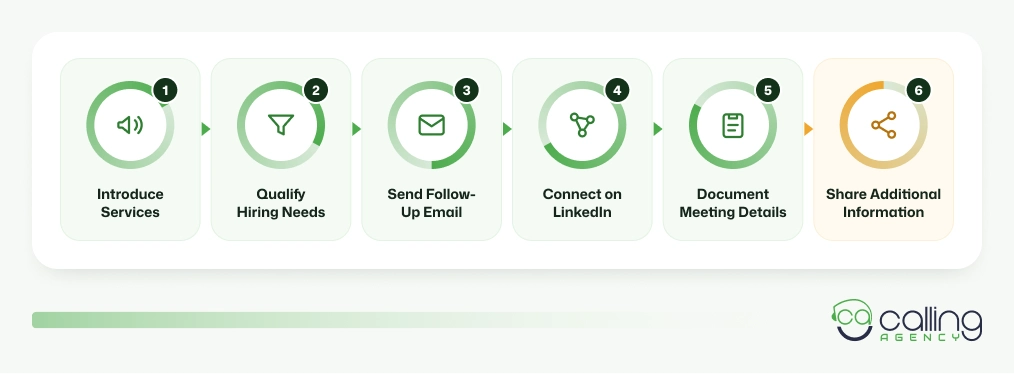
- Introduce the agency’s services and find out whether there are any job openings at that moment.
- Ask how many vacancies they currently have, how fast the vacancies have to be filled and by what time they need the staff to help with the recruitment work.
- Make sure to summarize the details of the phone conversation and send a follow-up email with the information on how your agency can help.
- Send them an invitation to connect on LinkedIn with a short personalized note.
- Write a note with the list of those who are going to attend the meeting, the date of the meeting, the number of job openings and the work schedule that you are about to carry out.
- Share with the recruiter or the owner of the agency if they need any information.
Try to review your results every week. If people answer but rarely accept meetings then reconsider your opening pitch. If meetings happen but produce no job orders then improve your qualification questions.
What to Say on the First Call
Keep the first call short but catchy. But make sure to share these 3 things with the prospect:
- Which roles you can offer,
- Explain briefly why you called
- Ask one specific question about their current hiring needs.
You can start with a recruitment agency cold calling script, but adjust the tone according to the flow of the conversation. For example, a light industrial staffing agency could say:
“Is this {{Manager Name}}? This is {{Caller Name}} with {{Agency Name}}. We help manufacturers in your area fill forklift operator and warehouse positions. Are you having any trouble covering shifts or filling open roles right now?”
If the manager is willing to talk, ask these 3 questions to get a basic idea:
- How many positions are open right now?
- How long have those positions been open?
- Who approves new staffing agency agreements?
The 3 questions will help you figure out what you need and also who is in charge of approving a new vendor for you.
Your offer must match your own services as well as the requirements of the company. You may analyze your outbound lead generation process in order to discover where prospects discontinue their reply.
When They Say “Go Through HR”
“Go through HR” phrase generally conveys the idea that HR, procurement or a third-party business service provider contracted with the MSP is now controlling which supplying agencies can cooperate with them. To avoid unnecessary circumstances, it would be wise to inquire as to who is accountable for the approved vendor list in this particular case and how your agency may make an application to the said list.
It would be better if you consulted the hiring manager concerning the position they intend to fill, what documents should be submitted for application and when they expect to start working with new staffing agencies.
In case the company is already dealing with other agencies, find out when it has checked its staffing suppliers last time and what challenges do current suppliers encounter while filling up different positions.
For example:
“I understand you already work with staffing partners. Are there any roles or shifts they have difficulty covering? I’d like to understand whether our team could help with those specific needs.”
The answer gives you a more useful reason to approach HR than simply asking to join the vendor list.
Is It Legal to Cold Call Businesses for Staffing?
Mostly yes. However, the rules will differ based on the approach of calling, the numbers used and the state laws.
The Federal Trade Commission’s Telemarketing Sales Rule does generally exempt business-to-business calls aimed at selling goods or services to a business. However, there are exceptions to the exemption and it does not eliminate all legal duties. The rule prohibits some forms of deception.
The Telephone Consumer Protection Act (TCPA) also prohibits the use of autodialers or prerecorded messages in some circumstances
Before launching a campaign, check the following:
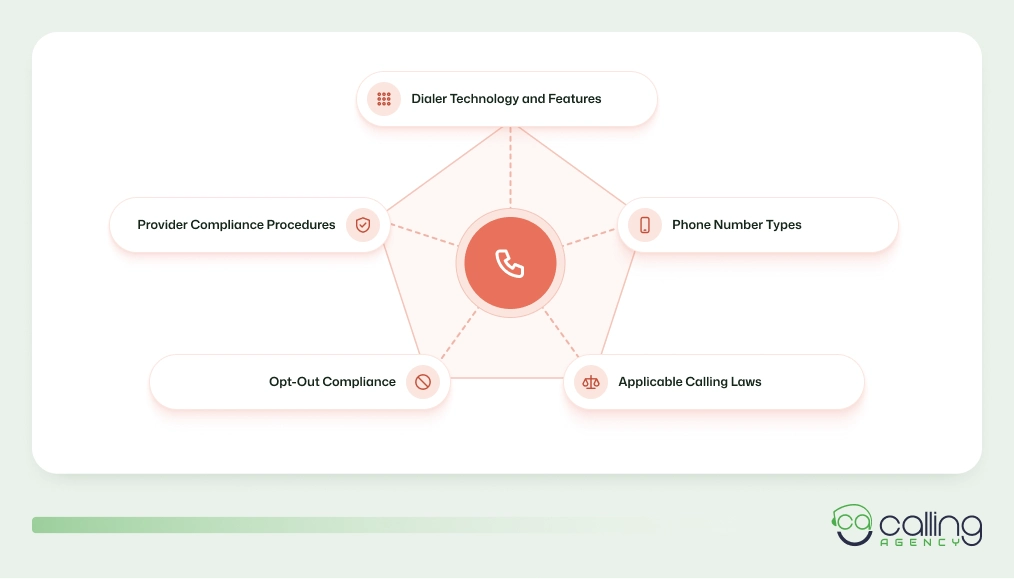
- Whether your dialer uses an automatic telephone dialing system or prerecorded messages.
- Whether the numbers belong to business landlines or mobile phones.
- Which federal and state rules apply to your campaign.
- Whether your process respects applicable requests to stop calling.
- Whether your calling provider can explain its compliance procedures.
This is general information. Don’t take it as legal advice. Seek assistance from a legal expert who is able to assist you with making outbound calls, especially if your company makes use of automation or if you operate in more than one state.
Turn the First Job Order Into an Account
After the first placement of a worker, follow up with the hiring manager to ensure that the job has been carried out properly and on time. Take care of any issues that arise so that your agency can establish a contract for future recruitment.
Always keep these 3 factors in mind after placing each worker:
- Did the worker start on time?
- Is the worker still able to meet the requirements set forth by the client?
- Is the invoice in accordance with the agreement that was made?
Once the client is pleased with the results then try to find out whether there are other departments or other offices of the organization that might require assistance. You can also professionally ask for an introduction to a business contact who faces similar hiring issues.
Keep in mind that outbound outreach can help you form a relationship. But only reliable delivery gives the client a reason to send the next job order.
Should You Run Outbound In-House or Outsource It?
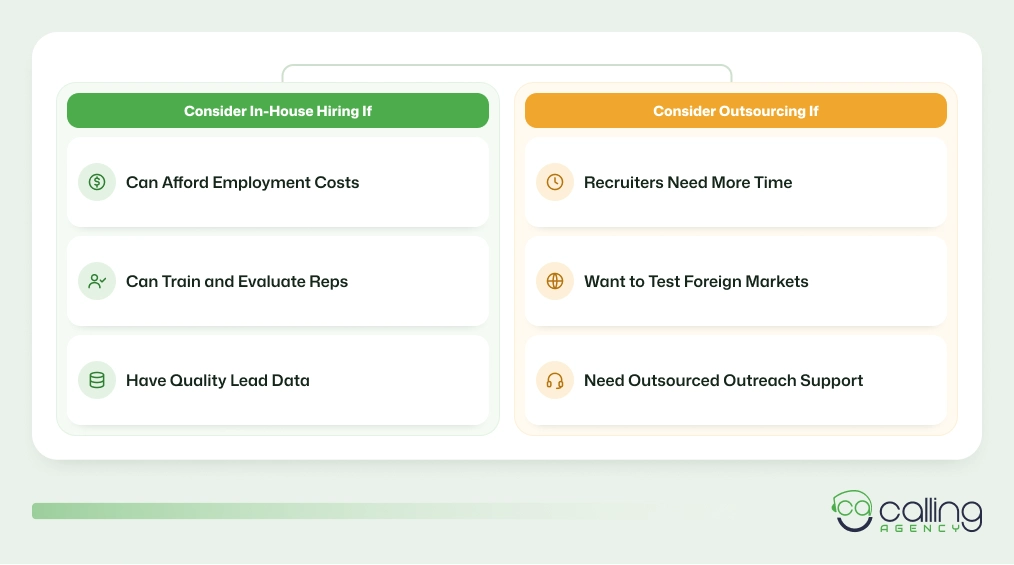
If you can manage a sales representative, their training, curating a prospect list and relevant daily activities then you can opt for in-house. On the other hand, if you lack the time or staff members to run marketing activities then outsourcing would be the suitable option for you.
| Factor | In-house representative | Outsourced team |
| Cost | Salary, benefits, data and tools | Campaign fees |
| Start-up | Recruitment and training required | Depends on provider onboarding |
| Prospect lists | Your team builds and maintains them | Provider may research and verify prospects |
| Management | Your team handles daily coaching | Provider manages agreed campaign activities |
| Flexibility | Depends on available staff | Depends on contract terms |
Consider an in-house hire if:
- You have the ability to bear the financial obligations of the employment.
- You have someone to instruct the sales representative and evaluate reps’ performance.
- You possess good quality lead data in addition to a sophisticated target audience.
Consider outsourcing if:
- Your recruiters use their time smartly exploring for candidates and organizing placements.
- You would like to explore a foreign market first and then see whether you need to employ a full-time sales agent.
- You want to take advantage of another company to make phone calls, send emails and qualify appointments on your behalf.
When it comes to making a decision regarding the method of acquiring new clients, it is important to make a thorough analysis of both inbound and outbound appointment settings and find out which method works faster for your particular business niche.
Frequently Asked Questions
How do staffing agencies get clients?
Staffing agencies usually acquire clients through referrals, previous contacts or existing business relationships. Then they increase their reach with inbound and outbound marketing techniques and strategic follow-ups on LinkedIn. This helps to increase the chances of getting clients.
How long does it take to get the first client?
There is no reliable universal timeline. It varies by the company and their hiring process. CallingAgency states that its staffing campaigns book the first qualified appointment within seven days of launch. A signed agreement or first job order may take longer because employers have their own purchasing and approval processes.
Should I contact HR or the hiring manager?
It would be ideal to start with the hiring manager if possible. They understand the open roles, duties and their urgency. Then pinpoint the HR, procurement or MSP contact whoever is responsible for approving staffing vendors. If HR says to go through them, ask whether the company uses a preferred vendor list or an MSP.
Is cold calling still effective for staffing agencies?
Yes. It’s still effective, especially when the targeted prospects list is right. Cold calling can generate qualified conversations when you target suitable employers and reach the right people. CallingAgency reports booking 223 qualified appointments for a U.S. staffing company over seven months. Results depend on the service needed, the titles you call and how fast you follow up.
Do I need consent to cold call businesses?
Many B2B calls don’t fall inside the FTC’s Telemarketing Sales Rule but some other restrictions may apply. The TCPA restricts certain automated or recorded calls to mobile phones if the caller doesn’t have permission. Check the applicable federal and state requirements before beginning your campaign.